

中国核心期刊要目总览
中国科技核心期刊
CSCD数据库源刊
中国科技核心期刊
CSCD数据库源刊
兽类学报 ›› 2026, Vol. 46 ›› Issue (2): 171-183.DOI: 10.16829/j.slxb.151004
张迅1, 黄娜婷1, 李静怡1, 陈家瑞1, 魏青1,2( )
)
收稿日期:2024-08-28
接受日期:2024-12-31
出版日期:2026-03-30
发布日期:2026-03-06
通讯作者:
魏青
作者简介:张迅(2001- ),男,硕士研究生,主要从事动物生态学研究.
基金资助:
Xun ZHANG1, Nating HUANG1, Jingyi LI1, Jiarui CHEN1, Qing WEI1,2()
Received:2024-08-28
Accepted:2024-12-31
Online:2026-03-30
Published:2026-03-06
Contact:
Qing WEI
摘要:
低氧会影响动物组织细胞氧化还原状态导致内质网应激,心脏在机体氧供需平衡调控中至关重要,在内质网应激下容易受到损伤。终年生活在高海拔低氧环境的牦牛(Bos grunniens)对高原环境具有良好的适应,但高海拔牦牛心脏组织为应对低氧造成的内质网应激,其免疫细胞相关功能有何变化尚不清楚。为此,本研究选取青海曲麻莱县(海拔4 500 m)与循化县(海拔2 600 m)不同海拔的高原型牦牛作为研究对象,利用转录组测序和单细胞转录组测序技术来探究高、低海拔牦牛心脏组织中免疫作用相关基因表达差异和主要免疫细胞的功能变化,以期进一步了解牦牛心脏组织在免疫方面的适应性变化。转录组测序数据分析结果表明,相对于低海拔牦牛,高海拔牦牛心脏中上调表达基因主要富集在内质网应激导致的受损细胞、错误蛋白清除等与免疫功能相关的通路上;GSEA分析发现高海拔牦牛心脏组织中,与内质网应激、内质网应激导致的受损细胞、错误蛋白清除的通路均被激活;RT‑qPCR实验表明免疫相关基因(LCP1、HLA‑A、IGHM、FCGR3等)的表达量在高海拔牦牛心脏组织中显著高于低海拔牦牛(P < 0.05),且表达趋势与转录组结果一致;单细胞转录组测序结果显示,高海拔牦牛心脏组织中淋巴细胞、巨噬细胞和树突状细胞3种免疫细胞的细胞频率下降,且单细胞转录组测序发现高海拔牦牛3种免疫细胞中上调表达基因均显著富集在Fcγ‑R介导的吞噬通路、T细胞受体信号、抗原处理和呈递通路等细胞异物清除的免疫通路中。综上,高海拔牦牛心脏免疫细胞吞噬、杀伤、免疫复合物清除等能力的增强,可有效保证内质网应激引起的细胞内错误折叠蛋白等异物增加的清除功能,以更好地适应高原低氧环境。
中图分类号:
张迅, 黄娜婷, 李静怡, 陈家瑞, 魏青. 基于转录组测序数据探讨高海拔牦牛心脏免疫细胞的功能[J]. 兽类学报, 2026, 46(2): 171-183.
Xun ZHANG, Nating HUANG, Jingyi LI, Jiarui CHEN, Qing WEI. Exploring the function of immune cells in the heart of high-altitude yaks based on transcriptomic sequencing data[J]. ACTA THERIOLOGICA SINICA, 2026, 46(2): 171-183.
| 基因 Gene | 引物序列(5′-3′) Primer sequence(5′-3′) | 片段长度 Product length/bp |
|---|---|---|
| GAPDH | F: CATCACTGCCACCCAGAAGAC R: AGTGAGTGTCGCTGTTGAAGTCG | 335 |
| LCP1 | F: TTTGGCTGCCAGAACTGTTGC R: GCAGCTGATGTACCCATTGC | 129 |
| HLA-A | F: CAGGCTGTAGGCTACGTGGATG R: GGCCATCTTCCTGGATCTCAC | 247 |
| IGHM | F: TCGCCGACATCTTCCTCACA R: TCGCTCAAAATACGTGTGGGTC | 134 |
| FCGR3 | F: AATGGTGGCACAATGGGACT R: CTGGACCTTTGCTACAGGAGTTT | 245 |
表1 RT-qPCR引物信息
Table 1 RT-qPCR primer information
| 基因 Gene | 引物序列(5′-3′) Primer sequence(5′-3′) | 片段长度 Product length/bp |
|---|---|---|
| GAPDH | F: CATCACTGCCACCCAGAAGAC R: AGTGAGTGTCGCTGTTGAAGTCG | 335 |
| LCP1 | F: TTTGGCTGCCAGAACTGTTGC R: GCAGCTGATGTACCCATTGC | 129 |
| HLA-A | F: CAGGCTGTAGGCTACGTGGATG R: GGCCATCTTCCTGGATCTCAC | 247 |
| IGHM | F: TCGCCGACATCTTCCTCACA R: TCGCTCAAAATACGTGTGGGTC | 134 |
| FCGR3 | F: AATGGTGGCACAATGGGACT R: CTGGACCTTTGCTACAGGAGTTT | 245 |
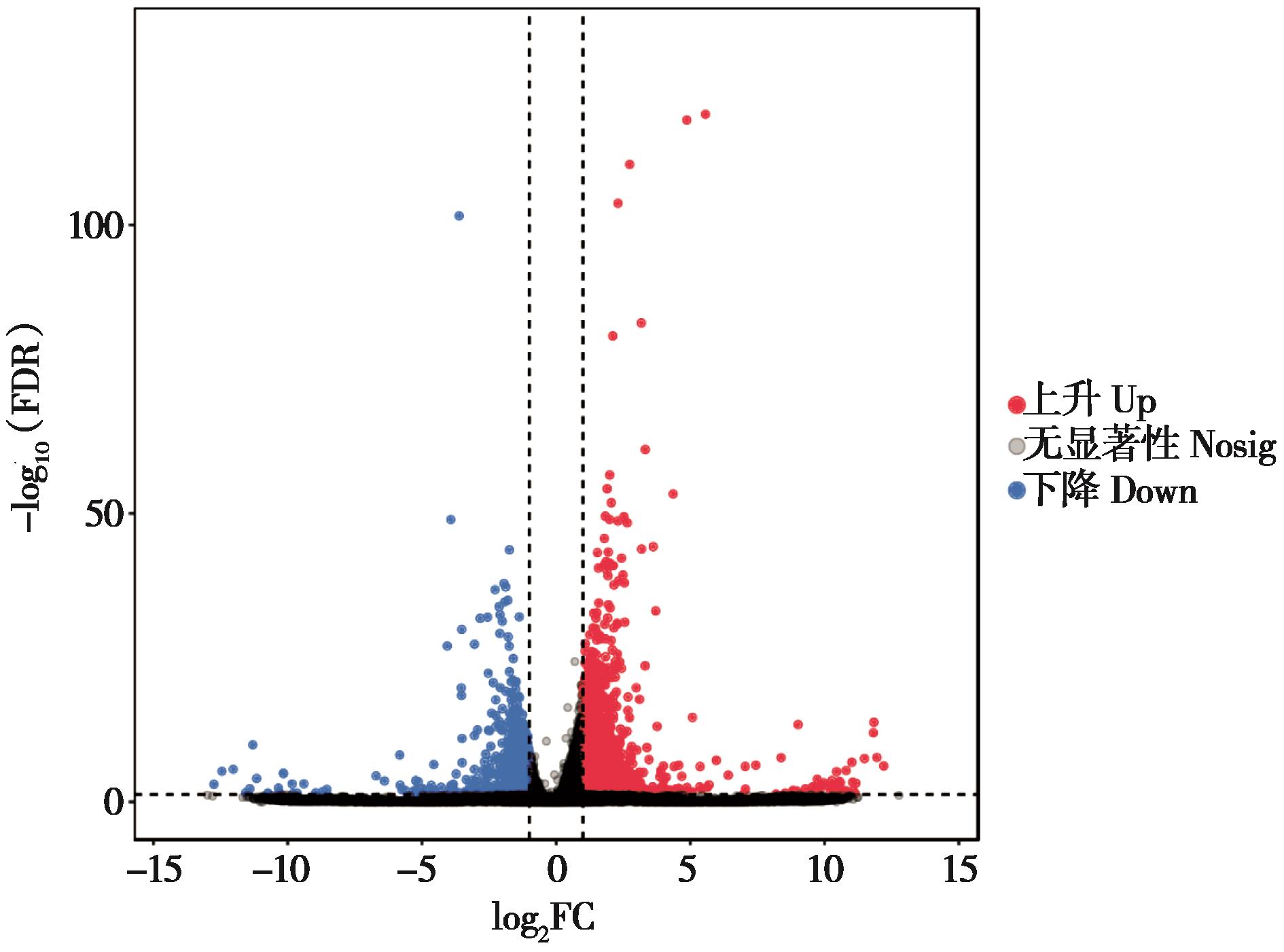
图1 高、低海拔牦牛心脏组织差异表达基因火山图
Fig. 1 Volcano map of differentially expressed genes in high and low altitude yak heart tissue
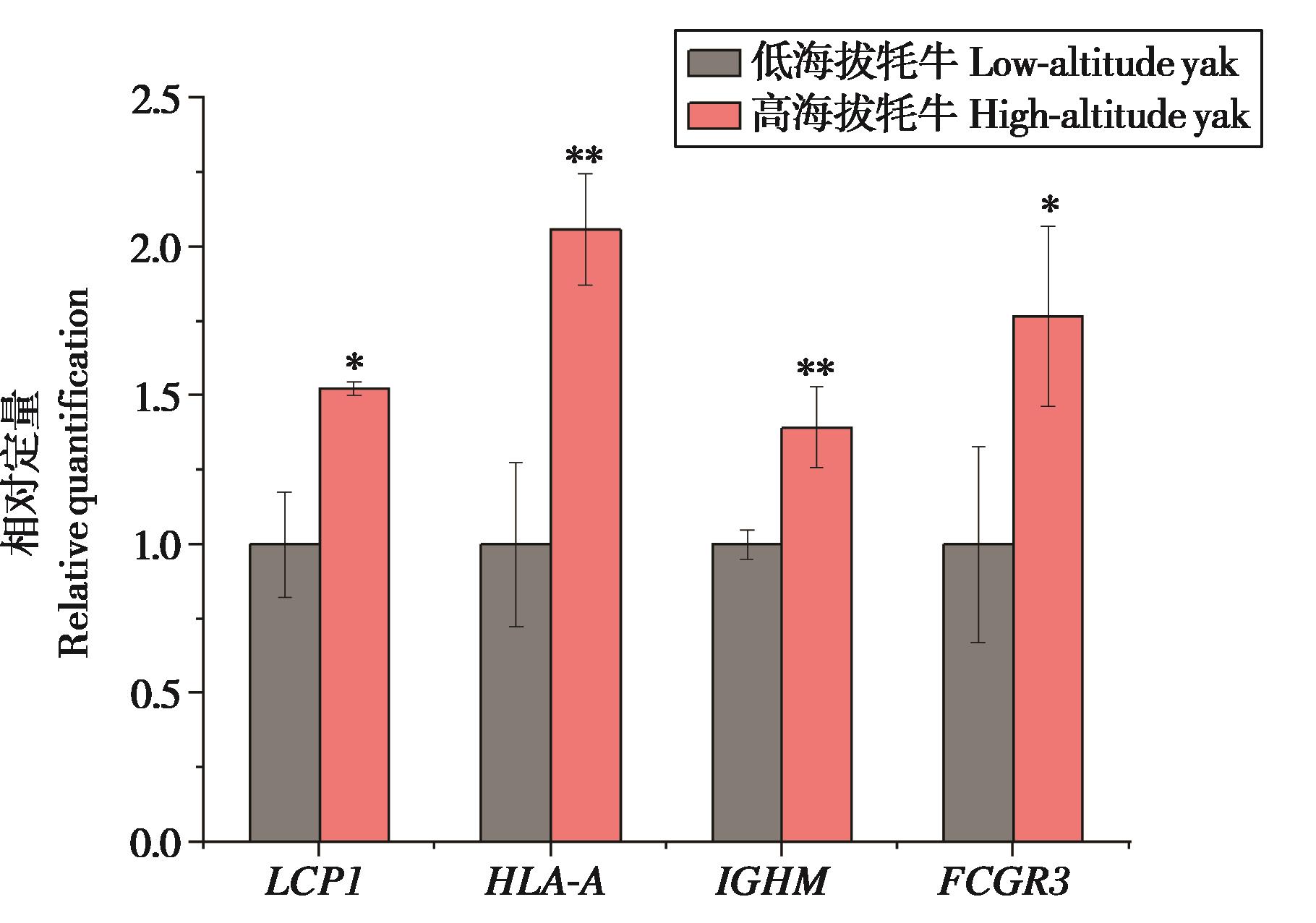
图2 高、低海拔牦牛免疫相关基因的mRNA的相对表达量. *表示差异显著,P < 0.05;**表示差异极显著,P < 0.01
Fig. 2 Relative expression of mRNAs of immunity-related genes in yaks at high and low altitudes. * indicates significant difference, P < 0.05; ** indicates highly significant difference, P < 0.01
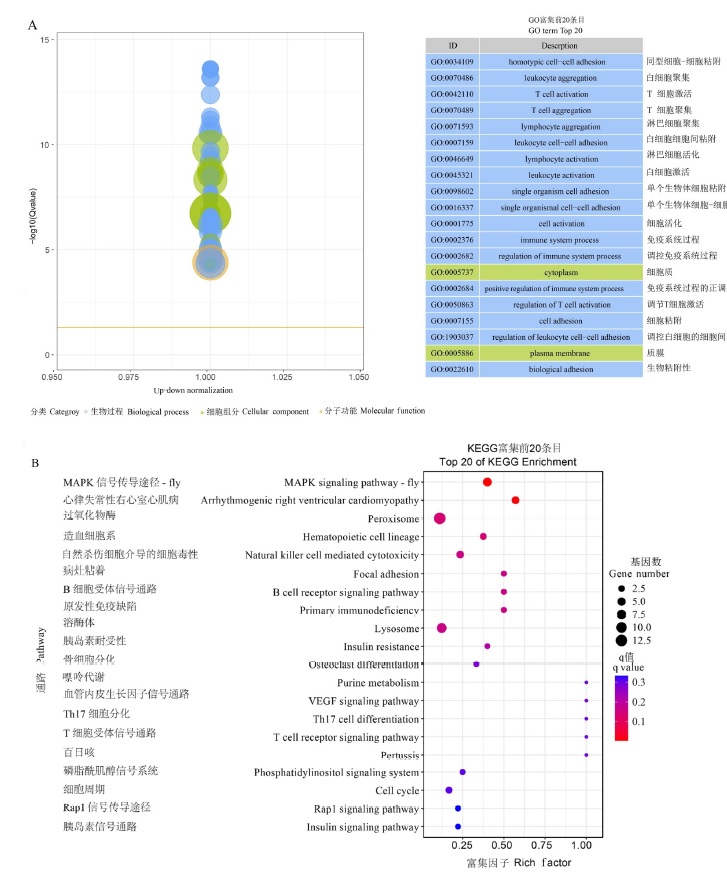
图3 高、低海拔牦牛心脏组织上调表达基因GO(A)和KEGG(B)富集分析. 纵坐标为-log10(Qvalue),横坐标为Z-score值(上调差异基因数目与下调差异基因数目的差值占总差异基因的比例),黄线代表Qvalue = 0.05的阈值
Fig. 3 Map of GO (A) and KEGG (B) enrichment analysis of up-regulated genes expressed in high and low altitude yak heart tissues. The vertical coordinate is -log10 (Qvalue), the horizontal coordinate is the Z-score value (the difference between the number of up-regulated differential genes and the number of down-regulated differential genes as a proportion of the total number of differential genes), and the yellow line represents the threshold of Qvalue = 0.05
| 基因 Gene | 差异倍数 FC | P值 P value | 功能描述 Description |
|---|---|---|---|
| CD3D | 1.70 | 4.78E-19 | TCR受体复合物 TCR receptor complex |
| CD8A | 1.90 | 5.55E-10 | CD8蛋白 CD8 protein |
| PRF1 | 2.67 | 1.70E-18 | 编码穿孔素蛋白,直接参与细胞杀伤 Encodes perforin protein, directly involved in cell killing |
| LCP1 | 1.81 | 4.75E-34 | LCP1响应CD28蛋白的共刺激增强第二信号的传导 LCP1 enhances second signalling in response to co-stimulation of CD28 protein |
| HLA-A | 1.50 | 6.24E-06 | MHCI蛋白 MHCI protein |
| IGHM | 1.68 | 5.87E-18 | 免疫球蛋白Fc区 Immunoglobulin Fc zone |
| FCGR3 | 2.78 | 2.70E-11 | Fcγ 受体 Fcγ receptor |
| RAC2 | 1.79 | 3.88E-12 | 增强吞噬细胞吞噬作用 Enhancement of phagocytosis by phagocytes |
| IL2RB | 1.40 | 9.00E-26 | IL-2受体 IL-2 receptor |
表2 免疫相关的主要差异表达基因
Table 2 Highly expressed immunity genes
| 基因 Gene | 差异倍数 FC | P值 P value | 功能描述 Description |
|---|---|---|---|
| CD3D | 1.70 | 4.78E-19 | TCR受体复合物 TCR receptor complex |
| CD8A | 1.90 | 5.55E-10 | CD8蛋白 CD8 protein |
| PRF1 | 2.67 | 1.70E-18 | 编码穿孔素蛋白,直接参与细胞杀伤 Encodes perforin protein, directly involved in cell killing |
| LCP1 | 1.81 | 4.75E-34 | LCP1响应CD28蛋白的共刺激增强第二信号的传导 LCP1 enhances second signalling in response to co-stimulation of CD28 protein |
| HLA-A | 1.50 | 6.24E-06 | MHCI蛋白 MHCI protein |
| IGHM | 1.68 | 5.87E-18 | 免疫球蛋白Fc区 Immunoglobulin Fc zone |
| FCGR3 | 2.78 | 2.70E-11 | Fcγ 受体 Fcγ receptor |
| RAC2 | 1.79 | 3.88E-12 | 增强吞噬细胞吞噬作用 Enhancement of phagocytosis by phagocytes |
| IL2RB | 1.40 | 9.00E-26 | IL-2受体 IL-2 receptor |

图4 高、低海拔牦牛心脏组织GO term(A)和KEGG Pathway GSEA(B)分析
Fig. 4 Analysis of GO term (A) and KEGG Pathway GSEA (B) in high and low altitude yak heart tissue.QML: The yaks of Qumalai County; XH-Y: The yaks of Xunhua County
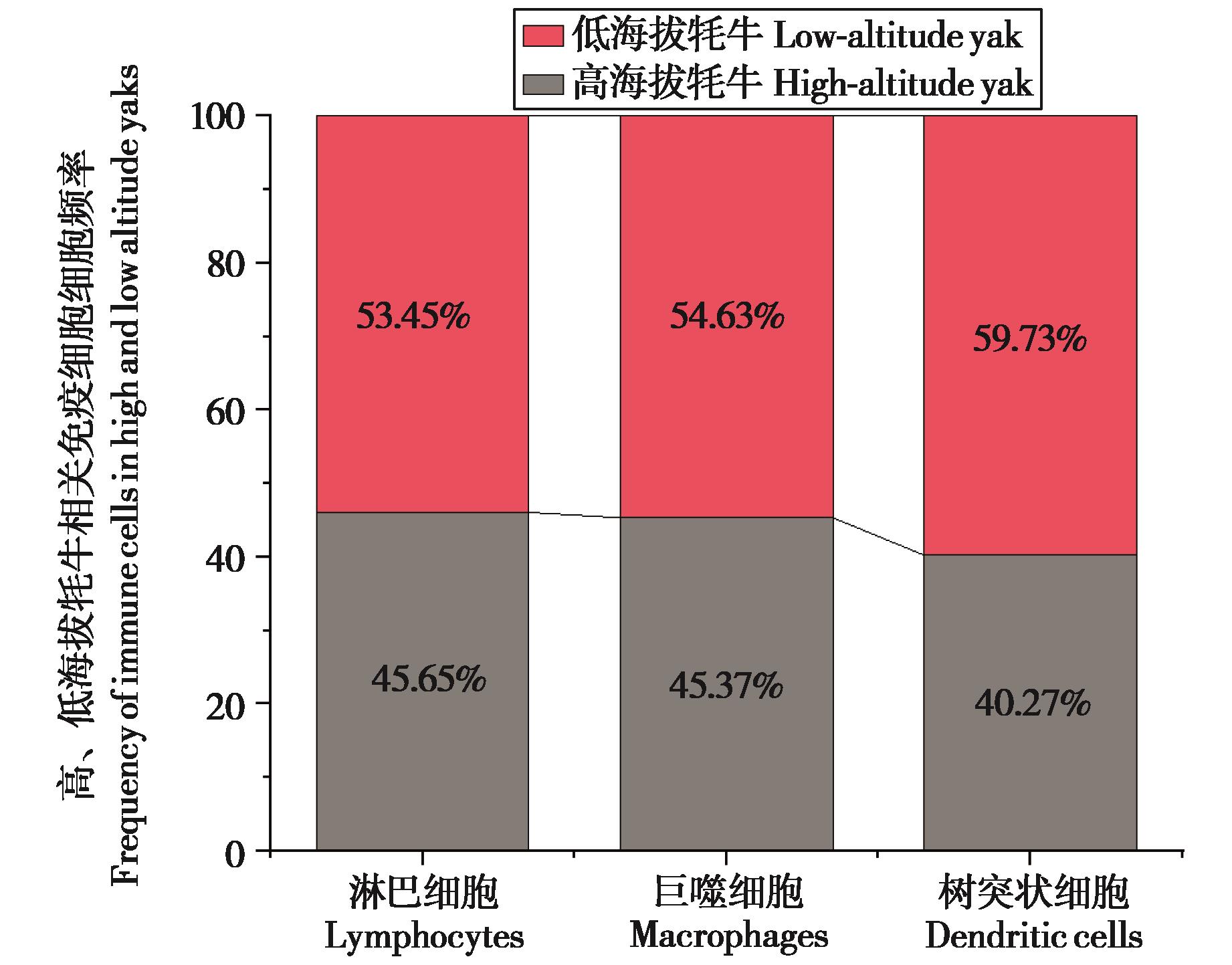
图5 高、低海拔牦牛心脏组织相关免疫细胞细胞频率
Fig. 5 Cell frequencies of cardiac tissue-associated immune cells in yaks at high and low altitude
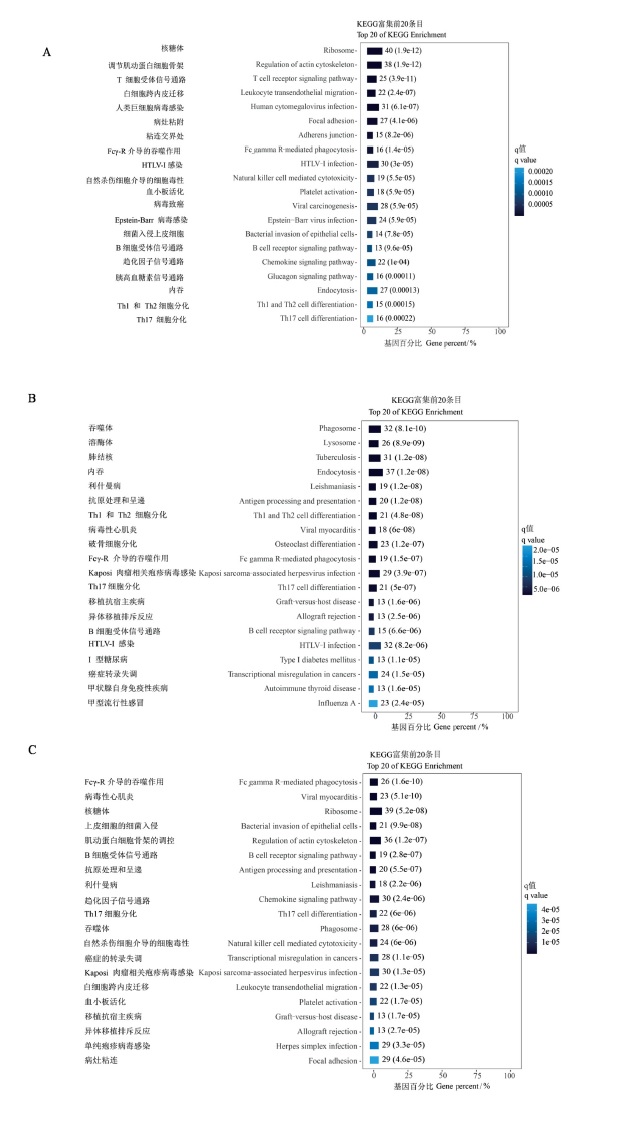
图6 高、低海拔牦牛心脏组织3种免疫细胞差异表达基因KEGG富集分析. A:淋巴细胞;B:巨噬细胞;C:树突状细胞
Fig. 6 Enrichment analysis of KEGG, a gene differentially expressed by three immune cells in the heart of yaks at high and low altitudes. A: lymphocytes; B: macrophages; C: dendritic cells
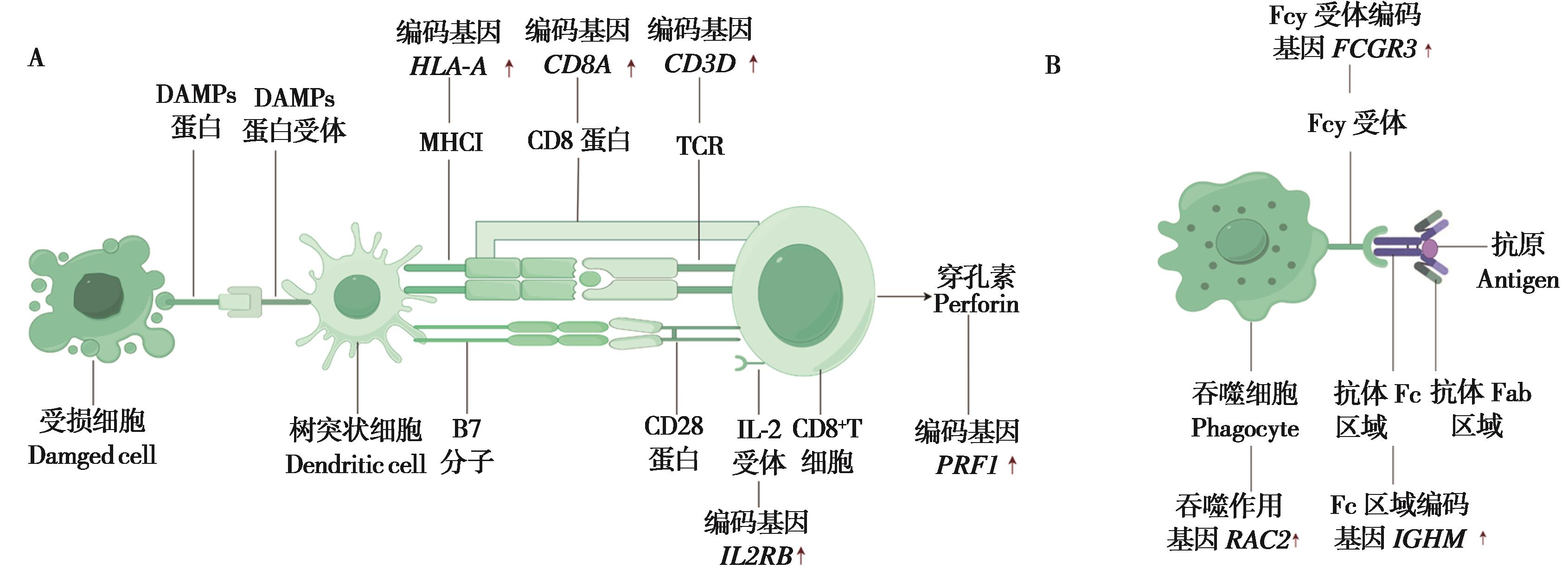
图7 相关免疫基因作用通路. A:CD8+T细胞激活、内质网应激受损细胞的清除;B:吞噬细胞对免疫复合物的吞噬;↑:基因上调表达
Fig. 7 Pathway map of relevant immune genes. A: activation of CD8+T cells and clearance of endoplasmic reticulum stress damaged cells; B: phagocytosis of immune complexes by phagocytes; ↑: up-regulated gene expression
| Berridge M J,2002. The endoplasmic reticulum: a multifunctional signaling organelle[J].Cell Calcium,32(5‑6):235‑249.DOI:10.1016/s0143416002001823 . | |
| Chen S, Zhou Y, Chen Y, Gu J,2018. fastp:an ultra‑fast all‑in‑one FASTQ preprocessor[J].Bioinformatics,234(17):884‑890. DOI:10.1093/bioinformatics/bty560 . | |
| Chen X, Chakravarty T, Zhang Y, Li X, Zhong J F, Wang C,2016. Single‑cell transcriptome and epigenomic reprogramming of cardiomyocyte‑derived cardiac progenitor cells[J].Scientific Data,3:160079. DOI:10.1038/sdata.2016.79 . | |
| Chen Y, Meng X, Wan R, Cheng R, Zhang G, Zhang Q, Yu H, Wei Q,2023. Single‑cell transcriptomic survey of cell diversity and functional changes in yak hearts at different altitude[J].Proteomics,23(11):e2200345.DOI:10.1002/pmic. 202200345 . | |
| Cornwell W K, Baggish A L, Bhatta Y K D, Brosnan M J, Dehnert C, Guseh J S, Hammer D, Levine B D, Parati G, Wolfel E E,2021. Clinical implications for exercise at altitude among individuals with cardiovascular disease:a scientific statement from the American heart association[J].Journal of the American Heart Association,10(19):e023225. DOI:10.1161/JAHA.121.023225 . | |
| Facco M, Zilli C, Siviero M, Ermolao A, Travain G, Baesso I, Bonamico S, Cabrelle A, Zaccaria M, Agostini C,2005. Modulation of immune response by the acute and chronic exposure to high altitude[J].Medicine and Science in Sports and Exercise,37(5):768‑774. DOI:10.1249/01.MSS. 0000162688.54089.CE . | |
| Gaur P, Prasad S, Kumar B, Sharma S K, Vats P,2021. High‑altitude hypoxia induced reactive oxygen species generation,signaling,and mitigation approaches[J].International Journal of Biometeorology,65(4):601‑615. DOI:10.1007/s00484-020-02037-1 . | |
| Guan J, Long K, Ma J, Zhang J, He D, Jin L, Tang Q, Jiang A, Wang X, Hu Y, Tian S, Jiang Z, Li M, Luo X,2017 .Comparative analysis of the microRNA transcriptome between yak and cattle provides insight into high‑altitude adaptation[J].PeerJ Publishing,5:e3959. DOI:10.7717/peerj.3959 . | |
| Guo Hengjuan, Li Jinna, Chen Baoyuan, Cao Jie, Feng Jing, Yang Xiaoyan, Jiang Junnan,2014. Effect of intermittent hypoxia on lymphocyte subset apoptosis in a mouse model of obstructive sleep apnea hypopnea syndrome[J].Chinese Journal of Pulmonary Diseases,7(6):7‑9. DOI:10.3877/cma.j.issn.1674-6902.2014.06.003. (in Chinese with English abstract) | |
| Hu Fangjie, Qiao Lijuan, Yu Kexian, Pu Xiaoyan, Yong Sheng, Liu Yan, Xu Yuzhen, Li Jidong,2018. Hypoxia inhibits the immune activity of spleen T lymphocytes in mice[J]. Chinese High Altitude Medicine,39(1):24‑28. DOI:10.13452/j.cnki.jqmc.2018.01.005. (in Chinese with English abstract) | |
| Jensen B C, Bultman S J, Holley D, Tang W, De Ridder G, Pizzo S, Bowles D, Willis M S,2017. Upregulation of autophagy genes and the unfolded protein response in human heart failure[J]. International Journal of Clinical and Experimental Medicine,10(1):1051‑1058. | |
| Kim D, Langmead B, Salzberg S L,2015. HISAT:a fast spliced aligner with low memory requirements[J]. Nature Methods,12(4):357‑360. DOI:10.1038/nmeth.3317 . | |
| Li B, Dewey C N,2011. RSEM:accurate transcript quantification from RNA‑Seq data with or without a reference genome[J]. BMC Bioinformatics,12:323. DOI:10.1186/1471-2105-12-323 . | |
| Li B, Li Y, Wu S, Yang Y, Fu S, Yin X, Tu X, Fang L, Guo Z, Ye J,2021. Identification and functional characterization of CD154 in T cell‑dependent immune response in Nile tilapia (Oreochromis niloticus)[J]. Fish & Shellfish Immunology,111:102‑110. DOI:10.1016/j.fsi.2021.01.009 . | |
| Li Na, Xu Chongyuan, Che Jinjing,2023. Research status of antibody drug metabolism substitution technology based on lymphoid organs[J].Chinese Journal of Clinical Pharmacology,39(9):1354‑1358.DOI:10.13699/j.cnki.1001-6821. 2023.09.029. (in Chinese with English abstract) | |
| Li Xiao, Gao Yanhua, Peng Zhongli, Guo Chunhua, Wang Qi, Liang Hong, Wang Dan,2022. Effect of altitude changes on blood cell physiological parameters and cardiopulmonary histomorphological characteristics of yaks[J]. Acta Ecologiae Animalis Domestici,43(4):47‑54. DOI:10.3969/j.issn.1673-1182.2022.04.008. (in Chinese with English abstract) | |
| Love M I, Huber W, Anders S,2014. Moderated estimation of fold change and dispersion for RNA‑seq data with DESeq2[J].Genome Biology,15(12):550. DOI:10.1186/s13059-014-0550-8 . | |
| Ma J, Zhang T, Wang W, Chen Y, Cai W, Zhu B, Xu L, Gao H, Zhang L, Li J, Gao X,2021. Comparative transcriptome analysis of gayal(Bos frontalis),yak(Bos grunniens),and cattle(Bos taurus) reveal the high‑altitude adaptation[J]. Front Genet,12:778788. DOI:10.3389/fgene.2021. 778788 . | |
| Maaten L V D, Hinton G,2008. Visualizing Data using t‑SNE[J].Journal of Machine Learning Research,9(2605):2579‑2605. | |
| Mishra K P, Ganju L,2010. Influence of high altitude exposure on the immune system:a review[J].Immunological Investigations,39(3):219‑234. DOI:10.3109/08820131003681144 . | |
| Naeije R,2018. Altitude and the right heart[J]. Revue des Maladies Respiratoires,35(4):441‑451. DOI:10.1016/j.rmr. 2017.01.013 . | |
| Noci B, Neocleous P, Gemeinhardt O, Hiebl B, Berg R, Plendl J, HüNigen H,2012. Age‑ and gender‑dependent changes of bovine myocardium architecture[J].Anatomia Histologia Embryologia,41(6):453‑600.DOI:10.1111/j.1439-0264. 2012.01156.x . | |
| Perman J C, Bostrom P, Lindbom M, Lidberg U, Stahlman M, Hagg D, Lindskog H, Scharin Tang M, Omerovic E, Mattsson Hulten L, Jeppsson A, Petursson P, Herlitz J, Olivecrona G, Strickland D K, Ekroos K, Olofsson S O, Boren J,2011. The VLDL receptor promotes lipotoxicity and increases mortality in mice following an acute myocardial infarction[J].Journal of Clinical Investigation,121(7):2625‑2640. DOI:10.1172/JCI43068 . | |
| PErtea M, Pertea G M, Antonescu C M, Chang T C, Mendell J T, Salzberg S L,2015. StringTie enables improved reconstruction of a transcriptome from RNA‑seq reads[J].Nature Biotechnology,3(3):290‑295. DOI:10.1038/nbt.3122 . | |
| Pichon A, Zhenzhong B, Favret F, Jin G, Shufeng H, Marchant D, Richalet J P, Ge R L,2009. Long‑term ventilatory adaptation and ventilatory response to hypoxia in plateau pika(Ochotona curzoniae):role of nNOS and dopamine[J].American Journal of Physiology‑Regulatory Integrative and Comparative Physiology,297(4):978‑987. DOI:10.1152/ajpregu.00108.2009 . | |
| Qi Xiaoyuan, Ma Li, Yang Shuli, Kong Xiaoyan, Yan Dawei, 2017. Study on the blood physiological representation for hypoxia adaptation in yaks and Tibetan cattle[J].Journal of Heilongjiang Animal Husbandry and Veterinary Medicine,(1):9‑14. DOI:10.13881/j.cnki.hljxmsy.2017.0116. (in Chinese with English abstract) | |
| Su S, Wang J, Wang J, Yu R, Sun L, Zhang Y, Song L, Pu W, Tang Y, Yu Y, Zhou K,2022. Cardioprotective effects of gypenoside XVII against ischemia/reperfusion injury:role of endoplasmic reticulum stress,autophagy,and mitochondrial fusion fission balance[J].Phytotherapy Research,36(7):2982‑2998.DOI:10.1002/ptr.7493 . | |
| Subramanian A, Tamayo P, Mootha V K, Mukherjee S, Ebert B L, Gillette M A, Paulovich A, Pomeroy S L, Golub T R, Lander E S, Mesirov J P,2005. Gene set enrichment analysis:a knowledge‑based approach for interpreting genome‑wide expression profiles[J]. Proceedings of the National Academy of Sciences of the United States of America,102(43):15545‑15550. DOI:10.1073/pnas.0506580102 . | |
| Tabas I, Ron D,2011. Integrating the mechanisms of apoptosis induced by endoplasmic reticulum stress[J].Nature Cell Biology,13(3):184‑190. DOI:10.1038/ncb0311-184 . | |
| Wang Yaxuan, Lin Xue, Dai Chongyan, Pu Xiaoyan,2023. Thyroid hormone T3 protects type Ⅱ alveolar epithelial cells and alleviates hypoxia‑induced lung injury in rats by inhibiting endoplasmic reticulum stress[J]. Chinese Journal of Pathophysiology,39(9):1596‑1604. DOI:10.3969/j.issn.1000-4718.2023. 09.008. (in Chinese with English abstract) | |
| Wei H D, Huang B, Richard A,2009. Systematic and integrative analysis of large gene lists using DAVID bioinformatics resources[J].Nature Protocols,4(1):44‑57.DOI:10.1038/nprot.2008.211 . | |
| Weng T P, Huang S C, Chuang Y F, Wang J S, Saraiva C N,2013. Effects of interval and continuous exercise training on CD4+ lymphocyte apoptotic and autophagic responses to hypoxic stress in sedentary men[J].Public Library of Science ONE,8(11).DOI:10.1371/journal.pone.0080248 . | |
| Xia Zhixiong,2019. Hypoxic ER stress suppresses β‑catenin expression and promotes cooperation between the transcription factors XBP1 and HIF1α for cell survival[D].Wuhan:Huazhong University of Science and Technology.DOI:10.27157/d.cnki.ghzku. 2019.005214. (in Chinese with English abstract) | |
| Xin J W, Chai Z X, Zhang C F, Zhang Q, Zhu Y, Cao H W, Ji Q M, Zhong J C,2019. Transcriptome profiles revealed the mechanisms underlying the adaptation of yak to high‑altitude environments[J].Scientific Reports,9(1):7558.DOI:10.1038/s41598-019-43773-8 . | |
| Xin J W, Chai Z X, Zhang C F, Zhang Q, Zhu Y, Cao H W, Yang J C, Chen X Y, Jiang H, Zhong J C, Ji Q M,2022. Differences in proteomic profiles between yak and three cattle strains provide insights into molecular mechanisms underlying high‑altitude adaptation[J].Journal of Animal Physiology and Animal Nutrition(Berlin),106(3):485‑493.DOI:10.1111/jpn.13629 . | |
| Zhou Jianchun,2023. Activation of CD8+ T lymphocytes induced by TLR7/8 agonistR848 against lung cancer[D].Chongqing:Chongqing Medical University. DOI:10.27674/d.cnki.gcyku. 2021.001599. (in Chinese with English abstract) | |
| 丁呈圣,金志明,2021.结肠癌免疫检查点抑制剂研究进展[J]. 医学研究杂志,50(1):8‑13.DOI:10.11969/j.issn.1673-548X.2021.01.003 . | |
| 王雅轩,林雪,戴重阳,蒲小燕,2023. 甲状腺激素T3抑制内质网应激保护大鼠Ⅱ型肺泡上皮细胞和减轻大鼠低氧性肺损伤[J]. 中国病理生理杂志,39(9):1596‑1604.DOI:10.3969/j.issn.1000-4718.2023.09.008 . | |
| 齐晓园,马黎,杨舒黎,孔小艳,严达伟,2017. 牦牛、藏黄牛低氧适应血液生理表征研究[J]. 黑龙江畜牧兽医,(1):9‑14. DOI:10.13881/j.cnki.hljxmsy.2017.0116 . | |
| 闫颖洁,2023. 砭贴预处理对急性低压低氧模型大鼠氧化应激及心肌损伤的影响研究[D].北京:北京中医药大学.DOI:10.26973/d.cnki.gbjzu.2023.000831 . | |
| 李娜,许重远,车津晶,2023. 基于淋巴类器官的抗体药物代谢替代技术研究现状[J]. 中国临床药理学杂志,39(9):1354‑1358.DOI:10.13699/j.cnki.1001-6821.2023.09.029 . | |
| 李潇,高彦华,彭忠利,郭春华,王琦,梁红,王丹,2022. 海拔高度变化对牦牛血细胞生理指标及心、肺组织形态特征的影响[J]. 家畜生态学报,43(4):47‑54.DOI:10.3969/.j.issn.1673-1182.2022.04.008 . | |
| 呙恒娟,李津娜,陈宝元,曹洁,冯靖,杨晓燕,姜君男,2014. 阻塞性睡眠呼吸暂停低通气综合征模式间歇低氧对大鼠淋巴细胞亚群凋亡的研究[J].中华肺部疾病杂志,7(6):617‑620.DOI:10.3877/cma.j.issn.1674-6902.2014.06.003 . | |
| 周健春,2023. TLR7/8配体R848激活CD8+ T淋巴细胞抗肺癌效应及机制研究[D].重庆:重庆医科大学.DOI:10.27674/d.cnki.gcyku.2021.001599 . | |
| 胡方杰,乔丽娟,俞科贤,蒲小燕,永胜,刘燕,许玉珍,李积东,2018. 低氧抑制小鼠脾脏T淋巴细胞的免疫功能[J].中国高原医学与生物学杂志,39(1):24‑28.DOI:10.13452/j.cnki.jqmc.2018.01.005 . | |
| 夏志雄,2019. 低氧条件下内质网应激抑制β‑catenin表达以及协调XBP1与HIF1α的促细胞存活作用[D].武汉:华中科技大学.DOI:10.27157/d.cnki.ghzku.2019.005214 . |
| [1] | 马嘉祺, 曾泽玲, 张梦蝶, Shinya Okabe, Daisuke Koyabu, 吴岳恒, 陈中正, 王应许, 王霞, 何锴. 基于micro‑CT对劳亚食虫目物种心脏解剖结构的比较[J]. 兽类学报, 2026, 46(4): 1-. |
| [2] | 王子涵, 王东, 侯陆一, 李全邦, 李其琴, 魏海娟, 连新明. 气候变化背景下三江源国家公园四种野生有蹄类动物栖息地适宜性分析[J]. 兽类学报, 2025, 45(5): 602-614. |
| [3] | 黄娜婷, 陈一博, 宋娜, 李静怡, 魏青, 陈家瑞. 基于单细胞转录组数据探究不同海拔牦牛心肌细胞通讯和基因表达差异[J]. 兽类学报, 2024, 44(2): 171-182. |
| [4] | 王强龙, 张同享, 高泽川, 王立斌, 余四九, 潘阳阳. 牦牛DBI基因的分子特征及其在乳腺组织中的表达与定位[J]. 兽类学报, 2022, 42(3): 295-303. |
| [5] | 傅芳, 王利, 字向东. 麦洼牦牛不同生长阶段肝脏差异表达基因分析[J]. 兽类学报, 2022, 42(1): 85-94. |
| [6] | 李娟, 王利, 罗晓林, 官久强, 张翔飞. 牦牛水通道蛋白AQP1和AQP3基因克隆及在不同组织中表达和定位[J]. 兽类学报, 2021, 41(1): 51-58. |
| [7] | 傅芳 官久强 曲秀龙 王利 罗晓林 安添午 张翔飞. 不同海拔饲育的麦洼牦牛肺脏组织转录组学分析[J]. 兽类学报, 2020, 40(5): 475-484. |
| [8] | 陈健楠 张全伟 王琪 王媛媛 马友记 张勇 赵兴绪. MTNR1a和MTNR1b在牦牛不同组织中的表达及其在睾丸中的定位[J]. 兽类学报, 2020, 40(1): 64-70. |
| [9] | 王靖雷 潘阳阳 马睿 王萌 崔燕 余四九. 牦牛Atg5基因克隆及其在输卵管、卵巢和子宫中的表达定位[J]. 兽类学报, 2019, 39(5): 546-555. |
| [10] | 刘传发 张良志 付海波 李文靖 张贺 李吉叶 皮立 张堰铭. 野牦牛和家牦牛粪便菌群与短链脂肪酸关系的研究[J]. 兽类学报, 2019, 39(1): 1-7. |
| [11] | 米玛旺堆. 植被覆盖度和土地利用对高原鼠兔觅食与警戒行为的影响[J]. 兽类学报, 2019, 39(1): 69-76. |
| [12] | 王琪 张全伟 张勇 马友记 赵兴绪. 天祝白牦牛OXGR1基因多态性与体尺性状的关联性分析[J]. 兽类学报, 2017, 37(4): 379-388. |
| [13] | 汪迁昊 刘健锋 丁艳平 王建林 邵宝平. 牦牛Endothelin-1基因CDS序列克隆及其真核表达质粒构建[J]. 兽类学报, 2017, 37(3): 293-299. |
| [14] | 田奎丽 潘阳阳 李月琴 崔燕 余四九. 牦牛SND1基因特征序列分析及其蛋白在乳腺的表达[J]. 兽类学报, 2017, 37(2): 207-214. |
| [15] | 孙娟 崔燕 段德勇 何俊峰 张倩 贺延玉 黄玉风. 初生与成年牦牛心肌的组织学结构比较[J]. 兽类学报, 2016, 36(1): 104-111. |
| 阅读次数 | ||||||
|
全文 |
|
|||||
|
摘要 |
|
|||||
 青公网安备 63010402000199号 青ICP备05000010号-2