

中国核心期刊要目总览
中国科技核心期刊
CSCD数据库源刊
中国科技核心期刊
CSCD数据库源刊
兽类学报 ›› 2026, Vol. 46 ›› Issue (1): 47-59.DOI: 10.16829/j.slxb.151002
孙楠1, 李国刚2, 薛顺芝3, 路纪琪1( )
)
收稿日期:2024-08-26
接受日期:2025-03-03
出版日期:2026-01-31
发布日期:2026-02-03
通讯作者:
路纪琪
作者简介:孙楠(1981- ),女,博士,主要从事动物生态与生物多样性科学研究.
基金资助:
Nan SUN1, Guogang LI2, Shunzhi XUE3, Jiqi LU1()
Received:2024-08-26
Accepted:2025-03-03
Online:2026-01-31
Published:2026-02-03
Contact:
Jiqi LU
摘要:
猕猴(Macaca mulatta)为国家二级重点保护野生动物,是青海省现生的唯一一种非人灵长类动物,仅分布于玉树藏族自治州和果洛藏族自治州的南部林区。明确青海省野生猕猴的亚种归属,掌握其种群动态及分布现状,对猕猴的有效保护具有重要意义。2021年1月,使用非损伤性采样方法,分别在青海省玉树白扎林区和果洛玛可河林区,获得猕猴1份肌肉组织样品和6份粪便样品。基于16S rRNA和Cytb基因序列的系统发育分析结果,确认分布于玉树和果洛的猕猴分别为西藏亚种(M. m. vestita)和川西亚种(M. m. lasiotus)。基于2021年1月至2023年5月红外相机监测数据,共获得猕猴存在位点91处,计838个独立事件。利用MaxEnt模型预测猕猴适宜栖息地面积分别为137 ~ 385 km2(白扎林区)和207 ~ 750 km2 (玛可河林区),发现青海地区的猕猴偏好在海拔较低、有一定坡度、距河流较近、向阳的森林和耕地等生境中活动。2021年和2022年冬季,在猕猴历史记录地区(玉树白扎林区和江西林区、果洛玛可河林区)进行重复样线调查,共记录野生猕猴24群约1 580只,数量较40年前增长43.8%。采用随机相遇模型,估计白扎和玛可河林区猕猴种群数量分别为73 ~ 205只和413 ~ 1 497只。本研究可望为青海省的生物多样性保护提供基础数据和技术支撑。
中图分类号:
孙楠, 李国刚, 薛顺芝, 路纪琪. 青海地区猕猴亚种归属与种群现状[J]. 兽类学报, 2026, 46(1): 47-59.
Nan SUN, Guogang LI, Shunzhi XUE, Jiqi LU. Subspecies affiliation and population status of rhesus macaque in Qinghai, China[J]. ACTA THERIOLOGICA SINICA, 2026, 46(1): 47-59.

图1 猕猴西藏亚种(粉色圆点)和川西亚种(黄色圆点)分子生物学样品采集地点
Fig. 1 Molecular materials sampling sites of Macaca mulatta vestita (pink dots) and M. m. lasiotus (yellow dots)

图2 青海地区猕猴群分布(基于样线调查)
Fig. 2 The distribution of rhesus macaques in Qinghai (based on transect survey)
位点 Locus | 引物名称 (5′ - 3′) Primers (5′ - 3′) | 测序长度 Length/bp | 参考文献 Primer reference | PCR扩增反应程序 Thermal cycling protocol |
|---|---|---|---|---|
| Cytb | L14724: CGAAGCTTGATATGAAAAACCATCGTTG | 1 140 | Irwin et al., 1991 | [30 s at 94 ℃, 30 s at 52 ℃, 70 s at 72 ℃] × 35 |
| H15915: GGAATTCATCTCTCCGGTTTACAAGAC | ||||
| 16S rRNA | fwd: CGCCTGTTTATCAAAAACAT | 565 | Guha et al., 2007 | [30 s at 94 ℃, 30 s at 48 ℃, 90 s at 72 ℃] × 33 |
| Rev: CTCCGGTTTGAACTCAGATC |
表1 用于Cytb和16S rRNA的PCR扩增的引物和反应程序
Table 1 Primers and PCR cycles used to amplify Cytb and 16S rRNA
位点 Locus | 引物名称 (5′ - 3′) Primers (5′ - 3′) | 测序长度 Length/bp | 参考文献 Primer reference | PCR扩增反应程序 Thermal cycling protocol |
|---|---|---|---|---|
| Cytb | L14724: CGAAGCTTGATATGAAAAACCATCGTTG | 1 140 | Irwin et al., 1991 | [30 s at 94 ℃, 30 s at 52 ℃, 70 s at 72 ℃] × 35 |
| H15915: GGAATTCATCTCTCCGGTTTACAAGAC | ||||
| 16S rRNA | fwd: CGCCTGTTTATCAAAAACAT | 565 | Guha et al., 2007 | [30 s at 94 ℃, 30 s at 48 ℃, 90 s at 72 ℃] × 33 |
| Rev: CTCCGGTTTGAACTCAGATC |
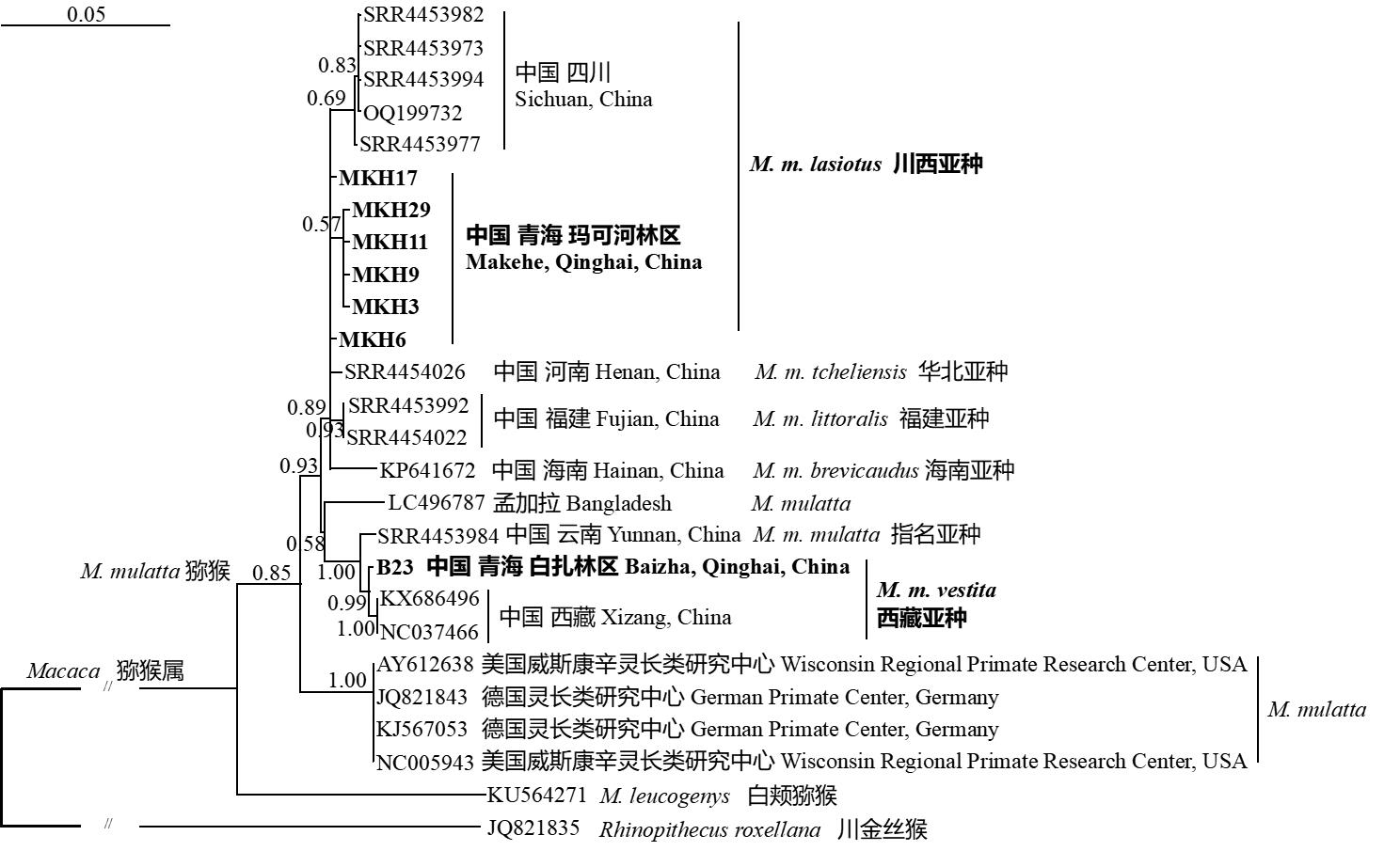
图3 基于16S rRNA-Cytb基因,通过贝叶斯法(BI)构建青海地区猕猴系统发育树,分支上的数字表示BI节点的后验概率,编号加粗的为本研究测得序列
Fig. 3 Based on the 16S rRNA-Cytb gene, the Bayesian inference (BI) phylogenetic tree were constructed for rhesus macaques in Qinghai, with numbers on the branches representing the posterior probabilities for BI nodes, and boldfaced numbers corresponding to sequences obtained in this study
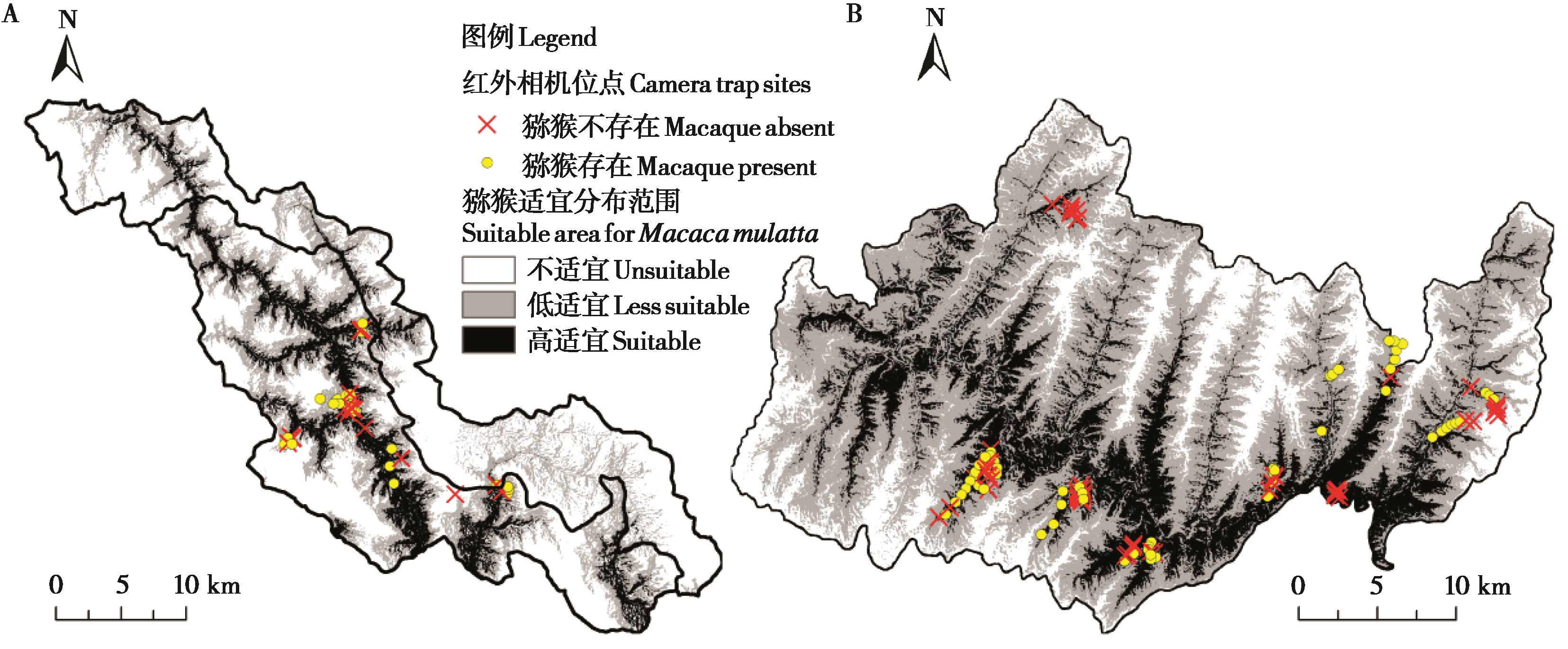
图4 基于红外相机猕猴探测位点分布,以及通过MaxEnt模型预测猕猴栖息地范围. A:白扎林区;B:玛可河林区
Fig. 4 The camera sites distribution of rhesus macaque detection and habitat area predicted by MaxEnt model. A: Baizha; B: Makehe
环境变量 Environmental variables | 模型贡献率 Percent contribution/% | 置换重要值 Permutation importance/% | ||
|---|---|---|---|---|
白扎 Baizha | 玛可河 Makehe | 白扎 Baizha | 玛可河 Makehe | |
| 海拔 Elevation/m | 59.0 | 49.2 | 62.0 | 75.2 |
距河流距离 Distance to river/m | 18.2 | 8.8 | 17.9 | 8.5 |
| 坡向 Aspect/(°) | 13.6 | 0.2 | 11.0 | 0.0 |
| 坡度 Slope/(°) | 8.0 | 19.4 | 8.8 | 12.4 |
| 植被类型 Vegetation | 1.2 | 22.5 | 0.2 | 3.9 |
表2 猕猴MaxEnt模型中的环境变量及其贡献
Table 2 The environmental variables and their contributions in MaxEnt modeling for macaques
环境变量 Environmental variables | 模型贡献率 Percent contribution/% | 置换重要值 Permutation importance/% | ||
|---|---|---|---|---|
白扎 Baizha | 玛可河 Makehe | 白扎 Baizha | 玛可河 Makehe | |
| 海拔 Elevation/m | 59.0 | 49.2 | 62.0 | 75.2 |
距河流距离 Distance to river/m | 18.2 | 8.8 | 17.9 | 8.5 |
| 坡向 Aspect/(°) | 13.6 | 0.2 | 11.0 | 0.0 |
| 坡度 Slope/(°) | 8.0 | 19.4 | 8.8 | 12.4 |
| 植被类型 Vegetation | 1.2 | 22.5 | 0.2 | 3.9 |
县, 林区 County, Forestry | 地名 Site | 经度 Longitude (E) | 纬度 Latitude (N) | 个体数 Individuals | 历史调查区域(王玉学和郑杰,1986) Historical survey area |
|---|---|---|---|---|---|
班玛, 玛可河 Banma, Makehe | 红军沟 Hongjungou | 100°49′35″ | 32°46′26″ | 96 | 班前乡, 青川交界处 Banqianxiang, Jucture of Qinghai and Sichuan |
| 依浪沟 Yilanggou | 100°49′36″ | 32°40′41″ | 60 | ||
| 俄沟 Egou | 100°57′29″ | 32°38′36″ | 24 | 科培, 灯塔, 阿格玛, 青川交界处 Kepei, Dengta, Agema, Jucture of Qinghai and Sichuan | |
| 热洪沟 Rehonggou | 100°53′58″ | 32°41′00″ | 55 | ||
| 里沟 Ligou | 101°02′29″ | 32°40′41″ | 43 | ||
| 沙沟 Shagou | 101°04′56″ | 32°44′48″ | 49 | ||
| 友谊桥 Youyiqiao | 101°06′45″ | 32°40′11″ | 32 | ||
| 哑巴沟 Yabagou | 101°07′39″ | 32°45′38″ | 44 | 哑巴沟, 格日则, 则囊 Yabagou, Golze, Zenang | |
| 格日则 Golze | 101°11′01″ | 32°44′12″ | 98 | ||
囊谦, 白扎 Nangqian, Baizha | 依羌诺 Yiqiangnuo | 96°29′02″ | 31°48′04″ | 34 | 穷塘涌, 日阿坡, 呆日尕, 尕藏青, 日巴 Qiongtangyong, Riape, Dairiga, Gazangqing, Riba |
| 尕尔寺 Gaersi | 96°29′08″ | 31°50′01″ | 87 | ||
| 色青卡 Seqingka | 96°34′16″ | 31°47′59″ | 43 | ||
| 匝娘沟 Zanianggou | 96°32′15″ | 31°49′37″ | 52 | 打旧涌, 他们尕, 江给 Dajiuyong, Tamenga, Jianggei | |
| 阿岗尕 Agangga | 96°39′59″ | 31°46′24″ | 102 | ||
| 甘达寺Gandasi | 96°45′15″ | 31°44′05″ | 71 | 日阿苏卡, 青藏交界处 Riasuka, Jucture of Qinghai and Sichuan | |
玉树, 江西 Yushu, Jiangxi | 果拉弄 Guolanong | 96°59′27″ | 32°07′43″ | 89 | 中枢卡, 果拉陇, 交腾尕日阿通 Zhongshuka, Guolalong, Jiaotenggariatong |
| 交腾, 尕日阿果 Jiaoteng, Gariaguo | 97°04′23″ | 32°10′17″ | 77 | ||
| 江达, 达事弄 Jiangda, Dashinong | 96°57′08″ | 32°04′36″ | 111 | 玉树玛, 江达, 达事陇, 龙卡陇 Yushuma, Jiangda, Dashilong, Longkalong | |
| 俄色陇 Eselong | 97°03′57″ | 32°00′56″ | 80 | ||
| 吉热弄 Jirenong | 97°12′47″ | 32°03′27″ | 104 | 草盖松多, 吉热陇, 尕哈陇, 包雅陇 Caogaisongduo, Jirelong, Gahalong, Baoyalong | |
| 草盖多 Caogaiduo | 97°16′06″ | 32°05′06″ | 57 | 草盖松多, 俄客格, 玛垫陇 Caogaisongduo, Ekege, Madianlong | |
| 巴龙弄 Balongnong | 97°09′27″ | 32°03′37″ | 61 | 沙叶陇, 巴陇格, 加来达 Shayelong, Balongge, Jialaida | |
| 沙叶弄 Sayenong | 96°51′54″ | 32°19′36″ | 69 | ||
| 甫兴高 Puxinggao | 96°48′01″ | 32°02′23″ | 41 |
表3 青海地区猕猴种群数量及分布(2021年1—4月)
Table 3 The population and distribution of rhesus macaque in Qinghai (January to April, 2021)
县, 林区 County, Forestry | 地名 Site | 经度 Longitude (E) | 纬度 Latitude (N) | 个体数 Individuals | 历史调查区域(王玉学和郑杰,1986) Historical survey area |
|---|---|---|---|---|---|
班玛, 玛可河 Banma, Makehe | 红军沟 Hongjungou | 100°49′35″ | 32°46′26″ | 96 | 班前乡, 青川交界处 Banqianxiang, Jucture of Qinghai and Sichuan |
| 依浪沟 Yilanggou | 100°49′36″ | 32°40′41″ | 60 | ||
| 俄沟 Egou | 100°57′29″ | 32°38′36″ | 24 | 科培, 灯塔, 阿格玛, 青川交界处 Kepei, Dengta, Agema, Jucture of Qinghai and Sichuan | |
| 热洪沟 Rehonggou | 100°53′58″ | 32°41′00″ | 55 | ||
| 里沟 Ligou | 101°02′29″ | 32°40′41″ | 43 | ||
| 沙沟 Shagou | 101°04′56″ | 32°44′48″ | 49 | ||
| 友谊桥 Youyiqiao | 101°06′45″ | 32°40′11″ | 32 | ||
| 哑巴沟 Yabagou | 101°07′39″ | 32°45′38″ | 44 | 哑巴沟, 格日则, 则囊 Yabagou, Golze, Zenang | |
| 格日则 Golze | 101°11′01″ | 32°44′12″ | 98 | ||
囊谦, 白扎 Nangqian, Baizha | 依羌诺 Yiqiangnuo | 96°29′02″ | 31°48′04″ | 34 | 穷塘涌, 日阿坡, 呆日尕, 尕藏青, 日巴 Qiongtangyong, Riape, Dairiga, Gazangqing, Riba |
| 尕尔寺 Gaersi | 96°29′08″ | 31°50′01″ | 87 | ||
| 色青卡 Seqingka | 96°34′16″ | 31°47′59″ | 43 | ||
| 匝娘沟 Zanianggou | 96°32′15″ | 31°49′37″ | 52 | 打旧涌, 他们尕, 江给 Dajiuyong, Tamenga, Jianggei | |
| 阿岗尕 Agangga | 96°39′59″ | 31°46′24″ | 102 | ||
| 甘达寺Gandasi | 96°45′15″ | 31°44′05″ | 71 | 日阿苏卡, 青藏交界处 Riasuka, Jucture of Qinghai and Sichuan | |
玉树, 江西 Yushu, Jiangxi | 果拉弄 Guolanong | 96°59′27″ | 32°07′43″ | 89 | 中枢卡, 果拉陇, 交腾尕日阿通 Zhongshuka, Guolalong, Jiaotenggariatong |
| 交腾, 尕日阿果 Jiaoteng, Gariaguo | 97°04′23″ | 32°10′17″ | 77 | ||
| 江达, 达事弄 Jiangda, Dashinong | 96°57′08″ | 32°04′36″ | 111 | 玉树玛, 江达, 达事陇, 龙卡陇 Yushuma, Jiangda, Dashilong, Longkalong | |
| 俄色陇 Eselong | 97°03′57″ | 32°00′56″ | 80 | ||
| 吉热弄 Jirenong | 97°12′47″ | 32°03′27″ | 104 | 草盖松多, 吉热陇, 尕哈陇, 包雅陇 Caogaisongduo, Jirelong, Gahalong, Baoyalong | |
| 草盖多 Caogaiduo | 97°16′06″ | 32°05′06″ | 57 | 草盖松多, 俄客格, 玛垫陇 Caogaisongduo, Ekege, Madianlong | |
| 巴龙弄 Balongnong | 97°09′27″ | 32°03′37″ | 61 | 沙叶陇, 巴陇格, 加来达 Shayelong, Balongge, Jialaida | |
| 沙叶弄 Sayenong | 96°51′54″ | 32°19′36″ | 69 | ||
| 甫兴高 Puxinggao | 96°48′01″ | 32°02′23″ | 41 |
| Bai Shouchang, Zeng Zhongxing, Qian Kaiming,1988. The natural community structure and resource conservation of macaques[J]. Shanghai Laboratory Animal Science,8(2):124‑126,121.(in Chinese with English abstract) | |
| Feng Dalin, Yu Jingjing,2022. Habitat selection research of Tibetan rhesus macaque during winter using infrared‑camera trapping technique[J]. Chinese Journal of Wildlife,43(3):629‑635. DOI:10.12375/ysdwxb.20220306. (in Chinese with English abstract) | |
| Fooden J,2000. Systematic review of the rhesus macaque,Macaca mulatta(Zimmermann,1780)[J]. Fieldiana:Zoology,96:1-180. | |
| Fu Wen, Ren Baoping, Lin Jianzhong, Luan Ke, Wang Pengcheng, Wang Bin, Li Dayong, Zhou Qihai,2020. Jiyuan Taihang Mountain macaque population and conservation status[J]. Journal of Guangxi Normal University(Natural Science Edition),39(1):45‑52. DOI:10.16088/j.issn.1001-6600. 2020071101. (in Chinese with English abstract) | |
| He Xiaorui, Mu Wenwei, Zhang Hejun, Liu Wenxing,1981. Preliminary study on hairy‑eared macaques in southwestern Sichuan and northwestern Yunnan[J]. Journal of Yunnan University(Natural Science Edition),2:90‑95.(in Chinese with English abstract) | |
| He Youjun, Cui Guofa, Zou Dalin, Zheng Jie, Dong Jiansheng, Li Yongbo,2007. Plant species diversity of main forest community types in Sanjiangyuan National Nature Reserve[J]. Forest Research,20(2):241‑245. DOI:10.13275/j.cnki.lykxyj.2007.02.017. (in Chinese with English abstract) | |
| Jia Ding, Li Peiyun, Zhao Xiang, Cheng Chen, Xiao Lingyun, Lv Zhi,2020. Overview of Sanjiangyuan community‑based camera‑trapping monitoring platform[J]. Biodiversity Science,28(9):1104‑1109. DOI:10.17520/biods.2019322. (in Chinese with English abstract) | |
| Jiang Haisheng, Liu Zhenhe, Yuan Xicai, Wang Hansheng,1988. The rhesus monkey(Macaca mulatta) population dynamic and distribution at Nanwan peninsula of Hainan Island[J]. Acta Ecologica Sinica,8(1):86‑94.(in Chinese with English abstract) | |
| Jiang Xuelong, Wang Yingxiang, Ma Shilai,1991. Taxonomic revision and distribution of subspecies of rhesus monkey(Macaca mulatta) in China[J]. Zoological Research,12(3):241‑247.(in Chinese with English abstract) | |
| Jiao Huifang,2024. Survey of Macaca mulatta resources and habitats suitability assessment in Shanxi Yangcheng Manghe Rhesus Monkey National Nature Reserve[J]. Shanxi Forestry Science and Technology,53(1):2‑7. DOI:10.19989/j.cnki.1007- 726X.20240101. (in Chinese with English abstract) | |
| Li Baoguo, Zhang He, Li Ming, Jiang Xuelong, Fan Penglai, Zhou Jiang, Guo Songtao, Qi Xiaoguang, Li Jinhua, Lu Jiqi, Xia Dongpo, Cui Liangwei, Xiang Zuofu, Zhou Qihai, Huang Zhipang, Huang Chengming, Xiao Wen, Hu Huijian, Zhou Zhixin, Chen Mingyong, Li Dayong, Fan Penglai, Yang Yin, Pan Ruliang,2024. Achievements and challenges in primate conservation in China[J]. Journal of Northwest University(Natural Science Edition),54(5):755‑766. DOI:10.16152/j.cnki.xdxbzr.2024-05-001. (in Chinese with English abstract) | |
| Li Daohong, He Minghui, Zhang Lingli, Zheng Chuanwei, Zhou Guchun, Han Kang,2014. Analysis on the population ecology and management of semi‑wild Macaca mulatta in Qianling park of Guiyang City[J]. Journal of Guizhou Normal University(Natural Science Edition),2(4):16‑21. DO:10.16614/j.cnki.issn1004‑ 5570.2014.04.006.(in Chinese with English abstract) | |
| Li Dayong, Hu Jie, Ren Baoping, Shen Yongsheng, Zhou Qihai,2012. Winter habitat selection by Macaca mulatta in Baimaxueshan National Nature Reserve,China[J]. Journal of Guangxi Normal University(Natural Science Edition),30(2):111‑116. DOI:10.16088/j.issn.1001-6600.2012.02.026. (in Chinese with English abstract) | |
| Li G G, Sun N, Swa K, Zhang M X, Lwin Y H, Quan R C,2020. Phylogenetic reassessment of gorals with new evidence from northern Myanmar reveals five distinct species[J]. Mammal Review,50(4):325‑330. DOI:10.1111/mam.12200 . | |
| Lu Jiqi, Tian Jundong, Zhang Peng,2018. Advances in ecological research regarding rhesus macaques(Macaca mulatta) in China[J]. Acta Theriologica Sinica,38(1):74‑84. DOI:10.16829/j.slxb.150128. (in Chinese with English abstract) | |
| Ma Li,2023. Study on the density and size of Macaca mulatta population in Huangshan City based on infrared camera technology[J]. Anhui Forestry Science and Technology,49(4):19‑23.(in Chinese with English abstract) | |
| Ma Yinglong, Ma Jinping, Li Peiyun, Ma Wenming, Jia Hongmei,2020. A preliminary survey of wildlife diversity in Makehe Protection Area of Sanjiangyuan Nature Reserve using infrared camera technology[J]. Science & Technology Information,18(34):50‑52. DOI:10.16661/j.cnki.1672-3791.2007-5042-7465. (in Chinese with English abstract) | |
| O’Brien T G,2008. On the use of automated cameras to estimate species richness for large‑ and medium‑sized rainforest mammals[J]. Animal Conservation,11(3):179‑181. DOI:10.1111/j.1469-1795.2008.00178.x . | |
| Phillips S J,2017. A brief tutorial on Maxent[EB/OL]. . | |
| Phillips S J, Dudik M, Schapire R E,2018. Maxent software for modeling species niches and distributions(Version 3.4.1)[EB/OL]. . | |
| Qi Dongming,2014. Winter habitat selection of Macaca mulatta in Lu Mountain,Sichuan Province[J]. Hubei Agricultural Sciences,53(6):1359‑1363. DOI:10.14088/j.cnki.issn0439-8114. 2014.06.004. (in Chinese with English abstract) | |
| Qi Huijuan, Tian Jundong, Wang Yonghong, Kong Xiaogang, Lu Jiqi,2012. Discussion on ecotourism and macaque conservation in Wangwu Mountain scenic area[J]. Journal of Henan Forestry Science and Technology,32(2):51‑54.(in Chinese with English abstract) | |
| Quan Guoqiang, Wang Song, Zhang Rongzu,1981. Taxonomy and distribution of primates in China[J]. Wildlife,3:7‑14. DOI:10.19711/j.cnki.issn2310-1490.1981.03.002. (in Chinese with English abstract) | |
| Ronquist F, Teslenko M, Van Der Mark P, Ayres D L, Darling A, Hohna S, Larget B, Liu L, Suchard M A, Huelsenbeck J P,2012. MrBayes 3.2:efficient Bayesian phylogenetic inference and model choice across a large model space[J]. Systematic Biology,61(3):539‑542. DOI:10.1093/sysbio/sys029 . | |
| Rowcliffe J M, Field J, Turvey S T, Carbone C,2008. Estimating animal density using camera traps without the need for individual recognition[J]. Journal of Applied Ecology,45:1228‑1236. DOI:10.1111/j.1365-2664.2008.01473.x . | |
| Sengupta A, Widayati K A, Tsuji Y, Yanti R, Rahman M F, Balakrishna N, Radhakrishna S,2021. Why do people visit primate tourism sites? Investigating macaque tourism in Japan and Indonesia[J]. Primates,62(6):981‑993. DOI:10.1007/s10329-021-00951-5 . | |
| Si Huangkai, Jin Zuxiang, Zhang Kechu, Zhou Fei, Yao Yongfang, Xiao Hongtao, Li Bajin,Pucuowangjia, Xu Huailiang,2023. Seasonal differences in habitat selection of rhesus macaques(Macaca mulatta)in the Western Sichuan Plateau region[J]. Acta Theriologica Sinica,43(6):676‑688. DOI:10.16829/j.slxb.150752. (in Chinese with English abstract) | |
| Singh M, Kumar A, Kumara H N,2020. Macaca mulatta[EB/OL]. The IUCN Red List of Threatened Species 2020:e.T12554A17950825. DOI:10.2305/IUCN.UK.2020-2.RLTS.T12554A17950825.en . | |
| Sun N, Ma X Y, Shi G H, Yang X H, Li W, Feng C G, Mi D, Li G G, Lu J Q,2024. Chromosome‑level genome provides insight into the evolution and conservation of the threatened goral(Naemorhedus goral)[J]. BMC Genomics,25:92. DOI:10.1186/s12864-024-09987-5 . | |
| Tang Chuangbin, Jiang Jianbo, Huang Chengming, Lu Changhu, Zhou Qihai,2017. Influence of environmental and social factors on activity rhythm and time budget of rhesus macaques(Macaca mulatta)in Karst habitat[J]. Acta Theriologica Sinica,37(2):131‑138. DOI:10.16829/j.slxb.201702003. (in Chinese with English abstract) | |
| Wang Haohan, Zhang Shuxia, Xu Ze, Xiao Wen, Ding Wei, Xu Luyan, Wang Junwei,2016. The temporal and spatial dynamics change of primate population in Yunlong County[J]. Sichuan Journal of Zoology,35(6):801‑809. DOI:10.11984/j.issn.1000-7083.20160098. (in Chinese with English abstract) | |
| Wang Xianglong, Peng Dong, Shen Jian, Zhang Hong, Zhu Mengen, Pan Bingkun, Zheng Hongwei, Zhou Jiang, Li Dayong,2021. Study on the population and conservation status of Tibetan macaques in Jiacha canyon of the Yarlung Zangbo River[J]. Journal of Puer University,37(6):1‑4.(in Chinese with English abstract) | |
| Wang Yuwei, Lu Jiqi, Tian Jundong,2022. Survey on the status of rhesus macaque‑involved tourism in China[J]. Chinese Journal of Zoology,57(4):514-520. DOI:10.13859/j.cjz.202204004. (in Chinese with English abstract) | |
| Wang Yuxue, Zheng Jie,1986. A survey of Macaca mulatta in Qinghai Province[J]. Acta Theriologica Sinica,6(3):237‑238. DOI:10.16829/j.slxb.1986.03.013. (in Chinese with English abstract) | |
| Wei Qiang,2016. On the value of macaque worship in Xizang culture[J]. Guangxi Minzu Yanjiu,128(2):79‑83.(in Chinese with English abstract) | |
| Xie Dongming, Lu Jiqi, Lv Jiuquan,2009. Winter habitat selection of rhesus macaques(Macaca mulatta tcheliensis)in Taihang Mountains,Jiyuan,China[J]. Acta Theriologica Sinica,29(3):252‑258. DOI:10.16829/j.slxb.2009.03.004. (in Chinese with English abstract) | |
| Zhang L, Yao Y, Su Q, Zhao J, Zhou F, Yu M, Xiao H, Xie M, Xiong Y, Wu J, Ni Q, Zhang M, Xu H L,2022. Insights into genetic differentiation and migration routes of rhesus macaques(Macaca mulatta)based on samples from almost all distribution areas[J]. Research Square,Preprint. DOI:10.21203/ rs.3.rs-2146450/v1 . | |
| Zhang Q X, Han S Y, Liu K S, Luo J, Lu J Q, He H X,2019. Occurrence of selected zoonotic fecal pathogens and first molecular identification of Hafnia paralvei in wild Taihangshan macaques(Macaca mulatta tcheliensis)in China[J]. BioMed Research International,2019:2494913. DOI:10.1155/2019/2494913 . | |
| Zhang Zhongyuan, Zhu Jing, Fan Yumai, Lou Yunxiang,2010. Comparative study on habitats of Macaca mulatta in Yongxing Township of Huaping County[J]. Journal of Southwest Forestry University,30(2):47‑51.(in Chinese with English abstract) | |
| Zhang Jie, Wang Zongwei,1963. Faunistic studies of mammals of the Chinghai Province[J]. Acta Zoologica Sinica,15(1):125‑138.(in Chinese with English abstract) | |
| Zhao Haitao, Wang Chengliang, Wang Xiaowei, Li Baoguo, Wang Kaifeng, Li Tingchun, Li Junfeng, Gao Cunlao,2015. Distribution and population status of Macaca mulatta in Shaanxi Micangshan National Nature Reserve[J]. Acta Ecologica Sinica,35(17):5632‑5637. DOI:10.5846/stxb201312212995. (in Chinese with English abstract) | |
| Zhao P, Zhang K, Jin Z, Li D, Xie M, Ni Q, Zhang M, Yao Y, Xu H,2020. Genetic characterization of rhesus macaque populations along the southeastern Qinghai‑Xizang Plateau based on a mitochondrial ATP6 gene closely related to energy metabolism[J]. Research Square,Preprint. DOI:10.21203/ rs.3.rs-17209/v1 . | |
| Zheng Rongquan, Chen Qianjin, Hu Yizhong,2003. An investigation on macaque resource in south region of Jinhua City in Zhejiang[J]. Journal of Zhejiang Forestry College,20(1):41‑43.(in Chinese with English abstract) | |
| Zhu Yuan, Lu Zhiyuan, Li Da, Wang Qi, Su Haijun,2019. Population dynamics of semi‑free‑ranging rhesus macaque(Macaca mulatta)in Qianlingshan Park,Guizhou,China[J]. Acta Theriologica Sinica,39(6):630‑638. DOI:10.16829/j.slxb. 150281. (in Chinese with English abstract) | |
| 马应龙,马金萍,李沛芸,马文明,贾红梅,2020. 利用红外相机技术研究玛可河林区野生动物多样性[J]. 科技资讯,18(34):50‑52. DOI:10.16661/j.cnki.1672-3791.2007-5042-7465 . | |
| 马莉,2023. 基于红外相机技术的黄山市猕猴种群密度和数量的调查研究[J]. 安徽林业科技,49(4):19‑23. | |
| 丰大林,于晶晶,2022. 基于红外触发相机技术对猕猴西藏亚种的冬季生境选择研究[J]. 野生动物学报,43(3):629‑635. DOI:10.12375/ysdwxb.20220306 . | |
| 王玉学,郑杰,1986. 青海猕猴的调查[J]. 兽类学报,6(3):237‑238. DOI:10.16829/j.slxb.1986.03.013 . | |
| 王相龙,彭东,申剑,张宏,朱蒙恩,潘炳锟,郑红伟,周江,黎大勇,2021. 雅鲁藏布江加查峡谷西藏猕猴的种群数量及保护现状研究[J]. 普洱学院学报,37(6):1‑4. | |
| 王钰炜,路纪琪,田军东,2022. 国内涉及非圈养猕猴的旅游区现状调查[J]. 动物学杂志,57(4):514‑520. DOI:10.13859/j.cjz.202204004 . | |
| 王浩瀚,张淑霞,许泽,肖文,丁伟,许路艳,王俊伟,2016. 云龙县灵长类种群时空动态变化[J]. 四川动物,35(6):801‑809. DOI:10.11984/j.issn.1000-7083.20160098 . | |
| 亓东明,2014. 四川泸山猕猴的冬季生境选择[J]. 湖北农业科学,53(6):1359‑1363. DOI:10.14088/j.cnki.issn0439-8114. 2014.06.004 . | |
| 文榕生,2018. 中国珍稀野生动物分布变迁(续)[M]. 济南:山东科学技术出版社. | |
| 付文,任宝平,林建忠,栾科,王朋程,王宾,黎大勇,周岐海,2020. 济源太行山猕猴种群数量和保护现状[J]. 广西师范大学学报(自然科学版),39(1):45‑52. DOI:10.16088/j.issn.1001-6600.2020071101 . | |
| 白寿昌,曾中兴,钱开明,1988. 猕猴的自然社群结构与资源保护[J]. 上海实验动物科学,8(2):124‑126,121. | |
| 朱源,卢志远,李达,王琦,粟海军,2019. 贵州黔灵山公园半野生猕猴的种群动态[J]. 兽类学报,39(6):630‑638. DOI:10.16829/j.slxb.150281 . | |
| 全国强,汪松,张荣祖,1981. 我国灵长类动物的分类与分布[J].野生动物,(3):7‑14. DOI:10.19711/j.cnki.issn2310-1490.1981.03.002 . | |
| 齐会娟,田军东,王永红,孔小刚,路纪琪,2012. 王屋山景区生态旅游与猕猴保护问题探讨[J]. 河南林业科技,32(2):51‑54. | |
| 江海声,刘振河,袁喜才,王韩生,1988. 海南岛南湾半岛猕猴(Macaca mulatta)种群数量动态及分布[J]. 生态学报,8(1):86‑94. | |
| 孙儒泳,2001. 动物生态学原理[M].第三版. 北京:北京师范大学出版社. | |
| 李保国,张河,李明,蒋学龙,范朋飞,周江,郭松涛,齐晓光,李进华,路纪琪,夏东坡,崔亮伟,向左甫,周岐海,黄志旁,黄乘明,肖文,胡慧建,周智鑫,陈明勇,黎大勇,范朋来,杨寅,潘汝亮,2024. 中国灵长类动物保护的成就与挑战[J]. 西北大学学报(自然科学版),54(5):755‑766. DOI:10.16152/j.cnki.xdxbzr.2024-05-001 . | |
| 李德浩,1989. 青海经济动物志[M]. 西宁:青海人民出版社. | |
| 何友均,崔国发,邹大林,郑杰,董建生,李永波,2007. 三江源自然保护区主要森林群落物种多样性研究[J]. 林业科学研究,20(2):241‑245. DOI:10.13275/j.cnki.lykxyj.2007.02.017 . | |
| 何友均,2008. 三江源自然保护区森林植物多样性及其保护研究[M]. 北京:中国林业出版社. | |
| 何晓瑞,木文伟,张和君,刘文兴,1981. 川西南及滇西北部毛耳猕猴的初步研究[J]. 云南大学学报,2:90‑95. | |
| 张忠员,朱静,番玉买,娄云祥,2010. 云南华坪县永兴乡猕猴生境比较[J]. 西南林学院学报,30(2):47‑51. | |
| 张荣祖,陈立伟,瞿文元, Coggins C,2002. 中国灵长类生物地理与自然保护:过去,现在与未来[M]. 北京:中国林业出版社. | |
| 张洁,王宗祎,1963. 青海的兽类区系[J]. 动物学报,15(1):125‑138. | |
| 郑荣泉,陈迁进,胡一中,2003. 浙江金华南山猕猴资源初步调查[J]. 浙江林学院学报,20(1):41‑43. | |
| 赵闪闪,薛长福,徐爱春,2023. 玛可河林区兽类及两爬动物多样性[M]. 上海:上海交通大学出版社. | |
| 赵海涛,王程亮,王晓卫,李保国,王开锋,李庭春,李俊峰,高存劳,2015. 陕西米仓山国家级自然保护区猕猴的分布及种群数量调查[J]. 生态学报,35(17):5632‑5637. DOI:10.5846/stxb201312212995 . | |
| 贾丁,李沛芸,赵翔,程琛,肖凌云,吕植,2020. 三江源红外相机社区监测平台概述[J]. 生物多样性,28(9):1104‑1109. DOI:10.17520/biods.2019322 . | |
| 唐创斌,蒋建波,黄乘明,鲁长虎,周岐海,2017. 环境和社会因素对喀斯特石山猕猴日活动节律和活动时间分配的影响[J]. 兽类学报,37(2):131‑138. DOI:10.16829/j.slxb. 201702003 . | |
| 斯煌凯,金祖祥,张克处,周飞,姚永芳,肖洪涛,李八斤,普错汪甲,徐怀亮,2023. 川西高原地区猕猴栖息地选择的季节差异[J]. 兽类学报,43(6):676‑688. DOI:10.16829/j.slxb.150752 . | |
| 蒋学龙,王应祥,马世来,1991. 中国猕猴的分类及分布[J]. 动物学研究,12(3):241‑247. | |
| 焦慧芳,2024. 山西阳城蟒河猕猴国家级自然保护区猕猴资源调查及栖息地适宜性评价[J]. 山西林业科技,53(1):2‑7. DOI:10.19989/j.cnki.1007-726X.20240101 . | |
| 谢东明,路纪琪,吕九全,2009. 太行山猕猴的冬季生境选择[J]. 兽类学报,29(3):252‑258. DOI:10.16829/j.slxb. 2009.03.004 . | |
| 路纪琪,田军东,张鹏,2018. 中国猕猴生态学研究进展[J]. 兽类学报,38(1):74‑84. DOI:10.16829/j.slxb.150128 . | |
| 路纪琪,2020. 太行山猕猴的社会[M]. 郑州:河南科学技术出版社. | |
| 黎大勇,胡杰,任宝平,沈永生,周岐海,2012. 白马雪山自然保护区猕猴冬季栖息地的选择[J]. 广西师范大学学报(自然科学版),30(2):111‑116. DOI:10.16088/j.issn.1001-6600.2012.02.026 . | |
| 黎道洪,何明会,张玲莉,郑传伟,周谷春,韩康,2014. 贵阳市黔灵山公园半野生猕猴的种群生态及管理研究[J]. 贵州师范大学学报:自然科学版,2(4):16‑21. DOI:10.16614/j.cnki.issn1004-5570.2014.04.006 . | |
| 魏强,2016. 论藏族猕猴崇拜的文化学价值[J]. 广西民族研究,128(2):79‑83. | |
| 附录A 猕猴MaxEnt模型结果(A:白扎,B:玛可河),包括接受者操作特性曲线ROC(1)、猕猴存在概率对各因子变量的响应曲线 (2 ~ 6)及其刀切法检验结果(7) | |
| Appendix A The results of MaxEnt model for rhesus macaque(A:Baizha,B:Makehe),including the receiver operating characteristic curve(ROC,1),response curves of macaque presence probability to variables(2 ‑ 6),and the jackknife test of variables(7) |
| [1] | 张子涵, 林宣龙, 江晓珩, 王瑞, 李叶, 蔡新斌, 郝帅. 土地利用/覆被变化对新疆藏羚栖息地适宜性的影响[J]. 兽类学报, 2026, 46(4): 1-. |
| [2] | 邹明江, 钱前, 田瑶瑶, 邓春韩, 高本旺, 朱凯, 刘益平, 周友兵, 彭刚志. 湖北大老岭同域中型食肉类动物的时间生态位分化[J]. 兽类学报, 2026, 46(4): 1-. |
| [3] | 钱宗亮, 陈星, 晋雨漪, 蒋欣芮, 蒋勇, 杨志松, 杨彪. 贡嘎山国家级自然保护区中华小熊猫的栖息地适宜性与活动节律[J]. 兽类学报, 2026, 46(4): 1-. |
| [4] | 刘梦雨, 戴文锐, 刘淑聪, 马光凯, 姜广顺. 一种基于多尺度神经网络的野生动物行为影像识别方法—以野生虎东北亚种为例[J]. 兽类学报, 2026, 46(4): 1-. |
| [5] | 唐明坤, 王旭明, 刘莹洵, 廖锐, 彭步青, 王新, 刘少英. 中国竹鼠属(啮齿目:鼹形鼠科)分类与系统发育研究[J]. 兽类学报, 2026, 46(3): 307-319. |
| [6] | 马英, 魏有文, 江峰, 张爱萍, 高红梅, 李积德, 王文龙, 张鹏辉, 李玲雯, 谷昕玥, 张同作. 青海东部农业区喜马拉雅旱獭肠道病毒种群宏基因组学分析[J]. 兽类学报, 2026, 46(3): 337-348. |
| [7] | 吴昊, 梁英, 胡发涛, 伏海莉, 徐武成, 于鹏. 甘肃安南坝保护区野生双峰驼种群遗传多样性及其数量研究[J]. 兽类学报, 2026, 46(3): 349-357. |
| [8] | 李沁芳, 魏楷丽, 张明海, 索朗坚参, 周良俊, 梁晓平, 王琳, 王彬影, 殷长潇, 张玮琪. 短期局部公路修建工程影响下马鹿藏南亚种潜在适宜生境分布区变化[J]. 兽类学报, 2026, 46(3): 379-389. |
| [9] | 江晓珩, 朱琳茵, 翟小琦, 林宣龙, 阿里木·买买提, 王瑞, 特列吾别尔德·卡玛勒江, 李晟, 蔡新斌. 亚洲胡狼在新疆的首次红外相机记录[J]. 兽类学报, 2026, 46(3): 463-464. |
| [10] | 邓有健, 林建忠, 吴世军, 农登攀, 黄乘明, 范鹏来, 周岐海. 群大小对白头叶猴家域和栖息地利用的影响[J]. 兽类学报, 2026, 46(2): 220-229. |
| [11] | 唐刚, 何向阳, 吴书德, 廖水意, 李文栋, 肖治术, 张礼标. 基于红外相机对广东连南板洞省级自然保护区的兽类和鸟类调查[J]. 兽类学报, 2026, 46(2): 287-298. |
| [12] | 罗伟, 章蜜, 卫长春, 邓俊, 张祖福, 宋育英, 张微微. 江西九连山国家级自然保护区斑林狸种群密度估算与栖息地适宜性研究[J]. 兽类学报, 2026, 46(2): 230-239. |
| [13] | 汪靖山, 郭强, 段文光, 李旭, 王卫斌, 王志胜, 杨绍兵. 基于时空分析南滚河国家级自然保护区亚洲象的集群特点[J]. 兽类学报, 2026, 46(2): 240-250. |
| [14] | 陈诗雨, 侯金, 刘丹, 刘晶, 罗鹏, 郑伯川, 张晋东. 深度学习在野生动物图像识别分析中的应用进展[J]. 兽类学报, 2026, 46(1): 20-38. |
| [15] | 刘莹洵, 彭步青, 王旭明, 廖锐, 潘璇, 刘少英. 西藏兽类一新纪录科——蹶鼠科[J]. 兽类学报, 2026, 46(1): 140-147. |
| 阅读次数 | ||||||
|
全文 |
|
|||||
|
摘要 |
|
|||||
 青公网安备 63010402000199号 青ICP备05000010号-2