

中国核心期刊要目总览
中国科技核心期刊
CSCD数据库源刊
中国科技核心期刊
CSCD数据库源刊
兽类学报 ›› 2026, Vol. 46 ›› Issue (1): 85-94.DOI: 10.16829/j.slxb.150975
张正宇1,2, 于思玉2, 房新民3, 马志红3, 马壮4, 李建4, 韩莹莹2, 高福利2, 鲍伟东1,2( )
)
收稿日期:2024-07-02
接受日期:2025-01-13
出版日期:2026-01-31
发布日期:2026-02-03
通讯作者:
鲍伟东
作者简介:张正宇(1999- ),男,硕士研究生,主要从事动物行为学研究.
基金资助:
Zhengyu ZHANG1,2, Siyu YU2, Xinmin FANG3, Zhihong MA3, Zhuang MA4, Jian LI4, Yingying HAN2, Fuli GAO2, Weidong BAO1,2()
Received:2024-07-02
Accepted:2025-01-13
Online:2026-01-31
Published:2026-02-03
Contact:
Weidong BAO
摘要:
活动节律可以反映动物在不同环境条件下的适应策略。有蹄类动物在森林生态系统中扮演着重要角色,其种群动态变化对森林生态系统、植物群落结构和大型食肉动物的回归有直接影响,然而有关有蹄类动物长时间跨度、不同季节的活动节律研究却较少。本文以北京市密云区雾灵山自然保护区内狍(Capreolus pygargus)为研究对象,采用红外相机监测技术,运用非参数核密度估算法,探讨其在2016—2021年的日活动节律变化。结果显示:(1)雾灵山保护区狍的活动节律在长时间跨度内保持稳定,年活动节律对轻微的环境因素改变敏感性较低。(2)雾灵山保护区狍的日活动节律有明显的晨昏活动特征,分别在05: 00—10: 00和17: 00—20: 00活动强度最大。(3)狍在春季和夏季夜间活动加强。(4)各季节狍的活动重叠系数均在0.83以上,活动节律的季节差异不明显,春季和夏季的活动重叠系数最高(Δ4 = 0.900 8),春季和冬季的重叠系数最低(Δ4 = 0.834 7)。(5)在夏季,狍选择更早和更晚的时间进行采食;在冬季,狍早上的活动高峰会推迟,傍晚活动高峰会提前,活动高峰持续时间较其他季节延长。本研究表明,雾灵山保护区狍的日活动节律随季节变化不明显,以晨昏活动为主、夜间活动为辅。本研究结果为评估狍栖息地恢复成效及食物链稳定性提供了科学依据,并对指导大型食肉动物的回归保护和管理具有重要参考价值。
中图分类号:
张正宇, 于思玉, 房新民, 马志红, 马壮, 李建, 韩莹莹, 高福利, 鲍伟东. 北京市密云区雾灵山自然保护区狍日活动节律[J]. 兽类学报, 2026, 46(1): 85-94.
Zhengyu ZHANG, Siyu YU, Xinmin FANG, Zhihong MA, Zhuang MA, Jian LI, Yingying HAN, Fuli GAO, Weidong BAO. Daily activity rhythm of roe deer in Wulingshan Nature Reserve, Miyun District, Beijing[J]. ACTA THERIOLOGICA SINICA, 2026, 46(1): 85-94.

图1 北京市雾灵山自然保护区地理位置及红外相机布设位点
Fig. 1 Geographic location of the Beijing Wulingshan Nature Reserve and camera trapping sites
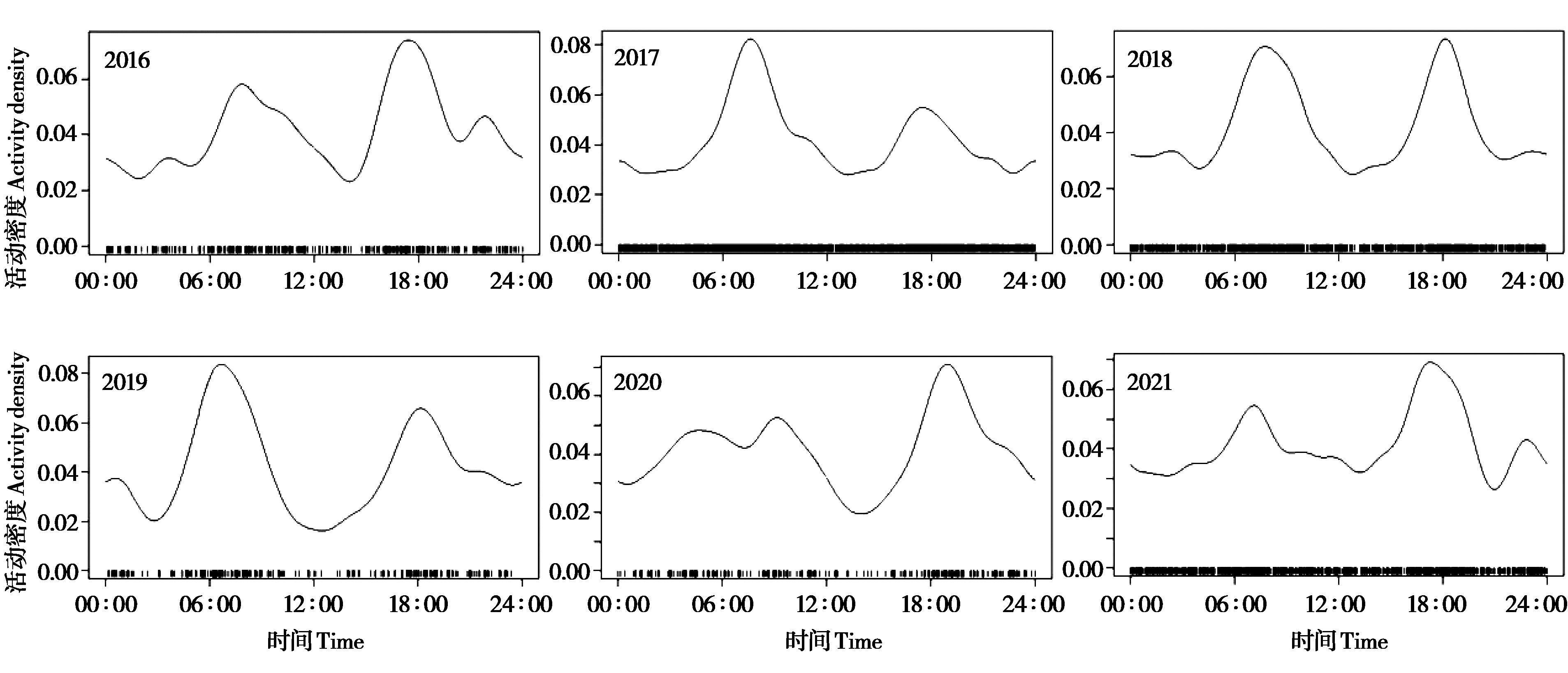
图2 北京市雾灵山自然保护区2016—2021年狍的活动节律
Fig. 2 The daily activity rhythm of roe deer from 2016 to 2021 in Beijing Wulingshan Nature Reserve
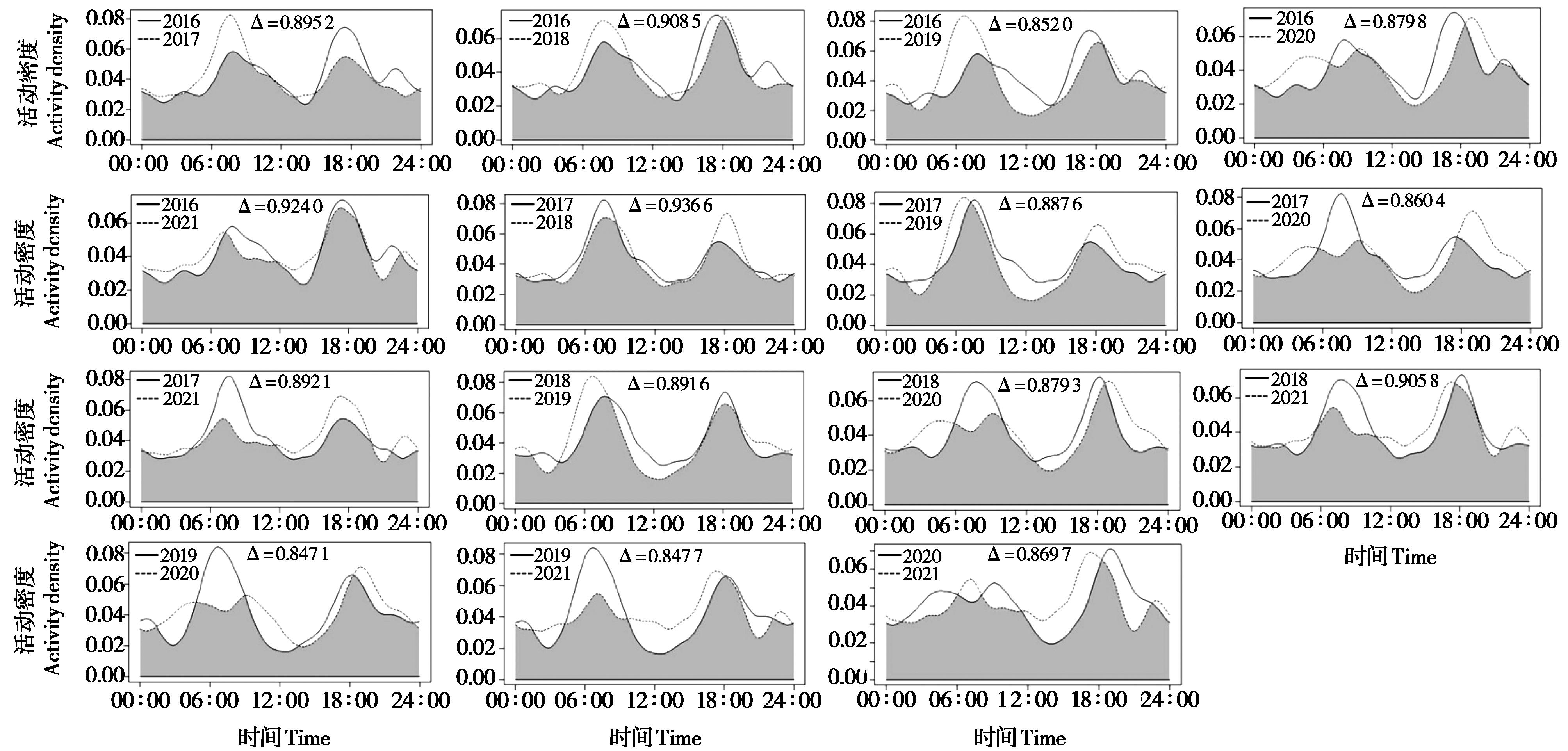
图3 北京市雾灵山自然保护区不同年份狍活动节律对比
Fig. 3 The daily activity rhythm comparison of roe deer between different years in Beijing Wulingshan Nature Reserve
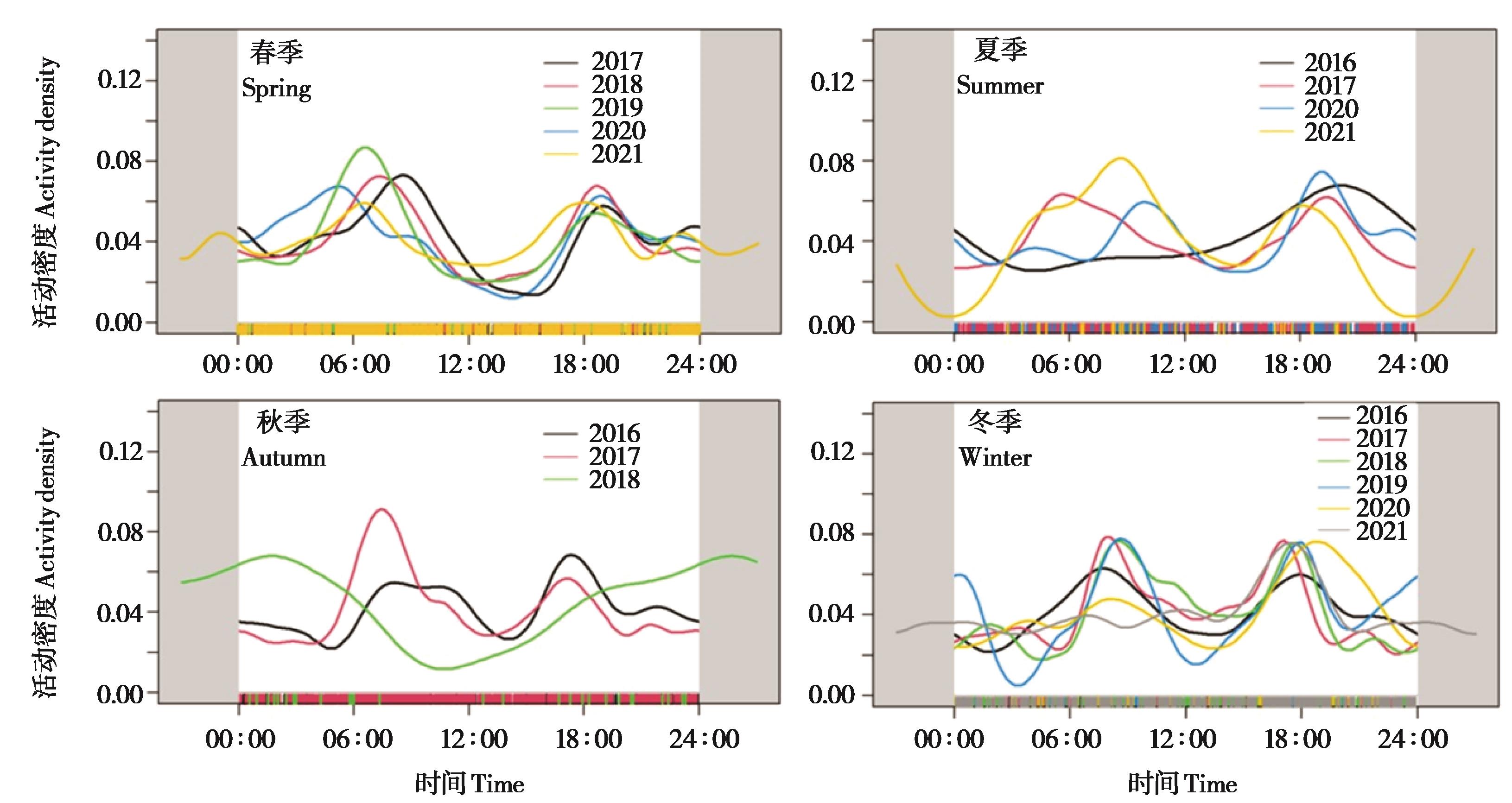
图4 北京市雾灵山自然保护区2016—2021年狍的季节性活动节律
Fig. 4 The daily activity rhythm of roe deer in four seasons from 2016 to 2021 in Beijing Wulingshan Nature Reserve
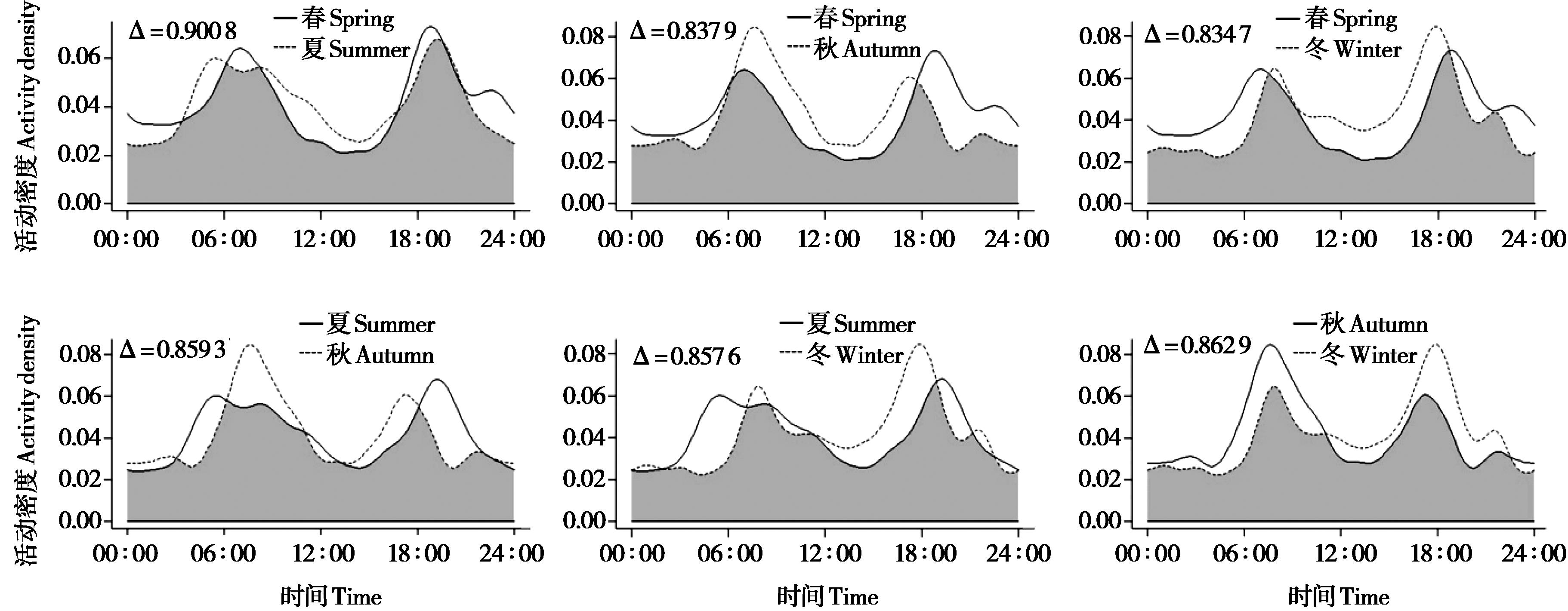
图5 北京市雾灵山自然保护区不同季节狍活动节律对比
Fig. 5 The daily activity rhythm comparison of roe deer between different seasons in Beijing Wulingshan Nature Reserve
| Ares-Pereira G, Rosalino L M, Teixeira D, Castro G, MagalhãEs A, Lima C, Fonseca C, Torres R T,2022. Eucalyptus plantations alter spatio-temporal relationships of wild ungulates[J]. Agriculture,Ecosystems and Environment,340:108174.DOI:10.1016/j.agee.2022.108174 . | |
| Banjade M, Jeong Y H, Jin S D, Son S H, Kunwar A, Park S M, Lee J W, Choi S H, Oh H S,2023. Spatiotemporal overlap between Siberian roe deer(Capreolus pygargus tianschanicus)and sympatric mammalian species on Jeju Island,South Korea[J]. Mammalia,87(2):101-109.DOI:10.1515/mammalia-2022-0059 . | |
| Bian Jianghui,2021. Research advances and perspectives on mammal population ecology in China[J]. Acta Theriologica Sinica,41(5):556-570. DOI:10.16829/j.slxb.150500. (in Chinese with English abstract) | |
| Bonnot N C, Couriot O, Berger A, Cagnacci P, Ciuti S, De J E, Gehr B, Heurich M, Kjellander P, KröSchel M, Morellet N, SöMmichesn L, Hewison A J M,2020. Fear of the dark? Contrasting impacts of humans versus lynx on diel activity of roe deer across Europe[J]. The Journal of Animal Ecology,89(1):132-145.DOI:10.1111/1365-2656.13161 . | |
| Chen Lijun, Xiao Wenhong, Xiao Zhishu,2019. Limitations of relative abundance indices calculated from camera trapping data[J]. Biodiversity Science,27(3):243-248. DOI:10.17520/biods.2018327. (in Chinese with English abstract) | |
| Chen Mengxiao, Wang Xiaoling, Mu Liguang, Jiang Xiuli, Hu Lei, Wu Liji, Wang Cui,Menghedalai, Bao Weidong,2019. Daily and seasonal activity rhythm of Capreolus pygargus in Inner Mongolia Saihanwula National Nature Reserve[J]. Sichuan Journal of Zoology,38(2):214-219. DOI:10.11984/j.issn.1000-7083.20180273. (in Chinese with English abstract) | |
| Chen Qiuting, Zhao Tiejian, Feng Xiaomei, Sun Guoming, Zhu Jinbao, Wang Yushen, Zhao Dapeng,2021. Cluster patterns and spatiotemporal activity patterns of wild roe deer in the Tianjin Baxianshan National Nature Reserve[J]. Sichuan Journal of Zoology,40(1):8-14. DOI:10.11984/j.issn.1000-7083.20200336. (in Chinese with English abstract) | |
| Chen Xing, Guan Tianpei, Jiang Wenle, Li Dandan, Yang Kong, Li Sheng,2021. Distribution and population status of bovine species in China based on bibliometric analysis[J]. Biodiversity Science,29(5):668-679. DOI:10.17520/biods.2020393. (in Chinese with English abstract) | |
| Chen Xing, Hu Qianqian, Liu Mingxing, Li Dandan, Jiang Wenle, Luo Chunping, Zhao Lianjun, Jiang Shiwei, Guan Tianpei,2021. A preliminary analysis on the spatio-temporal dynamic of ungulate's circadian activities:a case study of Bharal(Pseudois nayaur)[J]. Acta Ecologica Sinica,41(3):1251-1258. DOI:10.5846/stxb201912192742. (in Chinese with English abstract) | |
| Doormaal N V, Ohashi H, Koike S, Kaji K,2015. Influence of human activities on the activity patterns of Japanese sika deer(Cervus nippon)and wild boar(Sus scrofa)in Central Japan[J]. European Journal of Wildlife Research,61(4):517-527.DOI:10.1007/s10344-015-0922-8 . | |
| Hu Lei,2013. Activity rhythms of red deer and roe deer and group pattern of red deer by camera trapping[D]. Beijing:Beijing Forestry University.(in Chinese with English abstract) | |
| Ikeda T, Nakamori S, Ando M, Shirakawa T, Okamoto T, Suzuki M,2021. Seasonal diel activity patterns of three sympatric ungulates in forested area in Central Japan[J]. Mammal Study,47(1):47-56.DOI:10.3106/ms2021-0031 . | |
| Jiang Huilong, Zhou Shaochun, Zhang Minghai, Xu Wanpeng, Li Wei, Liu Jingyan,2023. Activity rhythm of wild boar and roe deer and its relationship with moonlight cycle in sympatric distribution[J]. Acta Ecologica Sinica,43(8):1-9. DOI:10.5846/stxb202203100582. (in Chinese with English abstract) | |
| Jia Xiaodong, Liu Xuehua, Yang Xingzhong, Wu Pengfeng, Songer M, Cai Qiong, He Xiangyun, Zhu Yun,2014. Seasonal activity patterns of ungulates in Qinling Mountains based on camera-trap data[J]. Biodiversity Science,22(6):737-745. DOI:10.3724/SP.J.1003.2014.140073. (in Chinese with English abstract) | |
| Jiang Zhigang, Jiang Jianping, Wang Yuezhao, Meng Zhibin, Fang Hongxia, Ping Xiaoge,2016. Red list of China’s vertebrates[J]. Biodiversity Science,24(5):501-551. DOI:10.17520/biods.2016076. (in Chinese with English abstract) | |
| Liu Mingxing, Ren Baoping, Chen Xing, Jin Guixiang, Leng Zhicheng, Yang Kong, Guan Tianpei,2022. Preliminary report on ungulate diversity and spatial distributions in Baihe National Nature Reserve and its surrounding areas,Sichuan[J]. Theriologica Sinica,42(3):250-260. DOI:10.16829/j.slxb.150583. (in Chinese with English abstract) | |
| Liu Yan,2017. Study on the feeding habits and reproductive behavior of Asiatic wild ass(Equus hemionus hemionus)in central Inner Mongolia[D]. Hohhot:Inner Mongolia Agricultural University.(in Chinese with English abstract) | |
| Mori E, Cicero M, Lovari S, Zaccaroni M, Salomoni S, Vendramin A, Augugliaro C,2021. Occupancy and activity rhythms of the Siberian roe deer[J]. Biologia,76(10):2991-2999.DOI:10.1007/s11756-021-00790-1 . | |
| Mahmoodi S, Shadloo S, Rezaei S,2023. Prediction of habitat suitability,connectivity,and corridors in the future to conserve roe deer(Capreolus capreolus)as a locally endangered species in northern Iran[J]. Journal for Nature Conservation,71:126313.DOI:10.1016/j.jnc.2022.126313 . | |
| Pagon N, Grignolio S, Pipia A, Bongi P, Bertolucci C, Apollonio M,2013. Seasonal variation of activity patterns in roe deer in a temperate forested area[J]. Chronobiology International,30(6):772-785.DOI:10.3109/07420528.2013.765887 . | |
| Qiu Baohong, Meng Qingli, Jin Zhejun, Jiang Quan, Wang Chao,2022. Analysis of daily activity rhythms of three ungulates in winter in Changbai Mountain National Nature Reserve[J]. Chinese Journal of Wildlife,43(2):331-336. DOI:10.12375 /ysdwxb.20220205. (in Chinese with English abstract) | |
| Rowcliffe J M, Kays R, Kranstauber B, Carbone C, Jansen P A,2014. Quantifying levels of animal activity using camera trap data[J]. Methods in Ecology and Evolution,5(11):1170-1179.DOI:10.1111/2041-210X.12278 . | |
| Sun Jiaxin, Li Jiaqi, Wan Yaqiong, Li Sheng, Guan Tianpei, Wang Jie, Xia Wancai, Xu Haigen,2018. Study on the activity rhythms of nine ungulates in summer and autumn in Sichuan[J]. Journal of Ecology and Rural Environment,34(11):1003-1009. DOI:10.11934 /j.issn.1673-4831.2018.11.007. (in Chinese with English abstract) | |
| Tang Xiaoming, Zhang Dehuai, Ma Zhihong, Wu Tonglu, Zhang Yuansheng, Bao Weidong,2016. Camera trapping survey on ground-dwelling birds and mammals of spring and winter in Beijing Wulingshan Nature Reserve[J]. Chinese Journal of Zoology,51(5):751-760. DOI:10.13859/j.cjz.201605005. (in Chinese with English abstract) | |
| Wang Guohai, Shi Zepan, Liu Xiuju, Zhou Qihai, Xiao Zhishu,2014. Camera trap survey of mammals and birds in Huaping National Nature Reserve,Guangxi[J]. Biodiversity Science,22(6):785-787. DOI:10.3724/SP.J.1003.2014.14125. (in Chinese with English abstract) | |
| Wang L, Feng J, Mou P,2023. Relative abundance of roe deer(Capreolus pygargus)related to overstory structure and understory food resources in Northeast China[J]. Global Ecology and Conservation,46:2542.DOI:10.1016/j.gecco.2023.e02542 . | |
| Wang Qiusheng,2023. Identification of hoofed wildlife habitats and conservation vacancies on the Tibetan Plateau under climate change scenarios[D]. Hohhot:Inner Mongolia University.DOI:10.27224/d.cnki.gnmdu.2023.001210. (in Chinese with English abstract) | |
| Wan Xinrong, Wang Mengjun, Liu Wei, Wang Ganghe, Zhong Wenqin,2002. Several numerical indicators of rodent activity patterns[J]. Acta Theriologica Sinica,(3):211-217. DOI:10.16829/j.slxb.2002.03.006. (in Chinese with English abstract) | |
| Wu Pengfeng, Liu Xuehua, Cai Qiong, He Xiangbo, Songer M, Zhu Yun, Shao Xiaoming,2021. The application of infrared camera in mammal research in Guanyinshan Nature Reserve,Shaanxi[J]. Acta Theriologica Sinica,32(1):67-71. DOI:10.16829/j.slxb.2012.01.009. (in Chinese with English abstract) | |
| Xiang R W, Da Z, Wu J Y, Bo X L, Wang J, Lu Q B, Hao Y H, Yan S, Meng X X,2021. Summer habitat preference of roe deer(Capreolus pygargus)in mountainous areas around Beijing[J]. Chinese Journal of Ecology,40(10):3252-3258. DOI:10.13292/j.1000-4890.202109.015. (in Chinese with English abstract) | |
| Xiong Zixiang, Xu Xiaomeng, Chang Yi, Wu Haowen, Du Jiahe, Yao Ziyi, Xu Hongying, Yang Qinyue, Li Xiang, Qi Jun,2024. Activity rhythm of Moschus anhuiensis based on camera-trapping monitoring data[J]. Chinese Journal of Zoology,59(1):19-28. DOI:10.13859/j.cjz.202423006. (in Chinese with English abstract) | |
| Yang Xi, Wang Xiaohong, Fu Mingxia, Song Xinqiang, Li Ping, Zhang Dongling, Zhou Hong,2024. Study on the activity rhythms of six ungulate species along the planned Sichuan-Tibet Railway(from Kangding to Batang section)based on infrared cameras[J]. Journal of Guizhou Normal University(Natural Sciences),42(3):68-75. DOI:10.16614/j.gznuj.zrb. 2024.03.008. (in Chinese with English abstract) | |
| Zaman M, Roberts N J, Zhu M, Vitekere K, Wang M, Jiang G,2022. Temporal activity patterns of North China leopards and their prey in response to moonlight and habitat factors[J]. Ecology and Evolution,12(6):e9032.DOI:10.1002/ece3.9032 . | |
| Zhang Fuxian, Meng Qinghui, Jiang Zhigang, Meng Xiuxiang, Cheng Zhibin, Song Yuan, Bai Jiade, Ding Yuhua, Wen Huajun,2022. The vicissitudes of fate and future protection prospects of Père David’s deer[J]. Acta Ecologica Sinica,42(1):1-10. DOI:10.5846/stxb202105131250. (in Chinese with English abstract) | |
| Zhang Hongyong, Zhang Dexi, Mao Ruirui, Wang Yizhu, Zhou Qian, Xu Tao, Zhang Lixun,2023. Daily activity patterns of leopard cats and their potential prey in forest ecosystem of Xinglong Mountains of Gansu Province,China[J]. Chinese Journal of Wildlife,44(2):239-247. DOI:10.12375/ysdwxb. 20230201. (in Chinese with English abstract) | |
| Zhang Hongfeng,2017. The migration and adaptation strategies of ungulate under the disturbance of road[D]. Xi’an:Northwest University.(in Chinese with English abstract) | |
| 王秋生,2023. 气候变化情景下青藏高原野生有蹄类动物生境与保护空缺识别[D]. 呼和浩特:内蒙古大学.DOI:10.27224/d.cnki.gnmdu.2023.001210 . | |
| 边疆晖,2021. 中国兽类种群生态学研究进展与展望[J]. 兽类学报,41(5):556-570.DOI:10.16829/j.slxb.150500 . | |
| 邢韶华,鲍伟东,王清春,崔国发,2013. 北京市雾灵山自然保护区综合科学考察报告[M]. 北京:中国林业出版社,1-102. | |
| 向荣伟,达珍,吴佳忆,卜向丽,王静,鲁庆斌,郝映红,盛岩,孟秀祥,2021. 北京周边山区狍(Capreolus pygargus)的夏季偏好生境特征[J]. 生态学杂志,40(10):3252-3258.DOI:10.13292/j.1000-4890.202109.015 . | |
| 刘明星,任宝平,陈星,金贵祥,冷志诚,杨孔,官天培,2022. 四川白河国家级自然保护区及其周边区域有蹄类多样性与空间分布初报[J]. 兽类学报,42(3):250-260.DOI:10.16829/j.slxb.150583 . | |
| 刘燕,2017. 内蒙古中部蒙古野驴(Equus hemionus hemionus)食性与繁殖行为研究[D]. 呼和浩特:内蒙古农业大学. | |
| 江辉龙,周绍春,张明海,徐万鹏,李薇,刘静岩,2023. 同域分布的野猪与狍活动节律及与月光周期的关系[J]. 生态学报,43(8):1-9.DOI:10.5846/stxb202203100582 . | |
| 汤小明,张德怀,马志红,吴同路,张源笙,鲍伟东,2016. 北京雾灵山自然保护区冬春季地面活动鸟兽红外相机初步调查[J]. 动物学杂志,51(5):751-760.DOI:10.13859/j.cjz. 201605005 . | |
| 孙佳欣,李佳琦,万雅琼,李晟,官天培,王杰,夏万才,徐海根,2018. 四川9种有蹄类动物夏秋季活动节律研究[J]. 生态与农村环境学报,34(11):1003-1009.DOI:10.11934/j.issn.1673-4831.2018.11.007 . | |
| 杨稀,王晓虹,付明霞,宋心强,李平,张冬玲,周宏,2024. 基于红外相机对拟建川藏铁路(康定至巴塘段)沿线6种有蹄类动物活动节律研究[J]. 贵州师范大学学报(自然科学版),42(3):68-75.DOI:10.16614/j.gznuj.zrb.2024.03.008 . | |
| 邱宝鸿,孟庆礼,金哲军,姜权,王超,2022. 长白山自然保护区三种有蹄类动物冬季日活动节律研究[J]. 野生动物学报,43(2):331-336.DOI:10.12375 /ysdwxb.20220205 . | |
| 汪国海,施泽攀,刘秀菊,周岐海,肖治术,2014. 花坪保护区鸟兽物种的红外相机初步监测[J]. 生物多样性,22(6):785-787.DOI:10.3724/SP.J.1003.2014.14125 . | |
| 张付贤,孟庆辉,蒋志刚,孟秀祥,程志斌,宋苑,白加德,丁玉华,温华军,2022. 麋鹿沧桑命运与未来保护展望[J]. 生态学报,42(1):1-10.DOI:10.5846/stxb202105131250 . | |
| 张红勇,张德喜,毛锐锐,王一竹,周倩,徐涛,张立勋,2023. 甘肃兴隆山森林生态系统豹猫及其潜在猎物的日活动模式[J]. 野生动物学报,44(2):239-247.DOI:10.12375/ysdwxb.20230201 . | |
| 张洪峰,2017. 道路干扰下秦岭有蹄类动物迁移及适应对策[D]. 西安:西北大学. | |
| 陈卫,高武,傅必谦,2000. 北京兽类志[M]. 北京:北京出版社,255-271. | |
| 陈立军,肖文宏,肖治术,2019. 物种相对多度指数在红外相机数据分析中的应用及局限[J]. 生物多样性,27(3):243-248.DOI:10.17520/biods.2018327 . | |
| 陈星,官天培,蒋文乐,李丹丹,杨孔,李晟,2021. 中国牛科动物分布与种群现状:基于文献计量数据[J]. 生物多样性,29(5):668-679.DOI:10.17520/biods.2020393 . | |
| 陈星,胡茜茜,刘明星,李丹丹,蒋文乐,罗春平,赵联军,蒋仕伟,官天培,2021. 有蹄类昼夜活动时空动态:以岩羊(Pseudois nayaur)为例[J]. 生态学报,41(3):1251-1258.DOI:10.5846/stxb201912192742 . | |
| 陈秋婷,赵铁建,冯小梅,孙国明,朱金保,王玉申,赵大鹏,2021. 天津八仙山国家级自然保护区野生狍集群模式和时空活动规律[J]. 四川动物,40(1):8-14.DOI:10.11984/j.issn.1000-7083.20200336 . | |
| 陈梦霄,王晓玲,穆丽光,姜秀丽,胡磊,乌力吉,王翠,孟和达来,鲍伟东,2019. 内蒙古赛罕乌拉国家级自然保护区狍的日活动节律及其季节变化研究[J]. 四川动物,38(2):214-219.DOI:10.11984/j.issn.1000-7083.20180273 . | |
| 武鹏峰,刘雪华,蔡琼,何祥博, Songer M,朱云,邵小明,2012. 红外相机技术在陕西观音山自然保护区兽类监测研究中的应用[J]. 兽类学报,32(1):67-71. DOI:10.16829/j.slxb.2012.01.009 . | |
| 尚玉昌,2014. 动物行为学[M].第二版. 北京:北京大学出版社,274-299. | |
| 国家林业局,2008. 中国重点陆生野生动物资源普查[M]. 北京:中国林业出版社,276-305. | |
| 宛新荣,王梦军,刘伟,王广和,钟文勤,2002. 啮齿动物活动模式的几种数值指标[J]. 兽类学报,(3):211-217.DOI:10.16829/j.slxb.2002.03.006 . | |
| 胡磊,2013. 基于红外自动相机技术的马鹿和狍活动节律与马鹿集群行为[D]. 北京:北京林业大学. | |
| 贾晓东,刘雪华,杨兴中,武鹏峰, Songer M,蔡琼,何祥博,朱云,2014. 利用红外相机技术分析秦岭有蹄类动物活动节律的季节性差异[J]. 生物多样性,22(6):737-745.DOI:10.3724/SP.J.1003.2014.140073 . | |
| 蒋志刚,江建平,王跃招,孟智斌,方红霞,平晓鸽,2016. 中国脊椎动物红色名录[J]. 生物多样性,24(5):501-551. DOI:10.17520/biods.2016076 . | |
| 熊子翔,许晓萌,唱意,吴昊玟,杜嘉和,姚子毅,徐红英,杨勤跃,李翔,漆俊,2024. 基于红外相机监测数据分析安徽麝活动节律[J]. 动物学杂志,59(1):19-28.DOI:10.13859/j.cjz.202423006 . |
| [1] | 李明慧, 黄莘钧, 常劲, 莫志民, 万冬梅, 蒋一婷. 辽西地区狍的相对多度、集群模式及日活动节律[J]. 兽类学报, 2025, 45(3): 356-367. |
| [2] | 黄莘钧, 莫志民, 李明慧, 张雷, 万冬梅, 蒋一婷. 基于MaxEnt模型对燕山山脉东段狍生境适宜性评价[J]. 兽类学报, 2024, 44(4): 478-488. |
| [3] | 蒙秉顺, 黄小龙, 谢波, 王维熙, 黄继池, 张涛, 冉景丞, 张明明. 贵州梵净山国家级自然保护区有蹄类动物适宜栖息地分布[J]. 兽类学报, 2023, 43(6): 664-675. |
| [4] | 陈红, 吉晟男, 张勘, 王大勇, 胡杰, 李艳红. 小相岭山系大中型兽类多样性的红外相机调查[J]. 兽类学报, 2022, 42(4): 461-470. |
| [5] | 刘明星, 任宝平, 陈星, 金贵祥, 冷志诚, 杨孔, 官天培. 四川白河国家级自然保护区及其周边区域有蹄类多样性与空间分布初报[J]. 兽类学报, 2022, 42(3): 250-260. |
| [6] | 王乐 冯佳伟 Amarsaikhan Tseveen 杨丽萌 黄春明 李栋 朱新亮 冯利民 王天明 葛剑平 牟溥. 森林放牧对东北虎豹国家公园东部有蹄类动物灌草层食物资源的影响[J]. 兽类学报, 2019, 39(4): 386-396. |
| [7] | 薛亚东 刘芳 郭铁征 袁磊 李迪强. 基于相机陷阱技术的阿尔金山北坡水源地鸟兽物种监测[J]. 兽类学报, 2014, 34(2): 164-171. |
| [8] | 张明海, 刘艳华,贾竞波. 东北地区狍种群的遗传多样性研究[J]. , 2010, 30(1): 58-64. |
| [9] | 李长生,周虚,王桂武. 圈养条件下仔狍的生长与发育[J]. , 2009, 29(4): 413-418. |
| [10] | 张玮琪,姜广顺,明海,马建章,董会书. HPLC 测定驼鹿和狍雪尿肌酐及嘌呤衍生物[J]. , 2008, 28(4): 422-429. |
| [11] | 王力军,洪美玲,肖向红,马建章. 狍冬季消化道形态特征及食物颗粒分布[J]. , 2005, 25(4): 361-366. |
| [12] | 张明海 肖朝庭 Koh Hungsun. 从分子水平探讨中国东北狍的分类地位[J]. , 2005, 25(1): 14-19. |
| [13] | 王力军 洪美玲 肖向红 马建章. 应用骨髓脂肪指数评价狍冬季体状况[J]. , 2004, 24(4): 353-356. |
| [14] | 王力军 马建章 洪美玲 肖向红. 应用雪尿分析技术评价不同类型栖息地中狍冬季的营养状况[J]. , 2003, 23(2): 109-114. |
| [15] | 高继宏,吕小雪,张雁辉,刘健,黄守华. 狍雪地痕迹特征及在数量调查中的应用[J]. , 1995, 15(2): 155-156. |
| 阅读次数 | ||||||
|
全文 |
|
|||||
|
摘要 |
|
|||||
 青公网安备 63010402000199号 青ICP备05000010号-2