

中国核心期刊要目总览
中国科技核心期刊
CSCD数据库源刊
中国科技核心期刊
CSCD数据库源刊
兽类学报 ›› 2025, Vol. 45 ›› Issue (6): 753-762.DOI: 10.16829/j.slxb.151104
李倩冰1,2, 张翔宇1, 高利霞1,2( )
)
收稿日期:2025-05-14
接受日期:2025-11-04
出版日期:2025-11-30
发布日期:2025-12-03
通讯作者:
高利霞
作者简介:李倩冰 (1997- ),女,博士研究生,主要从事狨猴语音交流的神经感知机制研究.
基金资助:
Qianbing LI1,2, Xiangyu ZHANG1, Lixia GAO1,2()
Received:2025-05-14
Accepted:2025-11-04
Online:2025-11-30
Published:2025-12-03
Contact:
Lixia GAO
摘要:
声音通讯是动物个体或群体间交流信息的形式之一,其表现随动物种类的不同而呈现多样性。普通狨 (Callithrix jacchus) 凭借其丰富的发声曲目、高度发达的听觉系统、复杂的声音通讯行为以及显著的社会化特征,成为神经生物学领域,特别是声音通讯研究中备受关注的非人灵长类模式动物。本文综述了关于普通狨声音通讯行为及神经机制的研究进展,首先梳理了其叫声曲目及声学特征;在此基础上,对叫声进行功能分类,重点介绍了其在社交互动、觅食行为和警戒反应中的具体功能及其生态意义。其次,阐述了普通狨声音通讯的神经机制,包括发声控制的神经环路和调节机制,以及听皮层、前额叶和边缘系统在声音初级加工和高级功能整合中的关键作用。最后,结合当前研究现状,提出了未来研究建议。本文旨在推动普通狨声音通讯研究的发展,并为相关领域提供理论参考。
中图分类号:
李倩冰, 张翔宇, 高利霞. 普通狨声音通讯行为及神经机制研究进展[J]. 兽类学报, 2025, 45(6): 753-762.
Qianbing LI, Xiangyu ZHANG, Lixia GAO. Research advances in vocal communication behavior and neural mechanisms of common marmosets[J]. ACTA THERIOLOGICA SINICA, 2025, 45(6): 753-762.
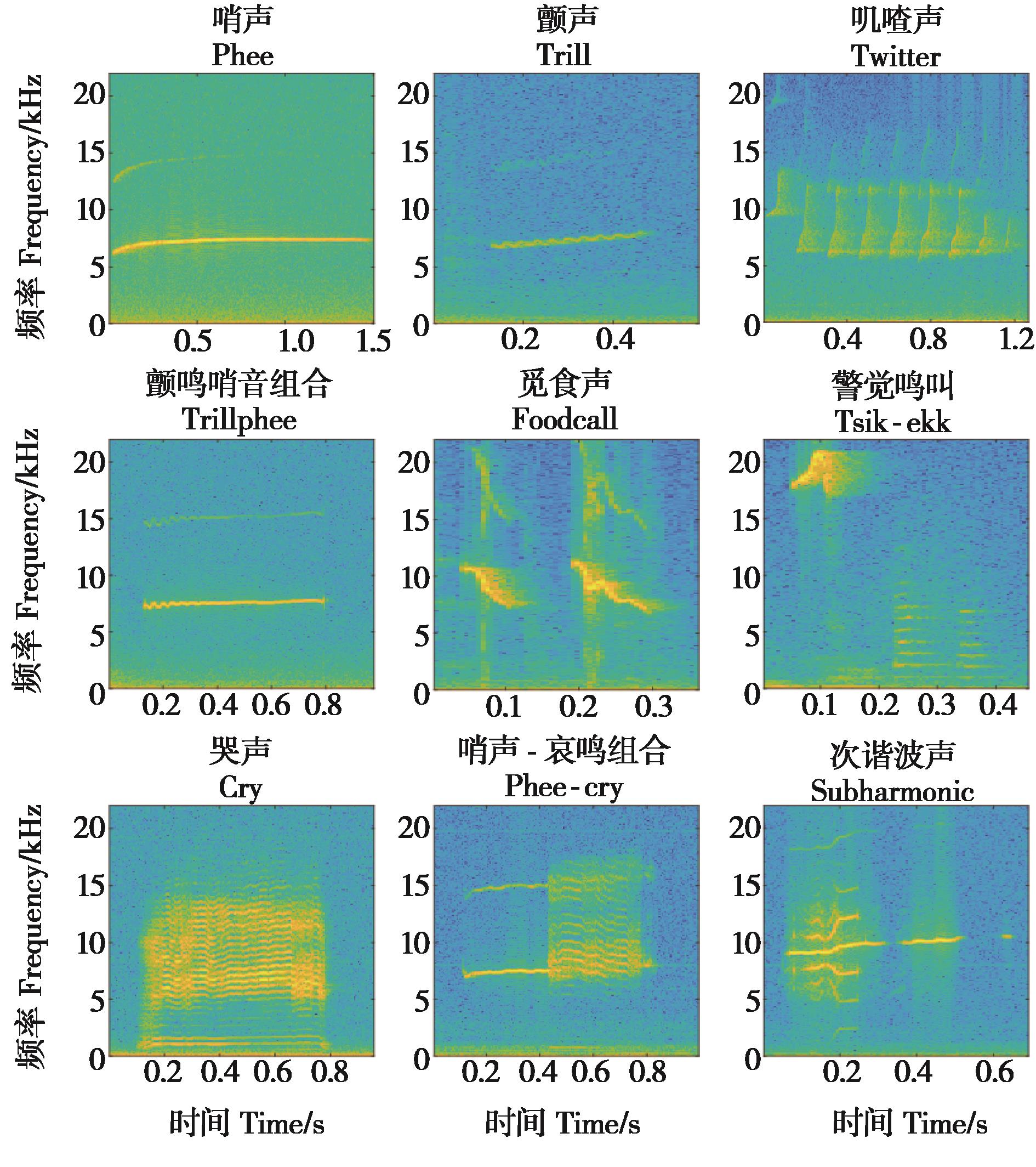
图1 普通狨常见叫声的声谱图
Fig. 1 Spectrograms of sampled marmoset calls
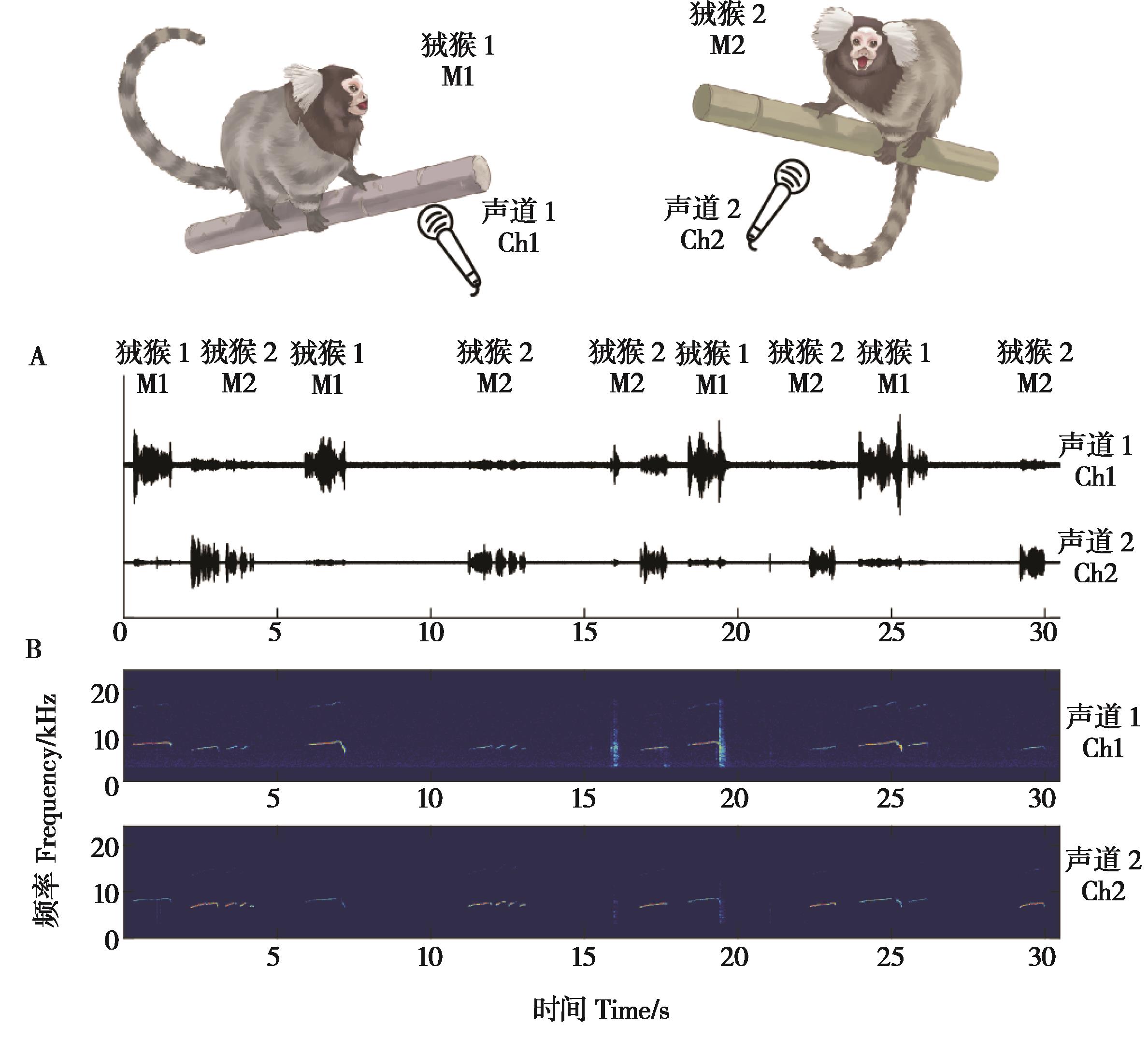
图2 普通狨的轮流发声现象. A:采用双通道独立麦克风系统对两只普通狨 (M1与M2) 同时进行声音信号采集所获取的时域信号.声道1 (Ch1) 指向M1,声道2 (Ch2) 指向M2. 通过比较两个声道所采集叫声的相对幅度,对发声个体进行判别与标识,结果如图A上部所示. B:图A所对应信号的声谱图
Fig. 2 Vocal turn-taking in marmosets. A: Time-domain signals of vocalizations from two marmosets (M1 and M2), recorded simultaneously using a dual-channel independent microphone system. Channel 1 (Ch1) was directed toward M1, and Channel 2 (Ch2) toward M2. The vocalizing individual was identified and labeled based on the relative amplitude of calls captured by the two channels, as illustrated in the upper part of Figure 2A. B: Spectrogram corresponding to the signals shown in A
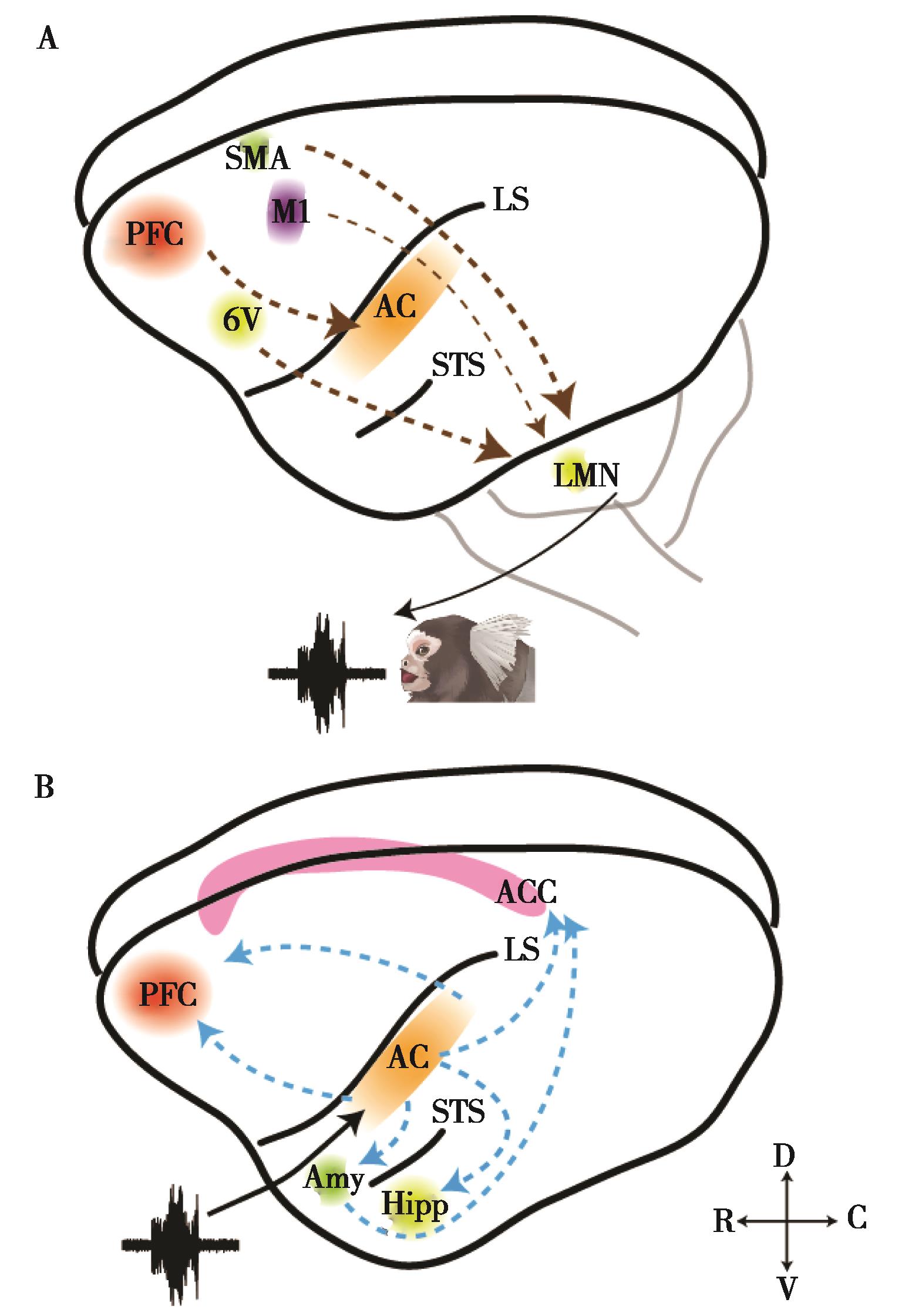
图3 普通狨发声控制和叫声编码的主要脑区和神经环路. A:普通狨发声的皮层网络. M1、SMA 和6V到喉运动神经元的控制,其中SMA和6V连接更强 (用较粗的线条表示). 前额叶皮层在个体自主发声前发出信号到听皮层形成反馈性抑制. B:普通狨参与叫声感知的神经环路. 从听觉皮层的喙侧投射到腹外侧前额叶,代表腹侧通路,而尾侧投射到背外侧前额叶,代表背侧通路. 前扣带回皮层、杏仁核、海马均呈现出对同类叫声选择性反应,其中前扣带回皮层逆行示踪至杏仁核和高级听觉皮层. AC:听皮层;ACC:前扣带回皮层;PFC:前额叶皮层;Amy:杏仁核;Hipp:海马;LS:外侧沟;STS:颞上沟;M1:初级运动皮层;SMA:辅助运动区;6V:布罗德曼6区腹侧部;LMN:喉运动神经元. 方向轴,D:背侧;V:腹侧;C:尾侧;R:喙侧
Fig.3 Key brain regions and neural circuits involved in vocal control and call encoding in marmosets. A: Cortical network underlying vocal production in marmosets. M1, SMA, and 6V regulate laryngeal motoneurons, with stronger connections from SMA and 6V (indicated by thicker lines). The prefrontal cortex sends signals to the auditory cortex before voluntary vocalization, forming feedback inhibition. B: Neural circuit involved in vocal perception in marmosets. The rostral projection from the auditory cortex to the ventrolateral prefrontal cortex represents the ventral pathway, while the caudal projection to the dorsolateral prefrontal cortex represents the dorsal pathway. The anterior cingulate cortex, amygdala, and hippocampus all exhibit selective responses to conspecific calls. The anterior cingulate cortex is retrogradely traced to the amygdala and higher auditory cortex. AC: Auditory cortex; ACC: Anterior cingulate cortex; PFC: Prefrontal cortex; Amy: Amygdala; Hipp: Hippocampus; LS: Lateral sulcus; STS: Superior temporal sulcus; M1: Primary motor cortex; SMA: Supplementary motor area; 6V: Area 6 ventral; LMN: Laryngeal motoneurons. Axis directions, D: Dorsal; V: Ventral; C: Caudal; R: Rostral
| Agamaite J A, Chang C J, Osmanski M S, Wang X. 2015. A quantitative acoustic analysis of the vocal repertoire of the common marmoset (Callithrix jacchus) [J].Journal of the Acoustical Society of America, 138 (5): 2906-2928. | |
| An R, Lu C, Wang C, Chang L, Huang J, Jiang F, Xu T L, Gong N. 2024. Developmental patterns and gender differences of vocal production in marmoset monkeys [J]. Neuroscience Bulletin, 40 (1): 133-138. | |
| Bakola S, Burman K J, Bednarek S, Chan J M, Jermakow N, Worthy K H, Majka P, Rosa M G P. 2021. Afferent connections of cytoarchitectural area 6 m and surrounding cortex in the marmoset: Putative homologues of the supplementary and pre‑supplementary motor areas [J]. Cerebral Cortex, 32 (1): 41-62. | |
| Bendor D, Wang X. 2008. Neural response properties of primary, rostral, and rostrotemporal core fields in the auditory cortex of marmoset monkeys [J]. Journal of Neurophysiollogy, 100 (2): 888-906. | |
| Bezerra B M, Souto A. 2008. Structure and usage of the vocal repertoire of Callithrix jacchus [J]. International Journal of Primatology, 29 (3): 671-701. | |
| Bosshard A B, Burkart J M, Merlo P, Cathcart C, Townsend S W, Bickel B. 2024. Beyond bigrams: call sequencing in the common marmoset (Callithrix jacchus) vocal system [J]. Royal Society Open Science, 11 (11): 240218.DOI: 10.1098/rsos.240218 . | |
| Buchinger T J, Li W. 2023. Chemical communication and its role in sexual selection across animalia [J]. Communications Biology, 6 (1): 1178.DOI: 10.1038/s42003-023-05572-w . | |
| Cerkevich C M, Rathelot J A, Strick P L. 2022. Cortical basis for skilled vocalization [J].Proceedings of the National Academy of Sciences of the United States of America, 119 (19): e2122345119.DOI: 10.1073/pnas.2122345119 . | |
| Chen H C, Kaplan G, Rogers L J. 2009. Contact calls of common marmosets (Callithrix jacchus): influence of age of caller on antiphonal calling and other vocal responses [J]. American Journal of Primatology, 71 (2): 165-170. | |
| Chow C P, Mitchell J F, Miller C T. 2015. Vocal turn‑taking in a non‑human primate is learned during ontogeny [J]. Proceedings of the Royal Society B-Biological Sciences, 282 (1807): 20150069.DOI: 10.1098/rspb.2015.0069 . | |
| Collier K, Bickel B, van Schaik C P, Manser M B, Townsend S W. 2014. Language evolution: Syntax before phonology? [J]. Proceedings of the Royal Society B-Biological Sciences, 281 (1788): 20140263.DOI: 10.1098/rspb.2014.0263 . | |
| Dureux A, Zanini A, Everling S. 2024. Mapping of facial and vocal processing in common marmosets with ultra‑high field fmri [J]. Communications Biology, 7 (1): 317.DOI: 10.1038/s42003-024-06002-1 . | |
| Dureux A, Zanini A, Trapeau R, Belin P, Everling S. 2025. Functional organization of voice patches in marmosets and cross‑species comparisons with macaques and humans [J]. Current Biology, 35 (16): 3869-3882. | |
| Ebina T, Sasagawa A, Hong D, Setsuie R, Obara K, Masamizu Y, Kondo M, Terada S I, Ozawa K, Uemura M, Takaji M, Watakabe A, Kobayashi K, Ohki K, Yamamori T, Murayama M, Matsuzaki M. 2024. Dynamics of directional motor tuning in the primate premotor and primary motor cortices during sensorimotor learning [J]. Nature Communications, 15 (1): 7127.DOI: 10.1038/s41467-024-51425-3 . | |
| Eliades S J, Miller C T. 2017. Marmoset vocal communication: behavior and neurobiology [J]. Developmental Neurobiology, 77 (3): 286-299. | |
| Eliades S J, Tsunada J. 2018. Auditory cortical activity drives feedback‑dependent vocal control in marmosets [J]. Nature Communications, 9: 2540.DOI: 10.1038/s41467-018-04961-8 . | |
| Eliades S J, Wang X. 2005. Dynamics of auditory‑vocal interaction in monkey auditory cortex [J]. Cerebral Cortex, 15 (10): 1510-1523. | |
| Eliades S J, Wang X. 2008. Neural substrates of vocalization feedback monitoring in primate auditory cortex [J]. Nature, 453 (7193): 1102-1106. | |
| Eliades S J, Wang X. 2012. Neural correlates of the lombard effect in primate auditory cortex [J]. Journal of Neuroscience, 32 (31): 10737-10748. | |
| Eliades S J, Wang X. 2019. Corollary discharge mechanisms during vocal production in marmoset monkeys [J]. Biological Psychiatry-Cognitive Neuroscience and Neuroimaging, 4 (9): 805-812. | |
| Engesser S, Townsend S W. 2019. Combinatoriality in the vocal systems of nonhuman animals [J]. Wiley Interdisciplinary Reviews-Cognitive Science, 10 (4): e1493. | |
| Fitch W T. 2010. The Evolution of Language [M]. Cambridge: Cambridge University Press, 175-176. | |
| Fox J G. 2019. The Common Marmoset in Captivity and Biomedical Research [M]. New York: Academic Press, 17. | |
| Gao L, Wang X. 2020. Intracellular neuronal recording in awake nonhuman primates [J]. Nature Protocols, 15 (11): 3615-3631.DOI: 10.1038/s41596-020-0388-3 . | |
| Gavassa S, Goldina A, Silva A C, Stoddard P K. 2013. Behavioral ecology, endocrinology and signal reliability of electric communication [J]. Journal of Experimental Biology, 216 (13): 2403-2411. | |
| Gilliland R L, Selvanayagam J, Zanini A, Johnston K D, Everling S. 2024. Neural activity for complex sounds in the marmoset anterior cingulate cortex [J]. Communications Biology, 7 (1): 1310.DOI: 10.1038/s42003-024-07019-2 . | |
| Gothard K M. 2022. Previews Marmosets confirm that context is king [J]. Neuron, 110 (8): 1273-1274. | |
| Grijseels D M, Fairbank D A, Miller C T. 2024. A model of marmoset monkey vocal turn‑taking [J]. Proceedings of the Royal Society B-Biological Sciences, 291 (2026): 20240150.DOI: 10.1098/rspb.2024.0150 | |
| Grijseels D M, Prendergast B J, Gorman J C, Miller C T. 2023. The neurobiology of vocal communication in marmosets [J]. Annals of the New York Academy of Sciences, 1528 (1): 13-28. | |
| Gultekin Y B, Hage S R. 2018. Limiting parental interaction during vocal development affects acoustic call structure in marmoset monkeys [J]. Science Advances, 4 (4): eaar4012.DOI: 10.1126/sciadv.aar4012 . | |
| Hauser M D, Chomsky N, Fitch W T. 2002. The faculty of language: What is it, who has it, and how did it evolve? [J]. Science, 298 (25598): 1569-1579. | |
| Huang J, Cheng X, Zhang S, Chang L, Li X, Liang Z, Gong N. 2020. Having infants in the family group promotes altruistic behavior of marmoset monkeys [J]. Current Biology, 30 (20): 4047-4055. | |
| Jia G, Bai S, Lin Y, Wang X, Zhu L, Lyu C, Sun G, An K, Roe A W, Li X, Gao L. 2023. Representation of conspecific vocalizations in amygdala of awake marmosets [J]. National Science Review, 10 (11): nwad194.DOI: 10.1093/nsr/nwad194 . | |
| Jovanovic V, Fishbein A R, de la Mothe L, Lee K F, Miller C T. 2022. Behavioral context affects social signal representations within single primate prefrontal cortex neurons [J]. Neuron, 110 (8): 1318-1326. | |
| Kadia S C, Wang X. 2003. Spectral integration in a1 of awake primates: Neurons with single‑ and multipeaked tuning characteristics [J]. Journal of Neurophysiology, 89: 1603-1622. | |
| Kajikawa Y, de la Mothe L A, Blumell S, Sterbing‑D’Angelo S J, D’Angelo W, Camalier C R, Hackett T A. 2008. Coding of fm sweep trains and twitter calls in area cm of marmoset auditory cortex [J]. Hearing Research, 239 (1-2): 107-125. | |
| Kato M, Yokoyama C, Kawasaki A, Takeda C, Koike T, Onoe H, Iriki A. 2018. Individual identity and affective valence in marmoset calls: In vivo brain imaging with vocal sound playback [J]. Animal Cognnition, 21 (3): 331-343. | |
| Kershenbaum A, Garland E C. 2015. Quantifying similarity in animal vocal sequences: Which metric performs best? [J]. Methods in Ecology and Evolution, 6 (12): 1452-1461. | |
| Landman R, Sharma J, Hyman J B, Fanucci‑Kiss A, Meisner O, Parmar S, Feng G, Desimone R. 2020. Close‑range vocal interaction in the common marmoset (Callithrix jacchus) [J]. PLoS ONE, 15(4): e0227392.DOI: 10.1371/journal.pone.0227392 . | |
| Li J, Aoi M C, Miller C T. 2024. Representing the dynamics of natural marmoset vocal behaviors in frontal cortex [J]. Neuron, 112 (21): 3542-3550. | |
| Liao D A, Zhang Y S, Cai L X, Ghazanfar A A. 2018. Internal states and extrinsic factors both determine monkey vocal production [J].Proceedings of the National Academy of Sciences of the United States of America, 115 (15): 3978-3983. | |
| Löschner J, Hage S R. 2025. Sound amongst the din: Primate strategies against noise [J]. Trends in Cognitive Sciences, 29 (2): 111-113. | |
| Lu T, Liang L, Wang X. 2001. Temporal and rate representations of time‑varying signals in the auditory cortex of awake primates [J]. Nature Neuroscience, 4 (11): 1131-1138. | |
| Marler P. 1967. Animal communication signals: We are beginning to understand how the structure of animal signals relates to the function they serve [J]. Science, 157 (3790): 769-774. | |
| Marler P. 2010. Bird calls: Their potential for behavioral neurobiology [J]. Behavioral Neurobiology of Birdsong, 1016: 31-44. | |
| Miller C T, Beck K, Meade B, Wang X. 2009. Antiphonal call timing in marmosets is behaviorally significant: Interactive playback experiments [J]. Journal of Comparative Physiology A-Neuroethology Sensory Neural and Behavioral Physiology, 195 (8): 783-789. | |
| Miller C T, Freiwald W A, Leopold D A, Mitchell J F, Silva A C, Wang X. 2016. Marmosets: A neuroscientific model of human social behavior [J]. Neuron, 90 (2): 219-233. | |
| Obara K, Ebina T, Terada S I, Uka T, Komatsu M, Takaji M, Watakabe A, Kobayashi K, Masamizu Y, Mizukami H, Yamamori T, Kasai K, Matsuzaki M. 2023. Change detection in the primate auditory cortex through feedback of prediction error signals [J]. Nature Communication, 14 (1): 6981.DOI: 10.1038/s41467-023-42553-3 . | |
| Oren G, Shapira A, Lifshitz R, Vinepinsky E, Cohen R, Fried T, Hadad G P, Omer D. 2024. Vocal labeling of others by nonhuman primates [J]. Science, 385 (6712): 996-1003. | |
| Pomberger T, Risueno‑Segovia C, Gultekin Y B, Dohmen D, Hage S R. 2019. Cognitive control of complex motor behavior in marmoset monkeys [J]. Nature Communications, 10: 3796.DOI: 10.1038/s41467-019-11714-8 . | |
| Qi R, Lin Y, Liu S, Cao X, Xie M, Yu C, Sun H, Gao L, Li X. 2025. Vocal taking turns is premature at birth and improved by the postnatal phonetic environment in marmosets [J]. National Science Review, 12 (7): nwaf162.DOI: 10.1093/nsr/nwaf162 . | |
| Risueno‑Segovia C, Hage S R. 2020. Theta synchronization of phonatory and articulatory systems in marmoset monkey vocal production [J]. Current Biology, 30 (21): 4276-4283. | |
| Rogers L J, Stewart L, Kaplan G. 2018. Food calls in common marmosets, Callithrix jacchus, and evidence that one is functionally referential [J]. Animals (Basel), 8: 99.DOI: 10.3390/ani8070099 . | |
| Roy S, Zhao L, Wang X. 2016. Distinct neural activities in premotor cortex during natural vocal behaviors in a new world primate, the common marmoset (Callithrix jacchus) [J]. Journal of Neuroscience, 36 (48): 12168-12179. | |
| Sadagopan S, Temiz‑Karayol N Z, Voss H U. 2015. High‑field functional magnetic resonance imaging of vocalization processing in marmosets [J]. Scientific Reports, 5: 10950.DOI: 10.1038/srep10950 . | |
| Scheerer‑Bernhard J U, Tkachenko O Y, Heistermann M, Grundker C, Nayudu P L. 2015. Body weight‑associated differences in ovarian morphology in captive common marmoset (Callithrix jacchus) [J]. Animal Reproduction Science, 157: 44-55. | |
| Schiel N, Souto A. 2017. The common marmoset: An overview of its natural history, ecology and behavior [J]. Developmental Neurobiology, 77 (3): 244-262. | |
| Smith D G. 1972. The role of the epaulets in the red‑winged blackbird, (Agelaius phoeniceus) social system [J]. Behaviour, 41: 251-268. | |
| Song X, Guo Y, Li H, Chen C, Lee J H, Zhang Y, Schmidt Z, Wang X. 2022. Mesoscopic landscape of cortical functions revealed by through‑skull wide‑field optical imaging in marmoset monkeys [J]. Nature Communication, 13 (1): 2238.DOI: 10.1038/s41467-022-29864-7 . | |
| Suzuki R, Buck J R, Tyack P L. 2006. Information entropy of humpback whale songs [J]. Journal of the Acoustical Society of America, 119 (3): 1849-1866. | |
| Takahashi D Y, Fenley A R, Teramoto Y, Narayanan D Z, Borjon J I, Holmes P, Ghazanfar A A. 2015. Language development. The developmental dynamics of marmoset monkey vocal production [J]. Science, 349: 734-738. | |
| Takahashi D Y, Narayanan D Z, Ghazanfar A A. 2013. Coupled oscillator dynamics of vocal turn‑taking in monkeys [J]. Current Biology, 23 (21): 2162-2168. | |
| Tsunada J, Eliades S J. 2025. Frontal‑auditory cortical interactions and sensory prediction during vocal production in marmoset monkeys [J]. Current Biology, 35: 2307-2322 e2303. | |
| Tyree T J, Metke M, Miller C T. 2023. Cross‑modal representation of identity in the primate hippocampus [J]. Science, 382: 417-423. | |
| Waal F B M D. 1989. Food sharing and reciprocal obligations among chimpanzees [J]. Journal of Human Evolution, 18 (5): 433-459. | |
| Wang X. 2007. Neural coding strategies in auditory cortex [J]. Hearing Research, 229 (1-2): 81-93. | |
| Wang X, Merzenich M M, Beitel R, Schreiner C E. 1995. Representation of a species‑specific vocalization in the primary auditory cortex of the common marmoset: temporal and spectral characteristics [J]. Journal of Neurophysiol, 74 (6): 2685-2706. | |
| Wilson E O. 2000. Sociobiology: The New Synthesis [M]. Massachusetts: Harvard University Press, 177. | |
| Zeng H H, Huang J F, Li J R, Shen Z, Gong N, Wen Y Q, Wang L, Poo M M. 2021. Distinct neuron populations for simple and compound calls in the primary auditory cortex of awake marmosets [J]. National Science Review, 8 (11): nwab126.DOI: 10.1093/nsr/nwab126 . | |
| Zhang H, Wang D, Wei P, Fan X, Yang Y, An Y, Dai Y, Feng T, Shan Y, Ren L, Zhao G. 2023. Integrative roles of human amygdala subdivisions: insight from direct intracerebral stimulations via stereotactic EEG [J]. Human Brain Mapping, 44 (9): 3610-3623. | |
| Zhang Y, Shen S X, Bibic A, Wang X. 2024. Evolutionary continuity and divergence of auditory dorsal and ventral pathways in primates revealed by ultra‑high field diffusion MRI [J]. Proceedings of the National Academy of Sciences of the United States of America, 121 (9): e2313831121.DOI: 10.1073/pnas. 2313831121 . | |
| Zhang Y S, Ghazanfar A A. 2022. Evolving alternative neural pathways for vocal dexterity [J]. Proceedings of the National Academy of Sciences of the United States of America, 119 (25): e2205899119.DOI: 10.1073/pnas.2205899119 . |
| [1] | 郭亭妍, 马海港, 韩普, 王子荻, 祝常悦, 楚原梦冉, 张利祥, 李如雪, 戚嘉儒, 李家华, 范朋飞. 天行长臂猿鸣唱的声谱特征与性别差异[J]. 兽类学报, 2024, 44(1): 14-25. |
| 阅读次数 | ||||||
|
全文 |
|
|||||
|
摘要 |
|
|||||
 青公网安备 63010402000199号 青ICP备05000010号-2