

中国核心期刊要目总览
中国科技核心期刊
CSCD数据库源刊
中国科技核心期刊
CSCD数据库源刊
兽类学报 ›› 2026, Vol. 46 ›› Issue (1): 20-38.DOI: 10.16829/j.slxb.150954
陈诗雨1, 侯金1,2, 刘丹3, 刘晶3, 罗鹏4, 郑伯川4, 张晋东1( )
)
收稿日期:2024-05-13
接受日期:2025-03-17
出版日期:2026-01-31
发布日期:2026-02-03
通讯作者:
张晋东
作者简介:陈诗雨(2001- ),女,硕士研究生,主要从事野生动物保护与自然保护区建设等研究;基金资助:
Shiyu CHEN1, Jin HOU1,2, Dan LIU3, Jing LIU3, Peng LUO4, Bochuan ZHENG4, Jindong ZHANG1()
Received:2024-05-13
Accepted:2025-03-17
Online:2026-01-31
Published:2026-02-03
Contact:
Jindong ZHANG
摘要:
建立完善的野生动物监测体系是开展保护研究的基础。传统人为监测手段由于存在多种局限,部分监测工作逐渐被红外相机陷阱技术所替代,而红外相机监测技术的广泛使用也随之带来海量数据处理与分析的难题。因此,亟需寻找高效处理分析大量红外相机数据的方法。近年来,深度学习在野生动物的图像研究上开展了诸多实践应用。为全面了解深度学习理论与技术在野生动物图像识别上的应用进展,本文梳理了2000—2024年的相关研究,从无效图像筛除、物种识别、个体识别和行为识别等4个方面阐述了常用网络模型应用及其研究进展。总结了深度学习在野生动物图像中的研究现状,并着重讨论了深度学习在红外相机图像中的现存问题及解决方案。针对人工智能图像处理技术在红外相机监测工作中的应用前景进行分析,并对其未来发展做出建议与展望,以期为野生动物的个体识别和种群监测的研究与工作提供思路与方向。
中图分类号:
陈诗雨, 侯金, 刘丹, 刘晶, 罗鹏, 郑伯川, 张晋东. 深度学习在野生动物图像识别分析中的应用进展[J]. 兽类学报, 2026, 46(1): 20-38.
Shiyu CHEN, Jin HOU, Dan LIU, Jing LIU, Peng LUO, Bochuan ZHENG, Jindong ZHANG. Progress in the application of deep learning in wildlife image recognition and analysis[J]. ACTA THERIOLOGICA SINICA, 2026, 46(1): 20-38.
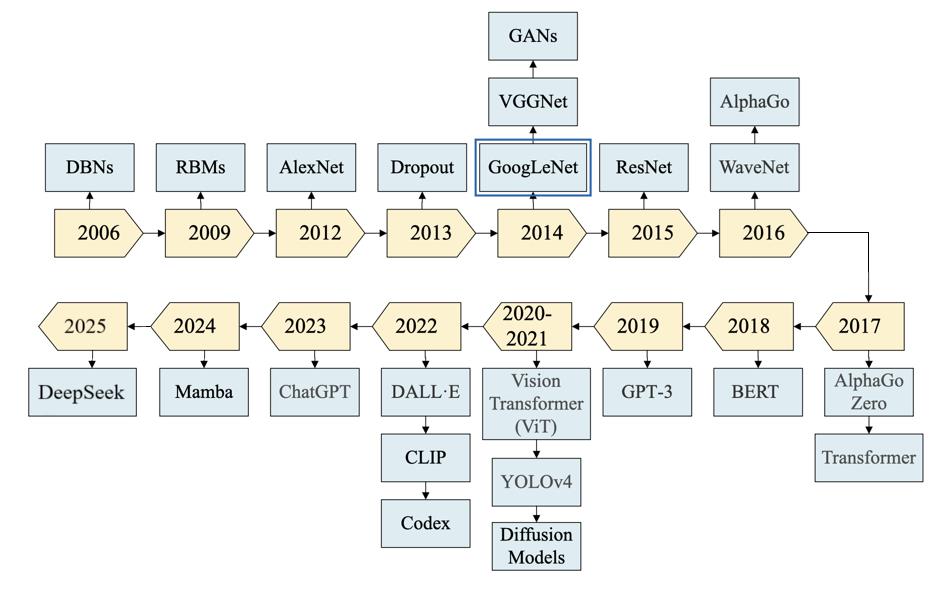
图1 深度学习网络架构发展史
Fig.1 Development history of deep learning network architecture
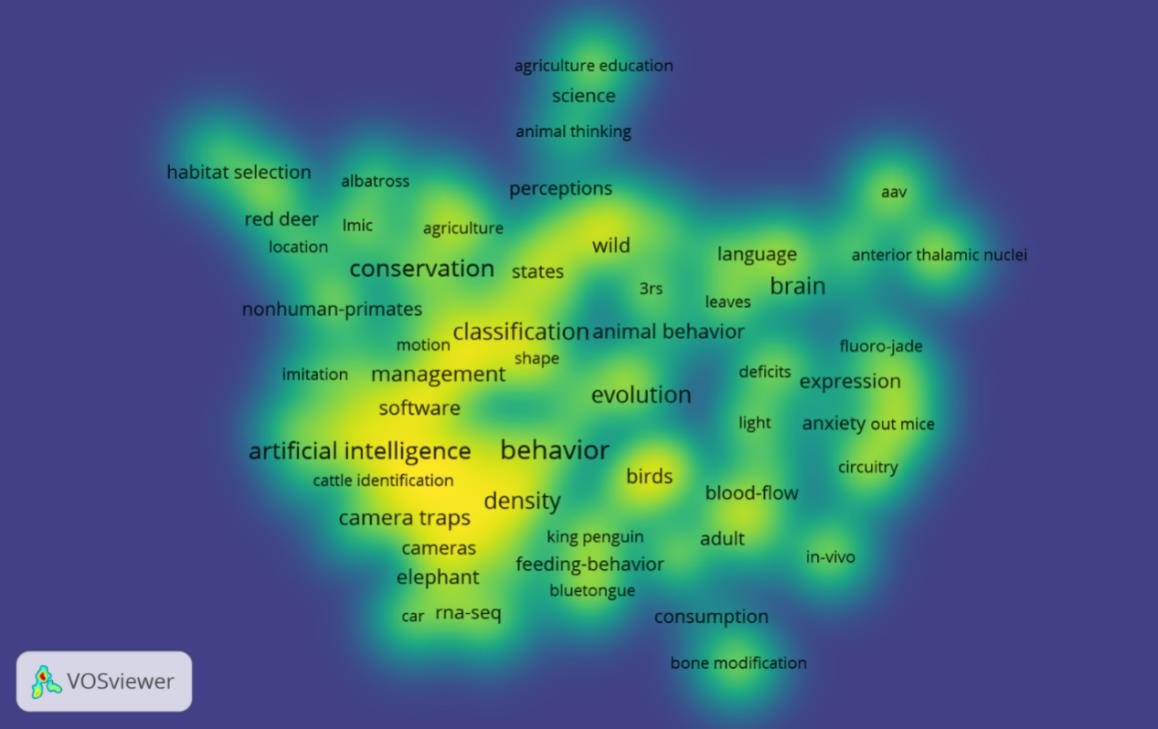
图2 深度学习文献可视化分析
Fig.2 Visualization analysis of deep learning literature
主要研究物种 Main research species | 研究模型 Research model | 模型准确度 Model accuracy | 研究优势 Research advantages | 文献 References |
|---|---|---|---|---|
| 鱼类 Fishs | ||||
蝴蝶鱼科 Chaetodontidae | FFDet | 61.40% | 设计新特征融合模块增强特征表示 Design a new feature fusion module to enhance feature representation | |
网纹宅泥鱼 Dascyllus reticulatus | PCANet | 77.27% | 缓解低分辨率问题 Relieve low resolution issues | |
鲣 Katsuwonus pelamis | ResNet50 | 93.30% | 使用混淆矩阵优化分类器 Optimizing classifiers using confusion matrices | |
小高鳍刺尾鱼 Zebrasoma scopas | Fast-RCNN | 98.57% | 引入随机梯度下降算法 Introducing random gradient descent algorithm | |
长棘光鳃鱼 Chromis chrysura | AlexNet | 99.50% | 结合迁移学习 Combining transfer learning | |
| 鸟类 Birds | ||||
绿纹霸鹟 Empidonax virescens | CNN | 88.33% | 结合图形处理单元技术并行处理数据 Parallel processing of data using graphics processing unit technology | |
| 鸡形目Galliformes | NicheNet | 90.23% | 结合生态位模型 Combining niche models | |
| 雀形目 Passeriformes | ResNet101 | 97.98% | 对网络模型进行预训练Pre training the network model | |
领月胸窜鸟 Melanopareia torquata | YOLOv5 | 98.49% | 迁移学习交叉验证 Cross validation of transfer learning | |
绿尾虹雉 Lophophorus lhuysii | YOLOv5 | 99.62% | 改进特征提取骨干网络和目标检测网络 Improve feature extraction backbone network and object detection network | |
| 兽类 Mammals | ||||
大熊猫 Ailuropoda melanoleuca | lnpectionV3、 MobileNet | 91.20% | 数据增强与迁移学习 Data augmentation and transfer learning | 宋益盛和 |
| 马鹿 Cervus elaphus | SA-ResNet | 92.20% | 引入自注意机制 Introducing self attention mechanism | |
| 长颈鹿 Giraffa camelopardalis | DenseNet-169 | 93.63% | 优化SSD模型 Optimize SSD model | |
非洲草原象 Loxodonta africana | ResNet-152 | 93.80% | — | |
| 野猪 Sus scrofa | Faster RCNN | 94.00% | 预训练 Pretraining | |
北极熊 Ursus maritimus | Xception | 95.63% | 引入通道注意力机制 Introducing channel attention mechanism | 倪黎和 |
| 猪獾 Arctonyx collaris | Swin-Transformer | 95.80% | — | |
虎东北亚种 Panthera tigris altaica | YOLO v3 | 96.00% | 基于darknet框架构建网络 Building a network based on the darknet framework | |
猞猁 Lynx lynx | VGG16 | 96.60% | 引入感兴趣区域克服复杂背景 Introducing regions of interest to overcome complex backgrounds | |
| 驼鹿 Alces alces | ResNet18 | 97.60% | — | |
鲸偶蹄目 Cetartiodactyla | Mask R-CNN | 98.00% | 添加新分支分割吸收图像特征 Add new branch segmentation to absorb image features | |
| 爬行类Reptiles | ||||
| 海龟属 Chelonia | VGG16-DenseNet 201 | 74.00% | 集成模型 Integrated model | |
蛇目 Serpentiformes | BRC-CNN | 89.06% | 卷积核数目加倍 Double the number of convolutional kernels | |
马来切喙鳄 Tomistoma schlegelii | CNN | 93.00% | Dropout技术防止过度拟合 Dropout technology prevents overfitting | |
鳄目 Crocodilia | YOLO-v5l | 96.24% | 背景消除的边界盒方法 Boundary box method for background elimination | |
| 昆虫类Insects | ||||
铜绿异丽金龟 Anomala corpulenta | CPAFNet | 92.26% | 引入三倍验证方法 Introducing triple validation method | |
草地贪夜蛾 Spodoptera frugiperda | T-CNN | 97.00% | 三个输入层同时输入 Three input layers simultaneously input | |
| 白蚁科 Termitidae | YOLO v3 | 97.00% | 采用级联方法 Adopting a cascading approach | |
鳞翅目 Lepidoptera | AlexNet | 100.00% | SVM作为分类方法 SVM as a classification method |
表1 深度学习在野生动物物种识别中的研究
Table 1 Research on deep learning in species identification of wildlife
主要研究物种 Main research species | 研究模型 Research model | 模型准确度 Model accuracy | 研究优势 Research advantages | 文献 References |
|---|---|---|---|---|
| 鱼类 Fishs | ||||
蝴蝶鱼科 Chaetodontidae | FFDet | 61.40% | 设计新特征融合模块增强特征表示 Design a new feature fusion module to enhance feature representation | |
网纹宅泥鱼 Dascyllus reticulatus | PCANet | 77.27% | 缓解低分辨率问题 Relieve low resolution issues | |
鲣 Katsuwonus pelamis | ResNet50 | 93.30% | 使用混淆矩阵优化分类器 Optimizing classifiers using confusion matrices | |
小高鳍刺尾鱼 Zebrasoma scopas | Fast-RCNN | 98.57% | 引入随机梯度下降算法 Introducing random gradient descent algorithm | |
长棘光鳃鱼 Chromis chrysura | AlexNet | 99.50% | 结合迁移学习 Combining transfer learning | |
| 鸟类 Birds | ||||
绿纹霸鹟 Empidonax virescens | CNN | 88.33% | 结合图形处理单元技术并行处理数据 Parallel processing of data using graphics processing unit technology | |
| 鸡形目Galliformes | NicheNet | 90.23% | 结合生态位模型 Combining niche models | |
| 雀形目 Passeriformes | ResNet101 | 97.98% | 对网络模型进行预训练Pre training the network model | |
领月胸窜鸟 Melanopareia torquata | YOLOv5 | 98.49% | 迁移学习交叉验证 Cross validation of transfer learning | |
绿尾虹雉 Lophophorus lhuysii | YOLOv5 | 99.62% | 改进特征提取骨干网络和目标检测网络 Improve feature extraction backbone network and object detection network | |
| 兽类 Mammals | ||||
大熊猫 Ailuropoda melanoleuca | lnpectionV3、 MobileNet | 91.20% | 数据增强与迁移学习 Data augmentation and transfer learning | 宋益盛和 |
| 马鹿 Cervus elaphus | SA-ResNet | 92.20% | 引入自注意机制 Introducing self attention mechanism | |
| 长颈鹿 Giraffa camelopardalis | DenseNet-169 | 93.63% | 优化SSD模型 Optimize SSD model | |
非洲草原象 Loxodonta africana | ResNet-152 | 93.80% | — | |
| 野猪 Sus scrofa | Faster RCNN | 94.00% | 预训练 Pretraining | |
北极熊 Ursus maritimus | Xception | 95.63% | 引入通道注意力机制 Introducing channel attention mechanism | 倪黎和 |
| 猪獾 Arctonyx collaris | Swin-Transformer | 95.80% | — | |
虎东北亚种 Panthera tigris altaica | YOLO v3 | 96.00% | 基于darknet框架构建网络 Building a network based on the darknet framework | |
猞猁 Lynx lynx | VGG16 | 96.60% | 引入感兴趣区域克服复杂背景 Introducing regions of interest to overcome complex backgrounds | |
| 驼鹿 Alces alces | ResNet18 | 97.60% | — | |
鲸偶蹄目 Cetartiodactyla | Mask R-CNN | 98.00% | 添加新分支分割吸收图像特征 Add new branch segmentation to absorb image features | |
| 爬行类Reptiles | ||||
| 海龟属 Chelonia | VGG16-DenseNet 201 | 74.00% | 集成模型 Integrated model | |
蛇目 Serpentiformes | BRC-CNN | 89.06% | 卷积核数目加倍 Double the number of convolutional kernels | |
马来切喙鳄 Tomistoma schlegelii | CNN | 93.00% | Dropout技术防止过度拟合 Dropout technology prevents overfitting | |
鳄目 Crocodilia | YOLO-v5l | 96.24% | 背景消除的边界盒方法 Boundary box method for background elimination | |
| 昆虫类Insects | ||||
铜绿异丽金龟 Anomala corpulenta | CPAFNet | 92.26% | 引入三倍验证方法 Introducing triple validation method | |
草地贪夜蛾 Spodoptera frugiperda | T-CNN | 97.00% | 三个输入层同时输入 Three input layers simultaneously input | |
| 白蚁科 Termitidae | YOLO v3 | 97.00% | 采用级联方法 Adopting a cascading approach | |
鳞翅目 Lepidoptera | AlexNet | 100.00% | SVM作为分类方法 SVM as a classification method |
主要研究物种 Main research species | 研究模型 Research model | 模型准确度 Model accuracy | 研究优势 Research advantages | 文献 References |
|---|---|---|---|---|
| 鱼类 Fishs | ||||
| 鲤形目 Cypriniformes | YOLOv4 | 90.00% | 融合FaceNet算法 Fusion of FaceNet algorithm | |
| YOLOv4 | 98.70% | 引入CBAM注意模块Introducing CBAM attention module | ||
| 鸟类 Birds | ||||
| 雀形目Passeriformes | VGG19 | 92.40% | 减轻过拟合以更新权重 Reduce overfitting to update weights | |
| 朱鹮Nipponia nippon | LVQ | 85.05% | 结合遗传算法解决初值敏感 Combining genetic algorithm to solve initial value sensitivity | |
| 兽类 Mammals | ||||
| 黑猩猩 Pan troglodytes | AlexNet | 80.30% | 避免后处理步骤 Avoiding post-processing steps | |
| VGG-M | 92.50% | 最小化身份识别的函数损失 Minimize the function loss of identity recognition | ||
| 金丝猴属 Rhinopithecus | Faster R-CNN | 85.80% | 引入TensorFlow深度学习框架 Introducing TensorFlow deep learning framework | |
| Faster R-CNN | 92.01% | 全天候实时识别 All-weather real-time recognition | ||
| GKP-Net | 92.60% | 两种不同尺度图像指导分类 Two different scale images guide classification | ||
| AKP-CNN | 93.46% | 结合注意力机制 Combining attention mechanisms | ||
| SP-BCNN | 93.60% | 结合自步学习策略 Combining self paced learning strategies | ||
| HE-Net | 96.56% | 结合集成学习与度量学习 Combining ensemble learning and metric learning | ||
大熊猫 Ailuropoda melanoleuca | YOLOv3、 Mask R-CNN | 92.30% | 双模型分别识别不同部位后融合 Dual models identify different parts separately and fuse them | |
| VGG | 95.00% | 使用全连接层对特征进行分类 Using fully connected layers to classify features | ||
| Faster R-CNN | 96.27% | 集成对象检测、序列深度匹配等多模式融合算法 Integrated object detection,sequence depth matching,and other multimodal fusion algorithms | ||
| YOLOv5 | 98.20% | 细粒度多模态融合检测 Fine grained multimodal fusion detection | ||
| 雪豹 Panthera uncia | ResNeSt50d | 97.00% | 引入关键特征法 Introduction of key feature method | |
豹印支亚种 Panthera pardus delacouri | CNN | 99.30% | 引入Dropout防止过拟合 Introducing Dropout to prevent overfitting | |
虎东北亚种 Panthera tigris altaica | ResNet34 | 86.28% | 单次多盒目标检测分割提取特征 Single shot multi box object detection segmentation and feature extraction | |
| ResNet34 | 95.55% | 结合多层感知机模型 Combining multi-layer perceptron models | ||
北太平洋露脊鲸 Eubalaena japonica | CNN | 87.44% | 完全自动化 Fully automated | |
| 昆虫类Insects | ||||
| 双翅目 Diptera | FFCNN | 94.03% | 多网络集成 Multi network integration |
表2 深度学习在野生动物个体身份识别中的研究
Table 2 Research on deep learning in individual identity recognition of wildlife
主要研究物种 Main research species | 研究模型 Research model | 模型准确度 Model accuracy | 研究优势 Research advantages | 文献 References |
|---|---|---|---|---|
| 鱼类 Fishs | ||||
| 鲤形目 Cypriniformes | YOLOv4 | 90.00% | 融合FaceNet算法 Fusion of FaceNet algorithm | |
| YOLOv4 | 98.70% | 引入CBAM注意模块Introducing CBAM attention module | ||
| 鸟类 Birds | ||||
| 雀形目Passeriformes | VGG19 | 92.40% | 减轻过拟合以更新权重 Reduce overfitting to update weights | |
| 朱鹮Nipponia nippon | LVQ | 85.05% | 结合遗传算法解决初值敏感 Combining genetic algorithm to solve initial value sensitivity | |
| 兽类 Mammals | ||||
| 黑猩猩 Pan troglodytes | AlexNet | 80.30% | 避免后处理步骤 Avoiding post-processing steps | |
| VGG-M | 92.50% | 最小化身份识别的函数损失 Minimize the function loss of identity recognition | ||
| 金丝猴属 Rhinopithecus | Faster R-CNN | 85.80% | 引入TensorFlow深度学习框架 Introducing TensorFlow deep learning framework | |
| Faster R-CNN | 92.01% | 全天候实时识别 All-weather real-time recognition | ||
| GKP-Net | 92.60% | 两种不同尺度图像指导分类 Two different scale images guide classification | ||
| AKP-CNN | 93.46% | 结合注意力机制 Combining attention mechanisms | ||
| SP-BCNN | 93.60% | 结合自步学习策略 Combining self paced learning strategies | ||
| HE-Net | 96.56% | 结合集成学习与度量学习 Combining ensemble learning and metric learning | ||
大熊猫 Ailuropoda melanoleuca | YOLOv3、 Mask R-CNN | 92.30% | 双模型分别识别不同部位后融合 Dual models identify different parts separately and fuse them | |
| VGG | 95.00% | 使用全连接层对特征进行分类 Using fully connected layers to classify features | ||
| Faster R-CNN | 96.27% | 集成对象检测、序列深度匹配等多模式融合算法 Integrated object detection,sequence depth matching,and other multimodal fusion algorithms | ||
| YOLOv5 | 98.20% | 细粒度多模态融合检测 Fine grained multimodal fusion detection | ||
| 雪豹 Panthera uncia | ResNeSt50d | 97.00% | 引入关键特征法 Introduction of key feature method | |
豹印支亚种 Panthera pardus delacouri | CNN | 99.30% | 引入Dropout防止过拟合 Introducing Dropout to prevent overfitting | |
虎东北亚种 Panthera tigris altaica | ResNet34 | 86.28% | 单次多盒目标检测分割提取特征 Single shot multi box object detection segmentation and feature extraction | |
| ResNet34 | 95.55% | 结合多层感知机模型 Combining multi-layer perceptron models | ||
北太平洋露脊鲸 Eubalaena japonica | CNN | 87.44% | 完全自动化 Fully automated | |
| 昆虫类Insects | ||||
| 双翅目 Diptera | FFCNN | 94.03% | 多网络集成 Multi network integration |
主要研究物种 Main research species | 研究模型 Research model | 模型准确度 Model accuracy | 研究优势 Research advantages | 文献 References |
|---|---|---|---|---|
| 鱼类 Fishs | ||||
三尖鱾 Girella tricuspidata | Mask R-CNN | 95.40% | — | |
沙丁鱼 Sardina pilchardus | MCNN | 90.14% | 冗余裁剪 Redundant cropping | |
仿刺参 Stichopus japonicus | YOLO v2 | 76.30% | 多尺度训练 Multiscale training | |
| 鸟类 Birds | ||||
野火鸡 Meleagris gallopavo | Mask R-CNN | 86.55% | 引入数据关联与过滤算法 Introducing data association and filtering algorithms | |
紫翅椋鸟 Sturnus vulgaris | Faster-CNN | 94.00% | 卷积滤波器 Convolutional filter | |
北极鸥 Larus hyperboreus | CNN | 95.00% | 系统特征学习 System feature learning | |
| 兽类 Mammals | ||||
非洲草原象 Loxodonta africana | Fast R-CNN | 75.00% | 能够处理复杂异质景观背景 Capable of handling complex heterogeneous landscape backgrounds | |
斑纹角马 Connochaetes taurinus | YOLOv3 | 减少锚框数量、使用迁移学习 Reduce the number of anchor boxes and use transfer learning | ||
偶蹄目 Artiodactyla | Mask-R-CNN | 92.80% | 提取掩膜转换为轮廓向量 Extract masks and convert them into contour vectors | |
| 昆虫类 Insects | ||||
红脂大小蠹 Dendroctonus valens | Fast R-CNN | 74.60% | k-means锚优化 k-means anchor optimization | |
飞虱科 Delphacidae | CornerNet | 95.53% | 使用阈值过滤等检测框抑制方法 Using threshold filtering and other detection box suppression methods | |
草地贪夜蛾 Spodoptera frugiperda | YOLO-V5 | 96.84% | 清除边缘残缺目标 Clear edge incomplete targets |
表3 深度学习在野生动物个体计数中的研究
Table 3 Research on deep learning in individual counting of wildlife
主要研究物种 Main research species | 研究模型 Research model | 模型准确度 Model accuracy | 研究优势 Research advantages | 文献 References |
|---|---|---|---|---|
| 鱼类 Fishs | ||||
三尖鱾 Girella tricuspidata | Mask R-CNN | 95.40% | — | |
沙丁鱼 Sardina pilchardus | MCNN | 90.14% | 冗余裁剪 Redundant cropping | |
仿刺参 Stichopus japonicus | YOLO v2 | 76.30% | 多尺度训练 Multiscale training | |
| 鸟类 Birds | ||||
野火鸡 Meleagris gallopavo | Mask R-CNN | 86.55% | 引入数据关联与过滤算法 Introducing data association and filtering algorithms | |
紫翅椋鸟 Sturnus vulgaris | Faster-CNN | 94.00% | 卷积滤波器 Convolutional filter | |
北极鸥 Larus hyperboreus | CNN | 95.00% | 系统特征学习 System feature learning | |
| 兽类 Mammals | ||||
非洲草原象 Loxodonta africana | Fast R-CNN | 75.00% | 能够处理复杂异质景观背景 Capable of handling complex heterogeneous landscape backgrounds | |
斑纹角马 Connochaetes taurinus | YOLOv3 | 减少锚框数量、使用迁移学习 Reduce the number of anchor boxes and use transfer learning | ||
偶蹄目 Artiodactyla | Mask-R-CNN | 92.80% | 提取掩膜转换为轮廓向量 Extract masks and convert them into contour vectors | |
| 昆虫类 Insects | ||||
红脂大小蠹 Dendroctonus valens | Fast R-CNN | 74.60% | k-means锚优化 k-means anchor optimization | |
飞虱科 Delphacidae | CornerNet | 95.53% | 使用阈值过滤等检测框抑制方法 Using threshold filtering and other detection box suppression methods | |
草地贪夜蛾 Spodoptera frugiperda | YOLO-V5 | 96.84% | 清除边缘残缺目标 Clear edge incomplete targets |
主要研究物种 Main research species | 研究方向 Research direction | 研究优势 Research advantages | 文献 References |
|---|---|---|---|
猎豹 Acinonyx jubatus | 2D pose 3D pose | 多视图同步高速相机系统和DeepLabCut进行2D注释 Multi view synchronized high-speed camera system and DeepLabCut for 2D annotation | |
| 3D mesh | 快速交互式动态关节形状重建 Fast interactive dynamic joint shape reconstruction | ||
猕猴 Macaca mulatta | 3D pose | 增强注释数据进行多视图3D重建 Enhance annotation data for multi view 3D reconstruction | |
| 3D pose | 利用多视角图像流和有限标签数据训练关键点检测器 Training keypoint detectors using multi view image streams and limited labeled data | ||
细纹斑马 Equus grevyi | 3D mesh | 结合SMAL动物模型与基于网络的回归流程 Combining SMAL animal model with network-based regression process | |
沙漠蝗虫 Schistocerca gregaria | 2D pose | 使用Stack DenseNet和基于GPU的快速峰值检测方法 Using Stack DenseNet and GPU based fast peak detection method | |
双峰驼 Camelus bactrianus | 3D mesh | 多模态热图回归和遗传算法优化二维到三维的关节对应关系 Multimodal heat map regression and genetic algorithm optimization of joint correspondence from 2D to 3D | |
狮 Panthera leo | 3D mesh | 结合部件形状模型、统计形状模型和姿势归一化 Combining component shape models,statistical shape models,and pose normalization | |
| 3D mesh | 少量图像帧中精确捕捉动物的详细3D形状,并提取真实纹理图 Accurately capturing detailed 3D shapes of animals in a small number of image frames and extracting real texture maps | ||
白犀 Ceratotherium simum | 2D pose | 跨领域学习并通过渐进式优化伪标签 Cross disciplinary learning and progressive pseudo label optimization | |
非洲象 Loxodonta africana | 2D pose | 时空一致性约束的半监督学习方法 Semi supervised learning method with spatiotemporal consistency constraints | |
长颈鹿 Giraffa camelopardalis | 3D mesh | 实现关节对象的实时、真实感三维建模 Real time and realistic 3D modeling of joint objects | |
| 3D mesh | 减少点对点对应关系的依赖 Reduce dependence on point-to-point correspondence relationships |
表4 深度学习在野生动物行为姿态估计识别中的研究
Table 4 Research on deep learning in wildlife behavior attitude estimation and recognition
主要研究物种 Main research species | 研究方向 Research direction | 研究优势 Research advantages | 文献 References |
|---|---|---|---|
猎豹 Acinonyx jubatus | 2D pose 3D pose | 多视图同步高速相机系统和DeepLabCut进行2D注释 Multi view synchronized high-speed camera system and DeepLabCut for 2D annotation | |
| 3D mesh | 快速交互式动态关节形状重建 Fast interactive dynamic joint shape reconstruction | ||
猕猴 Macaca mulatta | 3D pose | 增强注释数据进行多视图3D重建 Enhance annotation data for multi view 3D reconstruction | |
| 3D pose | 利用多视角图像流和有限标签数据训练关键点检测器 Training keypoint detectors using multi view image streams and limited labeled data | ||
细纹斑马 Equus grevyi | 3D mesh | 结合SMAL动物模型与基于网络的回归流程 Combining SMAL animal model with network-based regression process | |
沙漠蝗虫 Schistocerca gregaria | 2D pose | 使用Stack DenseNet和基于GPU的快速峰值检测方法 Using Stack DenseNet and GPU based fast peak detection method | |
双峰驼 Camelus bactrianus | 3D mesh | 多模态热图回归和遗传算法优化二维到三维的关节对应关系 Multimodal heat map regression and genetic algorithm optimization of joint correspondence from 2D to 3D | |
狮 Panthera leo | 3D mesh | 结合部件形状模型、统计形状模型和姿势归一化 Combining component shape models,statistical shape models,and pose normalization | |
| 3D mesh | 少量图像帧中精确捕捉动物的详细3D形状,并提取真实纹理图 Accurately capturing detailed 3D shapes of animals in a small number of image frames and extracting real texture maps | ||
白犀 Ceratotherium simum | 2D pose | 跨领域学习并通过渐进式优化伪标签 Cross disciplinary learning and progressive pseudo label optimization | |
非洲象 Loxodonta africana | 2D pose | 时空一致性约束的半监督学习方法 Semi supervised learning method with spatiotemporal consistency constraints | |
长颈鹿 Giraffa camelopardalis | 3D mesh | 实现关节对象的实时、真实感三维建模 Real time and realistic 3D modeling of joint objects | |
| 3D mesh | 减少点对点对应关系的依赖 Reduce dependence on point-to-point correspondence relationships |
| Akcay H G, Kabasakal B, Aksu D, Demir N, ÖZ M, Erdoğan A,2020. Automated bird counting with deep learning for regional bird distribution mapping[J]. Animals,10(7):1027.DOI:10.3390/ani10071207 . | |
| Annesa O D, Kartiko C, Prasetiadi A,2020.Identification of reptile species using convolutional neural networks(CNN)[J]. Rekayasa Sistem Dan Teknologi Informasi,4(5):899‑906. | |
| Antoine M D, Marion V, Georgina B, Frederic T, Beata U,2021.Machine learning is a powerful tool to study the effect of cancer on species and ecosystems[J]. Methods in Ecology and Evolution,12(12):2310‑2323.DOI:10.29207/resti.v4i5.2282 . | |
| Bala P C, Eisenreich B R, Yoo S B, Hayden B Y, Park H S, Zimmermann J,2020. Automated markerless pose estimation in freely moving macaques with OpenMonkeyStudio[J]. Nature Communications,11(1).DOI:10.1038/s41467-020-18441-5 . | |
| Bengio Y, Lamblin P, Popovici D, Larochelle H,2006.Greedy layer‑wise training of deep networks[C].Neural Information Processing Systems 19. DOI:10.7551/mitpress/7503.003.0024 . | |
| Bertasius G, Wang H, Torresani L,2021. Is space‑time attention all you need for video understanding?[C]. International Conference on Machine Learning.DOI:10.48550/arXiv.2102.05095 . | |
| Bi D X, Chen D L, Chen G T,et al.,2024. DeepSeek LLM:scaling open‑source language models with longtermism[J/OL]. arXiv preprint arXiv:. | |
| Biggs B, Boyne O, Charles J, Fitzgibbon A, Cipolla R,2020.Who left the dogs out? 3D animal reconstruction with expectation maximization in the loop[C]. Computer Vision‑ECCV 2020. DOI:10.1007/978-3-030-58621-8_12 . | |
| Biggs B, Roddick T, Fitzgibbon A, Cipolla R,2019. Creatures great and SMAL:recovering the shape and motion of animals from video[C]. Computer Vision ‑ ACCV 2018. DOI:10.1007/978-3-030-20873-8_1 . | |
| Bochkovskiy A, Wang C Y, Liao H Y M,2020. YOLOv4:optimal speed and accuracy of object detection[J/OL]. arXiv preprint arXiv:. | |
| Bogucki R, Cygan M, Khan C B, Klimek M, Milczek J K, Mucha M,2018. Applying deep learning to right whale photo identification[J]. Conservation Biology,33(3):676‑684. | |
| Boudaoud L B, Maussang F, Garello R, Chevallier A,2019. Marine bird detection based on deep learning using high‑resolution aerial images[C]. Oceans2019‑Marseille. DOI:10.1109/OCEANSE.2019.8867242 . | |
| Brust C A, Burghardt T, Groenenberg M, KäDing C, KüHl H S, Manguette M L, Denzler J,2017. Towards automated visual monitoring of individual gorillas in the wild[C]. 2017 IEEE International Conference on Computer Vision Workshops(ICCVW). DOI:10.1109/ICCVW.2017.333,2820‑2830. | |
| Cao J K, Tang H Y, Fang H S, Shen X Y, Lu C, Tai Y W,2019. Cross‑domain adaptation for animal pose estimation[C]. 2019 IEEE/CVF International Conference on Computer Vision(ICCV). DOI:10.1109/ICCV.2019.00959 . | |
| Cao Y, Xie Z D, Liu B, Lin Y T, Zhang Z, Hu H,2020. Parametric instance classification for unsupervised visual feature learning[J]. Advances in Neural Information Processing Systems,33:15614‑15624. | |
| Cao Z, Hidalgo G, Simon T, Wei S E, Sheikh Y,2021. OpenPose:realtime multi‑person 2D pose estimation using part affinity fields[J]. Transactions on Pattern Analysis and Machine Intelligence,43(1):172‑186.DOI:10.1109/TPAMI.2019. 2929257 . | |
| Carl C, SchöNfeld F, Profft I, Klamm A, Landgraf D,2020. Automated detection of European wild mammal species in camera trap images with an existing and pre‑trained computer vision model[J]. European Journal of Wildlife Research,66(4):62.DOI:10.1007/s10344-020-01404-y . | |
| Chen C H, Ramanan D,2017. 3D human pose estimation = 2D pose estimation + matching[C]. 2017 IEEE Conference on Computer Vision and Pattern Recognition(CVPR). DOI:10.1109/CVPR.2017.610 . | |
| Chen C H, Tyagi A, Agrawal A, Drover D, Mv R, Stojanov S, Rehg J M,2019. Unsupervised 3D pose estimation with geometric self‑supervision[C]. 2019 IEEE/CVF Conference on Computer Vision and Pattern Recognition(CVPR). DOI:10.1109/CVPR.2019.00586 . | |
| Chen P, Swarup P, Matkowski W M, Kong A W, Han S, Zhang Z, Rong H,2020. A study on giant panda recognition based on images of a large proportion of captive pandas[J]. Ecology and Evolution,10(7):3561‑3573.DOI:10.1002/ece3.6152 . | |
| Cui Y, Jia M L, Lin T Y, Song Y, Belongie S J,2019. Class‑balanced loss based on effective number of samples[C]. 2019 IEEE/CVF Conference on Computer Vision and Pattern Recognition(CVPR). DOI:10.1109/CVPR.2019.00949 . | |
| Dai D M, Deng C Q, Zhao C G, Xu R X, Gao H Z, Chen D L, Li J S, Zeng W D, Yu X K, Wu Y, Xie Z D, Li Y K, Huang P P, Luo F L, Ruan C, Sui Z F, Liang W F,2024. DeepSeekMoE:towards ultimate expert specialization in mixture‑of‑experts language models[C]. 62nd Annual Meeting of the Association for Computational Linguistics. DOI:10.18653/v1/2024.acl-long.70 . | |
| Deepseek‑Ai, Liu A X, Feng B,et al., 2024. DeepSeek‑V3 technical report[J/OL]. arXiv preprint arXiv:. | |
| Deepseek‑Ai, Guo D Y, Yang D J,et al.,2025. DeepSeek‑R1:incentivizing reasoning capability in LLMs via reinforcement learning[J/OL]. arXiv preprint arXiv:. | |
| Desai B, Patel A J, Patel V, Shah S, Raval M S, Ghosal R,2022. Identification of free‑ranging mugger crocodiles by applying deep learning methods on UAV imagery[J]. Ecological Informatics,72:101874.DOI:10.1016/j.ecoinf.2022.101874 . | |
| Dhariwal P, Nichol A,2021. Diffusion models beat GANs on image synthesis[C]. Neural Information Processing Systems 34(NeurIPS 2021). DOI:10.48550/arXiv.2105.05233 . | |
| Ditria E M, Lopez‑Marcano S, Sievers M, Jinks E L, Brown C J, Connolly R M,2020. Automating the analysis of fish abundance using object detection:optimizing animal ecology with deep learning[J]. Frontiers in Marine Science,7:429.DOI:10.3389/fmars.2020.00429 . | |
| Donahue J, Hendricks L A, Rohrbach M, Venugopalan S, Guadarrama S, Saenko K, Darrell T,2017. Long‑term recurrent convolutional networks for visual recognition and description[J]. Transactions on Pattern Analysis and Machine Intelligence,39(4):677‑691.DOI:10.1109/TPAMI.2016.2599174 . | |
| Dosovitskiy A, Beyer L, Kolesnikov A, Weissenborn D, Zhai X H, Unterthiner T, Dehghani M, Minderer M, Heigold G, Gelly S, Uszkoreit J, Houlsby N,2021. An image is worth 16x16 words:transformers for image recognition at scale[J/OL]. Computing Research Repository,arXiv preprint arXiv:. | |
| Duporge I, Isupova O, Reece S, Macdonald D W, Wang T J,2021. Using very high‑resolution satellite imagery and deep learning to detect and count African elephants in heterogeneous landscapes[J]. Remote Sensing in Ecology and Conservation,7(3):369‑381.DOI:10.1002/rse2.195 . | |
| Egmont P M, Ridder D D, Handels H,2002. Image processing with neural networks‑a review[J]. Pattern Recognition,35(10):2279‑2301.DOI:10.1016/s0031-3203(01)00178-9 . | |
| Fabrizio S, Alessandro T, Julio B, Guillermo B, Fernando H,2019. Reliable methods for identifying animal deaths in GPS‑ and satellite‑tracking data:review,testing and calibration[J]. Journal of Applied Ecology,56(3):562‑572.DOI:10.1111/1365-2664.13294 . | |
| Fan Z, Liu Y, Xovee X, Goce T,2021. Decoupling representation and regressor for long‑tailed information cascade prediction[C]. Annual International ACM SIGIR Conference on Research and Development in Information Retrieval(SIGIR)(2021). DOI:10.1145/3404835.3463104 . | |
| Faurina R, Wijanarko A, Heryuanti A F, Ishak S I, Agustian I. 2023. Comparative study of ensemble deep learning models to determine the classification of turtle species[J]. Computer Science and Information Technologies,4(1):24‑32. | |
| Feng L Q, Zhao Y Q, Sun Y C, Zhao W X, Tang J X,2021. Action recognition using a spatial‑temporal network for wild felines[J]. Animals,11(2):485.DOI:10.3390/ani11020485 . | |
| Ferreira A C, Silva L R, Renna F, Brandl H B, Renoult J P, Farine D R, Covas R, Doutrelant C,2020. Deep learning‑based methods for individual recognition in small birds[J]. Methods in Ecology and Evolution,11(9):1072‑1085.DOI:10.1111/2041-210X.13436 . | |
| Freytag A, Rodner E, Simon M, Loos A, KüHl H S, Denzler J,2016. Chimpanzee faces in the wild:log‑euclidean CNNs for predicting identities and attributes of primates[J]. German Conference on Pattern Recognition,9796:51‑63.DOI:10.1007/978-3-319-45886-1_5 . | |
| Gao C Q, Wu J F, Yu H, Yin J H, Guo S H,2022. FIRN:a novel fish individual recognition method with accurate detection and attention mechanism[J]. Electronics,11(21):3459.DOI:10.3390/electronics11213459 . | |
| Gavali P R, Banu J S,2020. Bird species identification using deep learning on GPU platform[C]. 2020 International Conference on Emerging Trends in Information Technology and Engineering(ic‑ETITE). DOI:10.1109/ic-ETITE47903.2020.85 . | |
| Glorot X, Bengio Y,2010. Understanding the difficulty of training deep feedforward neural networks[C]. Journal of Machine Learning Research Proceedings of the 13th International Conference on Artificial Intelligence and Statistics(AISTATS). DOI:10.5555/3104322.3104425 . | |
| Goodfellow I, Pouget‑Abadie J, Mirza M, Xu B, Warde‑Farley D, Ozair S, Courville A, Bengio Y,2020. Generative adversarial networks[J]. Communications of the ACM,63(11):139‑144. | |
| Graving J M, Chae D, Naik H, Li L, Koger B, Costelloe B R, Couzin I D,2019. DeepPoseKit,a software toolkit for fast and robust animal pose estimation using deep learning[J]. eLife,8. DOI:10.7554/eLife.47994.DOI:10.7554/eLife.47994 . | |
| Gray P C, Bierlich K C, Mantell S A, Friedlaender A S, Goldbogen J A, Johnston D W,2019. Drones and convolutional neural networks facilitate automated and accurate cetacean species identification and photogrammetry[J]. Methods in Ecology and Evolution,10(9):1490‑1500.DOI:10.1111/2041-210X.13246 . | |
| Guo Q W, Wang C T, Xiao D Q, Huang Q,2024. A lightweight open‑world pest image classifier using ResNet8‑based matching network and NT‑Xent loss function[J]. Expert Systems with Applications,237:121395.DOI:10.1016/j.eswa.2023.121395 . | |
| Guo S T, Xu P F, Miao Q G, Shao G F, Chapman C A, Chen X J, He G, Fang D Y, Zhang H, Sun Y W, Shi Z H, Li B G,2020. Automatic identification of individual primates with deep learning techniques[J]. iScience,23(8):DOI:org/10.1016/j.isci.2020.101412. | |
| Guo Y M, Liu Y, Oerlemans A, Lao S Y, Wu S, Lew M S,2016. Deep learning for visual understanding:a review[J]. Neurocomputing,187:27‑48.DOI:10.1016/j.neucom.2015.09.116 . | |
| Harrison D J, Chapin T G,1998. Extent and connectivity of habitat for wolves in eastern north America[J]. Wildlife Society Bulletin,26(4):767‑775. | |
| He K M, Zhang X Y, Ren S Q, Sun J,2016. Deep residual learning for image recognition[C]. 2016 IEEE Conference on Computer Vision and Pattern Recognition(CVPR). DOI:10.1109/CVPR.2016.90 . | |
| Hebert P D N, Gregory T R,2005. The promise of DNA barcoding for taxonomy[J]. Systematic Biology,54(5):852‑859.DOI:10.1080/10635150500354886 . | |
| Hinton G E, Salakhutdinov R R,2006. Reducing the dimensionality of data with neural networks[J]. Science,313(5786):504‑507.DOI:10.1126/science.1127647 . | |
| Hinton G E, Srivastava N, Krizhevsky A, Sutskever I, Salakhutdinov R R,2012. Improving neural networks by preventing co‑adaptation of feature detectors[J/OL]. Neural and Evolutionary Computing,arXiv preprint arXiv:. | |
| Hou J, He Y X, Yang H B, Connor T, Gao J, Wang Y J, Zeng Y C, Zhang J D, Huang J Y, Zheng B C, Zhou S Q,2020. Identification of animal individuals using deep learning:a case study of giant panda[J]. Biological Conservation,242:108414. DOI:10.1016/j.biocon.2020.108414 . | |
| Howard A G, Zhu M L, Chen B, Kalenichenko D, Wang W, Weyand T, Andreetto M, Adam H,2017. Mobilenets:efficient convolutional neural networks for mobile vision applications[J]. Computer Vision and Pattern Recognition,arXiv preprint arXiv:. | |
| Huang Y P, Basanta H,2021. Recognition of endemic bird species using deep learning models[J]. IEEE Access,9:102975‑102984.DOI:10.1109/ACCESS.2021.3098532 . | |
| Iskakov K, Burkov E, Lempitsky V, Malkov Y,2019. Learnable triangulation of human pose[C]. 2019 IEEE/CVF International Conference on Computer Vision(ICCV). DOI:10.1109/ICCV.2019.00781 . | |
| Jiang L, Lee C, Teotia D, Ostadabbas S,2022. Animal pose estimation:a closer look at the state‑of‑the‑art,existing gaps and opportunities[J]. Computer Vision and Image Understanding,222:103483. DOI:10.1016/j.cviu.2022.103483 . | |
| Jin L L, Liang H,2017. Deep learning for underwater image recognition in small sample size situations[C]. Oceans2017‑ Aberdeen. DOI:10.1109/OCEANSE.2017.8084645 . | |
| Joe Y N, Matthew J H, Sudheendra V, Oriol V, Rajat M, George T,2015. Beyond short snippets:deep networks for video classification[C]. 2015 IEEE Conference on Computer Vision and Pattern Recognition(CVPR). DOI:10.1109/CVPR.2015. 7299101 . | |
| Joska D, Clark L, Muramatsu N, Jericevich R, Nicolls F, Mathis A, Mathis M W, Patel A,2021. AcinoSet:a 3D pose estimation dataset and baseline models for cheetahs in the wild[C]. 2021 IEEE International Conference on Robotics and Automation(ICRA). DOI:10.1109/ICRA48506.2021.9561338 . | |
| Kanopoulos N, Vasanthavada N, Baker R,1988. Design of an image edge detection filter using the sobel operator[J]. IEEE Journal of Solid‑State Circuits,23(2):358‑367.DOI:10.1109/4.996 . | |
| Kassim Y M, Byrne M E, Burch C G, Mote K, Hardin J B, Larsen D R, Palaniappan K,2020. Small object bird detection in infrared drone videos using Mask R‑CNN deep learning[J]. Electronic Imaging,32(8):85‑1‑85‑8. | |
| Kekre H B, Thepade S D, Banura V K,2011. Amelioration of walsh‑hadamard texture patterns based image retrieval using HSV color space[J]. International Journal of Computer Science and Information Security,9(3):64‑69. | |
| Kocon J, Cichecki I, Kaszyca O, Kochanek M, Szydlo D, Baran J, Bielaniewicz J, Gruza M, Janz A, Kanclerz K, Kocon A, Koptyra B, Kowszewicz W M, Milkowski P, Oleksy M, Piasecki M, Radlinski L, Wojtasik K, Wozniak S, Kazienko P,2023. ChatGPT:jack of all trades,master of none[J]. Information Fusion,99:101861. DOI:10.1016/j.inffus.2023.101861 . | |
| Krizhevsky A, Sutskever I, Hinton G E,2017. ImageNet classification with deep convolutional neural networks[J]. Communications of the ACM,60(6):84‑90.DOI:10.1145/3065386 . | |
| Lecun Y, Bengio Y, Hinton G,2015. Deep learning[J]. Nature,521(7553):436‑444.DOI:10.1038/nature14539 . | |
| Ledig C, Theis L, Huszar F, Caballero J, Cunningham A, Acosta A, Aitken A, Tejani A, Totz J, Wang Z H, Shi W Z,2017. Photo‑realistic single image super‑resolution using a generative adversarial network[C]. 2017 IEEE Conference on Computer Vision and Pattern Recognition(CVPR). DOI:10.1109/CVPR.2017.19 . | |
| Lewis M, Liu Y H, Goyal N, Ghazvininejad M, Mohamed A, Levy O, Stoyanov V, Zettlemoyer L,2019. BART:denoising sequence‑to‑sequence pre‑training for natural language generation,translation,and comprehension[C]. 58th Annual Meeting of the Association for Computational Linguistics. DOI:10.18653/v1/2020.acl-main.703 . | |
| Lin T Y, Dollar P, Girshick R, He K M, Hariharan B, Belongie S,2017. Feature pyramid networks for object detection[C]. 2017 IEEE Conference on Computer Vision and Pattern Recognition(CVPR). DOI:10.1109/CVPR.2017.106 . | |
| Liu Y B, Han T T, Gao Z,2020. Pairwise generalization network for cross‑domain image recognition[J]. Neural Processing Letters,52(2):1023‑1041.DOI:10.1007/s11063-019-10041-9 . | |
| Liu Z W, Miao Z Q, Zhan X H, Wang J Y, Gong B Q, Yu S X,2019. Large‑scale long‑tailed recognition in an open world[C]. 2019 IEEE/CVF Conference on Computer Vision and Pattern Recognition(CVPR). DOI:10.1109/CVPR.2019.00264 . | |
| Luo W, Jin Y T, Li X Q, Liu K,2021. Application of deep learning in remote sensing monitoring of large herbivores‑a case study in Qinghai Tibet Plateau[J]. Pakistan Journal of Zoology,54(1):413‑421.DOI:10.17582/journal.pjz/20191205021259 . | |
| Man T, Shen H W, Jin X L, Cheng X Q,2017. Cross‑domain recommendation:an embedding and mapping approach[C]. 26th International Joint Conference on Artificial Intelligence Main track. DOI:10.24963/ijcai.2017/343,2464‑2470. | |
| Marton F, Säljö R,1976. On qualitative differences in learning:I‑outcome and process[J]. British Journal of Educational Psychology,46(1):4‑11. | |
| Miao Z Q, Liu Z W, Gaynor K M, Palmer M S, Yu S X, Getz W M,2021. Iterative human and automated identification of wildlife images[J]. Nature Machine Intelligence,3(10):885‑895.DOI:10.1038/s42256-021-00393-0 . | |
| Morrison M L, Mathewson H A,2015. Wildlife habitat conservation:concepts,challenges,and solutions[M]. Baltimore:Johns Hopkins University Press,53. | |
| Mu J T, Qiu W C, Hager G, Yuille A,2020. Learning from synthetic animals[C]. 2020 IEEE/CVF Conference on Computer Vision and Pattern Recognition(CVPR). DOI:10.1109/CVPR42600.2020.01240 . | |
| Najafabadi M M, Villanustre F, Khoshgoftaar T M, Seliya N, Wald R, Muharemagic E A,2015. Deep learning applications and challenges in big data analytics[J]. Journal of Big Data,2(1):1‑21.DOI:10.1186/s40537-014-0007-7 . | |
| Nie J, Anwer R M, Cholakkal H, Khan F S, Pang Y W, Shao L,2019. Enriched feature guided refinement network for object detection[C]. 2019 IEEE/CVF International Conference on Computer Vision(ICCV). DOI:10.1109/ICCV.2019.00963 . | |
| Norouzzadeh M S, Morris D, Beery S, Joshi N, Jojic N, Clune J,2021. A deep active learning system for species identification and counting in camera trap images[J]. Methods in Ecology and Evolution,12(1):150‑161.DOI:10.1111/2041-210X.13504 . | |
| Norouzzadeh M S, Nguyen A M, Kosmala M, Swanson A, Palmer M S, Packer C, Clune J,2017. Automatically identifying,counting,and describing wild animals in camera‑trap images with deep learning[J]. Proceedings of the National Academy of Sciences,115(25):E5716‑E5725.DOI:10.1073/pnas. 1719367115 . | |
| Ntouskos V, Sanzari M, Cafaro B, Nardi F, Natola F, Pirri F, Ruiz M,2015. Component‑wise modeling of articulated objects[C]. 2015 IEEE International Conference on Computer Vision(ICCV). DOI:10.1109/ICCV.2015.268 . | |
| Ouyang W, Wang X G, Zhang C, Yang X K,2016. Factors in finetuning deep model for object detection with long‑tail distribution[C]. 2016 IEEE Conference on Computer Vision and Pattern Recognition(CVPR). DOI:10.1109/CVPR.2016.100 . | |
| Qin H W, Li X, Yang Z X, Shang M,2015. When underwater imagery analysis meets deep learning:a solution at the age of big visual data[C]. OCEANS 2015‑MTS/IEEE Washington. DOI:10.23919/OCEANS.2015.7404463 . | |
| Qin T,2020. Dual learning[M]. Singapore:Springer Press,73‑93. | |
| Ragib K M, Shithi R T, Haq S A, Hasan M, Sakib K M, Farah T,2020. PakhiChini:automatic bird species identification using deep learning[C]. 2020 Fourth World Conference on Smart Trends in Systems,Security and Sustainability(WorldS4). DOI:10.1109/WorldS450073.2020.9210259 . | |
| Rajasegaran J, Khan S, Hayat M, Khan F S, Shah M,2020. iTAML:an incremental task‑agnostic meta‑learning approach[C]. 2020 IEEE/CVF Conference on Computer Vision and Pattern Recognition(CVPR). DOI:10.1109/CVPR42600. 2020.01360 . | |
| Reinert B, Ritschel T, Seidel H P,2016. Animated 3D creatures from single‑view video by skeletal sketching[C]. Proceedings of Graphics Interface 2016. DOI:10.20380/GI2016.17 . | |
| Robin C W, Thijs S, Tim V D, JęDrzej ś, Hervé M, Nazaire M, Narcys M, Joeri A Z, AuréLie F K P, Laila B, Stephanie B, Anabelle W C, Philipp H, David L, Brice R M, LoïC M, Christopher O, Lee J W, Donald M I, Katharine A A,2021. Real‑time alerts from AI‑enabled camera traps using the Iridium satellite network:a case‑study in Gabon,central Africa[J]. Methods in Ecology and Evolution,14(3):867‑874. | |
| Ruilong C, Ruth L, Lyudmila M, Richard D, Ruth C,2019. Wildlife surveillance using deep learning methods[J]. Ecology and Evolution,9(17):9453‑9466.DOI:10.1002/ece3. 5410 . | |
| Rustia D J A, Chao J J, Chiu L Y, Wu Y F, Chung J Y, Hsu J C, Lin T T,2020. Automatic greenhouse insect pest detection and recognition based on a cascaded deep learning classification method[J]. Journal of Applied Entomology,145(3):206‑222.DOI:10.1111/jen.12834 . | |
| Ryan C, Cameron T, Andrew S M,2021. Application of deep learning to camera trap data for ecologists in planning / engineering‑can captivity imagery train a model which generalizes to the wild?[C]. 2021 IEEE International Conference on Big Data(Big Data). DOI:10.1109/BigData52589.2021.9671661 . | |
| Santisudha P, Anuja N, Tripti S,2021. A survey on transfer learning [A]. // MISHRA D,BUYYA R,MOHAPATRA P,PATNAIK S eds. Intelligent and cloud computing[M]. Singapore:Springer,781‑789. | |
| Schindler F, Steinhage V,2021. Identification of animals and recognition of their actions in wildlife videos using deep learning techniques[J]. Ecological Informatics,61:101215. DOI:10.1016/j.ecoinf.2021.101215 . | |
| Schofield D, Nagrani A, Zisserman A, Hayashi M, Matsuzawa T, Biro D, Carvalho S,2019. Chimpanzee face recognition from videos in the wild using deep learning[J]. Science Advances,5(9):eaaw0736. DOI:10.1126/sciadv.aaw0736 . | |
| Shi C C, Jia C Y, Chen Z N,2018. FFDet:a fully convolutional network for coral reef fish detection by layer fusion[C]. 2018 IEEE Visual Communications and Image Processing(VCIP).DOI:10.1109/VCIP.2018.8698738 . | |
| Shi C M, Xu J, Roberts N J, Liu D, Jiang G S,2023. Individual automatic detection and identification of big cats with the combination of different body parts[J]. Integrative Zoology,18(1):157‑168. DOI:10.1111/1749-4877.12641 . | |
| Silver D, Schrittwieser J, Simonyan K, Antonoglou I, Huang A J, Guez A, Hubert T, Baker L, Lai M, Bolton A, Chen Y T, Lillicrap T, Hui F, Sifre L, Driessche G V D, Graepel T, Hassabis D,2017. Mastering the game of go without human knowledge[J]. Nature,550(7676):354‑359. DOI:10.1038/nature24270 . | |
| Simoes F, Bouveyron C, Precioso F,2023. DeepWILD:wildlife identification,localisation and estimation on camera trap videos using deep learning[J]. Ecological Informatics,75:102095. DOI:10.1016/j.ecoinf.2023.102095 . | |
| Simonyan K, Zisserman A,2014. Very deep convolutional networks for large‑scale image recognition[J]. International Conference on Learning Representations,arXiv preprint arXiv:. | |
| Sohn K, Berthelot D, Li C L, Zhang Z Z, Carlini N, Cubuk E D, Kurakin A, Zhang H, Raffel C,2020. FixMatch:simplifying semi‑supervised learning with consistency and confidence[J]. Neural Information Processing Systems,33:596‑608. | |
| Sun X, Shi J Y, Dong J Y, Wang X H,2016. Fish recognition from low‑resolution underwater images[C]. 2016 9th International Congress on Image and Signal Processing,BioMedical Engineering and Informatics(CISP‑BMEI). DOI:10.1109/CISP-BMEI.2016.7852757 . | |
| Sun Y, Liu X X, Yuan M S, Ren L L, Wang J X, Chen Z B,2018. Automatic in‑trap pest detection using deep learning for pheromone‑based Dendroctonus valens monitoring[J]. Biosystems Engineering,176:140‑150.DOI:10.1016/j.biosystemseng.2018.10.012 . | |
| Swarup P, Chen P, Hou R, Que P J, Liu P, Kong A W K,2021. Giant panda behaviour recognition using images[J]. Global Ecology and Conservation,26:e01510. DOI:10.1016/j.gecco.2021.e01510 . | |
| Szegedy C, Liu W, Jia Y Q, Sermanet P, Reed S, Anguelov D, Erhan D, Vanhoucke V, Rabinovich A,2015. Going deeper with convolutions[C]. 2015 IEEE Conference on Computer Vision and Pattern Recognition(CVPR). DOI:10.1109/CVPR.2015.7298594 . | |
| Tabak M A, Norouzzadeh M S, Wolfson D W, Sweeney S J, Vercauteren K C, Snow N P, Halseth J M, Di Salvo P A, Lewis J S, White M, Teton B S, Beasley J C, Schlichting P E, Boughton R K, Wight B, Newkirk E S, Ivan J S, Odell E A, Brook R K, Lukacs P M, Moeller A K, Mandeville E G, Clune J, Miller R S,2018. Machine learning to classify animal species in camera trap images:applications in ecology[J]. Methods in Ecology and Evolution,10(4):585‑590.DOI:10.1111/2041-210X.13120 . | |
| Tamou A B, Benzinou A, Nasreddine K, Ballihi L,2018. Underwater live fish recognition by deep learning[C]. Image and Signal Processing. DOI:10.1007/978-3-319-94211-7_30 . | |
| Tan M X, Quoc V L,2019. EfficientNet:rethinking model scaling for convolutional neural networks[J]. arXiv preprint arXiv:. | |
| Timm M, Maji S, Fuller T K,2018. Large‑scale ecological analyses of animals in the wild using computer vision[C]. 2018 IEEE/CVF Conference on Computer Vision and Pattern Recognition Workshops(CVPRW). DOI:10.1109/CVPRW.2018.00252 . | |
| Tomkiewicz S M, Fuller M R, Kie J G, Bates K K,2010. Global positioning system and associated technologies in animal behaviour and ecological research[J]. Philosophical Transactions of the Royal Society B:Biological Sciences,365:2163‑2176.DOI:10.1098/rstb.2010.0090 . | |
| Torney C J, Lloyd‐Jones D J, Chevallier M, Moyer D C, Maliti H T, Mwita M, Kohi E M, Hopcraft G G J C,2019. A comparison of deep learning and citizen science techniques for counting wildlife in aerial survey images[J]. Methods in Ecology and Evolution,10(6):779‑787.DOI:10.1111/2041-210X.13165 . | |
| Tran D, Bourdev L D, Fergus R, Torresani L, Paluri M,2015. Learning spatiotemporal features with 3D convolutional networks[C]. 2015 IEEE International Conference on Computer Vision(ICCV). DOI:10.1109/ICCV.2015.510 . | |
| Tri D, Gu A,2024. Transformers are SSMs:Generalized models and efficient algorithms through structured state space duality [J/OL]. Computing Research Repository,arXiv preprint arXiv:. | |
| Van Zyl T L, Woolway M, Engelbrecht B,2020. Unique animal identification using deep transfer learning for data fusion in Siamese networks[C]. 2020 IEEE 23rd International Conference on Information Fusion(FUSION). DOI:10.23919/FUSION- 45008.2020.9190426 . | |
| Vaswani A, Shazeer N, Parmar N, Uszkoreit J, Jones L, Gomez A N, Kaiser L, Polosukhin I,2017. Attention is all you need[J]. Advances in Neural Information Processing Systems,30:5998‑6008.DOI:10.1080/14746700.2025.2472118 . | |
| Vicente S, Agapito L,2013. Balloon shapes:reconstructing and deforming objects with volume from images[C]. 2013 International Conference on 3Vision ‑D 3DV 2013. DOI:10.1109/3DV. 2013.37 . | |
| Wang H L, Zhong J S, Xu Y F, Luo G, Jiang B Y, Hu Q, Lin Y C, Ran J H,2022. Automatically detecting the wild giant panda using deep learning with context and species distribution model[J]. Ecological Informatics,72:101868.DOI:10.1016/j.ecoinf.2022.101868 . | |
| Wang J, Li Y, Feng H L, Ren L J, Du X C, Wu J,2020. Common pests image recognition based on deep convolutional neural network[J]. Computers and Electronics in Agriculture,179:105834. DOI:10.1016/j.compag.2020.105834 . | |
| Wang J D, Sun K, Cheng T H, Jiang B R, Deng C R, Zhao Y, Liu D, Mu Y D, Tan M K, Wang X G, Liu W Y, Xiao B,2020. Deep high‑resolution representation learning for visual recognition[J]. IEEE Transactions on Pattern Analysis and Machine Intelligence,43(10):3349‑3364.DOI:10.1109/TPAMI. 2020.2983686 . | |
| Willi M, Pitman R T, Cardoso A W, Locke C M, Swanson A, Boyer A, Veldthuis M, Fortson L,2019. Identifying animal species in camera trap images using deep learning and citizen science[J]. Methods in Ecology and Evolution,10(1):80‑91.DOI:10.1111/2041-210X.13099 . | |
| Xia C L, Fu L W, Liu H, Chen L X,2018. In situ sea cucumber detection based on deep learning approach[C]. 2018 OCEANS ‑ MTS/IEEE Kobe Techno‑Oceans(OTO). DOI:10.1109/OCEANSKOBE.2018.8559317 . | |
| Xiang L Y, Ding G G,2020. Learning from multiple experts:self‑paced knowledge distillation for long‑tailed classification[C]. Computer Vision‑ECCV 2020. DOI:10.1007/978- 3-030-58558-7_15 . | |
| Yang D Q, Tan K, Huang Z P, Li X W, Chen B H, Ren G P, Xiao W,2021. An automatic method for removing empty camera trap images using ensemble learning[J]. Ecology and Evolution,11(12):7591‑7601.DOI:10.1002/ece3.7591 . | |
| Yang Z, Luo T G, Wang D, Hu Z Q, Gao J, Wang L W,2018. Learning to navigate for fine‑grained classification[C]. Computer Vision‑ECCV 2018. DOI:10.1007/978-3-030-01264- 9_26 . | |
| Yuan J Y, Gao H Z, Dai D M, Luo J Y, Zhao L, Zhang Z Y, Xie Z D, Wei Y X, Wang L, Xiao Z P, Wang Y Q, Ruan C, Zhang M, Liang W F, Zeng W D,2025. Native sparse attention:hardware‑aligned and natively trainable sparse attention [J/OL]. arXiv preprint arXiv:. | |
| Zhang H J, Wu J F, Yu H, Wang W F, Zhang Y X, Zhou Y Z,2021. An underwater fish individual recognition method based on improved YoloV4 and FaceNet[C]. 2021 20th International Conference on Ubiquitous Computing and Communications(IUCC/CIT/DSCI/SmartCNS).DOI:10.1109/IUCC- CIT-DSCI-SmartCNS55181.2021.00042 . | |
| Zhang N, Donahue J, Girshick R B, Darrell T,2014. Part‑based R‑CNNs for fine‑grained category detection[C]. Computer Vision‑ECCV 2014. DOI:10.1007/978-3-319-10590-1_54 . | |
| Zhang Y L, Park H S,2020. Multiview supervision by registration[C]. 2020 IEEE Winter Conference on Applications of Computer Vision(WACV).DOI:10.1109/WACV45572. 2020.9093591 . | |
| Zhou B Y, Cui Q, Wei X S, Chen Z M,2019. BBN:Bilateral‑branch network with cumulative learning for long‑tailed visual recognition[C]. 2020 IEEE/CVF Conference on Computer Vision and Pattern Recognition(CVPR). DOI:10.1109/CVPR42600.2020.00974 . | |
| Zhou B L, Lapedriza à, Khosla A, Oliva A, Torralba A,2018. Places:a 10 million image database for scene recognition[J]. Transactions on Pattern Analysis and Machine Intelligence,40(6):1452‑1464.DOI:10.1109/TPAMI.2017.2723009 . | |
| Zhu L Q, Ma M Y, Zhang Z, Zhang P Y, Wu W, Wang D D, Zhang D X, Wang X, Wang H Y,2017. Hybrid deep learning for automated lepidopteran insect image classification[J]. Oriental Insects,51(2):79‑91.DOI:10.1080/00305316. 2016.1252805 . | |
| Zuffi S, Kanazawa A, Berger W T, Black M J,2019. Three‑D Safari:learning to estimate zebra pose,shape,and texture from images ‘in the wild’[C]. 2019 IEEE/CVF International Conference on Computer Vision(ICCV). DOI:10.1109/ICCV.2019.00546 . | |
| Zuffi S, Kanazawa A, Black M J,2018. Lions and tigers and bears:capturing non‑rigid,3D,articulated shape from images[C]. 2018 IEEE/CVF Conference on Computer Vision and Pattern Recognition. DOI:10.1109/CVPR.2018.00416 . | |
| Zuffi S, Kanazawa A, Jacobs D, Black M J,2016. 3D menagerie:modeling the 3D shape and pose of animals[C]. 2017 IEEE Conference on Computer Vision and Pattern Recognition(CVPR).DOI:10.1109/CVPR.2017.586 . | |
| 于业达,顾偌铖,唐运林,韦俊宏,潘国庆,陈通,2019. 基于深度学习的草地贪夜蛾自动识别[J]. 西南大学学报(自然科学版),41(9):24‑31.DO:10.13718/j.cnki.xdzk. 2019.09.004. | |
| 王文成,蒋慧,乔倩,祝捍皓,郑红,2019. 基于ResNet50网络的十种鱼类图像分类识别研究[J]. 农村经济与科技,30(19):60‑62. | |
| 王民,赵伟,张立材,要趁红,黄斐,2015. 基于LVQ神经网络的朱鹮个体辨识技术研究[J]. 信息通信,9:7‑8. | |
| 王革伟,2018. 川金丝猴面部识别方法研究[D].西安:西北大学. | |
| 王俊红,闫家荣,2021. 基于欠采样和代价敏感的不平衡数据分类算法[J]. 计算机应用,41(1):48‑52.DOI:10. 11772/j.issn. 1001-9081.2020060878 . | |
| 王翰霖,文帅,白俊,李东睿,罗概,林玉成,2022. 红外相机监测目标物种的一种自动化检测方法:以绿尾虹雉为例[J]. 四川动物,41(4):361‑369.DOI:10.11984/j.issn. 1000-7083.20210316 . | |
| 史春妹,谢佳君,顾佳音,刘丹,姜广顺,2021. 基于目标检测的东北虎个体自动识别[J]. 生态学报,41(12):4685‑4693.DOI:10.5846 / stxb201912232768 . | |
| 付永钦,2019. 基于深度学习的蛇类图像分类问题研究[D]. 杭州:浙江大学. | |
| 刘文定,李安琪,张军国,谢将剑,鲍伟东,2018. 基于ROI‑CNN的赛罕乌拉国家级自然保护区陆生野生动物自动识别[J]. 北京林业大学学报,40(8):123‑131.DOI:10.13332/j.1000-1522.20180141 . | |
| 孙蕊,张旭,郭颖,于新文,陈艳,侯亚男,2020. 基于Faster R‑CNN金丝猴优化检测方法[J]. 激光与光电子学进展,57(12):259‑268.DOI:10.3788/LOP57.121022 . | |
| 李顺,邹亮,宫一男,杨海涛,王天明,冯利民,葛剑平,2019. 激光雷达技术在动物生态学领域的研究进展[J].生物多样性,27(9):1021‑1031.DOI:10.17520/biods.2019166 . | |
| 李晟,王大军,肖治术,李欣海,王天明,冯利民,王云,2014. 红外相机技术在我国野生动物研究与保护中的应用与前景[J]. 生物多样性,22(6):685‑695. DOI:10.3724/SP.J. 1003.2014.14203 . | |
| 李婧,吴俊峰,于红,周弈志,2020. 一种基于冗余裁剪的鱼群密度估计算法[J]. 计算机与数字工程,48(12):2864‑2868,2911.DOI:10.3969/j.issn.1672-9722. 2020.12.012 . | |
| 杨铭伦,张旭,郭颖,于新文,侯亚男,高家军,2022. 基于YOLOv5的红外相机野生动物图像识别[J]. 激光与光电子学进展,59(12):382‑390.DOI:10.3788/LOP202259.1215015 . | |
| 邱荣洲,赵健,何玉仙,陈韶萍,黄美玲,池美香,梁勇,翁启勇,2021. 基于性诱和深度学习的草地贪夜蛾成虫自动识别计数方法[J]. 昆虫学报,64(12):1444‑1454.DOI:10.16380/j.kcxb.2021.12.010 . | |
| 宋益盛,林志杰,2019. 基于迁移学习和数据增强技术的物种识别[J]. 现代计算机,(14):57‑63.DOI:10.3969/j.issn.1007-1423.2019.14.013 . | |
| 张荣,邓赵红,王士同,蔡及时,钱鹏江,2012. 针对小样本数据集的鲁棒单隐层前馈网络建模方法[J]. 控制与决策,27(9):1308‑1312,1319.DOI:10.13195/j.cd.2012.09.30.zhangr.022 . | |
| 张雪莹,张浩林,韩莹莹,翁强,袁峥嵘,姚远,2022. 基于深度学习的野生动物监测与识别研究进展[J]. 野生动物学报,43(1):251‑258.DOI:10.19711/j.cnki.issn2310-1490. 2022.01.032 . | |
| 张毓,高雅月,常峰源,谢将剑,张军国,2021. 小样本条件下基于数据扩充和ResNeSt的雪豹识别[J]. 北京林业大学学报,43(10):89‑99.DOI:10.12171/j.1000-1522.20210185 . | |
| 陈永康,宋亚男,何嘉俊,徐荣华,黄栩滨,2019. 基于深度学习的动物姿态估计和状态评估研究[J]. 电子世界,(5):47‑48.DOI:10.19353/j.cnki.dzsj.2019.05.026 . | |
| 陈彦彤,陈伟楠,张献中,李雨阳,王俊生,2020. 基于深度卷积神经网络的蝇类面部识别[J]. 光学精密工程,28(7):1558‑1567.DOI:10.37188/OPE.20202807.1558 . | |
| 范莹莹,2018. 基于深度学习的金丝猴面部识别软件设计与实现[D]. 西安:西安电子科技大学. | |
| 林聪田,2020. 基于大数据与深度学习的生物物种智能识别研究[D]. 北京:中国科学院大学. | |
| 周学红,杨锡涛,唐谨成,张伟,2016. 野生动物就地保护与其分布地经济发展的相容性[J]. 生态学报,36(21):6708‑6718.DOI:10.5846 /stxb201404080668 . | |
| 周章玉,侯佳萍,刘鹏,陈鹏,段昶,2023. 基于双模型融合的大熊猫头部图像分割[J].兽类学报,43(1):82‑88. DOI:10.16829/j.slxb.150635 . | |
| 赵玄润,2022.基于分级集成网络和自监督聚类的金丝猴面部识别算法研究[D]. 西安:西北大学.DOI:10.27405/d.cnki.gxbdu.2022.001589 . | |
| 赵婷婷,周哲峰,李东喜,刘松,李明,2018. 基于改进的Cifar‑10深度学习模型的金钱豹个体识别研究[J]. 太原理工大学学报,49(4):585‑591,598.DOI:10.16355/j.cnki.issn1007-9432tyut.2018.04.011 . | |
| 胡旭,2019. 基于注意力机制的金丝猴面部识别研究与实现 [D]. 西安:西安电子科技大学.DOI:10.27389/d.cnki.gxadu.2019.002935 . | |
| 姜福豪,隋晨红,欧世峰,王中训,胡国英,杨国斌,潘云豪,胡健,2021. 基于Swin‑Transformer的野生动物检测[J]. 人工智能与机器人研究,10(4):281‑291.DOI:10.12677/AIRR.2021.104028 . | |
| 宫一男,谭孟雨,王震,赵国静,蒋沛林,蒋仕铭,张鼎基,葛剑平,冯利民,2019. 基于深度学习的红外相机动物影像人工智能识别:以东北虎豹国家公园为例[J]. 兽类学报,39(4):458‑465.DOI:10.16829/j.slxb.150333 . | |
| 姚青,吴叔珍,蒯乃阳,杨保军,唐健,冯晋,朱旭华,朱先敏,2021. 基于改进CornerNet的水稻灯诱飞虱自动检测方法构建与验证[J]. 农业工程学报,37(7):183‑189.DOI:10.11975/j.issn.1002-6819.2021.07.022 . | |
| 倪黎,邹卫军,2020. 基于SE模块改进Xception的动物种类识别[J]. 导航与控制,19(2):106‑111.DOI:10.3969 /j.issn.1674-5558.2020.02.015 . | |
| 高云,侯鹏飞,熊家军,许学林,陈斌,李康,2022. 基于光流注意力网络的梅花鹿攻击行为自动识别方法[J]. 农业机械学报,53(10):261‑270.DOI:10.6041/j.issn.1000-1298.2022. 10.028 . | |
| 梁华刚,温晓倩,梁丹丹,李怀德,茹锋,2019. 多级卷积特征金字塔的细粒度食物图片识别[J]. 中国图象图形学报,24(6):870‑881.DOI:10.11834 /jig.180495 . | |
| 韩家臣,2021. 基于深度学习的野生动物图像识别方法研究[D]. 兰州:西北师范大学.DOI:10.26949/d.cnki.gblyu.2019.000425 . | |
| 程浙安,2019. 基于深度卷积神经网络的内蒙古地区陆生野生动物自动识别[D]. 北京:北京林业大学. | |
| 蔡前舟,郑伯川,曾祥银,侯金,2022. 结合长尾数据解决方法的野生动物目标检测[J]. 计算机应用,42(4):1284‑1291.DOI:10.11772/j.issn.1001-9081. 2021071279 . | |
| 漆愚,苏菡,侯蓉,刘鹏,陈鹏,臧航行,张志和,2022. 基于高分辨率网络的大熊猫姿态估计方法[J]. 兽类学报,42(4):451‑460.DOI:10.16829/j.slxb.150639 . |
| [1] | 刘梦雨, 戴文锐, 刘淑聪, 马光凯, 姜广顺. 一种基于多尺度神经网络的野生动物行为影像识别方法—以野生虎东北亚种为例[J]. 兽类学报, 2026, 46(4): 1-. |
| [2] | 黄泳桥, 张承云, 张梓欣, 郝泽周. 陆生哺乳动物声音数据处理分析软件进展与展望[J]. 兽类学报, 2025, 45(6): 784-796. |
| [3] | 李明慧, 黄莘钧, 常劲, 莫志民, 万冬梅, 蒋一婷. 辽西地区狍的相对多度、集群模式及日活动节律[J]. 兽类学报, 2025, 45(3): 356-367. |
| [4] | 尹光华, 覃忠义, 罗文富, 卢立雄, 李函, 高文俊, 徐萍, 李乾恩, 尹存全, 李根会, 张志强, 李育武, 刘东, 蒋学龙, 李学友. 云南哀牢山国家级自然保护区楚雄州片区大中型兽类和雉类多样性初探[J]. 兽类学报, 2024, 44(2): 237-246. |
| [5] | 钟俊杰, 钮冰, 陈沁, 陈翔, 王艳. 深度学习在野生动物保护中的应用[J]. 兽类学报, 2023, 43(6): 734-744. |
| [6] | 漆愚, 苏菡, 侯蓉, 刘鹏, 陈鹏, 臧航行, 张志和. 基于高分辨率网络的大熊猫姿态估计方法[J]. 兽类学报, 2022, 42(4): 451-460. |
| [7] | 宫一男 谭孟雨 王震 赵国静 蒋沛林 蒋仕铭 张鼎基 葛剑平 冯利民. 基于深度学习的红外相机动物影像人工智能识别:以东北虎豹国家公园为例[J]. 兽类学报, 2019, 39(4): 458-465. |
| [8] | 粟海军 李光容 陈光平 姚小刚 张明明 胡灿实. 贵州宽阔水自然保护区野生动物红外相机调查初报[J]. 兽类学报, 2018, 38(2): 221-229. |
| 阅读次数 | ||||||
|
全文 |
|
|||||
|
摘要 |
|
|||||
 青公网安备 63010402000199号 青ICP备05000010号-2