

中国核心期刊要目总览
中国科技核心期刊
CSCD数据库源刊
中国科技核心期刊
CSCD数据库源刊
兽类学报 ›› 2026, Vol. 46 ›› Issue (1): 116-128.DOI: 10.16829/j.slxb.150993
蔡振媛1( ), 孔虹颖2, 何振邦3, 宋鹏飞1, 郭凡1,4, 李斌1,4, 梁程博1,4, 胡天石1,4, 徐波1,4, 林中原2, 张同作1()
收稿日期:2024-08-09
接受日期:2024-12-13
出版日期:2026-01-31
发布日期:2026-02-03
通讯作者:
张同作
作者简介:蔡振媛(1981- ),女,博士,副研究员,主要从事动物学研究. E-mail: caizhenyuan@nwipb.cas.cn
基金资助:
Zhenyuan CAI1(), Hongying KONG2, Zhenbang HE3, Pengfei SONG1, Fan GUO1,4, Bin LI1,4, Chengbo LIANG1,4, Tianshi HU1,4, Bo XU1,4, Zhongyuan LIN2, Tongzuo ZHANG1()
Received:2024-08-09
Accepted:2024-12-13
Online:2026-01-31
Published:2026-02-03
Contact:
Tongzuo ZHANG
摘要:
物种分类和鉴定是生物学研究的基石,综合分子生物学和经典分类学方法进行物种鉴定可提高结果可靠性。本研究采用传统形态学和线粒体细胞色素b基因(Cytb)序列对青藏高原东缘青海省海东市平安区采集的74个鼢鼠样本进行物种鉴定。头骨形态鉴定结果显示,尾巴被稀疏短白毛的鼢鼠个体(Pac)为甘肃鼢鼠(Eospalax cansus),而尾巴被密毛的个体(Pab)为高原鼢鼠(Eospalax baileyi)。74个鼢鼠样本的Cytb序列共定义了25个单倍型,结合GenBank中8种鼢鼠的Cyt b序列进行分析,在构建的系统发育树中,已知8种鼢鼠序列各自聚为1个单系群,平安区Pab的16个单倍型与已知高原鼢鼠聚为一支,Pac的8个单倍型与已知甘肃鼢鼠聚为一支。遗传距离结果显示,Pac与已知甘肃鼢鼠遗传距离小于与其他物种的遗传距离(P < 0.001),Pab与已知高原鼢鼠的遗传距离小于与其他物种的遗传距离(P < 0.001)。Cytb基因分析和形态鉴定结果一致,Cytb是鼢鼠鉴定的一个有效的DNA条形码基因。综合形态学和DNA条形码鉴定结果,平安区分布着2种鼢鼠:甘肃鼢鼠和高原鼢鼠。在地理分布上,甘肃鼢鼠主要分布在平安区北部邻近黄土高原海拔相对较低的区域,高原鼢鼠则分布在南部邻近青藏高原海拔相对较高的区域。本研究加深了对平安区鼢鼠物种组成和分布特征的了解,并为解决鼢鼠物种形态鉴定难的问题提供了DNA条形码解决方案。
中图分类号:
蔡振媛, 孔虹颖, 何振邦, 宋鹏飞, 郭凡, 李斌, 梁程博, 胡天石, 徐波, 林中原, 张同作. 基于形态学和DNA条形码的青藏高原东缘鼢鼠物种鉴定[J]. 兽类学报, 2026, 46(1): 116-128.
Zhenyuan CAI, Hongying KONG, Zhenbang HE, Pengfei SONG, Fan GUO, Bin LI, Chengbo LIANG, Tianshi HU, Bo XU, Zhongyuan LIN, Tongzuo ZHANG. Species identification of zokors in the east of the Qinghai-Xizang Plateau based on both morphology and DNA barcoding[J]. ACTA THERIOLOGICA SINICA, 2026, 46(1): 116-128.
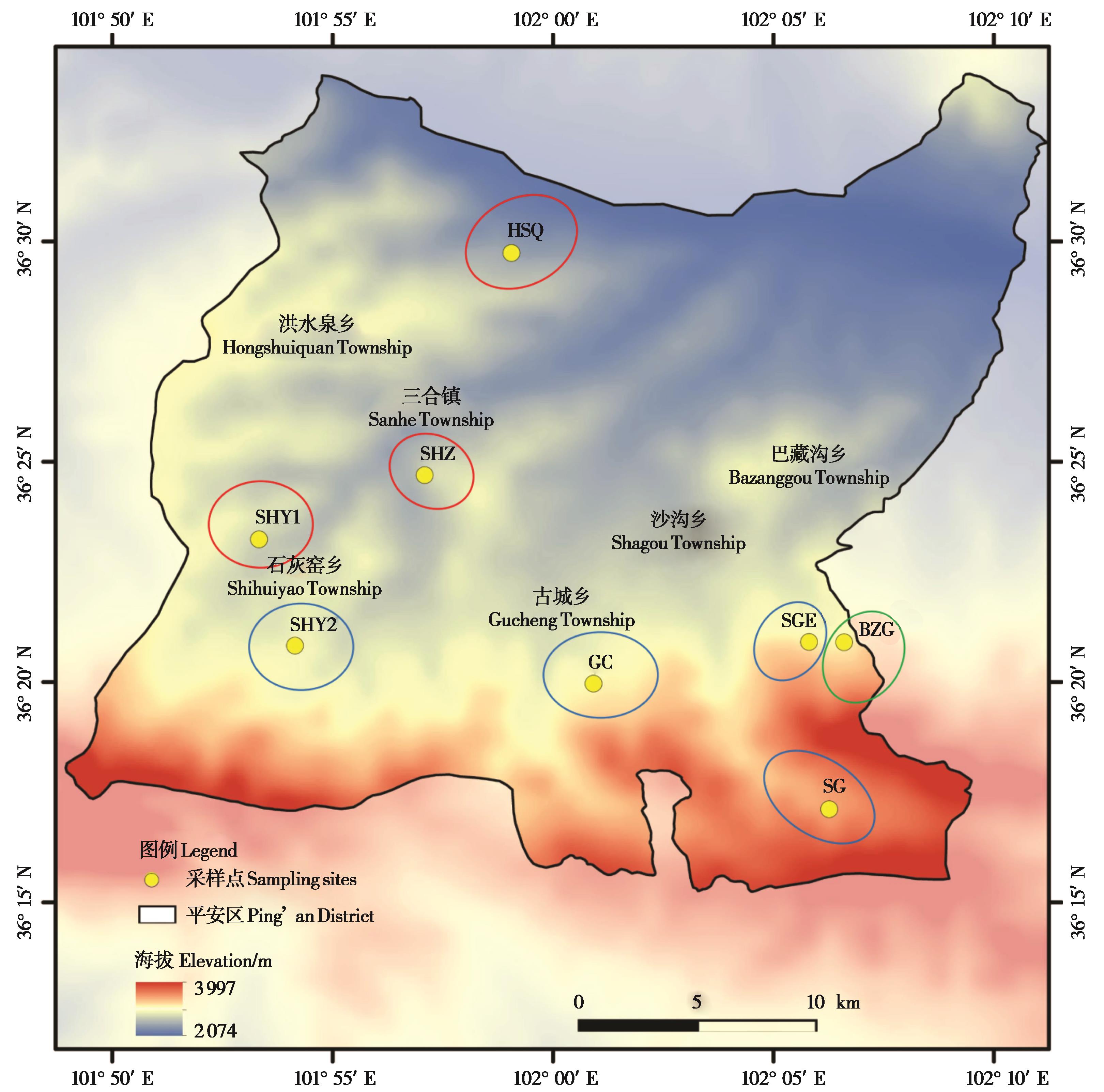
图 1 海东市平安区鼢鼠采样点. 用不同颜色的椭圆表示该采样点后期鉴定的鼢鼠种类,红色表示甘肃鼢鼠,蓝色表示高原鼢鼠,绿色表示同时有高原鼢鼠和甘肃鼢鼠
Fig. 1 Sampling sites for zokors in Ping’an District in Haidong City. Different colored ovals are used to represent the zokor species identified later at this sampling site. The red indicates Eospalax cansus, the blue indicates Eospalax baileyi, and the green circle indicates E. cansus and E. baileyi
序号 Code | 物种 Species | GenBank登录号 Accession numbers | 序列数 Numbers of sequence | 单倍型数 Numbers of haplotype |
|---|---|---|---|---|
| 1 | 草原鼢鼠 Myospalax aspalax | AF326272, KP724691, KY754052 | 3 | 3 |
| 2 | 东北鼢鼠 Myospalax psilurus | AF326270, AF326271, JX014234, OM329998, OM329999 | 5 | 4 |
| 3 | 中华鼢鼠 Eospalax fontanierii | AF326264 ~ AF326266, MH884481, OM329961 ~ OM329965 | 9 | 5 |
| 4 | 罗氏鼢鼠 Eospalax rothschildi | AF326267, AF326268, JN544420 | 3 | 3 |
| 5 | 斯氏鼢鼠 Eospalax smithii | GU339018, GU339019, KM103905 ~ KM103907, KM103909, MH891800, OM329981,OM329982, OM329985, OM329986, OM330012 ~ OM330014 | 14 | 9 |
| 6 | 秦岭鼢鼠 Eospalax rufescens | AF326269, EF530742, GU339025, GU339026, MH933740 | 5 | 4 |
| 7 | 甘肃鼢鼠 Eospalax cansus | AF326260 ~ AF326263, EF530738, EF530739, GQ244363 ~ GQ244402, KC514112, KM103797, KM103799, KM103854 ~ KM103857 | 52 | 51 |
| 8 | 高原鼢鼠 Eospalax baileyi | AF326255, AF326256, AF387081~ AF387084, EF530743, EF530744, GU339022 ~ GU339024, JN540033, KM103774 ~ KM103796, KM103798, KM103800 ~ KM103853, KM103858 ~ KM103908, OM140664 | 139 | 136 |
表1 GenBank下载的已知鼢鼠Cytb基因序列信息表
Table 1 The Cytb sequence information of zokor downloaded from GenBank
序号 Code | 物种 Species | GenBank登录号 Accession numbers | 序列数 Numbers of sequence | 单倍型数 Numbers of haplotype |
|---|---|---|---|---|
| 1 | 草原鼢鼠 Myospalax aspalax | AF326272, KP724691, KY754052 | 3 | 3 |
| 2 | 东北鼢鼠 Myospalax psilurus | AF326270, AF326271, JX014234, OM329998, OM329999 | 5 | 4 |
| 3 | 中华鼢鼠 Eospalax fontanierii | AF326264 ~ AF326266, MH884481, OM329961 ~ OM329965 | 9 | 5 |
| 4 | 罗氏鼢鼠 Eospalax rothschildi | AF326267, AF326268, JN544420 | 3 | 3 |
| 5 | 斯氏鼢鼠 Eospalax smithii | GU339018, GU339019, KM103905 ~ KM103907, KM103909, MH891800, OM329981,OM329982, OM329985, OM329986, OM330012 ~ OM330014 | 14 | 9 |
| 6 | 秦岭鼢鼠 Eospalax rufescens | AF326269, EF530742, GU339025, GU339026, MH933740 | 5 | 4 |
| 7 | 甘肃鼢鼠 Eospalax cansus | AF326260 ~ AF326263, EF530738, EF530739, GQ244363 ~ GQ244402, KC514112, KM103797, KM103799, KM103854 ~ KM103857 | 52 | 51 |
| 8 | 高原鼢鼠 Eospalax baileyi | AF326255, AF326256, AF387081~ AF387084, EF530743, EF530744, GU339022 ~ GU339024, JN540033, KM103774 ~ KM103796, KM103798, KM103800 ~ KM103853, KM103858 ~ KM103908, OM140664 | 139 | 136 |
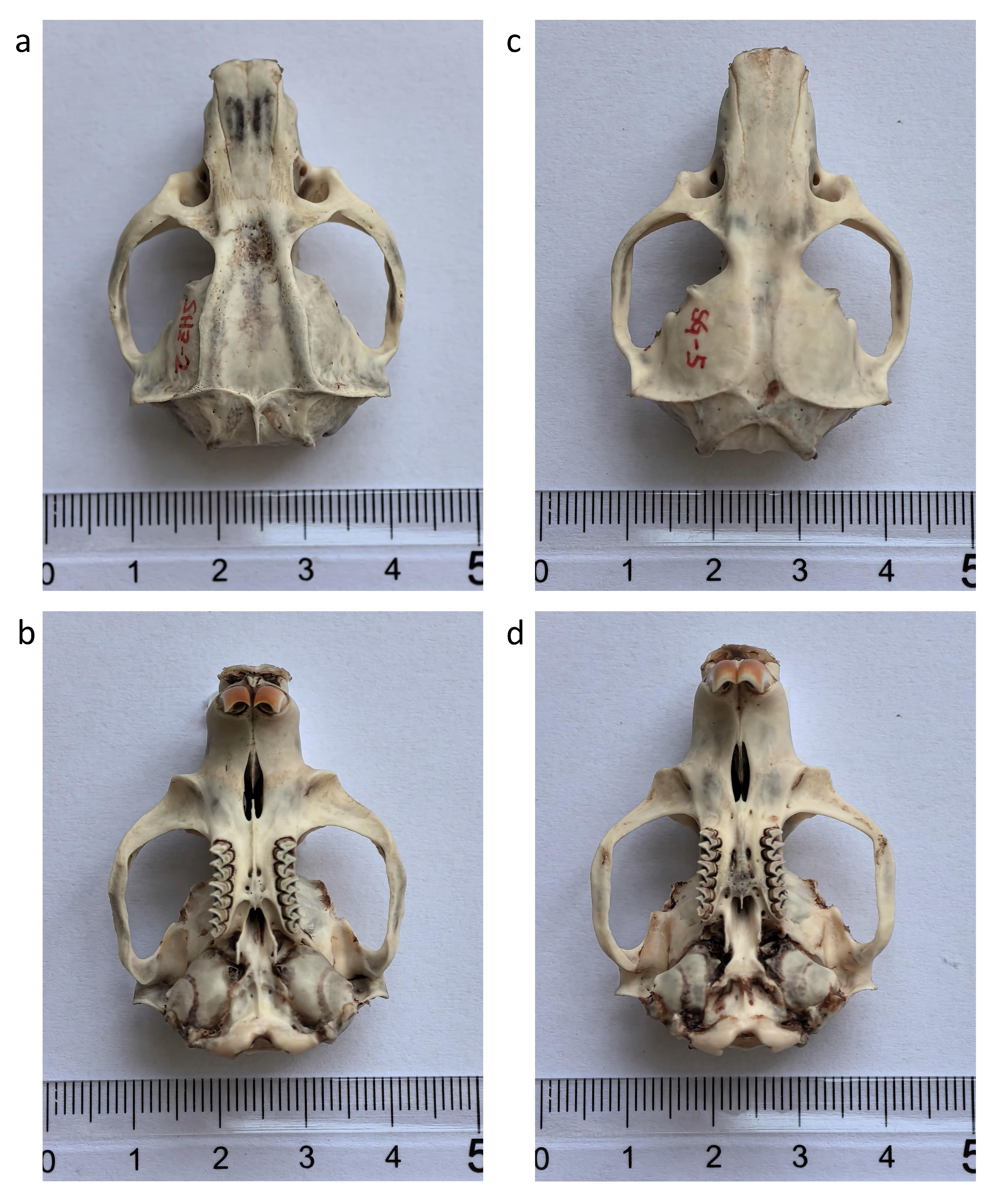
图2 平安区两种鼢鼠头骨. a:尾巴被稀疏短白毛鼢鼠的头骨背面观;b:尾巴被稀疏短白毛鼢鼠的头骨腹面观;c:尾巴被密毛鼢鼠的头骨背面观;d:尾巴被密毛鼢鼠的头骨腹面观
Fig. 2 Skull of two species of zokor in Ping’an District in Haidong City. a: the dorsal cranium of zokor whose tail is sparsely coated with short white hair; b: the ventral cranium of zokor whose tail sparsely coated with short white hair; c: the dorsal cranium of zokor whose tail is densely coated with hair; d: the ventral cranium of zokor whose tail is densely coated with hair
采样点 Sampling sites | 样本量 Sample size | 特有单倍型数目: 单倍型 (n) Number of specific haplotypes: haplotypes | 共享单倍型 (n) Shared haplotypes | 物种 Species |
|---|---|---|---|---|
| HSQ | 11 | 1:H25(4) | H18(2)、H21(4)、H24(1) | 甘肃鼢鼠 Eospalax cansus |
| SHZ | 10 | 3:H17(1)、H19(3)、H20(1) | H18(4)、H21(1) | 甘肃鼢鼠 Eospalax cansus |
| SHY1 | 10 | 1:H23(7) | H24(3) | 甘肃鼢鼠 Eospalax cansus |
| SHY2 | 6 | 3:H14(3)、H15(2)、H16(1) | 高原鼢鼠 Eospalax baileyi | |
| GC | 12 | 4:H1(1)、H2(1)、H3(1)、H5(1) | H4(8) | 高原鼢鼠 Eospalax baileyi |
| BZG | 12 | 6:H9(1)、H10(1)、H11(5)、H12(1)、H13(1)、H22(2) | H7(1) | 高原鼢鼠 Eospalax baileyi; 甘肃鼢鼠 Eospalax cansus |
| SGE | 1 | 0 | H8(1) | 高原鼢鼠 Eospalax baileyi |
| SG | 12 | 1:H6(2) | H4(4)、H7(2)、H8(4) | 高原鼢鼠 Eospalax baileyi |
表 2 平安区鼢鼠Cyt b基因各单倍型在采样点间的分布
Table 2 Haplotype frequencies of Cyt b gene in each zokor sampling site
采样点 Sampling sites | 样本量 Sample size | 特有单倍型数目: 单倍型 (n) Number of specific haplotypes: haplotypes | 共享单倍型 (n) Shared haplotypes | 物种 Species |
|---|---|---|---|---|
| HSQ | 11 | 1:H25(4) | H18(2)、H21(4)、H24(1) | 甘肃鼢鼠 Eospalax cansus |
| SHZ | 10 | 3:H17(1)、H19(3)、H20(1) | H18(4)、H21(1) | 甘肃鼢鼠 Eospalax cansus |
| SHY1 | 10 | 1:H23(7) | H24(3) | 甘肃鼢鼠 Eospalax cansus |
| SHY2 | 6 | 3:H14(3)、H15(2)、H16(1) | 高原鼢鼠 Eospalax baileyi | |
| GC | 12 | 4:H1(1)、H2(1)、H3(1)、H5(1) | H4(8) | 高原鼢鼠 Eospalax baileyi |
| BZG | 12 | 6:H9(1)、H10(1)、H11(5)、H12(1)、H13(1)、H22(2) | H7(1) | 高原鼢鼠 Eospalax baileyi; 甘肃鼢鼠 Eospalax cansus |
| SGE | 1 | 0 | H8(1) | 高原鼢鼠 Eospalax baileyi |
| SG | 12 | 1:H6(2) | H4(4)、H7(2)、H8(4) | 高原鼢鼠 Eospalax baileyi |
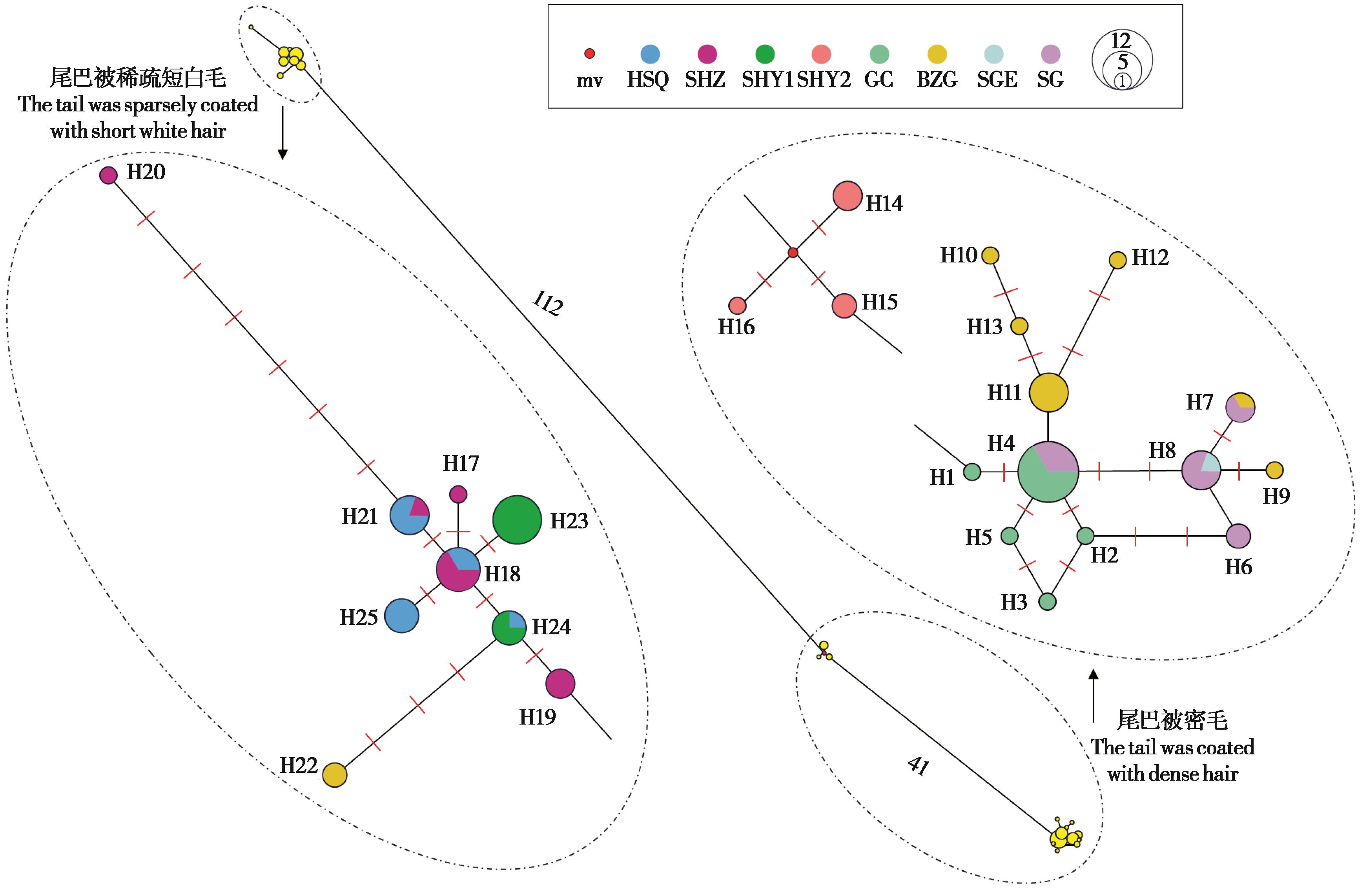
图3 海东市平安区鼢鼠线粒体Cyt b基因单倍型网络结构. 圆的大小表示单倍型频率;颜色表示不同采样点
Fig. 3 Structure of Cytb haplotype network of zokors in Ping’an District in Haidong City. The sizes of the circles and colored segments are proportional to the haplotype frequencies in the datasets; the color indicates different sampling sites

图4 基于鼢鼠Cytb基因单倍型构建的NJ系统树. 进化树节点旁边的数字为NJ树(前)和ML树(后)的bootstrap支持比例. 进化枝末端名称为GenBank下载序列号或本研究测序单倍型,暗红色字体的为本研究测序的单倍型,其中4条与GenBank已知鼢鼠物种序列单倍型一致. H1 ~ H25代表haplotype1 ~ 25
Fig. 4 NJ phylogenetic tree based on zokor Cyt b haplotypes. Numbers beside the nodes indicate bootstrap support proportion for NJ tree (front) and ML tree (back). The tip labels are either the accession numbers or the haplotypes sequenced in this study. The dark red text fonts are the haplotypes sequenced in this study, and 4 of them are consistent with the species haplotypes known in GenBank. H1 - H25:haplotype1 - 25
物种 Species | 草原鼢鼠 Myospalax aspalax | 东北鼢鼠 Myospalax psilurus | 中华鼢鼠 Eospalax fontanierii | 秦岭鼢鼠 Eospalax rufescens | 罗氏鼢鼠 Eospalax rothschildi | 甘肃鼢鼠 Eospalax cansus | 斯氏鼢鼠 Eospalax smithii | 高原鼢鼠 Eospalax baileyi |
|---|---|---|---|---|---|---|---|---|
| 草原鼢鼠 Myospalax aspalax | 0.094 370 | 0.167 552 | 0.207 979 | 0.189 865 | 0.176 608 | 0.188 558 | 0.181 838 | |
| 东北鼢鼠 Myospalax psilurus | 0.115 043 | 0.171 535 | 0.183 942 | 0.199 857 | 0.171 096 | 0.187 502 | 0.162 555 | |
| 中华鼢鼠 Eospalax fontanierii | 0.196 136 | 0.190 695 | 0.156 134 | 0.164 944 | 0.135 094 | 0.154 925 | 0.123 388 | |
| 秦岭鼢鼠 Eospalax rufescens | 0.240 337 | 0.211 283 | 0.184 605 | 0.135 269 | 0.129 138 | 0.108 713 | 0.121 904 | |
| 罗氏鼢鼠 Eospalax rothschildi | 0.206 836 | 0.223 518 | 0.192 594 | 0.170 735 | 0.119 807 | 0.139 937 | 0.114 777 | |
| 甘肃鼢鼠 Eospalax cansus | 0.213 120 | 0.206 836 | 0.177 516 | 0.158 922 | 0.159 530 | 0.109 647 | 0.115 207 | |
| 斯氏鼢鼠 Eospalax smithii | 0.229 016 | 0.204 423 | 0.172 348 | 0.142 772 | 0.165 211 | 0.139 260 | 0.110 340 | |
| 高原鼢鼠 Eospalax baileyi | 0.226 554 | 0.209 927 | 0.178 068 | 0.168 335 | 0.159 598 | 0.148 902 | 0.145 632 |
表3 GenBank中已知8种鼢鼠Cytb基因种间遗传距离
Table 3 The interspecific genetic distance of the Cyt b gene among eight zokor species in GenBank
物种 Species | 草原鼢鼠 Myospalax aspalax | 东北鼢鼠 Myospalax psilurus | 中华鼢鼠 Eospalax fontanierii | 秦岭鼢鼠 Eospalax rufescens | 罗氏鼢鼠 Eospalax rothschildi | 甘肃鼢鼠 Eospalax cansus | 斯氏鼢鼠 Eospalax smithii | 高原鼢鼠 Eospalax baileyi |
|---|---|---|---|---|---|---|---|---|
| 草原鼢鼠 Myospalax aspalax | 0.094 370 | 0.167 552 | 0.207 979 | 0.189 865 | 0.176 608 | 0.188 558 | 0.181 838 | |
| 东北鼢鼠 Myospalax psilurus | 0.115 043 | 0.171 535 | 0.183 942 | 0.199 857 | 0.171 096 | 0.187 502 | 0.162 555 | |
| 中华鼢鼠 Eospalax fontanierii | 0.196 136 | 0.190 695 | 0.156 134 | 0.164 944 | 0.135 094 | 0.154 925 | 0.123 388 | |
| 秦岭鼢鼠 Eospalax rufescens | 0.240 337 | 0.211 283 | 0.184 605 | 0.135 269 | 0.129 138 | 0.108 713 | 0.121 904 | |
| 罗氏鼢鼠 Eospalax rothschildi | 0.206 836 | 0.223 518 | 0.192 594 | 0.170 735 | 0.119 807 | 0.139 937 | 0.114 777 | |
| 甘肃鼢鼠 Eospalax cansus | 0.213 120 | 0.206 836 | 0.177 516 | 0.158 922 | 0.159 530 | 0.109 647 | 0.115 207 | |
| 斯氏鼢鼠 Eospalax smithii | 0.229 016 | 0.204 423 | 0.172 348 | 0.142 772 | 0.165 211 | 0.139 260 | 0.110 340 | |
| 高原鼢鼠 Eospalax baileyi | 0.226 554 | 0.209 927 | 0.178 068 | 0.168 335 | 0.159 598 | 0.148 902 | 0.145 632 |
物种 Species | 最小遗传距 Minimal genetic distance | 最大遗传距离 Maximal genetic distance | 平均遗传距离 Mean genetic distance |
|---|---|---|---|
| 草原鼢鼠 Myospalax aspalax | 0.017 191 | 0.076 339 | 0.056 352 |
| 东北鼢鼠 Myospalax psilurus | 0.004 426 | 0.025 790 | 0.020 119 |
| 中华鼢鼠 Eospalax fontanierii | 0.003 534 | 0.118 332 | 0.049 252 |
| 秦岭鼢鼠 Eospalax rufescens | 0.000 880 | 0.124 744 | 0.095 154 |
| 罗氏鼢鼠 Eospalax rothschildi | 0.007 097 | 0.067 543 | 0.045 748 |
| 甘肃鼢鼠 Eospalax cansus | 0.000 880 | 0.074 386 | 0.024 405 |
| 斯氏鼢鼠 Eospalax smithii | 0.000 880 | 0.061 916 | 0.030 981 |
| 高原鼢鼠 Eospalax baileyi | 0.000 880 | 0.096 440 | 0.054 556 |
表4 GenBank中已知8种鼢鼠Cytb基因种内遗传距离
Table 4 The intraspecific genetic distance of the Cytb gene among eight zokor species in GenBank
物种 Species | 最小遗传距 Minimal genetic distance | 最大遗传距离 Maximal genetic distance | 平均遗传距离 Mean genetic distance |
|---|---|---|---|
| 草原鼢鼠 Myospalax aspalax | 0.017 191 | 0.076 339 | 0.056 352 |
| 东北鼢鼠 Myospalax psilurus | 0.004 426 | 0.025 790 | 0.020 119 |
| 中华鼢鼠 Eospalax fontanierii | 0.003 534 | 0.118 332 | 0.049 252 |
| 秦岭鼢鼠 Eospalax rufescens | 0.000 880 | 0.124 744 | 0.095 154 |
| 罗氏鼢鼠 Eospalax rothschildi | 0.007 097 | 0.067 543 | 0.045 748 |
| 甘肃鼢鼠 Eospalax cansus | 0.000 880 | 0.074 386 | 0.024 405 |
| 斯氏鼢鼠 Eospalax smithii | 0.000 880 | 0.061 916 | 0.030 981 |
| 高原鼢鼠 Eospalax baileyi | 0.000 880 | 0.096 440 | 0.054 556 |
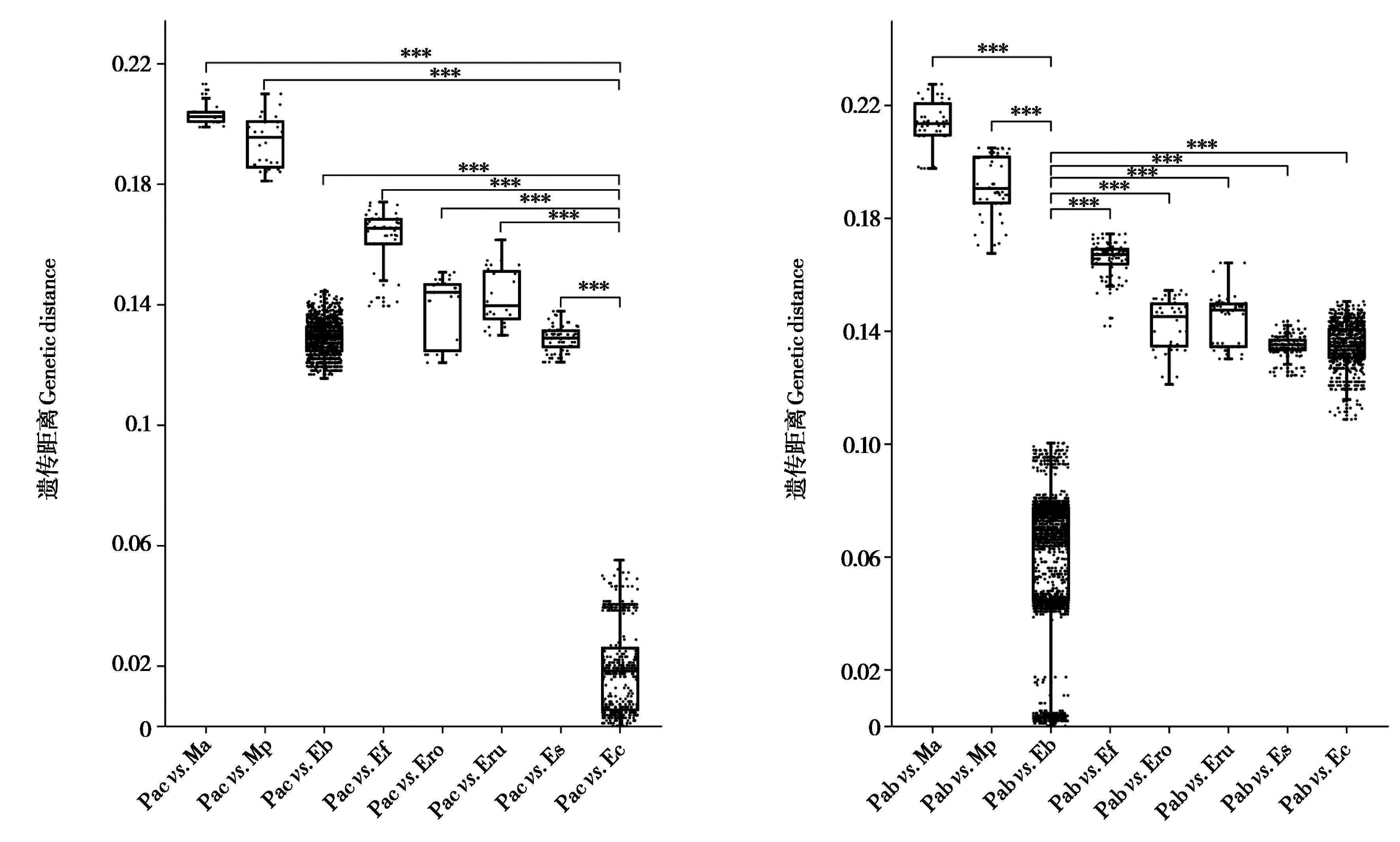
图5 平安区两种不同形态鼢鼠与GenBank中已知8种鼢鼠Cytb基因遗传距离. Pac为平安区尾巴被稀疏短白毛的鼢鼠样本,Pab为平安区尾巴被密毛的鼢鼠样本. Mp:东北鼢鼠;Ma:草原鼢鼠;Ef:中华鼢鼠;Ec:甘肃鼢鼠;Eru:秦岭鼢鼠;Es:斯氏鼢鼠;Ero:罗氏鼢鼠;Eb:高原鼢鼠.***P < 0.001
Fig.5 The genetic distances of the Cyt b gene between two distinct zokors in Ping’an District and eight zokor species in GenBank. Pac and Pab indicate the zokor populations featuring sparse short white hair and dense hair on the tail in Ping’an District. Mp: Myospalax psilurus; Ma: Myospalax aspalax; Ef: Eospalax fontanierii; Ec: Eospalax cansus, Eru: Eospalax rufescens; Es: Eospalax smithii; Ero: Eospalax rothschildi; Eb: Eospalax baileyi.***P < 0.001
采样地及时间 Sampling site and date | 编号 Code | 性别 Gender | 单倍型 Haplotype | 尾巴特征 Feature of tail hair |
|---|---|---|---|---|
石灰窑乡 Shihuiyao Township 2023-05-16 | SHY1-01 | 雄 Male | H23 | 稀疏短白毛 Sparse short white hair |
| SHY1-02 | 雄Male | H23 | 稀疏短白毛 Sparse short white hair | |
| SHY1-03 | 雄Male | H23 | 稀疏短白毛 Sparse short white hair | |
| SHY1-04 | 雄Male | H24 | 稀疏短白毛 Sparse short white hair | |
| SHY1-05 | 雌Female | H24 | 稀疏短白毛 Sparse short white hair | |
| SHY1-06 | 雄Male | H23 | 稀疏短白毛 Sparse short white hair | |
| SHY1-07 | 雌Female | H23 | 稀疏短白毛 Sparse short white hair | |
| SHY1-08 | 雌Female | H23 | 稀疏短白毛 Sparse short white hair | |
| SHY1-09 | 雌Female | H24 | 稀疏短白毛 Sparse short white hair | |
| SHY1-10 | 雌Female | H23 | 稀疏短白毛 Sparse short white hair | |
石灰窑乡 Shihuiyao Township 2023-05-17 | SHY2-02 | 雌Female | H14 | 密毛 Dense hair |
| SHY2-03 | 雌Female | H15 | 密毛 Dense hair | |
| SHY2-04 | 雌Female | H14 | 密毛 Dense hair | |
| SHY2-06 | 雌Female | H16 | 密毛 Dense hair | |
| SHY2-07 | 雄Male | H14 | 密毛 Dense hair | |
| SHY2-08 | 雌Female | H15 | 密毛 Dense hair | |
洪水泉乡 Hongshuiquan Township 2023-05-18至2023-05-20 | HSQ-01 | 雄Male | H21 | 稀疏短白毛 Sparse short white hair |
| HSQ-02 | 雌Female | H21 | 稀疏短白毛 Sparse short white hair | |
| HSQ-03 | 雌Female | H25 | 稀疏短白毛 Sparse short white hair | |
| HSQ-04 | 雌Female | H25 | 稀疏短白毛 Sparse short white hair | |
| HSQ-05 | 雄Male | H24 | 稀疏短白毛 Sparse short white hair | |
| HSQ-06 | 雄Male | H21 | 稀疏短白毛 Sparse short white hair | |
| HSQ-07 | 雌Female | H21 | 稀疏短白毛 Sparse short white hair | |
| HSQ-08 | 雌Female | H25 | 稀疏短白毛 Sparse short white hair | |
| HSQ-09 | 雌Female | H18 | 稀疏短白毛 Sparse short white hair | |
| HSQ-10 | 雄Male | H18 | 稀疏短白毛 Sparse short white hair | |
| HSQ-11 | 雌Female | H25 | 稀疏短白毛 Sparse short white hair | |
三合镇 Sanhe Township 2023-10-08 | SHZ-01 | 雌Female | H18 | 稀疏短白毛 Sparse short white hair |
| SHZ-02 | 雄Male | H18 | 稀疏短白毛 Sparse short white hair | |
| SHZ-03 | 雄Male | H19 | 稀疏短白毛 Sparse short white hair | |
| SHZ-04 | 雌Female | H17 | 稀疏短白毛 Sparse short white hair | |
| SHZ-05 | 雌Female | H19 | 稀疏短白毛 Sparse short white hair | |
| SHZ-06 | 雄Male | H20 | 稀疏短白毛 Sparse short white hair | |
| SHZ-07 | 雄Male | H21 | 稀疏短白毛 Sparse short white hair | |
| SHZ-08 | 雌Female | H18 | 稀疏短白毛 Sparse short white hair | |
| SHZ-09 | 雄Male | H19 | 稀疏短白毛 Sparse short white hair | |
| SHZ-10 | 雌Female | H18 | 稀疏短白毛 Sparse short white hair | |
沙沟乡 Shagou Township 2023-10-14 | SG-01 | 雄Male | H4 | 密毛 Dense hair |
| SG-02 | 雌Female | H4 | 密毛 Dense hair | |
| SG-03 | 雄Male | H6 | 密毛 Dense hair | |
| SG-04 | 雄Male | H4 | 密毛 Dense hair | |
| SG-05 | 雄Male | H4 | 密毛 Dense hair | |
| SG-06 | 雄Male | H7 | 密毛 Dense hair | |
| SG-07 | 雌Female | H8 | 密毛 Dense hair | |
| SG-08 | 雌Female | H8 | 密毛 Dense hair | |
| SG-09 | 雄Male | H7 | 密毛 Dense hair | |
| SG-10 | 雄Male | H6 | 密毛 Dense hair | |
| SG-11 | 雌Female | H8 | 密毛 Dense hair | |
| SG-12 | 雌Female | H8 | 密毛 Dense hair | |
巴藏沟乡 Bazanggou Township 2023-05-20 | SGE-01 | — | H8 | 密毛 Dense hair |
巴藏沟乡 Bazanggou Township 2023-10-19 | BZG-01 | 雄Male | H22 | 稀疏短白毛 Sparse short white hair |
| BZG-02 | 雌Female | H22 | 稀疏短白毛 Sparse short white hair | |
| BZG-03 | 雄Male | H9 | 密毛 Dense hair | |
| BZG-04 | 雄Male | H7 | 密毛 Dense hair | |
| BZG-05 | 雌Female | H10 | 密毛 Dense hair | |
| BZG-06 | 雌Female | H11 | 密毛 Dense hair | |
| BZG-07 | 雄Male | H11 | 密毛 Dense hair | |
| BZG-08 | 雌Female | H12 | 密毛 Dense hair | |
| BZG-09 | 雌Female | H11 | 密毛 Dense hair | |
| BZG-10 | 雌Female | H11 | 密毛 Dense hair | |
| BZG-11 | 雄Male | H11 | 密毛 Dense hairs | |
| BZG-12 | 雄Male | H13 | 密毛 Dense hair | |
古城乡 Gucheng Township 2023-10-24 | GC-01 | 雌Female | H1 | 密毛 Dense hair |
| GC-02 | 雄Male | H2 | 密毛 Dense hair | |
| GC-03 | 雄Male | H3 | 密毛 Dense hair | |
| GC-04 | 雄Male | H4 | 密毛 Dense hair | |
| GC-05 | 雌Female | H4 | 密毛 Dense hair | |
| GC-06 | 雌Female | H4 | 密毛 Dense hair | |
| GC-07 | 雌Female | H4 | 密毛 Dense hair | |
| GC-08 | 雌Female | H4 | 密毛 Dense hair | |
| GC-09 | 雌Female | H5 | 密毛 Dense hair | |
| GC-10 | 雄Male | H4 | 密毛 Dense hair | |
| GC-11 | 雄Male | H4 | 密毛 Dense hair | |
| GC-12 | 雄Male | H4 | 密毛 Dense hair |
附录A 本研究中平安区74个鼢鼠样本信息
Appendix A Details of 74 zokor samples from Ping’an District in this study
采样地及时间 Sampling site and date | 编号 Code | 性别 Gender | 单倍型 Haplotype | 尾巴特征 Feature of tail hair |
|---|---|---|---|---|
石灰窑乡 Shihuiyao Township 2023-05-16 | SHY1-01 | 雄 Male | H23 | 稀疏短白毛 Sparse short white hair |
| SHY1-02 | 雄Male | H23 | 稀疏短白毛 Sparse short white hair | |
| SHY1-03 | 雄Male | H23 | 稀疏短白毛 Sparse short white hair | |
| SHY1-04 | 雄Male | H24 | 稀疏短白毛 Sparse short white hair | |
| SHY1-05 | 雌Female | H24 | 稀疏短白毛 Sparse short white hair | |
| SHY1-06 | 雄Male | H23 | 稀疏短白毛 Sparse short white hair | |
| SHY1-07 | 雌Female | H23 | 稀疏短白毛 Sparse short white hair | |
| SHY1-08 | 雌Female | H23 | 稀疏短白毛 Sparse short white hair | |
| SHY1-09 | 雌Female | H24 | 稀疏短白毛 Sparse short white hair | |
| SHY1-10 | 雌Female | H23 | 稀疏短白毛 Sparse short white hair | |
石灰窑乡 Shihuiyao Township 2023-05-17 | SHY2-02 | 雌Female | H14 | 密毛 Dense hair |
| SHY2-03 | 雌Female | H15 | 密毛 Dense hair | |
| SHY2-04 | 雌Female | H14 | 密毛 Dense hair | |
| SHY2-06 | 雌Female | H16 | 密毛 Dense hair | |
| SHY2-07 | 雄Male | H14 | 密毛 Dense hair | |
| SHY2-08 | 雌Female | H15 | 密毛 Dense hair | |
洪水泉乡 Hongshuiquan Township 2023-05-18至2023-05-20 | HSQ-01 | 雄Male | H21 | 稀疏短白毛 Sparse short white hair |
| HSQ-02 | 雌Female | H21 | 稀疏短白毛 Sparse short white hair | |
| HSQ-03 | 雌Female | H25 | 稀疏短白毛 Sparse short white hair | |
| HSQ-04 | 雌Female | H25 | 稀疏短白毛 Sparse short white hair | |
| HSQ-05 | 雄Male | H24 | 稀疏短白毛 Sparse short white hair | |
| HSQ-06 | 雄Male | H21 | 稀疏短白毛 Sparse short white hair | |
| HSQ-07 | 雌Female | H21 | 稀疏短白毛 Sparse short white hair | |
| HSQ-08 | 雌Female | H25 | 稀疏短白毛 Sparse short white hair | |
| HSQ-09 | 雌Female | H18 | 稀疏短白毛 Sparse short white hair | |
| HSQ-10 | 雄Male | H18 | 稀疏短白毛 Sparse short white hair | |
| HSQ-11 | 雌Female | H25 | 稀疏短白毛 Sparse short white hair | |
三合镇 Sanhe Township 2023-10-08 | SHZ-01 | 雌Female | H18 | 稀疏短白毛 Sparse short white hair |
| SHZ-02 | 雄Male | H18 | 稀疏短白毛 Sparse short white hair | |
| SHZ-03 | 雄Male | H19 | 稀疏短白毛 Sparse short white hair | |
| SHZ-04 | 雌Female | H17 | 稀疏短白毛 Sparse short white hair | |
| SHZ-05 | 雌Female | H19 | 稀疏短白毛 Sparse short white hair | |
| SHZ-06 | 雄Male | H20 | 稀疏短白毛 Sparse short white hair | |
| SHZ-07 | 雄Male | H21 | 稀疏短白毛 Sparse short white hair | |
| SHZ-08 | 雌Female | H18 | 稀疏短白毛 Sparse short white hair | |
| SHZ-09 | 雄Male | H19 | 稀疏短白毛 Sparse short white hair | |
| SHZ-10 | 雌Female | H18 | 稀疏短白毛 Sparse short white hair | |
沙沟乡 Shagou Township 2023-10-14 | SG-01 | 雄Male | H4 | 密毛 Dense hair |
| SG-02 | 雌Female | H4 | 密毛 Dense hair | |
| SG-03 | 雄Male | H6 | 密毛 Dense hair | |
| SG-04 | 雄Male | H4 | 密毛 Dense hair | |
| SG-05 | 雄Male | H4 | 密毛 Dense hair | |
| SG-06 | 雄Male | H7 | 密毛 Dense hair | |
| SG-07 | 雌Female | H8 | 密毛 Dense hair | |
| SG-08 | 雌Female | H8 | 密毛 Dense hair | |
| SG-09 | 雄Male | H7 | 密毛 Dense hair | |
| SG-10 | 雄Male | H6 | 密毛 Dense hair | |
| SG-11 | 雌Female | H8 | 密毛 Dense hair | |
| SG-12 | 雌Female | H8 | 密毛 Dense hair | |
巴藏沟乡 Bazanggou Township 2023-05-20 | SGE-01 | — | H8 | 密毛 Dense hair |
巴藏沟乡 Bazanggou Township 2023-10-19 | BZG-01 | 雄Male | H22 | 稀疏短白毛 Sparse short white hair |
| BZG-02 | 雌Female | H22 | 稀疏短白毛 Sparse short white hair | |
| BZG-03 | 雄Male | H9 | 密毛 Dense hair | |
| BZG-04 | 雄Male | H7 | 密毛 Dense hair | |
| BZG-05 | 雌Female | H10 | 密毛 Dense hair | |
| BZG-06 | 雌Female | H11 | 密毛 Dense hair | |
| BZG-07 | 雄Male | H11 | 密毛 Dense hair | |
| BZG-08 | 雌Female | H12 | 密毛 Dense hair | |
| BZG-09 | 雌Female | H11 | 密毛 Dense hair | |
| BZG-10 | 雌Female | H11 | 密毛 Dense hair | |
| BZG-11 | 雄Male | H11 | 密毛 Dense hairs | |
| BZG-12 | 雄Male | H13 | 密毛 Dense hair | |
古城乡 Gucheng Township 2023-10-24 | GC-01 | 雌Female | H1 | 密毛 Dense hair |
| GC-02 | 雄Male | H2 | 密毛 Dense hair | |
| GC-03 | 雄Male | H3 | 密毛 Dense hair | |
| GC-04 | 雄Male | H4 | 密毛 Dense hair | |
| GC-05 | 雌Female | H4 | 密毛 Dense hair | |
| GC-06 | 雌Female | H4 | 密毛 Dense hair | |
| GC-07 | 雌Female | H4 | 密毛 Dense hair | |
| GC-08 | 雌Female | H4 | 密毛 Dense hair | |
| GC-09 | 雌Female | H5 | 密毛 Dense hair | |
| GC-10 | 雄Male | H4 | 密毛 Dense hair | |
| GC-11 | 雄Male | H4 | 密毛 Dense hair | |
| GC-12 | 雄Male | H4 | 密毛 Dense hair |
| Bandelt H J, Forster P, Rohl A,1999. Median‑joining networks for inferring intraspecific phylogenies[J]. Molecular Biology and Evolution,16:37‑48.DOI:10.1093/oxfordjournals.molbev.a026036 . | |
| Bickford D, Lohman D J, Sodhi N S, Ng P K, Meier R, Winker K, Ingram K K, Das I,2007. Cryptic species as a window on diversity and conservation[J]. Trends in Ecology & Evolution,22(3):148‑155.DOI:10.1016/j.tree.2006. 11.004 . | |
| Candek K, Kuntner M,2015. DNA barcoding gap:Reliable species identification over morphological and geographical scales[J]. Molecular Ecology Resources,15:268‑277.DOI:10.1111/1755-0998.12304 . | |
| Fan Naichang, Shi Yinzhu,1982. A revision of the zokors of subgenus Eospalax [J]. Acta Theriologica Sinica,2(2):183‑199.(in Chinese with English abstract) | |
| Felsenstein J,1985. Confidence limits on phylogenies:an approach using the bootstrap[J]. Evolution,39(4):783‑791.DOI:10.2307/2408678 . | |
| Gao Lianming,2015. Applications of DNA barcoding in biodiversity inventory and assessment[J]. Biodiversity Science,23(3):286‑287. DOI:10.17520/biods.2015070. (in Chinese with English abstract) | |
| Ginestet C,2011. ggplot2:Elegant graphics for data analysis[J]. Journal of the Royal Statistical Society Series A:Statistics in Society,174(1):245‑246.DOI:10.1111/j.1467-985X. 2010.00676_9.x . | |
| Guo Limin, Xin Jinxiao, Shi Zhanwen, Zhang Fenchun, Jiang Haiwei, Bai Zhonghui,2019. Evaluation on effect of DNA barcoding on identification of rodent species in Spermophilus alaschanicus plague foci of Pingchuan district[J]. Bulletin of Disease Control & Prevention(China),34(6):1‑3,24. DOI:10.13215/j.cnki.jbyfkztb.1911001. (in Chinese with English abstract) | |
| He Kai, Wang Wenzhi, Li Quan, Luo Peipeng, Sun Yuehua, Jiang Xuelong,2013. DNA barcoding in surveys of small mammal community:a case study in Lianhuashan,Gansu Province,China[J]. Biodiversity Science,21(2):197‑205. DOI:10.3724/SP.J.1003.2013.09160. (in Chinese with English abstract) | |
| Hebert P D, Cywinska A, Ball S L, Dewaard J R,2003. Biological identifications through DNA barcodes[J]. Proceedings of the Royal Society of London Series B:Biological Sciences,270(1512):313‑321.DOI:10.1098/rspb.2002.2218 . | |
| Jiang F, Jin Q, Liang L, Zhang A B, Li Z H,2014. Existence of species complex largely reduced barcoding success for invasive species of Tephritidae:a case study in Bactrocera spp.[J]. Molecular Ecology Resources,14:1114‑1128.DOI:10.1111/1755-0998.12259 . | |
| Kimura M,1980. A simple method for estimating evolutionary rates of base substitutions through comparative studies of nucleotide sequences[J]. Journal of Molecular Evolution,16(2):111‑120.DOI:10.1007/BF01731581 . | |
| Kress W J, GarcíA‑Robledo C, Uriarte M, Erickson D L,2015. DNA barcodes for ecology,evolution,and conservation[J]. Trends in Ecology & Evolution,30(1):25‑35.DOI:10.1016/j.tree.2014.10.008 . | |
| Leasi F, Sevigny J L, Laflamme E M, Artois T, Curini‑Galletti M, De Jesus Navarrete A, Di Domenico M, Goetz F, Hall J A, Hochberg R, JöRger K M,2018. Biodiversity estimates and ecological interpretations of meiofaunal communities are biased by the taxonomic approach[J]. Communications Biology,1(1):112.DOI:10.1038/s42003-018-0119-2 . | |
| Li Baoguo, Chen Fuguan,1992. A taxonomic revision of the subgenus Eospalax genus Myospalax [J]. Journal of Northwest University(Natural Science Edition),22(3):339‑344.(in Chinese with English abstract) | |
| Li Xiaochen, Wang Tingzheng,1996. Taxonomy and phylogeny of subgenus Eospalax [J]. Journal of Shaanxi Normal University(Natural Science Edition),24(3):79‑82.(in Chinese with English abstract) | |
| Lin Y H, Waddell P J, Penny D,2002. Pika and vole mitochondrial genomes increase support for both rodent monophyly and glires[J]. Gene,294(1‑2):119‑129.DOI:10.1016/S0378-1119(02)00695-9 . | |
| Liu D X, Yan J Y, Wang H J, Jiang F, Song P F, Cai Z Y, Zhang T Z,2021. Microbial biogeography along the gastrointestinal tract segments of sympatric subterranean rodents(Eospalax baileyi and Eospalax cansus)[J]. Animals,11(11):3297.DOI:10.3390/ani11113297 . | |
| Liu J L, Dujsebayeva T N, Chirikova M A, Gong X, Li D J, Guo X G,2021. Does the Dzungarian racerunner(Eremias dzungarica Orlova,Poyarkov,Chirikova,Nazarov,Munkhbaatar,Munkhbayar & Terbish,2017)occur in China? Species delimitation and identification with DNA barcoding and morphometric analyses[J]. Zoological Research,42(3):287.DOI:10.24272/j.issn.2095-8137.2020.318 . | |
| Liu Li, Zhou Yanshan, Chu Bin, Wang Guizhen, Hua Limin,2018. Classification of two zokor species based on mitochondrial gene,morphological and habitat indices[J]. Acta Theriologica Sinica,38(4):402‑410. DOI:10.16829/j.slxb.150188. (in Chinese with English abstract) | |
| Lou Qian, Xin Tianyi, Song Jingyuan,2020. Application of DNA barcoding technology in the whole industrial chain of traditional Chinese medicine[J]. Acta Pharmaceutica Sinica,55(8):1784‑1791. DOI:0.16438/j.0513-4870.2020-0290. (in Chinese with English abstract) | |
| Norris R W, Zhou K Y, Zhou C Q, Yang G, Kipatrick C W, Honeycutt R L,2004. The phylogenetic position of the zokors(Myospalacinae) and comments on the families of muroids(Rodentia)[J]. Molecular Phylogenetics and Evolution,31(3):972-978.DOI:10.1016/j.ympev.2003.10.020 . | |
| Rozas J, Ferrer‑Mata A, SáNchez‑Delbarrio J C, Guirao‑Rico S, Librado P, Ramos‑Onsins S E, SáNchez‑Gracia A,2017. DnaSP 6:DNA sequence polymorphism analysis of large data sets[J]. Molecular Biology and Evolution,34(12):3299‑3302.DOI:10.1093/molbev/msx248 . | |
| Tamura K, Stecher G, Kumar S,2021. MEGA11:molecular evolutionary genetics analysis version 1l[J]. Molecular Biology and Evolution,38(7):3022‑3027.DOI:10.1093/molbev/msab120 . | |
| Thompson J D, Gibson T J, Plewniak F, Jeanmougin F, Higgins D G,1997. The CLUSTAL X windows interface:flexible strategies for multiple sequence alignment aided by quality analysis tools[J]. Nucleic Acids Research,25(24):4876‑4882.DOI:10.1093/NAR/25.24.4876 . | |
| Wang Chan, Pan Yongtai, Wang Jing, Liu Fayang, Yao Baohui, Su Junhu,2020. Selection of plateau zokor(Eospalax baileyi) DNA barcodes[J]. Pratacultural Science,37(12):2574‑2583. DOI:10.11829/j.issn.1001-0629.2020-0054. (in Chinese with English abstract) | |
| Wang Jialian, Yang Guang, Liu Hai, Zhou Kaiya, Wei Fuwen,2003. Application of mitochondrial DNA sequences in the species identification of common dolphins(Genus Delphinus) in Chinese waters[J]. Acta Theriologica Sinica,23(2):120‑126. DOI:10.16829/j.slxb.2003.02.006. (in Chinese with English abstract) | |
| Xing Chao, Lin Yi, Zhou Zhiqiang, Zhao Lianjun, Jiang Shiwei, Lin Zhenzhen, Xu Jiliang, Zhan Xiangjiang,2023. The establishment of terrestrial vertebrate genetic resource bank and species identification base on DNA barcoding in Wanglang National Nature Reserve[J]. Biodiversity Science,31(7):87‑99. DOI:10.17520/biods. 2022661. (in Chinese with English abstract) | |
| Yang Qianqian, Liu Suwen, Yu Xiaoping,2018. Research progress on DNA barcoding analysis methods[J]. Chinese Journal of Applied Ecology,29(3):1006‑1014. DOI:10.13287/j.1001-9332. 201803.032. (in Chinese with English abstract) | |
| Zhang Caiyun, Huang Shanshan, Yan Haifei,2017. Applications of DNA barcoding in Chinese materia medica identification[J]. Chinese Traditional and Herbal Drugs,48(11):2306‑2312. DOI:10.7501/j.issn.0253-2670.2017.11.026 . (in Chinese with English abstract) | |
| Zhao Fang, Deng Xiaogong, Zhang Tongzuo, Su Jianping, Lin Gonghua,2015. Molecular authentication of Sailonggu and its resource distribution in Qinghai‑Xizang Plateau[J]. China Journal of Chinese Materia Medica,40(3):399‑403. DOI:10.4268 /cjcmm20150306. (in Chinese with English abstract) | |
| Zhao Xianxian, Li Bang, Lin Gonghua, Ma Wanjun, Ju Hailan, Su Jianping, Zhang Tongzuo,2017. Molecular identification of voles in the east of the Qinghai‑Xizang Plateau[J]. Acta Theriologica Sinica,37(1):44‑52. DOI:10.16829/j.slxb.201701002. (in Chinese with English abstract) | |
| Zhou C Q, Zhou K Y, Zhang S L,2004. Molecular authentication of the animal crude drug Sailonggu(bone of Myospalax baileyi)[J]. Biological and Pharmaceutical Bulletin,27(11):1850.DOI:10.1248/bpb.27.1850 . | |
| Zhu Lin, Li Ting, Chen Bingyao, Yang Guang,2020. The morphological and mtDNA molecular identification of Fin whale and Omura’s whale[J]. Acta Theriologica Sinica,40(1):37‑46. DOI:10.16829/j.slxb.150349. (in Chinese with English abstract) | |
| 王加连,杨光,刘海,周开亚,魏辅文,2003. 线粒体DNA序列分析在中国水域真海豚物种鉴定中的初步应用[J]. 兽类学报,23(2):120‑126.DOI:10.16829/j.slxb.2003.02.006 . | |
| 王缠,潘永泰,王静,刘发央,姚宝辉,苏军虎,2020. 高原鼢鼠DNA条形码筛选[J]. 草业科学,37(12):2574‑2583.DOI:10.11829/j.issn.1001-0629.2020-0054 . | |
| 中国科学院西北高原生物研究所,1989. 青海经济动物志[M]. 西宁:青海人民出版社. | |
| 邢超,林依,周智强,赵联军,蒋仕伟,林蓁蓁,徐基良,詹祥江,2023. 基于DNA条形码技术构建王朗国家级自然保护区陆生脊椎动物遗传资源数据库及物种鉴定[J]. 生物多样性,31(7):87‑99.DOI:10.17520/biods.2022661 . | |
| 朱林,李婷,陈炳耀,杨光,2020. 利用形态学及mtDNA基因分子鉴定长须鲸和大村鲸[J]. 兽类学报,40(1):37‑46. DOI:10.16829/j.slxb.150349 . | |
| 刘丽,周延山,楚彬,王贵珍,花立民,2018. 基于线粒体基因、形态学和栖息地指标的两种鼢鼠分类研究[J]. 兽类学报,38(4):402‑410.DOI:10.16829/j.slxb.150188 . | |
| 李保国,陈服官,1992. 鼢鼠属凸颅亚属的分类整理[J]. 西北大学学报(自然科学版),22(3):339‑344. | |
| 李晓晨,王廷正,1996. 论鼢鼠属Eospalax亚属的分类及系统演化[J]. 陕西师范大学学报(自然科学版),24(3):79‑82. | |
| 杨倩倩,刘苏汶,俞晓平,2018. DNA条形码分析方法研究进展[J]. 应用生态学报,29(3):1006‑1014.DOI:10.13287/j.1001-9332.201803.032 . | |
| 何锴,王文智,李权,罗培鹏,孙悦华,蒋学龙,2013. DNA条形码技术在小型兽类鉴定中的探索:以甘肃莲花山为例[J]. 生物多样性,21(2):197‑205.DOI:10.3724/SP.J.1003. 2013.09160 . | |
| 张彩云,黄珊珊,颜海飞,2017. DNA条形码技术在中药鉴定中的应用进展[J]. 中草药,48(11):2306‑2312.DOI:10.7501/j.issn.0253-2670.2017.11.026 . | |
| 赵芳,邓小弓,张同作,苏建平,林恭华,2015. 青藏高原地区塞隆骨资源的分子鉴定和地理分布[J]. 中国中药杂志,40(3):399‑403.DOI:10.4268 /cjcmm20150306 . | |
| 赵贤贤,李邦,林恭华,马万军,巨海兰,苏建平,张同作,2017. 青藏高原东部地区田鼠物种的分子鉴定[J]. 兽类学报,37(1):44‑52.DOI:10.16829/j.slxb.201701002 . | |
| 娄千,辛天怡,宋经元,2020. DNA条形码技术在中药全产业链的应用进展[J]. 药学学报,55(8):1784‑1791.DOI:0.16438/j.0513-4870.2020-0290 . | |
| 高连明,2015. DNA条形码在生物多样性编目与评价中的应用[J]. 生物多样性,23(3):286‑287.DOI:10.17520/biods.2015070 . | |
| 郭丽民,席进孝,师占文,张奋春,姜海威,白仲慧,2019. DNA条形码对平川区阿拉善黄鼠疫源地鼠种鉴定的效果评价[J]. 疾病预防控制通报,34(6):1‑3,24.DOI:10.13215/j.cnki.jbyfkztb.1911001 . | |
| 樊乃昌,施银柱,1982. 中国鼢鼠(EOSPALAX)亚属分类研究[J].兽类学报,2(2):183‑199. |
| [1] | 刘庆, 彭步青, 邓榆, 刘霜, 王晶, 郭克疾, 郭祥龙, 刘少英, 陈顺德. 小臭鼩分类地位的探讨及西藏自治区兽类一新纪录属[J]. 兽类学报, 2026, 46(4): 1-. |
| [2] | 唐明坤, 王旭明, 刘莹洵, 廖锐, 彭步青, 王新, 刘少英. 中国竹鼠属(啮齿目:鼹形鼠科)分类与系统发育研究[J]. 兽类学报, 2026, 46(3): 307-319. |
| [3] | 钱怡顺, 牟鑫, 罗斌, 李小平, 罗云丽, 李松. 中国西南地区鼠耳蝠属(翼手目:蝙蝠科)两新种[J]. 兽类学报, 2026, 46(3): 320-336. |
| [4] | 刘铸, 张璐, 郭秋颖, 张智慧, 蒋纹静, 田新民, 金志民, 张隽晟. 分布于贵州的一种小麝鼩分类地位的厘定[J]. 兽类学报, 2025, 45(4): 537-547. |
| [5] | 蒲小燕, 戴重阳, 王雅轩, 魏登邦. 低氧环境下高原鼢鼠及SD大鼠肺和骨骼肌中SP‑A的表达模式[J]. 兽类学报, 2025, 45(3): 283-294. |
| [6] | 陈顺德, 杨思雨, 青娇, 范荣辉, 唐刻意, 廖锐, 郭克疾, 张梦斐, 吴南飞, 刘少英. 中国西藏发现麝鼩属(劳亚食虫目:鼩鼱科)两新物种[J]. 兽类学报, 2024, 44(5): 529-550. |
| [7] | 刘莹洵, 彭步青, 王旭明, 廖锐, 潘璇, 刘少英. 中国兽类一新纪录:尼泊尔长尾鼩鼱[J]. 兽类学报, 2024, 44(5): 551-557. |
| [8] | 李玉鹏, 戴宇飞, 吴福星, 祝茜. 福建长乐一头搁浅柏氏中喙鲸的形态学记录[J]. 兽类学报, 2024, 44(4): 506-514. |
| [9] | 高艺, 吴禹岐, 韩美凤, 郭秋颖, 蔡赫, 张春凤, 金志民, 陈欢, 张隽晟, 刘铸. 长尾蹶鼠形态学和分子系统学初步分析[J]. 兽类学报, 2024, 44(4): 515-522. |
| [10] | 祝常悦, 钟旭凯, 王昱心, 李文永, 齐旭明, 范朋飞. 海南长臂猿的毛色变化[J]. 兽类学报, 2024, 44(1): 1-13. |
| [11] | 张佳钰, 安志芳, 王志洁, 陈晓琦, 魏登邦. 高海拔环境抑制高原鼢鼠和高原鼠兔的胆汁酸代谢[J]. 兽类学报, 2023, 43(5): 553-567. |
| [12] | 杨思雨, 谢菲, 唐刻意, 付长坤, 刘洋, 刘少英, 陈顺德. 福建、浙江和湖南三省兽类新纪录——安徽麝鼩[J]. 兽类学报, 2023, 43(5): 620-625. |
| [13] | 刘铸, 钱洪安, 王再山, 韩美凤, 蔡赫, 张春凤, 时艳菁, 金志民, 陈欢, 张隽晟. 基于Cyt b基因和形态学探讨大麝鼩的亚种分化[J]. 兽类学报, 2023, 43(4): 422-429. |
| [14] | 刘强, 王海军, 赵越, 陈世玉, 姜广顺. 中国东北豹头骨三维重建及测量参数[J]. 兽类学报, 2023, 43(3): 315-321. |
| [15] | 覃雯, 杨传华, 蔡振媛. 高原鼢鼠和甘肃鼢鼠胆汁无机元素含量分析[J]. 兽类学报, 2023, 43(2): 229-234. |
| 阅读次数 | ||||||
|
全文 |
|
|||||
|
摘要 |
|
|||||
 青公网安备 63010402000199号 青ICP备05000010号-2