

中国核心期刊要目总览
中国科技核心期刊
CSCD数据库源刊
中国科技核心期刊
CSCD数据库源刊
兽类学报 ›› 2026, Vol. 46 ›› Issue (2): 199-208.DOI: 10.16829/j.slxb.151020
兰洁1, 李红凤1, 韦雪敏1, 王玉昊1, 张文强2, 许一菲1( )
)
收稿日期:2024-10-14
接受日期:2025-02-27
出版日期:2026-03-30
发布日期:2026-03-06
通讯作者:
许一菲
作者简介:兰洁(2000- ),女,硕士研究生,主要从事病原生态学研究.
基金资助:
Jie LAN1, Hongfeng LI1, Xuemin WEI1, Yuhao WANG1, Wenqiang ZHANG2, Yifei XU1()
Received:2024-10-14
Accepted:2025-02-27
Online:2026-03-30
Published:2026-03-06
Contact:
Yifei XU
摘要:
啮齿类、蝙蝠类和非人灵长类被广泛认为是与人类共享病原体较多的哺乳动物类群。比较这3个哺乳动物类群作为人兽共患病原储存和传播宿主的重要性,对于预防哺乳动物源的人类新发传染病具有重要意义。本研究整合了数据库中啮齿类(啮齿目)、蝙蝠类(翼手目)和非人灵长类动物的宿主‑病原相互作用信息,分别构建了针对总病原和人类相关病原的宿主‑病原网络和病原共享网络,并比较了这三类哺乳动物病原体的多样性及其传播病原的能力。结果表明,非人灵长类动物在人类相关病原的出现和传播中发挥的作用高于啮齿类和蝙蝠类动物。具体而言,非人灵长类动物每个物种平均携带的人类相关病原比例高于其他两类,显示出其较强的人类相关病原携带能力。此外,非人灵长类的病原和人类相关病原共享网络均表现出较高的连通性,表明病原可能更容易在非人灵长类物种之间传播。另一方面,蝙蝠类动物所携带的病原和人类相关病原中病毒的比例均较高,强调了蝙蝠在人类相关病毒出现与传播中的重要角色。啮齿类网络中心物种的中心性高于蝙蝠类和非人灵长类,提示该类群在病原传播中的作用同样不可忽视。本研究为深入理解啮齿类、蝙蝠类与非人灵长类动物在人类相关病原出现与传播中的重要性提供了新的见解,对识别潜在的人类新发传染病宿主具有重要的应用价值。
中图分类号:
兰洁, 李红凤, 韦雪敏, 王玉昊, 张文强, 许一菲. 啮齿类、蝙蝠类和非人灵长类动物作为疫病病原体储存与传播宿主的比较[J]. 兽类学报, 2026, 46(2): 199-208.
Jie LAN, Hongfeng LI, Xuemin WEI, Yuhao WANG, Wenqiang ZHANG, Yifei XU. Comparison of rodents, bats, and non-human primates as reservoirs and vectors of microbes[J]. ACTA THERIOLOGICA SINICA, 2026, 46(2): 199-208.
共享网络 Sharing networks | 目 Order | 标准化系数 Standardized regression coefficient | t值 t value | P值 P value | 多元相关平方 R² |
|---|---|---|---|---|---|
病原共享网络 Microbe-sharing networks | 啮齿目 Rodentia | 4.06e-05 | 62.37 | P < 0.001 | 0.17 |
| 翼手目 Chiroptera | 2.70e-02 | 45.20 | P < 0.001 | 0.07 | |
| 灵长目 Primates | 2.13e-04 | 15.97 | P < 0.001 | 0.03 | |
人类相关病原共享网络 Human-associated microbe-sharing networks | 啮齿目 Rodentia | 2.61e-05 | 50.99 | P < 0.001 | 0.17 |
| 翼手目 Chiroptera | 1.32e-02 | 42.09 | P < 0.001 | 0.09 | |
| 灵长目 Primates | 1.43e-04 | 16.01 | P < 0.001 | 0.03 |
表1 病原共享网络中共享病原数量和采样工作量的回归结果
Table 1 Regression results of the number of shared microbes and sampling efforts in different microbe-sharing networks
共享网络 Sharing networks | 目 Order | 标准化系数 Standardized regression coefficient | t值 t value | P值 P value | 多元相关平方 R² |
|---|---|---|---|---|---|
病原共享网络 Microbe-sharing networks | 啮齿目 Rodentia | 4.06e-05 | 62.37 | P < 0.001 | 0.17 |
| 翼手目 Chiroptera | 2.70e-02 | 45.20 | P < 0.001 | 0.07 | |
| 灵长目 Primates | 2.13e-04 | 15.97 | P < 0.001 | 0.03 | |
人类相关病原共享网络 Human-associated microbe-sharing networks | 啮齿目 Rodentia | 2.61e-05 | 50.99 | P < 0.001 | 0.17 |
| 翼手目 Chiroptera | 1.32e-02 | 42.09 | P < 0.001 | 0.09 | |
| 灵长目 Primates | 1.43e-04 | 16.01 | P < 0.001 | 0.03 |
经校正的加权节点统计指标 Weighted nodal statistics indicators have been adjusted | 病原共享网络 Microbe-sharing networks | 人类相关病原共享网络 Human-associated microbe-sharing networks | ||||
|---|---|---|---|---|---|---|
啮齿类 (啮齿目) Rodents(Rodentia) | 蝙蝠类 (翼手目) Bats(Chiroptera) | 非人灵长类 Non-human primates | 啮齿类 (啮齿目) Rodents(Rodentia) | 蝙蝠类 (翼手目) Bats(Chiroptera) | 非人灵长类 Non-human primates | |
| 度数 Degree | -0.51 | 0.50 | -0.50 | 0.51 | 0.50 | -0.50 |
| 接近中心性 Closeness | -0.48 | 0.50 | -0.50 | 0.50 | 0.50 | -0.50 |
| 特征向量中心性 Eigen | -0.50 | 0.50 | -0.50 | 0.49 | 0.50 | -0.50 |
| PR中心性 Pr_evcent | -0.50 | 0.50 | -0.50 | 0.50 | 0.50 | -0.50 |
PC1方差贡献率 Variance contribution rate of PC1 | 94.82% | 98.27% | 98.69% | 96.72% | 98.15% | 99.08% |
表2 病原共享网络中心性指标的主成分分析PC1结果
Table 2 Results of PC1 from principal component analysis of centrality indicators in different microbe-sharing networks
经校正的加权节点统计指标 Weighted nodal statistics indicators have been adjusted | 病原共享网络 Microbe-sharing networks | 人类相关病原共享网络 Human-associated microbe-sharing networks | ||||
|---|---|---|---|---|---|---|
啮齿类 (啮齿目) Rodents(Rodentia) | 蝙蝠类 (翼手目) Bats(Chiroptera) | 非人灵长类 Non-human primates | 啮齿类 (啮齿目) Rodents(Rodentia) | 蝙蝠类 (翼手目) Bats(Chiroptera) | 非人灵长类 Non-human primates | |
| 度数 Degree | -0.51 | 0.50 | -0.50 | 0.51 | 0.50 | -0.50 |
| 接近中心性 Closeness | -0.48 | 0.50 | -0.50 | 0.50 | 0.50 | -0.50 |
| 特征向量中心性 Eigen | -0.50 | 0.50 | -0.50 | 0.49 | 0.50 | -0.50 |
| PR中心性 Pr_evcent | -0.50 | 0.50 | -0.50 | 0.50 | 0.50 | -0.50 |
PC1方差贡献率 Variance contribution rate of PC1 | 94.82% | 98.27% | 98.69% | 96.72% | 98.15% | 99.08% |

图1 宿主目每个物种平均携带的病原和人类相关病原种类数量(A),宿主目每个物种携带的人类相关病原比例(B),及宿主目病原(C)和人类相关病原多样性NMDS分析结果(D)
Fig. 1 Average number of microbes and human-associated microbes species carried by per species of the host order (A), proportion of human-associated microbes carried by per species of the host order (B) and results of NMDS analyses of the richness of microbes (C) and human-associated microbes among three host orders (D)
| 项目Item | 宿主‑病原网络 Host-microbe networks | 宿主-人类相关病原网络 Host-human-associated microbe networks | ||||
|---|---|---|---|---|---|---|
啮齿类 (啮齿目) Rodents(Rodentia) | 蝙蝠类 (翼手目) Bats(Chiroptera) | 非人灵长类 Non-human primates | 啮齿类 (啮齿目) Rodents(Rodentia) | 蝙蝠类 (翼手目) Bats(Chiroptera) | 非人灵长类 Non-human primates | |
| 宿主 Host | 650 | 514 | 219 | 432 | 350 | 194 |
| 病原 Microbe | 4 535 | 4 618 | 1 588 | 617 | 285 | 362 |
| 病毒 Viruses | 2 218 | 3 581 | 991 | 202 | 126 | 146 |
| 细菌 Bacteria | 1 766 | 621 | 332 | 382 | 122 | 185 |
| 原生生物 Protists | 420 | 128 | 247 | 27 | 11 | 27 |
| 真菌 Fungi | 131 | 288 | 18 | 6 | 26 | 4 |
每个宿主物种的病原种类 Number of microbes per host species | 12.91 | 17.09 | 19.07 | 6.40 | 5.02 | 9.54 |
每个病原的宿主物种数量 Number of host species per microbe | 1.85 | 1.90 | 2.63 | 4.48 | 6.17 | 5.11 |
表3 宿主-病原网络的网络统计
Table 3 Network statistics of Host-microbe networks
| 项目Item | 宿主‑病原网络 Host-microbe networks | 宿主-人类相关病原网络 Host-human-associated microbe networks | ||||
|---|---|---|---|---|---|---|
啮齿类 (啮齿目) Rodents(Rodentia) | 蝙蝠类 (翼手目) Bats(Chiroptera) | 非人灵长类 Non-human primates | 啮齿类 (啮齿目) Rodents(Rodentia) | 蝙蝠类 (翼手目) Bats(Chiroptera) | 非人灵长类 Non-human primates | |
| 宿主 Host | 650 | 514 | 219 | 432 | 350 | 194 |
| 病原 Microbe | 4 535 | 4 618 | 1 588 | 617 | 285 | 362 |
| 病毒 Viruses | 2 218 | 3 581 | 991 | 202 | 126 | 146 |
| 细菌 Bacteria | 1 766 | 621 | 332 | 382 | 122 | 185 |
| 原生生物 Protists | 420 | 128 | 247 | 27 | 11 | 27 |
| 真菌 Fungi | 131 | 288 | 18 | 6 | 26 | 4 |
每个宿主物种的病原种类 Number of microbes per host species | 12.91 | 17.09 | 19.07 | 6.40 | 5.02 | 9.54 |
每个病原的宿主物种数量 Number of host species per microbe | 1.85 | 1.90 | 2.63 | 4.48 | 6.17 | 5.11 |
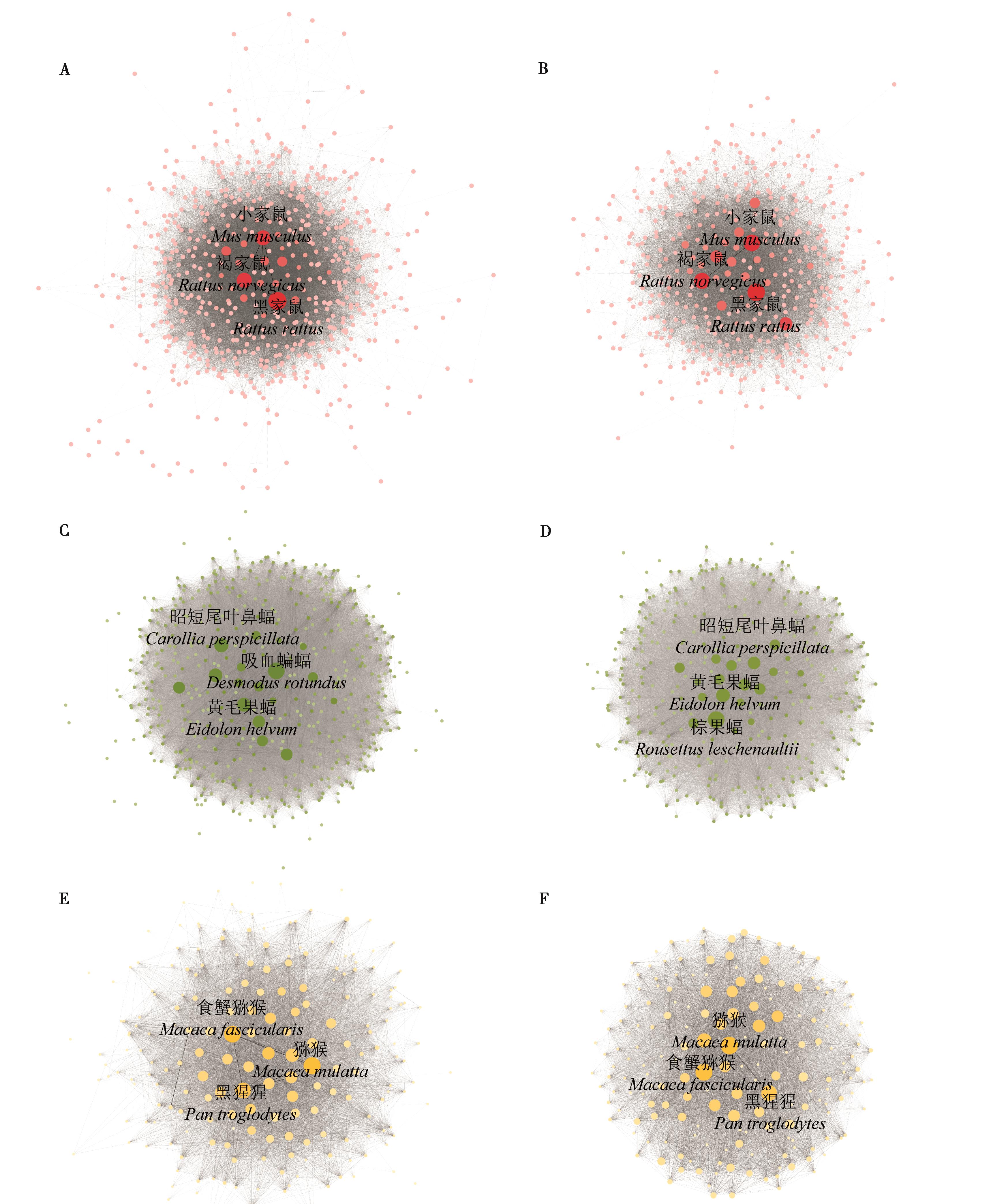
图2 病原共享网络. 啮齿类(啮齿目)(A)总病原和人类相关(B)病原共享网络;蝙蝠类(翼手目)(C)总病原和人类相关(D)病原共享网络;非人灵长类(E)总病原和人类相关(F)病原共享网络
Fig. 2 Microbe-sharing networks. Rodents (Rodentia) (A) total and human-associated (B) microbe-sharing networks; Rats (Chiroptera) (C) total and human-associated (D) microbe-sharing networks; Non-human primates (E) total and human-associated (F) microbe-sharing networks
网络统计指标 Network statistical indicators | 病原共享网络 Microbe-sharing networks | 人类相关病原共享网络 Human-associated microbe-sharing networks | |||||||
|---|---|---|---|---|---|---|---|---|---|
啮齿类 (啮齿目) Rodents (Rodentia) | 蝙蝠类 (翼手目) Bats (Chiroptera) | 非人灵长类 Non-human primates | P值 P value | 啮齿类 (啮齿目) Rodents (Rodentia) | 蝙蝠类 (翼手目) Bats (Chiroptera) | 非人灵长类 Non-human primates | P值 P value | ||
| 同配系数 Assortativity | -0.19 | -0.20 | -0.19 | -0.19 | -0.12 | -0.19 | |||
| 聚类系数 Transitivity | 0.47 | 0.60 | 0.72 | 0.50 | 0.72 | 0.74 | |||
| 网络密度 Density | 0.11 | 0.22 | 0.42 | 0.14 | 0.28 | 0.48 | |||
| 平均度 Mean degree | 64.73 | 106.98 | 88.42 | 59.49 | 98.23 | 90.66 | |||
平均加权度 Mean weighted degree | 121.83 | 219.41 | 248.35 | P < 0.000 1 | 105.90 | 144.43 | 207.84 | P < 0.000 1 | |
校正后的平均加权度 Corrected mean weighted degree | 3 919.03 | 4 211.73 | 1 767.55 | P < 0.000 1 | 2 150.66 | 1 149.16 | 1 255.70 | P < 0.000 1 | |
表4 病原共享网络的统计指标及P值
Table 4 Statistical indicators and P-values for microbe-sharing networks
网络统计指标 Network statistical indicators | 病原共享网络 Microbe-sharing networks | 人类相关病原共享网络 Human-associated microbe-sharing networks | |||||||
|---|---|---|---|---|---|---|---|---|---|
啮齿类 (啮齿目) Rodents (Rodentia) | 蝙蝠类 (翼手目) Bats (Chiroptera) | 非人灵长类 Non-human primates | P值 P value | 啮齿类 (啮齿目) Rodents (Rodentia) | 蝙蝠类 (翼手目) Bats (Chiroptera) | 非人灵长类 Non-human primates | P值 P value | ||
| 同配系数 Assortativity | -0.19 | -0.20 | -0.19 | -0.19 | -0.12 | -0.19 | |||
| 聚类系数 Transitivity | 0.47 | 0.60 | 0.72 | 0.50 | 0.72 | 0.74 | |||
| 网络密度 Density | 0.11 | 0.22 | 0.42 | 0.14 | 0.28 | 0.48 | |||
| 平均度 Mean degree | 64.73 | 106.98 | 88.42 | 59.49 | 98.23 | 90.66 | |||
平均加权度 Mean weighted degree | 121.83 | 219.41 | 248.35 | P < 0.000 1 | 105.90 | 144.43 | 207.84 | P < 0.000 1 | |
校正后的平均加权度 Corrected mean weighted degree | 3 919.03 | 4 211.73 | 1 767.55 | P < 0.000 1 | 2 150.66 | 1 149.16 | 1 255.70 | P < 0.000 1 | |

图3 病原(A)和人类相关病原(B)共享网络节点统计指标及病原(C)和人类相关病原(D)共享网络中心物种节点统计指标
Fig. 3 Statistical indicators for microbes (A) and human-associated (B) microbe-sharing network nodes, and statistical indicators for microbes (C) and human-associated (D) microbe-sharing network nodes of the central species
| Benson D A, Cavanaugh M, Clark K, Karsch‑Mizrachi I, Lipman D J, Ostell J, Sayers E W,2013. GenBank[J].Nucleic Acids Research,41(Database issue):D36‑42. | |
| Bordes F, Caron A, Blasdell K, de Garine‐Wichatitsky M, Morand S, du Toit J,2016. Forecasting potential emergence of zoonotic diseases in South‑East Asia: network analysis identifies key rodent hosts[J].Journal of Applied Ecology,54(3):691‑700. DOI:10.1111/1365-2664.12804 . | |
| Calisher C H, Childs J E, Field H E, Holmes K V, Schountz T,2006. Bats:important reservoir hosts of emerging viruses[J].Clinical Microbiology Reviews,19(3):531‑545. DOI:10.1128/CMR.00017-06 . | |
| Calvignac‑Spencer S, Leendertz S A, Gillespie T R, Leendertz F H,2012. Wild great apes as sentinels and sources of infectious disease[J].Linical Microbiology and Infection,18(6):521‑527. DOI:10.1111/j.1469-0691.2012.03816.x . | |
| Cooper N, Griffin R, Franz M, Omotayo M, Nunn C L, Fryxell J,2012. Phylogenetic host specificity and understanding parasite sharing in primates[J].Ecology Letters,15(12):1370‑1377. DOI:10.1111/j.1461-0248.2012.01858.x . | |
| Daszak P, Cunningham A A, Hyatt A D,2000. Emerging infectious diseases of wildlife‑threats to biodiversity and human health[J].Science,287(5452):443‑449. DOI:10.1126/science.287.5452.443 . | |
| Ecke F, Han B A, Hornfeldt B, Khalil H, Magnusson M, Singh N J, Ostfeld R S,2022. Population fluctuations and synanthropy explain transmission risk in rodent‑borne zoonoses[J].Nature Communications,13(1):7532. DOI:10.1038/s41467-022-35273-7 . | |
| Gomez J M, Nunn C L, Verdu M,2013. Centrality in primate‑parasite networks reveals the potential for the transmission of emerging infectious diseases to humans[J].Proceedings of the National Academy of Sciences of the United States of America,110(19):7738‑7741. DOI:10.1073/pnas. 1220716110 . | |
| Han B A, Schmidt J P, Bowden S E, Drake J M,2015. Rodent reservoirs of future zoonotic diseases[J].Proceedings of the National Academy of Sciences of the United States of America,112(22):7039‑7044. DOI:10.1073/pnas.1501598112 . | |
| Johnson P T, de Roode J C, Fenton A,2015. Why infectious disease research needs community ecology[J].Science,349(6252):1259504. DOI:10.1126/science.1259504 . | |
| Jones K E, Patel N G, Levy M A, Storeygard A, Balk D, Gittleman J L, Daszak P,2008. Global trends in emerging infectious diseases[J].Nature,451(7181):990‑993. DOI:10.1038/nature06536 . | |
| Karesh W B, Dobson A, Lloyd‑Smith J O, Lubroth J, Dixon M A, Bennett M, Aldrich S, Harrington T, Formenty P, Loh E H, Machalaba C C, Thomas M J, Heymann D L,2012. Ecology of zoonoses: natural and unnatural histories[J].Lancet,380(9857):1936‑1945. DOI:10.1016/S0140-6736(12)61678-X . | |
| Li B G, Zhang H, Li M, Jiang X L, Fan P F, Zhou J, Guo S T, Qi X G, Li J H, Lu J Q, Xia D P, Cui L W, Xiang Z F, Zhou Q H, Huang Z P, Huang C M, Xiao W, Hu H J, Zhou Z X, Chen M Y, Li D Y, Fan P L, Yang Y, Pan R L,2024. Achievements and challenges of primate conservation in China[J].Zoological Research:Diversity and Conservation,1(1):66‑74. | |
| Li H, Chen Y, Machalaba C C, Tang H, Chmura A A, Fielder M D, Daszak P,2021. Wild animal and zoonotic disease risk management and regulation in China:examining gaps and One Health opportunities in scope,mandates,and monitoring systems[J].One Health,13. DOI:10.1016/j.onehlt. 2021. 100301 . | |
| Liu W, Worobey M, Li Y, Keele B F, Bibollet‑Ruche F, Guo Y, Goepfert P A, Santiago M L, Ndjango J B, Neel C, Clifford S L, Sanz C, Kamenya S, Wilson M L, Pusey A E, Gross‑Camp N, Boesch C, Smith V, Zamma K, Huffman M A, Mitani J C, Watts D P, Peeters M, Shaw G M, Switzer W M, Sharp P M, Hahn B H,2008. Molecular ecology and natural history of simian foamy virus infection in wild‑living chimpanzees[J].PLoS Pathog,4(7).DOI:10.1371/journal.ppat. 1000097 . | |
| Luis A D, Hayman D T, O’Shea T J, Cryan P M, Gilbert A T, Pulliam J R, Mills J N, Timonin M E, Willis C K, Cunningham A A, Fooks A R, Rupprecht C E, Wood J L, Webb C T,2013. A comparison of bats and rodents as reservoirs of zoonotic viruses:are bats special?[J].Proceedings of the Royal Society B:Biological Sciences,280(1756). DOI: 10.1098/rspb. 2012.2753 . | |
| Luis A D, O’Shea T J, Hayman D T S, Wood J L N, Cunningham A A, Gilbert A T, Mills J N, Webb C T,2015. Network analysis of host‑virus communities in bats and rodents reveals determinants of cross‑species transmission[J].Ecology Letters,18(11):1153‑1162. DOI:10.1111/ele.12491 . | |
| Mammal Diversity Database,2024. Mammal diversity database[DB/OL].DOI:10.5281/zenodo.12738010.(Accessed on 2024‑12‑06) | |
| Mou X, Qian Y, Li M, Li B, Luo X, Li S,2024. A new species of Murina(Chiroptera:Vespertilionidae) from Yunnan,China[J].Animals(Basel),14(16).DOI:10.3390/ani 14162371 . | |
| Olival K J, Hosseini P R, Zambrana‑Torrelio C, Ross N, Bogich T L, Daszak P,2017. Host and viral traits predict zoonotic spillover from mammals[J].Nature,546(7660):646‑650. DOI:10.1038/nature22975 . | |
| Schoch C L, Ciufo S, Domrachev M, Hotton C L, Kannan S, Khovanskaya R, Leipe D, McVeigh R, O’Neill K, Robbertse B, Sharma S, Soussov V, Sullivan J P, Sun L, Turner S, Karsch‑Mizrachi I,2020. NCBI Taxonomy:a comprehensive update on curation,resources and tools[EB/OL]. Database(Oxford). DOI:10.1093/database/baaa062 . | |
| Shang Yuchang,2016. Status and advance on study of behavior and ecology in primates(IV):primate society[J].Chinese Journal of Nature,38(5):367‑370.DOI:10.3969/j.issn. 0253-9608.2016.05.007. (in Chinese with English abstract) | |
| Shannon P, Markiel A, Ozier O, Baliga N S, Wang J T, Ramage D, Amin N, Schwikowski B, Ideker T,2003. Cytoscape: a software environment for integrated models of biomolecular interaction networks[J].Genome Research,13(11):2498‑2504. DOI:10.1101/gr.1239303 . | |
| Simmons N B, Cirranello A L,2024. Bat species of the world: A taxonomic and geographic database [DB/OL]. Version 1.6. DOI:10.5281/zenodo.12802826.(Accessed on 2024‑12‑06) | |
| Taylor L H, Latham S M, Woolhouse M E,2001. Risk factors for human disease emergence[J].Philosophical Transactions of the Royal Society B:Biological Sciences,356(1411):983‑989. DOI:10.1098/rstb.2001.0888 . | |
| Wang L F, Walker P J, Poon L L,2011. Mass extinctions,biodiversity and mitochondrial function:are bats ‘special’ as reservoirs for emerging viruses?[J].Current Opinion in Virology,1(6):649‑657. DOI:10.1016/j.coviro.2011.10.013 . | |
| Wang X, Han X, Csorba G, Wu Y, Chen H, Zhao X, Dong Z, Yu W, Lu Z, Moratelli R,2024. A new species of tube‑nosed bat(Chiroptera:Vespertilionidae:Murina)from Qinghai‑Xizang Plateau,China[J]. Journal of Mammalogy,106(1):178‑186. DOI:10.1093/jmammal/gyae104 . | |
| Wardeh M, Risley C, McIntyre M K, Setzkorn C, Baylis M,2015. Database of host‑microbe and related species interactions,and their global distribution[J].Scientific Data,2:150049. | |
| White L A, Forester J D, Craft M E,2017. Using contact networks to explore mechanisms of parasite transmission in wildlife[J]. Biological Reviews of the Cambridge Philosophical Society,92(1):389‑409. DOI:10.1111/brv.12236 . | |
| 尚玉昌,2016. 灵长动物行为与生态学的研究现状与进展(四):灵长动物的社会性[J].自然杂志,38(5):367‑370. DOI:10.3969/j.issn.0253-9608.2016.05.007 . | |
| 魏辅文,杨奇森,吴毅,蒋学龙,刘少英,2022. 中国兽类分类与分布[M]. 北京:科学出版社. |
| [1] | 秦嘉豪, 何向阳, 黄泽双, 朱俊宇, 颜奥然, 沈田田, 赵华斌, 张礼标. 阿拉善伏翼在陕西省和江苏省的新纪录[J]. 兽类学报, 2026, 46(3): 444-452. |
| [2] | 黄泰涵, 傅晓雪, 李健, 王涛, 刘昊, 张炼, 蒋夏威, 李雪, 凌征文, 张泽钧, 石红艳. 四川翼手类一新纪录——菲氏管鼻蝠[J]. 兽类学报, 2026, 46(3): 453-462. |
| [3] | 张一舟, 姚永芳, 肖洪涛, 解萌, 武佳韵, 倪庆永, 杨盛智, 徐怀亮, 熊鹰. 非人灵长类和鹦鹉脑大小与多样化速率间的全球趋同关系[J]. 兽类学报, 2025, 45(4): 438-445. |
| [4] | 刘佩莹, 何向阳, 王龙祥, 邓瑾, 黄泽双, 陈创杰, 邱源, 张礼标. 广西发现霍氏鼠耳蝠及印支鼠耳蝠[J]. 兽类学报, 2025, 45(2): 243-250. |
| [5] | 苏浩晖, 刁海欣, 詹夏沁, 何敏怡, 黄泽锋, 吴毅, 林良恭, 陈中正, 蒋学龙, 王晓云, 余文华. 西藏采集大蹄蝠指名亚种特征描述及亚种分类的探讨[J]. 兽类学报, 2025, 45(2): 175-184. |
| [6] | 詹夏沁, 苏浩晖, 何敏怡, 蔡斌, 雍凡, 崔鹏, 吴毅, 余文华, 王晓云. 水甫管鼻蝠湖南和福建新分布及适生区预测[J]. 兽类学报, 2025, 45(2): 209-217. |
| [7] | 杜建滢, 郭东革, 陈煜, 王续帆, 范巧丹, 徐言言, 刘森. 北京宽耳蝠河北新纪录及其声音和食性初步研究[J]. 兽类学报, 2025, 45(2): 218-227. |
| [8] | 李易航, 李彦男, 李仲乐, 冯江, 林爱青. 柯氏长耳蝠中国再发现[J]. 兽类学报, 2025, 45(2): 228-235. |
| [9] | 丁晶晶, 王梽强, 司曼, 翟飞飞, 王玄, 赵永强, 孙文杰, 黄正澜懿, 王磊, 江廷磊. 江苏省翼手目二新纪录:高颅鼠耳蝠和亚洲长翼蝠[J]. 兽类学报, 2025, 45(2): 236-242. |
| [10] | 孙浩, 翟瑞清, 汪琪莹, 凌化矾, 吴孝兵, 潘涛. 安徽翼手目分布新纪录:暗褐彩蝠[J]. 兽类学报, 2025, 45(2): 265-270. |
| [11] | 李毅, 王奕凯, 骆畅, 叶秀林, 吴忠荣, 匡中帆, 赵序茅. 贵阳市人猴冲突及其时空分布[J]. 兽类学报, 2024, 44(4): 449-455. |
| [12] | 李念隆, 赵海涛, 李炜, 王晓卫, 王程亮, 牟俊洁, 李保国. 非人灵长类的个性研究进展[J]. 兽类学报, 2024, 44(1): 118-128. |
| [13] | 林锦煌, 姚辉, 吴锋, 向左甫. 色彩信号在非人灵长类动物性选择中的作用[J]. 兽类学报, 2024, 44(1): 103-117. |
| [14] | 黄泽锋, 廖雅晴, 王晓云, 张惠光, 蔡斌, 雍凡, 崔鹏, 余文华, 吴毅. 福建省两种管鼻蝠新纪录[J]. 兽类学报, 2023, 43(4): 472-478. |
| [15] | 邵伟伟, 乔芬, 蔡玮, 林植华, 韦力. 大蹄蝠全基因组微卫星分布特征分析[J]. 兽类学报, 2023, 43(2): 182-192. |
| 阅读次数 | ||||||
|
全文 |
|
|||||
|
摘要 |
|
|||||
 青公网安备 63010402000199号 青ICP备05000010号-2