

中国核心期刊要目总览
中国科技核心期刊
CSCD数据库源刊
中国科技核心期刊
CSCD数据库源刊
兽类学报 ›› 2026, Vol. 46 ›› Issue (2): 209-219.DOI: 10.16829/j.slxb.151075
曲嫱1, 王力1, 吴慧1,2( ), 冯江1,2
收稿日期:2025-03-06
接受日期:2025-09-01
出版日期:2026-03-30
发布日期:2026-03-06
通讯作者:
吴慧
作者简介:曲嫱(2000- ),女,硕士,主要从事野生动物行为生态学研究.
基金资助:
Qiang QU1, Li WANG1, Hui WU1,2(), Jiang FENG1,2
Received:2025-03-06
Accepted:2025-09-01
Online:2026-03-30
Published:2026-03-06
Contact:
Hui WU
摘要:
食虫蝙蝠作为高效的夜间捕食者,其害虫控制生态服务功能的量化评估已成为当前研究热点。准确精细分析食虫蝙蝠食性中害虫的比例,尤其是针对异质农业景观中不同觅食生境偏好的食虫蝙蝠,分析比较其食性差异对于客观评估其提供的害虫控制服务功能至关重要。本研究以云南省普洱市异质性农业景观中的食虫蝙蝠作为研究对象,通过DNA宏条形码技术,系统解析了开阔空间、狭窄空间以及边缘空间3个觅食类群食虫蝙蝠的食物组成及其食性中有害昆虫占比,并分析各类群蝙蝠食性中昆虫的占比与环境中食物资源占比的相关性。结果表明,10种食虫蝙蝠食性中最常见的昆虫类型为鳞翅目,占总昆虫量的73.1%。食虫蝙蝠食物组成中害虫比例超过88.7%。3个觅食类群食虫蝙蝠食性中昆虫目水平的组成与环境中食物资源的组成均呈现显著相关。开阔空间觅食类群食性中害虫比例超过85.0%,狭窄空间觅食类群食性中昆虫目水平的多样性最高,边缘空间觅食类群所捕食的农业害虫中鳞翅目(99.13%)昆虫占绝对优势。本研究精细分析异质景观中3个觅食类群食虫蝙蝠食物组成及其食性中的害虫比例,证实食虫蝙蝠控制害虫的有效性。研究结果不仅为蝙蝠在生态系统中的害虫控制功能提供了直接的证据,也为蝙蝠物种多样性保护提供了科学依据。
中图分类号:
曲嫱, 王力, 吴慧, 冯江. 同域十种食虫蝙蝠的食物组成及其害虫控制作用研究[J]. 兽类学报, 2026, 46(2): 209-219.
Qiang QU, Li WANG, Hui WU, Jiang FENG. Study on dietary composition and pest control roles of ten sympatric insectivorous bat species[J]. ACTA THERIOLOGICA SINICA, 2026, 46(2): 209-219.
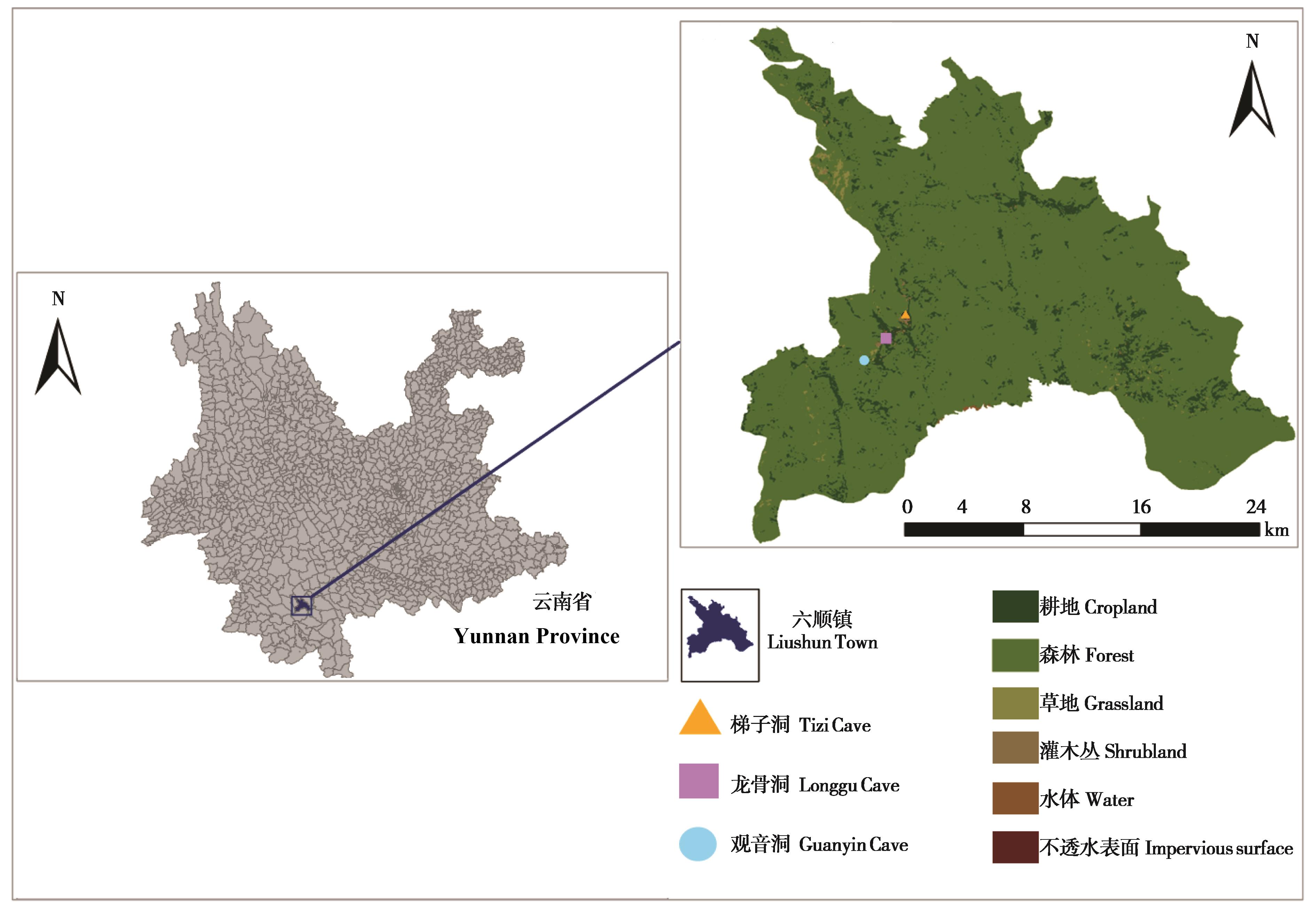
图1 研究区域3个蝙蝠洞穴采样点及周边生境特征
Fig.1 The characteristics of three sampling sites of bat caves and surrounding habitats in the study area
物种 Species | 平均前臂长 Mean forearm length/mm | 平均体质量 Average weight/g | 雌性个体数量 No.of female | 雄性个体数量 No.of male | 粪便样本 Fecal sample |
|---|---|---|---|---|---|
| 黑髯墓蝠 Taphozous melanopogon | 65.65 | 27.16 | 41 | 31 | 10 ♀ |
| 亚洲长翼蝠 Miniopterus fuliginosus | 47.38 | 14.46 | 9 | 16 | 5 ♀;5 ♂ |
| 南蝠 Iaio | 77.78 | 58.66 | 3 | 5 | 3 ♀;5 ♂ |
| 中华鼠耳蝠 Myotis chinensis | 66.18 | 27.43 | 3 | 1 | 3 ♀;1 ♂ |
| 大足鼠耳蝠 Myotis pilosus | 59.95 | 23.77 | 2 | 1 | 2 ♀;1 ♂ |
| 大蹄蝠 Hipposideros armiger | 96.93 | 54.15 | 15 | 17 | 14 ♀;16 ♂ |
| 小蹄蝠 Hipposideros pomona | 42.46 | 7.17 | 7 | 2 | 6 ♀;2 ♂ |
| 三叶小蹄蝠 Aselliscus stoliczkanus | 43.17 | 6.04 | 15 | 4 | 4 ♀;1 ♂ |
| 大菊头蝠 Rhinolophus perniger | 75.54 | 38.37 | 2 | 1 | 1♀ |
| 中华菊头蝠 Rhinolophus sinicus | 44.44 | 9.15 | 0 | 3 | 1♂ |
表1 采集的蝙蝠物种及其体型数据以及雌雄个体数量
Table 1 Collected data on bat species including their bodysize as well as the number of male and female individuals
物种 Species | 平均前臂长 Mean forearm length/mm | 平均体质量 Average weight/g | 雌性个体数量 No.of female | 雄性个体数量 No.of male | 粪便样本 Fecal sample |
|---|---|---|---|---|---|
| 黑髯墓蝠 Taphozous melanopogon | 65.65 | 27.16 | 41 | 31 | 10 ♀ |
| 亚洲长翼蝠 Miniopterus fuliginosus | 47.38 | 14.46 | 9 | 16 | 5 ♀;5 ♂ |
| 南蝠 Iaio | 77.78 | 58.66 | 3 | 5 | 3 ♀;5 ♂ |
| 中华鼠耳蝠 Myotis chinensis | 66.18 | 27.43 | 3 | 1 | 3 ♀;1 ♂ |
| 大足鼠耳蝠 Myotis pilosus | 59.95 | 23.77 | 2 | 1 | 2 ♀;1 ♂ |
| 大蹄蝠 Hipposideros armiger | 96.93 | 54.15 | 15 | 17 | 14 ♀;16 ♂ |
| 小蹄蝠 Hipposideros pomona | 42.46 | 7.17 | 7 | 2 | 6 ♀;2 ♂ |
| 三叶小蹄蝠 Aselliscus stoliczkanus | 43.17 | 6.04 | 15 | 4 | 4 ♀;1 ♂ |
| 大菊头蝠 Rhinolophus perniger | 75.54 | 38.37 | 2 | 1 | 1♀ |
| 中华菊头蝠 Rhinolophus sinicus | 44.44 | 9.15 | 0 | 3 | 1♂ |
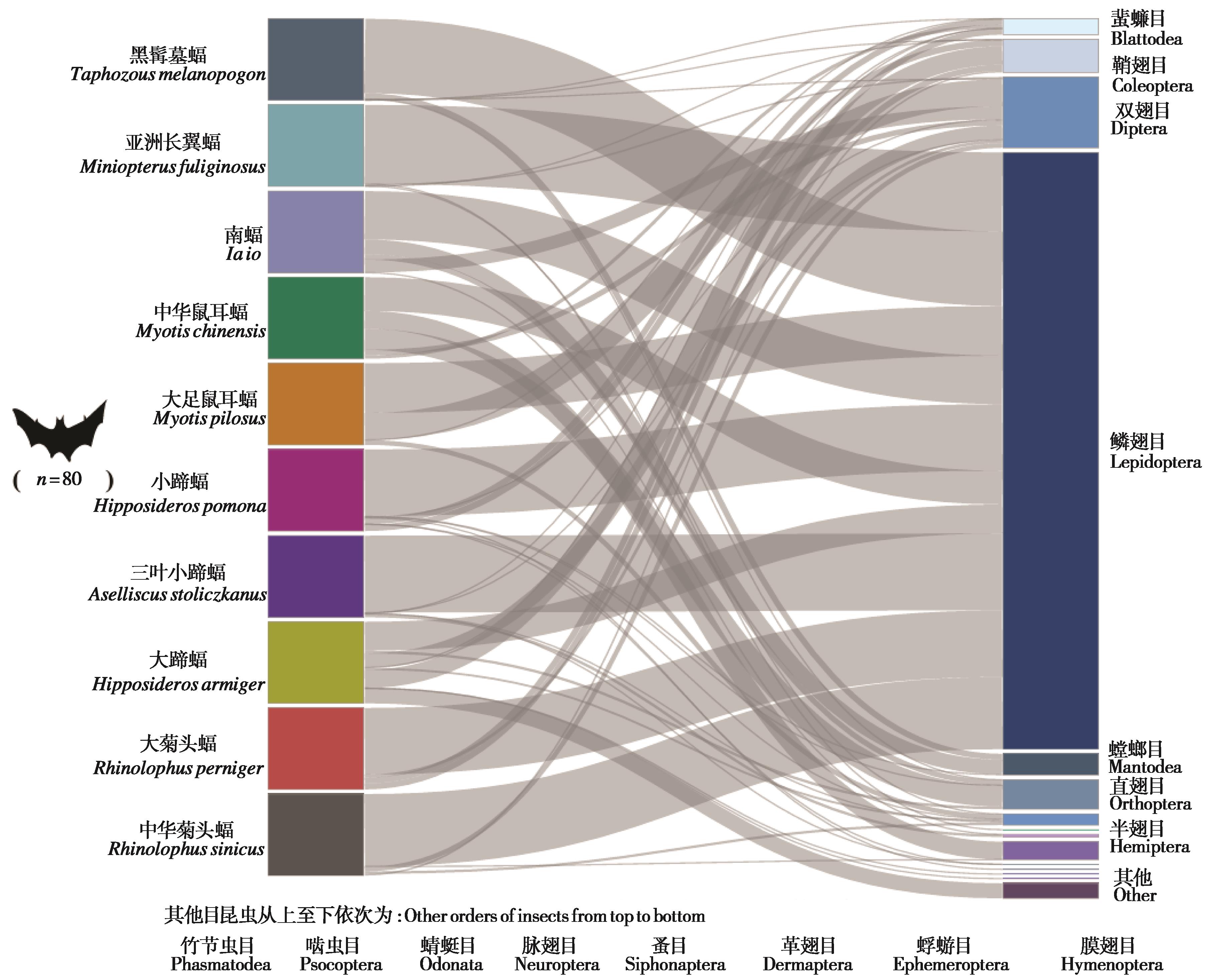
图2 三个觅食类群食虫蝙蝠及其猎物之间的捕食者-猎物营养网络
Fig. 2 The predator-prey food web between three foraging guilds of insectivorous bats and their main prey
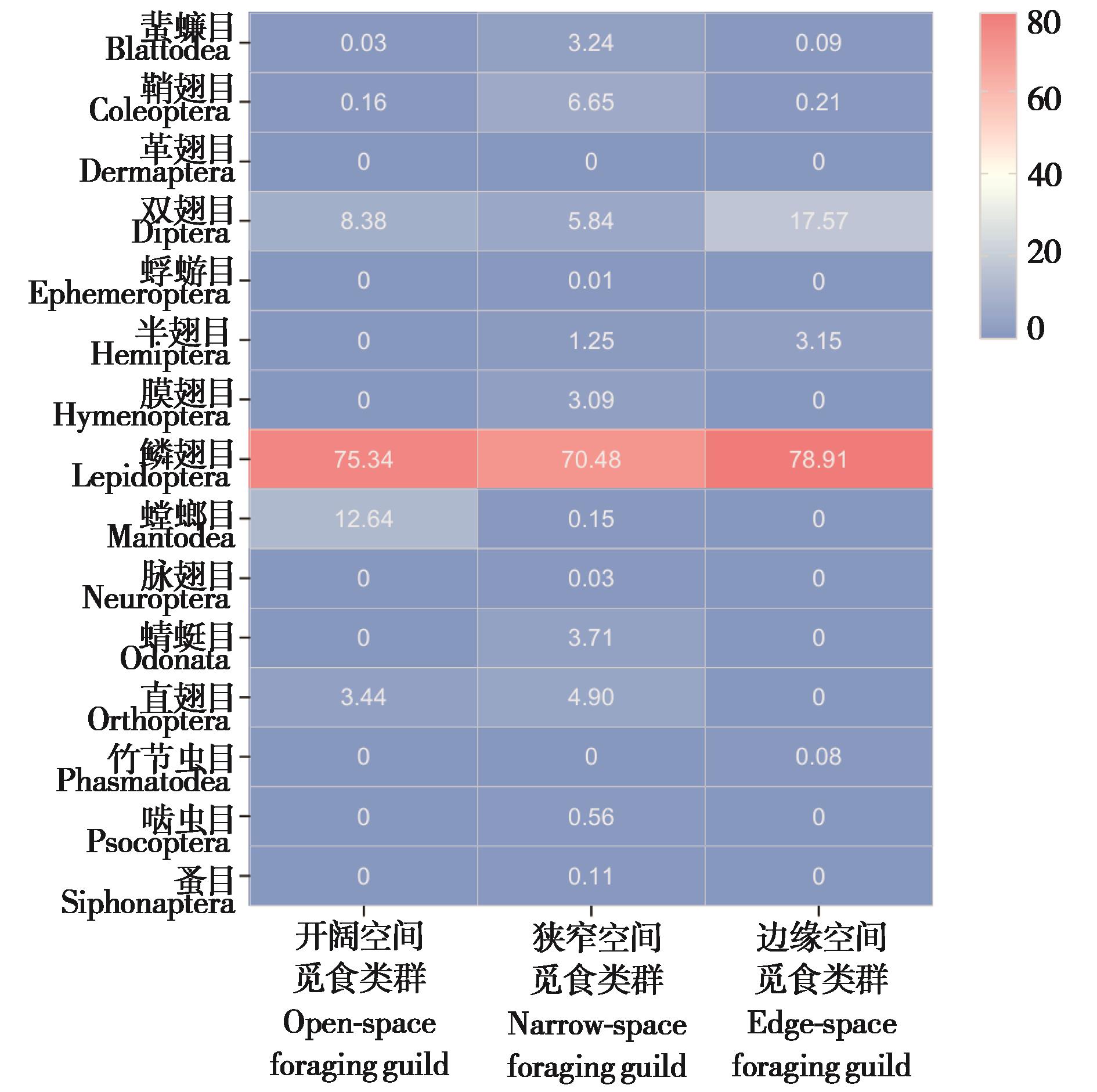
图3 三个觅食类群食虫蝙蝠的食物组成在目水平上的分布
Fig. 3 Distribution of dietary composition at the order level in three foraging guilds of insectivorous bats
| 目Order | 科Family | 物种 Species | 出现频率百分比%FOO | 分类 Classification |
|---|---|---|---|---|
| 鳞翅目 Lepidoptera | 天蛾科 Sphingidae | 栗六点天蛾 Marumba sperchius | 4.64% | b |
| 鳞翅目 Lepidoptera | 裳蛾科 Erebidae | 苹梢鹰夜蛾 Hypocala subsatura | 3.67% | a, b |
| 双翅目 Diptera | 丽蝇科 Calliphoridae | 壶绿蝇 Lucilia ampullacea | 3.51% | a, c |
| 膜翅目 Hymenoptera | 蜜蜂科 Apidae | 大蜜蜂 Apis dorsata | 3.21% | d |
| 鳞翅目 Lepidoptera | 木蠹蛾科 Cossidae | 白背斑目蠹蛾 Xyleutes persona | 3.17% | a, b |
| 螳螂目 Mantodea | 螳螂科 Mantidae | 田野静螳 Statilia agresta | 3.15% | d |
| 鳞翅目 Lepidoptera | 草螟科 Crambidae | 稻纵卷叶螟 Cnaphalocrocis medinalis | 3.09% | a |
| 鳞翅目 Lepidoptera | 天蚕蛾科 Saturniidae | 明目大蚕蛾 Antheraea frithi | 3.06% | a, b |
| 膜翅目 Hymenoptera | 蚁科 Formicidae | 大头蚁属 Pheidole sp. | 2.97% | d |
| 直翅目 Orthoptera | 螽斯科 Tettigoniidae | 日本纺织娘 Mecopoda niponensis | 2.21% | a, b |
| 鳞翅目 Lepidoptera | 天蛾科 Sphingidae | 台湾鹰翅天蛾 Ambulyx sericeipennis | 2.04% | b |
| 鳞翅目 Lepidoptera | 夜蛾科 Noctuidae | 易点夜蛾 Condica illecta | 1.63% | a |
| 鞘翅目 Coleoptera | 叶甲科 Chrysomelidae | 十星瓢萤叶甲 Oides decempunctatus | 1.63% | a |
| 鳞翅目 Lepidoptera | 天蛾科 Sphingidae | 缺角天蛾属 Acosmeryx | 1.53% | a, b |
| 鳞翅目 Lepidoptera | 夜蛾科 Noctuidae | 白条夜蛾 Ctenoplusia albostriata | 1.53% | a |
表2 十种蝙蝠捕食的主要节肢动物的物种分类、出现频率以及功能性分类
Table 2 List of species classification, frequency of occurrence and functional classification of the main arthropods preyed on by ten species of bats
| 目Order | 科Family | 物种 Species | 出现频率百分比%FOO | 分类 Classification |
|---|---|---|---|---|
| 鳞翅目 Lepidoptera | 天蛾科 Sphingidae | 栗六点天蛾 Marumba sperchius | 4.64% | b |
| 鳞翅目 Lepidoptera | 裳蛾科 Erebidae | 苹梢鹰夜蛾 Hypocala subsatura | 3.67% | a, b |
| 双翅目 Diptera | 丽蝇科 Calliphoridae | 壶绿蝇 Lucilia ampullacea | 3.51% | a, c |
| 膜翅目 Hymenoptera | 蜜蜂科 Apidae | 大蜜蜂 Apis dorsata | 3.21% | d |
| 鳞翅目 Lepidoptera | 木蠹蛾科 Cossidae | 白背斑目蠹蛾 Xyleutes persona | 3.17% | a, b |
| 螳螂目 Mantodea | 螳螂科 Mantidae | 田野静螳 Statilia agresta | 3.15% | d |
| 鳞翅目 Lepidoptera | 草螟科 Crambidae | 稻纵卷叶螟 Cnaphalocrocis medinalis | 3.09% | a |
| 鳞翅目 Lepidoptera | 天蚕蛾科 Saturniidae | 明目大蚕蛾 Antheraea frithi | 3.06% | a, b |
| 膜翅目 Hymenoptera | 蚁科 Formicidae | 大头蚁属 Pheidole sp. | 2.97% | d |
| 直翅目 Orthoptera | 螽斯科 Tettigoniidae | 日本纺织娘 Mecopoda niponensis | 2.21% | a, b |
| 鳞翅目 Lepidoptera | 天蛾科 Sphingidae | 台湾鹰翅天蛾 Ambulyx sericeipennis | 2.04% | b |
| 鳞翅目 Lepidoptera | 夜蛾科 Noctuidae | 易点夜蛾 Condica illecta | 1.63% | a |
| 鞘翅目 Coleoptera | 叶甲科 Chrysomelidae | 十星瓢萤叶甲 Oides decempunctatus | 1.63% | a |
| 鳞翅目 Lepidoptera | 天蛾科 Sphingidae | 缺角天蛾属 Acosmeryx | 1.53% | a, b |
| 鳞翅目 Lepidoptera | 夜蛾科 Noctuidae | 白条夜蛾 Ctenoplusia albostriata | 1.53% | a |
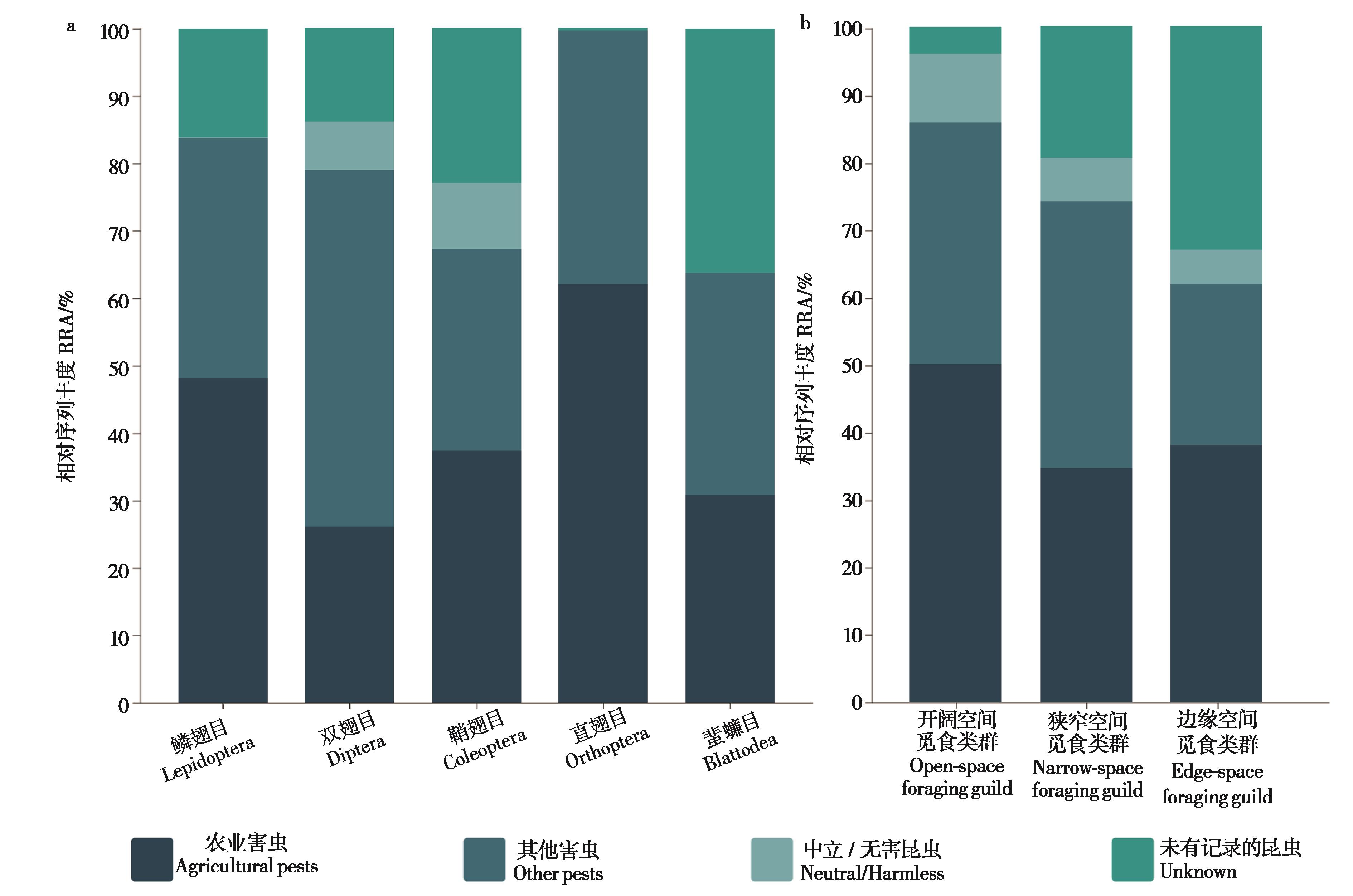
图4 三个觅食类群食虫蝙蝠所捕食主要的目水平(a)和每类食虫蝙蝠的食性中不同功能猎物的比例(b)
Fig. 4 The proportion of different functional prey found at the total order level of three foraging guilds of insectivorous bats (a) and in the diet of each insectivorous bat guild (b). RRA: Relative read abundance
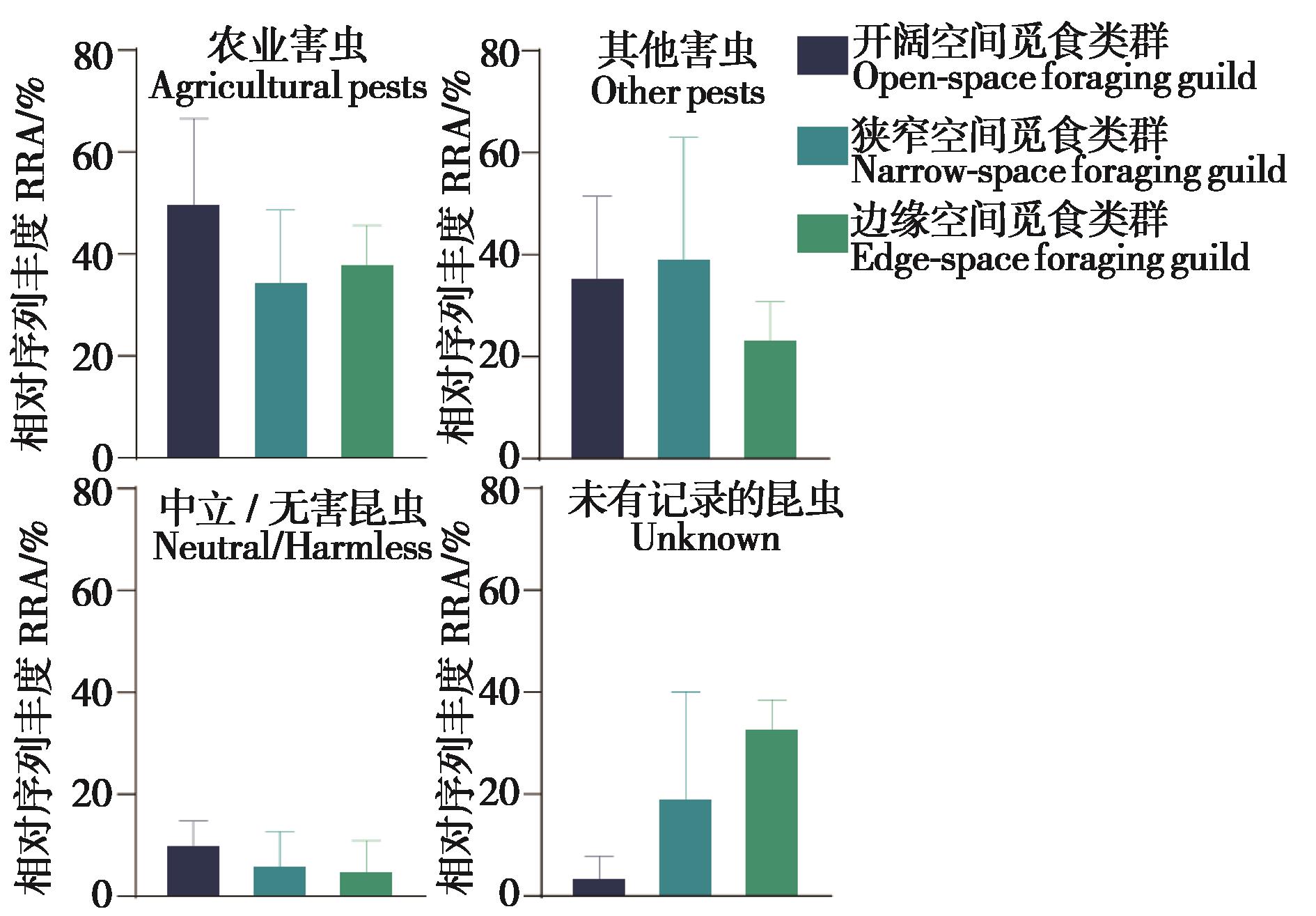
图5 三个觅食类群食虫蝙蝠食性中功能性猎物组成在目水平上的差异
Fig.5 Differences in functional prey composition at the order level among three foraging guilds of insectivorous bats. RRA: Relative read abundance
| Aizpurua O, Budinski I, Georgiakakis P, Gopalakrishnan S, Ibañez C, Mata V, Rebelo H, Russo D, Szodoray‑Parádi F, Zhelyazkova V, Zrncic V, Gilbert T, Alberdi A,2018. Agriculture shapes the trophic niche of a bat preying on multiple pest arthropods across Europe:evidence from DNA metabarcoding[J].Molecular Ecology,27(3):815‑825. DOI:10.1111/mec.14474 . | |
| Alberdi A, Gilbert M T P,2019. A guide to the application of Hill numbers to DNA‐based diversity analyses[J]. Molecular Ecology Resources,19(4):804‑817. DOI:10.1111/1755-0998. 13014 . | |
| Ancillotto L, Borrello M, Caracciolo F, Dartora F, Ruberto M, Rummo R, Scaramella C, Odore A, Garonna A P, Russo D,2024. A bat a day keeps the pest away:bats provide valuable protection from pests in organic apple orchards[J].Journal for Nature Conservation,78:126558. DOI:10.1016/j.jnc.2024.126558 . | |
| Bhalla I S, Aguirre‐Gutiérrez J, Whittaker R J,2023. Batting for rice:the effect of bat exclusion on rice in North‑East India[J].Agriculture,Ecosystems & Environment,341:108196. DOI:10.1016/J.AGEE.2022.108196 . | |
| Bolger A M, Lohse M, Usadel B,2014. Trimmomatic:a flexible trimmer for Illumina sequence data[J].Bioinformatics,30(15):2114‑2120. DOI:10.1093/bioinformatics/btu170 . | |
| Na Borray‑Escalante, Pérez‑Torres J, Castro‑Benítez M,2022. Nutritional Ecology of Carollia perspicillata(Chiroptera:Phyllostomidae):relationship between the preference and the nutritional content of fruits[J].Acta Chiropterologica,24:177‑185. DOI:10.3161/15081109ACC2022.24.1.014 | |
| Boyles J G, Cryan P M, Mccracken G F, Kunz T H,2011. Economic importance of bats in agriculture[J].Science,332(6025):41‑42. DOI:10.1126/science.1201366 . | |
| Brown D S, Burger R, Cole N, Vencatasamy D, Clare E L, Montazam A, Symondson W O C,2014. Dietary competition between the alien Asian musk shrew(Suncus murinus)and a re‐introduced population of Telfair’s skink(Leiolopisma telfairii)[J].Molecular Ecology,23(15):3695‑3705. DOI:10.1111/mec.12445 | |
| Chang Y, Song S, Li A, Zhang Y, Li Z, Xiao Y, Jiang T, Feng J, Lin A,2019. The roles of morphological traits,resource variation and resource partitioning associated with the dietary niche expansion in the fish‐eating bat Myotis pilosus [J].Molecular Ecology,28(11):2944‑2954. DOI:10.1111/mec.15127 . | |
| Coutts R A, Fenton M B, Glen E,1973. Food intake by captive Myotis lucifugus and Eptesicus fuscus(Chiroptera:Vespertilionidae)[J].Journal of Mammalogy,54(4):985‑990. DOI:10.2307/1379098 . | |
| Deagle B E, Thomas A C, Mcinnes J C, Clarke L J, Vesterinen E J, Clare E L, Kartzinel T R, Eveson J P,2018. Counting with DNA in metabarcoding studies:How should we convert sequence reads to dietary data?[J].Molecular Ecology,28(2):391‑406. DOI:10.1111/mec.14734 . | |
| Denzinger A, Schnitzler H U,2013. Bat guilds,a concept to classify the highly diverse foraging and echolocation behaviors of microchiropteran bats[J].Frontiers in Physiology,4:164. DOI:10.3389/fphys.2013.00164 . | |
| Edgar R C,2010. Search and clustering orders of magnitude faster than blast[J].Bioinformatics,26(19):2460‑2461.DOI:10.1093/bioinformatics/btq461 . | |
| Folmer O, Black M, Hoeh W, Lutz R, Vrijenhoek R,1994. DNA primers for amplification of mitochondrial cytochrome c oxidase subunit I from diverse metazoan invertebrates[J].Molecular Marine Biology and Biotechnology,3(5):294‑299.DOI:10.4028/www.scientific.net/DDF.7.460 . | |
| Foster Z S, Sharpton T J, Grünwald N J,2017. Metacoder:An R package for visualization and manipulation of community taxonomic diversity data[J]. PLoS Computational Biology,13(2):e1005404. DOI:10.1371/journal.pcbi.1005404 . | |
| Froidevaux J S, Louboutin B, Jones G J,2017. Does organic farming enhance biodiversity in Mediterranean vineyards?A case study with bats and arachnids[J].Agriculture,Ecosystems & Environment,249:112‑122.DOI:10.1016/j.agee. 2017.08.012 . | |
| Jung K, Molinari J, Kalko E K,2014. Driving factors for the evolution of species‑specific echolocation call design in new world free‑tailed bats(Molossidae)[J].PLoS ONE,9(1):e85279. DOI:10.1371/journal.pone.0085279 . | |
| Kolkert H, Smith R, Rader R, Reid N,2021. Insectivorous bats provide significant economic value to the Australian cotton industry[J].Ecosystem Services,49:101280. DOI:1016/J.ECOSER.2021.101280 . | |
| Kunz T H, Braun De Torrez E, Bauer D, Lobova T, Fleming T H,2011. Ecosystem services provided by bats[J]. Annals of the New York Academy of Sciences,1223(1):1‑38. DOI:10.1111/j.1749-6632.2011.06004 . | |
| Kunz T H, Stern A A,1995. Maternal investment and post‑natal growth in bats[J].Ecology,Evolution and Behaviour of Bats,123‑138. DOI:10.1093/oso/9780198549451.003.0008 . | |
| Lee Y F, Kuo Y M, Chu W C, Lin Y H,2020. Perch use by flycatching Rhinolophus formosae in relation to vegetation structure[J]. Journal of Mammalogy,101(2):455‑463. DOI:10.1093/jmammal/gyz213 . | |
| Librán‑Embid F, De Coster G, Metzger J P,2017. Effects of bird and bat exclusion on coffee pest control at multiple spatial scales[J].Landscape Ecology,32:1907‑1920.DOI:10.1007/s10980-017-0555-2 . | |
| Linden V M, Grass I, Joubert E, Tscharntke T, Weier S M, Taylor P J,2019. Ecosystem services and disservices by birds,bats and monkeys change with macadamia landscape heterogeneity[J].Journal of Applied Ecology,56(8):2069‑2078. DOI:10.1111/1365-2664.13424 . | |
| Lothian A J, Hoye G A,2023. Emergence patterns at a non‑breeding eastern bent‑winged bat(Miniopterus orianae oceanensis)roost in New South Wales[J].Australian Mammalogy,45(3):361‑368. DOI:10.1071/AM22023 . | |
| Luo B, Leiser‑Miller L, Santana S E, Zhang L, Liu T, Xiao Y, Liu Y, Feng J,2019. Echolocation call divergence in bats:a comparative analysis[J].Behavioral Ecology and Sociobiology,73(11):154. DOI:10.1007/s00265-019-2766-9 . | |
| Magoč T, Salzberg S L,2011. FLASH:fast length adjustment of short reads to improve genome assemblies[J].Bioinformatics,27(21):2957‑2963. DOI:10.1093/bioinformatics/btr507 . | |
| Maine J J, Boyles J G,2015. Bats initiate vital agroecological interactions in corn[J].Proceedings of the National Academy of Sciences,112(40):12438‑12443.DOI:10.1073/pnas. 1505413112 . | |
| Maas B, Karp D S, Bumrungsri S, Darras K, Gonthier D, Huang J C C, Lindell C A, Maine J J, Mestre L, Michel N L, Morrison E B, Perfecto I, Philpott S M, Şekercioğlu Ç H, Silva R M, Taylor P J, Tscharntke T, Bael S A V, Whelan C J, Williams‑Guillén K,2016. Bird and bat predation services in tropical forests and agroforestry landscapes[J].Biological Reviews,91(4):1081‑1101.DOI:10.1111/brv.12211 . | |
| Miya M, Sato Y, Fukunaga T, Sado T, Poulsen J Y, Sato K, Minamoto T, Yamamoto S, Yamanaka H, Araki H, Kondoh M, Iwasaki W,2015. MiFish,a set of universal PCR primers for metabarcoding environmental DNA from fishes:detection of more than 230 subtropical marine species[J].Royal Society Open Science,2(7):150088. DOI:10.1098/rsos.150088 . | |
| Murray D C, Coghlan M L, Bunce M,2015. From benchtop to desktop:important considerations when designing amplicon sequencing workflows[J].PLoS ONE,10(4):e0124671. DOI:10.1371/journal.pone.0124671 . | |
| Polyakov A Y, Weller T J, Tietje W D,2019. Remnant trees increase bat activity and facilitate the use of vineyards by edge‑space bats[J].Agriculture,Ecosystems & Environment,281:56‑63. DOI:10.1016/j.agee.2019.05.008 . | |
| Puig‑Montserrat X, Torre I, López‑Baucells A, Guerrieri E, Monti M M, Ràfols‑García R, Ferrer X, Gisbert D, Flaquer C,2015. Pest control service provided by bats in mediterranean rice paddies:linking agroecosystems structure to ecological functions[J].Mammalian Biology,80(3):237‑245. DOI:10.1016/j.mambio.2015.03.008 . | |
| Rodrigues L, Palmeirim J M,2008. Migratory behaviour of the Schreiber’s bat:when,where and why do cave bats migrate in a Mediterranean region?[J]. Journal of Zoology,274(2):116‑125. DOI:10.1111/j.1469-7998.2007.00361.x . | |
| Rodríguez‑San Pedro A, Allendes J L, Beltrán C, Chaperon P N, Saldarriaga‑Cordoba M M, Silva A X, Grez A A,2020. Quantifying ecological and economic value of pest control services provided by bats in a vineyard landscape of central Chile[J].Agriculture,Ecosystems & Environment,302:107063. DOI:10.1016/j.agee.2020.107063 . | |
| Rodríguez‑San Pedro A, Rodríguez‑Herbach C, Allendes J L, Chaperon P N, Beltrán C A, Grez A A,2019. Responses of aerial insectivorous bats to landscape composition and heterogeneity in organic vineyards[J].Agriculture,Ecosystems & Environment,277:74‑82. DOI:10.1016/j.agee.2019.03.009 . | |
| Schnitzler H U, Moss C F, Denzinger A,2003. From spatial orientation to food acquisition in echolocating bats[J].Trends in Ecology & Evolution,18(8):386‑394. DOI:10.1016/S0169-5347(03)00185-X . | |
| Siemers B M, Schnitzler H U,2004. Echolocation signals reflect niche differentiation in five sympatric congeneric bat species[J].Nature,429(6992):657‑661. DOI:10.1038/nature02547 . | |
| Sierra‑Durán C, Torres‑Alcántara Á, López‑Baucells A, Medellín R A,2025. Bats over rice:assessing the contribution of insectivorous bats to pest suppression in Mexican rice fields[J].Agriculture,Ecosystems & Environment,383:109503. DOI:10.1016/j.agee.2025.109503 . | |
| Troxell S A, Holderied M W, Pētersons G, Voigt C C,2019. Nathusius’ bats optimize long‑distance migration by flying at maximum range speed[J].Journal of Experimental Biology,222(4):jeb176396. DOI:10.1242/jeb.176396 . | |
| Tuneu‐Corral C, Puig‑Montserrat X, Riba‐Bertolín D, Russo D, Rebelo H, Cabeza M, López‑Baucells A,2023. Pest suppression by bats and management strategies to favour it:a global review[J].Biological Reviews,98(5):1564‑1582. DOI:10.1111/BRV.12967 . | |
| Wang Q, Feng J, Wu H, Jiang T,2024. Insectivorous bats provide more pest suppression services than disservices‑a case study in China[J].Biological Control,188:105435. DOI:10.1016/j.biocontrol.2023.105435 . | |
| Weier S M, Linden V M, Hammer A, Grass I, Tscharntke T, Taylor P J,2021. Bat guilds respond differently to habitat loss and fragmentation at different scales in macadamia orchards in South Africa[J].Agriculture,Ecosystems & Environment,320:107588. DOI:10.1016/J.AGEE.2021.107588 . | |
| Whitby M D, Kieran T J, Glenn T C, Allen C R,2020. Agricultural pests consumed by common bat species in the United States corn belt:the importance of DNA primer choice[J].Agriculture,Ecosystems & Environment,303:107105.DOI:10.1016/j.agee.2020.107105 . | |
| Zhu D, Liu Y, Gong L, Si M, Wang Q, Feng J, Jiang T,2024. The consumption and diversity variation responses of agricultural pests and their dietary niche differentiation in insectivorous bats[J]. Animals,14(5):815. DOI:10.3390/ANI1 4050815 . | |
| Zou W, Liang H, Wu P, Luo B, Zhou D, Liu W, Wu J, Fang L, Lei Y, Feng J,2022. Correlated evolution of wing morphology and echolocation calls in bats[J].Frontiers in Ecology and Evolution,10:1031548. DOI:10.3389/FEVO. 2022.1031548 . | |
| 张巍巍,2014. 昆虫家谱[M].重庆:重庆大学出版社. |
| [1] | 刘莹莹, 冯江, 江廷磊. 蝙蝠的生态系统服务研究进展[J]. 兽类学报, 2025, 45(2): 137-151. |
| [2] | 丛微, 张溢, 黄太福, 李佳, 徐俊泉, 张圣发, 李欢, 薛亚东, 张于光. 阿尔金山国家级自然保护区同域食肉目动物的食性组成和营养生态位分化[J]. 兽类学报, 2024, 44(6): 695-705. |
| [3] | 郑佳鑫, 左清秋, 王刚, 韦旭, 翁晓东, 王正寰. 藏狐的食物组成及其季节差异[J]. 兽类学报, 2023, 43(4): 398-411. |
| [4] | 滕扬, 盖立新, 李建, 房新民, 杨南, 鲍伟东. 两种分析方法在豹猫食物构成中的应用比较[J]. 兽类学报, 2023, 43(1): 50-58. |
| [5] | 邓怀庆, 任宝平, 刘赟, 周江. 海南长臂猿破碎化生境中食物资源可利用性分析[J]. 兽类学报, 2022, 42(6): 615-623. |
| [6] | 周良俊, 王琳, 魏楷丽, 张明海, 张玮琪. 内蒙古森林—草原交错带中野生东北马鹿冬季食物组成模式[J]. 兽类学报, 2022, 42(3): 240-249. |
| [7] | 刘超, 李文博, 李博文, 杨佩佩, 夏东坡, 李进华. 野生藏酋猴冬季食物组成及营养成分[J]. 兽类学报, 2021, 41(6): 649-657. |
| [8] | 廖荣, 陆施毅, 黄中豪, 李友邦. 白头叶猴与黑叶猴觅食行为的比较[J]. 兽类学报, 2021, 41(4): 406-415. |
| [9] | 谭梁静 孙云霄 刘奇 彭兴文 张琴 刘会 梁捷 彭真 何向阳 张礼标. 云南西双版纳蝙蝠咬合力及生态位分化[J]. 兽类学报, 2017, 37(2): 139-145. |
| [10] | 李生强, 黎大勇, 黄中豪, 李友邦, 黄乘明, 周岐海. 黑叶猴食物组成的地域性差异比较[J]. 兽类学报, 2016, 36(1): 46-55. |
| [11] | 赵海涛 党高弟 王程亮 王晓卫 郭东 罗茜 赵建强 贺征兵 李保国. 秦岭南坡川金丝猴的食物组成及季节性变化[J]. 兽类学报, 2015, 35(2): 130-137. |
| [12] | 包新康 马建章 张迎梅. 大兴安岭紫貂食物组成分析[J]. , 2003, 23(3): 203-207. |
| [13] | 吴林, 张美文, 李波. 洞庭湖区东方田鼠的食物组成调查[J]. , 1998, 18(4): 282-291. |
| 阅读次数 | ||||||
|
全文 |
|
|||||
|
摘要 |
|
|||||
 青公网安备 63010402000199号 青ICP备05000010号-2