

中国核心期刊要目总览
中国科技核心期刊
CSCD数据库源刊
中国科技核心期刊
CSCD数据库源刊
兽类学报 ›› 2026, Vol. 46 ›› Issue (2): 220-229.DOI: 10.16829/j.slxb.151019
邓有健1,2,3, 林建忠1,2,3, 吴世军3, 农登攀3, 黄乘明1,2,3, 范鹏来1,2,3( ), 周岐海1,2,3()
收稿日期:2024-10-08
接受日期:2025-02-27
出版日期:2026-03-30
发布日期:2026-03-06
通讯作者:
范鹏来,周岐海
作者简介:邓有健(2000- ),男,硕士研究生,主要从事动物生态学研究;基金资助:
Youjian DENG1,2,3, Jianzhong LIN1,2,3, Shijun WU3, Dengpan NONG3, Chengming HUANG1,2,3, Penglai FAN1,2,3(), Qihai ZHOU1,2,3()
Received:2024-10-08
Accepted:2025-02-27
Online:2026-03-30
Published:2026-03-06
Contact:
Penglai FAN, Qihai ZHOU
摘要:
群体大小是影响非人灵长类家域和栖息地利用的重要因素之一。然而,群体大小是否影响叶食性非人灵长类的家域大小和栖息地利用仍存在争议。对此,2017年9月至2018年8月,我们以广西崇左白头叶猴国家级自然保护区板利片区的4群白头叶猴(Trachypithecus leucocephalus)为研究对象,系统收集了猴群的群体组成、活动位点、行为以及对不同山体部位利用等数据,探讨该物种群体大小对其家域和栖息地利用的影响。结果表明,白头叶猴的家域面积与群体大小之间不存在相关性,这可能是由于高的猴群密度和高质量夜宿地数量偏少限制了猴群扩大其家域面积。然而,大猴群的平均日漫游距离显著大于小猴群。虽然白头叶猴群偏好在崖壁休息,在山坡和山脚觅食,但与小猴群相比,大猴群明显增加对山脚的利用,而相应地减少对山顶和崖壁的利用。
中图分类号:
邓有健, 林建忠, 吴世军, 农登攀, 黄乘明, 范鹏来, 周岐海. 群大小对白头叶猴家域和栖息地利用的影响[J]. 兽类学报, 2026, 46(2): 220-229.
Youjian DENG, Jianzhong LIN, Shijun WU, Dengpan NONG, Chengming HUANG, Penglai FAN, Qihai ZHOU. Influence of group size on home range and habitat use of white-headed langurs[J]. ACTA THERIOLOGICA SINICA, 2026, 46(2): 220-229.
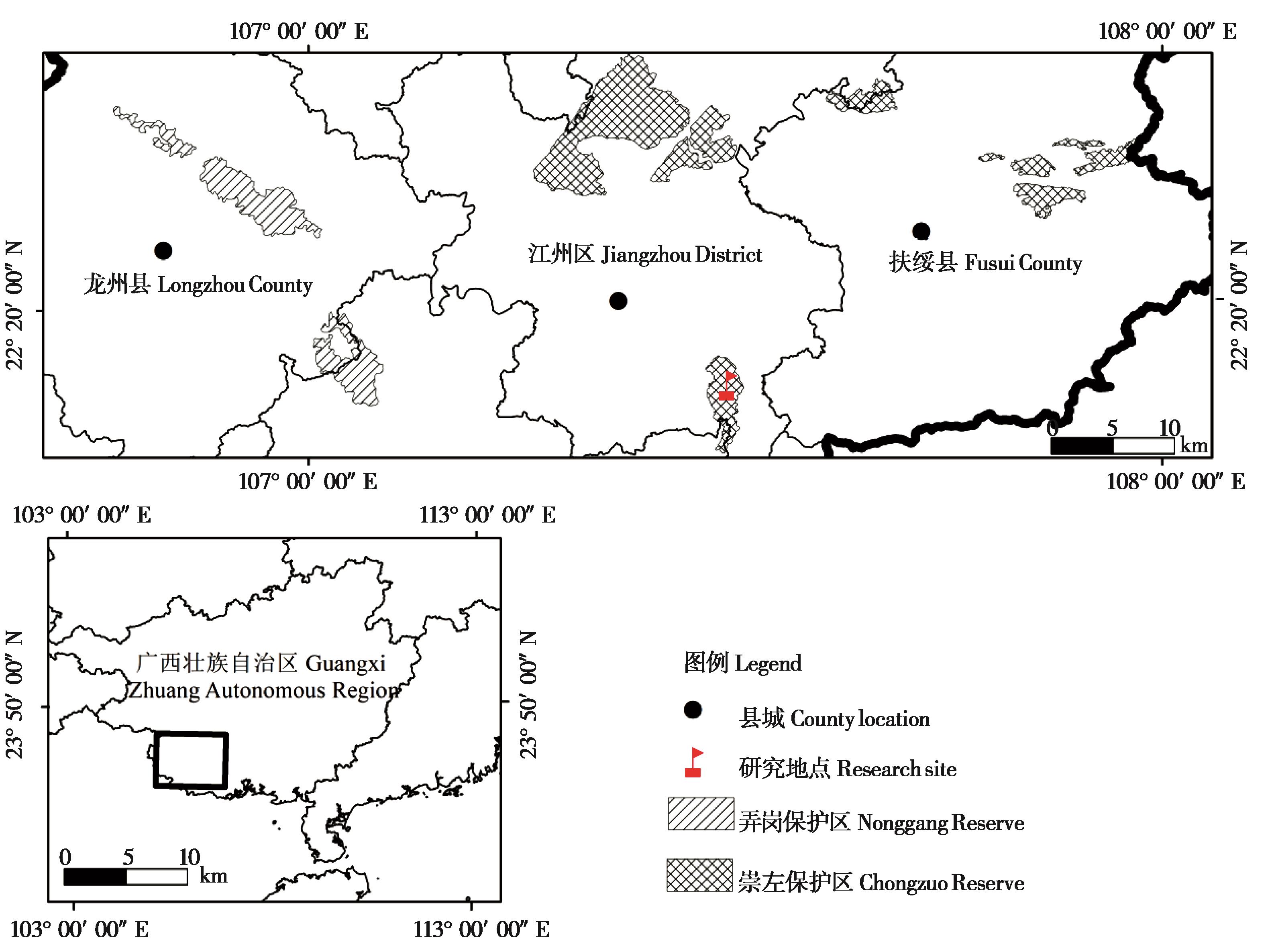
图1 广西崇左白头叶猴国家级自然保护区
Fig. 1 Guangxi Chongzuo White-Headed Langur National Nature Reserve
| 群 Group | 雄性 Male | 雌性 Female | 未成年 Juvenile | 新生婴猴 Newborn | 总数 Total |
|---|---|---|---|---|---|
| 大群-1 Large group-1 | 1 | 13 | 11 | 4 | 29 |
| 大群-2 Large group-2 | 1 | 9 | 9 | 4 | 23 |
| 小群-1 Small group-1 | 1 | 5 | 3 | 1 | 10 |
| 小群-2 Small group-2 | 1 | 4 | 4 | 0 | 9 |
表1 研究猴群的大小和组成
Table 1 Group size and compositions of the studied groups
| 群 Group | 雄性 Male | 雌性 Female | 未成年 Juvenile | 新生婴猴 Newborn | 总数 Total |
|---|---|---|---|---|---|
| 大群-1 Large group-1 | 1 | 13 | 11 | 4 | 29 |
| 大群-2 Large group-2 | 1 | 9 | 9 | 4 | 23 |
| 小群-1 Small group-1 | 1 | 5 | 3 | 1 | 10 |
| 小群-2 Small group-2 | 1 | 4 | 4 | 0 | 9 |
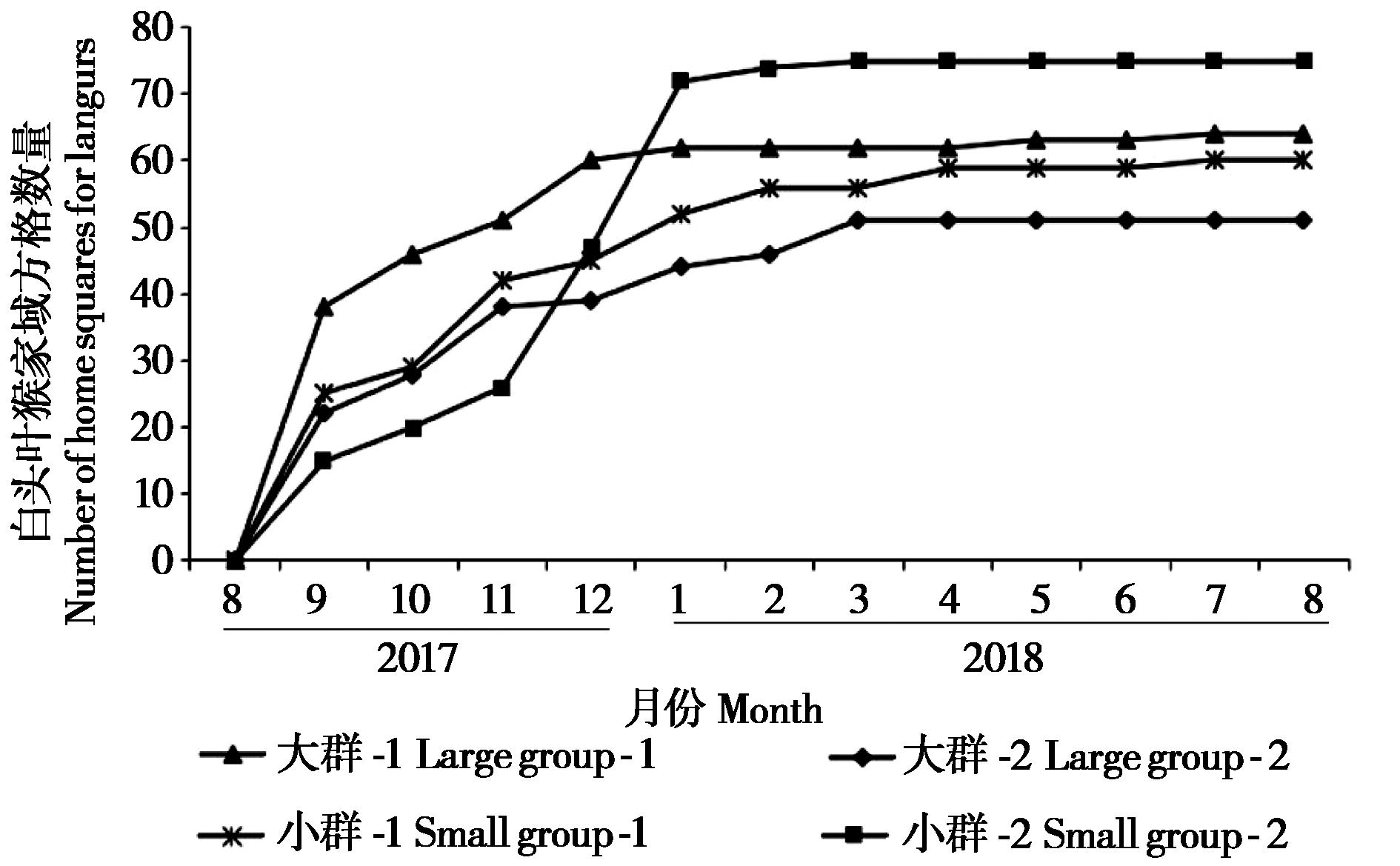
图2 每月利用的方格数量随取样天数增加的累加曲线
Fig. 2 The monthly cumulative increase in the number of quadrats during observation days
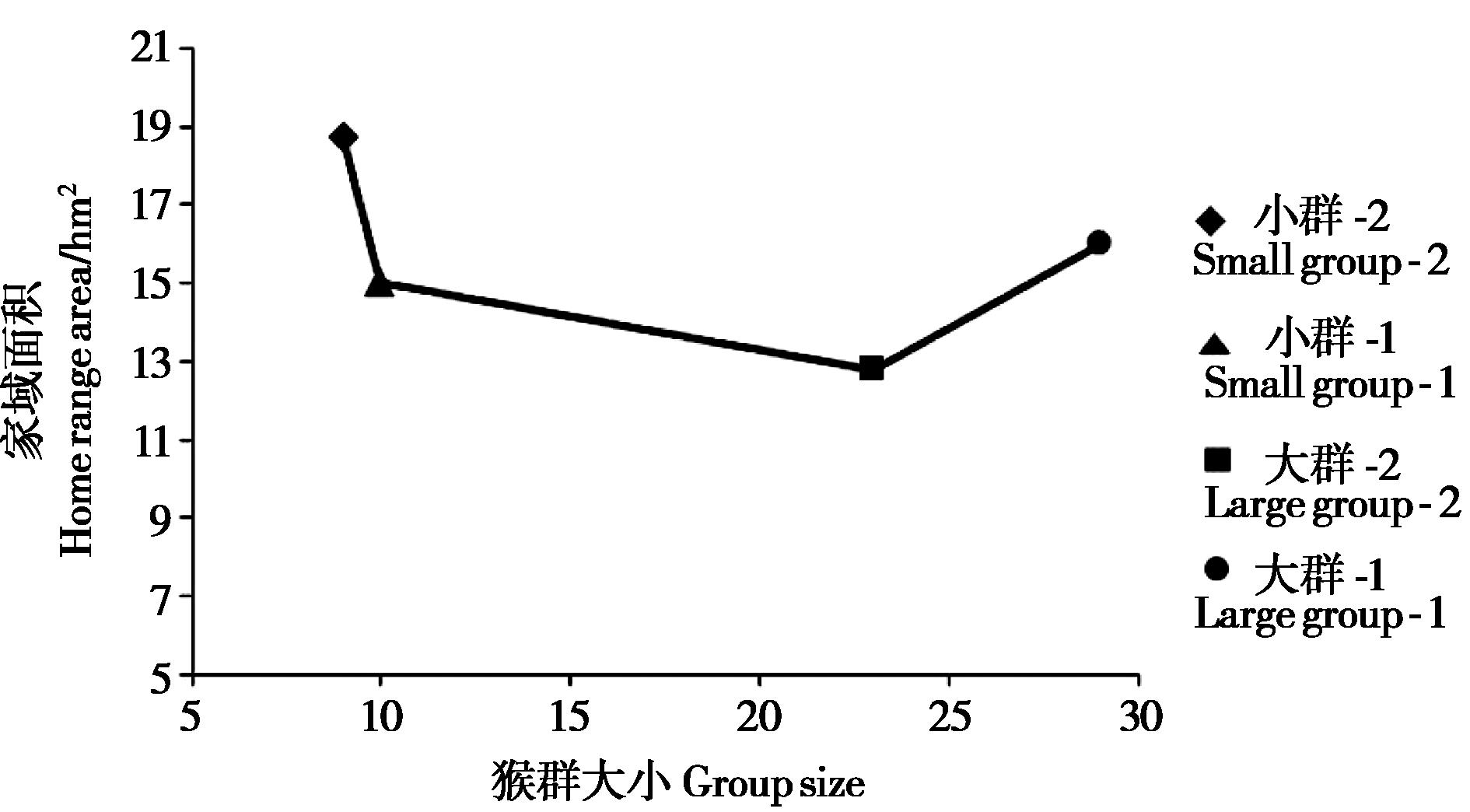
图3 各猴群的家域面积
Fig. 3 Home range area of each group
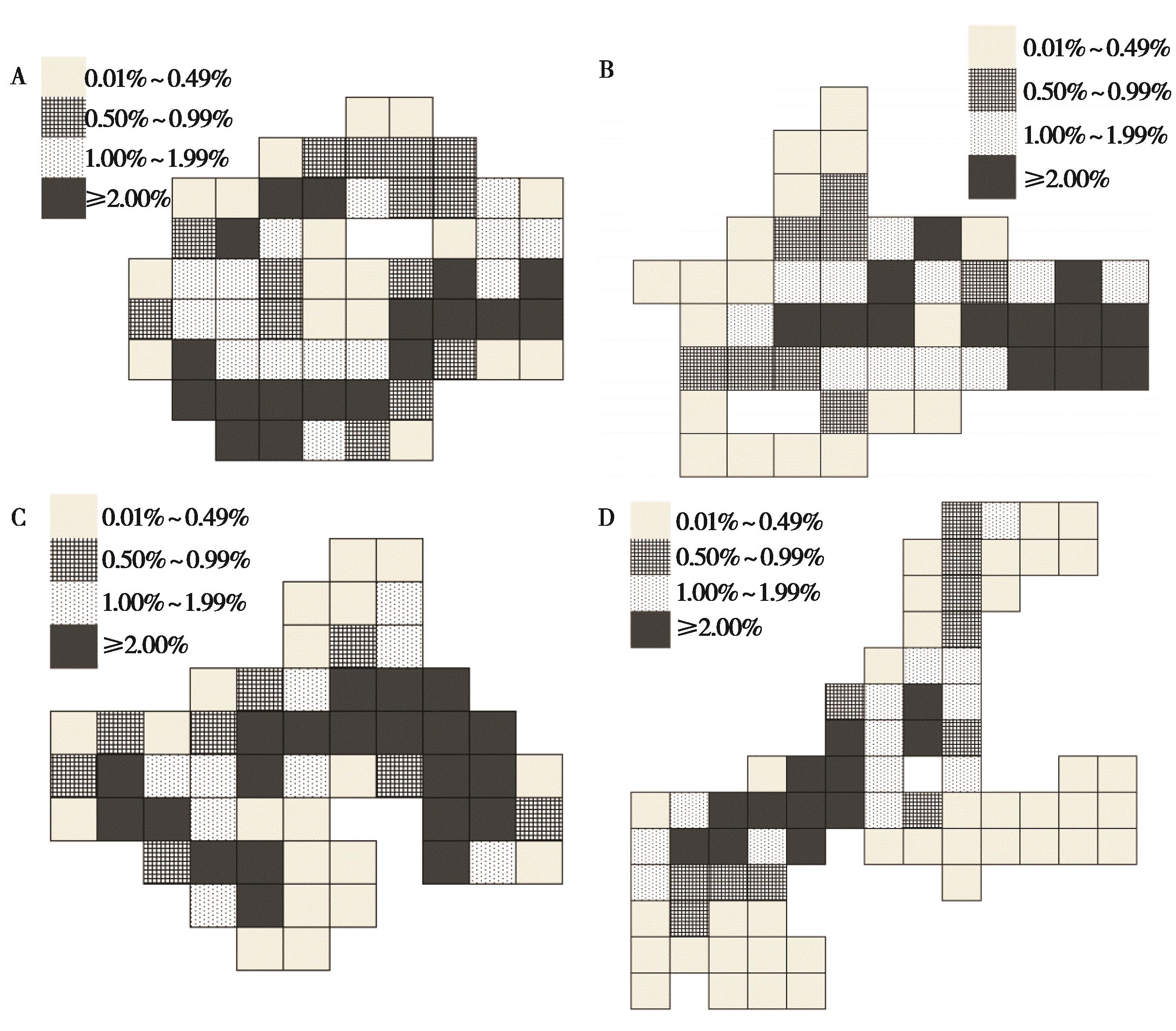
图4 各猴群利用方格的频次(A:大群-1;B:大群-2;C:小群-1;D:小群-2)
Fig. 4 Frequency of grid utilization by each group (A: Large group-1; B: Large group-2; C: Small group-1; D: Small group-2)
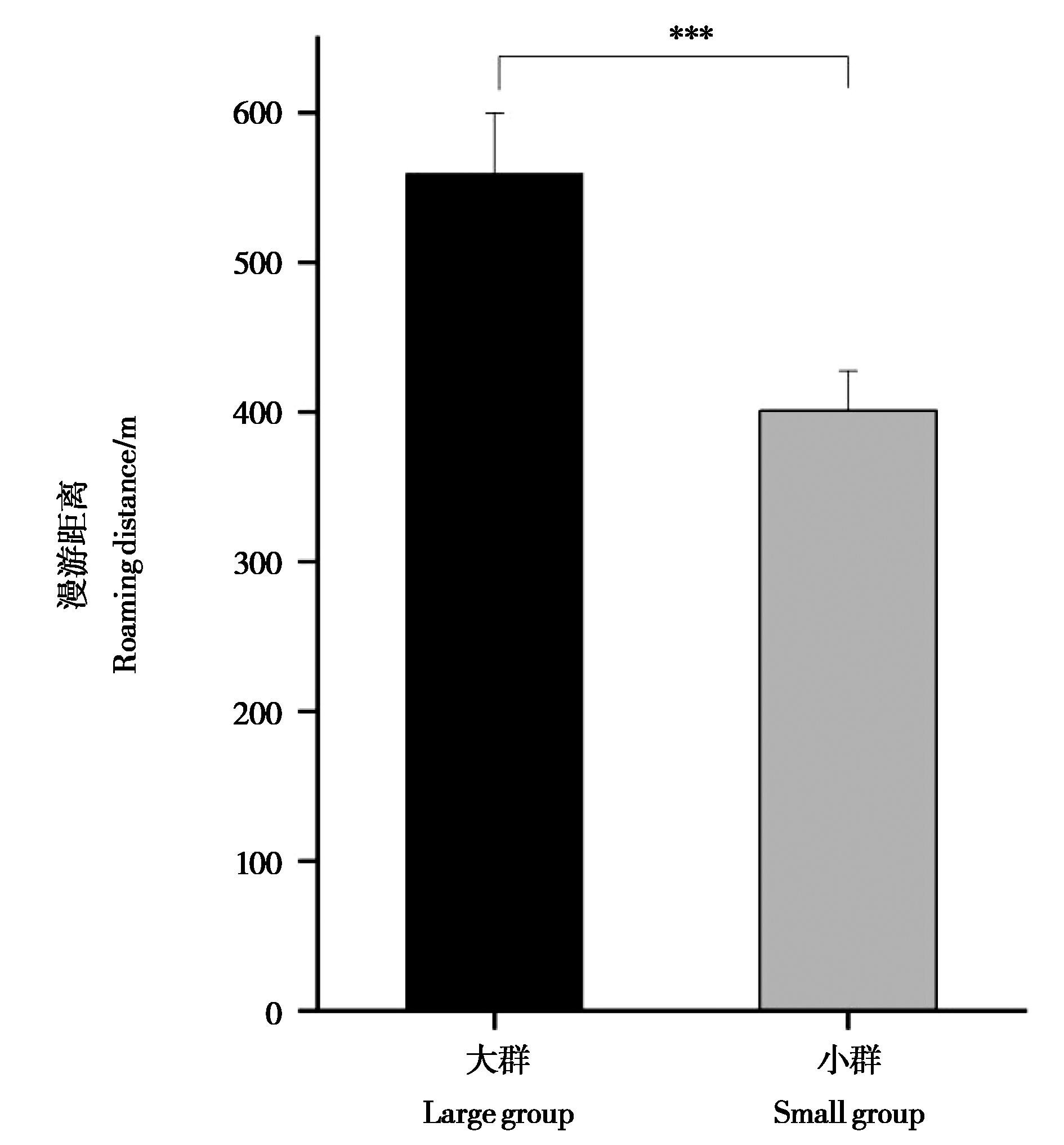
图5 平均日漫游距离的群间差异. *** P < 0.01表示差异极显著
Fig. 5 Intergroup differences in average daily roaming distance. *** P < 0.01 indicates highly significant difference
群 Group | 山顶 Hilltop | 崖壁 Cliff | 山坡 Slope | 山脚 Hill foot | 总数 Total |
|---|---|---|---|---|---|
大群-1 Large group-1 | 63 | 1 146 | 555 | 513 | 2 277 |
大群-2 Large group-2 | 23 | 1 109 | 602 | 748 | 2 482 |
小群-1 Small group-1 | 52 | 1 492 | 631 | 60 | 2 235 |
小群-2 Small group-2 | 118 | 1 398 | 566 | 164 | 2 246 |
表2 白头叶猴群对山体不同部位的利用频次
Table 2 The frequency of vertical space used of white-headed langur groups
群 Group | 山顶 Hilltop | 崖壁 Cliff | 山坡 Slope | 山脚 Hill foot | 总数 Total |
|---|---|---|---|---|---|
大群-1 Large group-1 | 63 | 1 146 | 555 | 513 | 2 277 |
大群-2 Large group-2 | 23 | 1 109 | 602 | 748 | 2 482 |
小群-1 Small group-1 | 52 | 1 492 | 631 | 60 | 2 235 |
小群-2 Small group-2 | 118 | 1 398 | 566 | 164 | 2 246 |
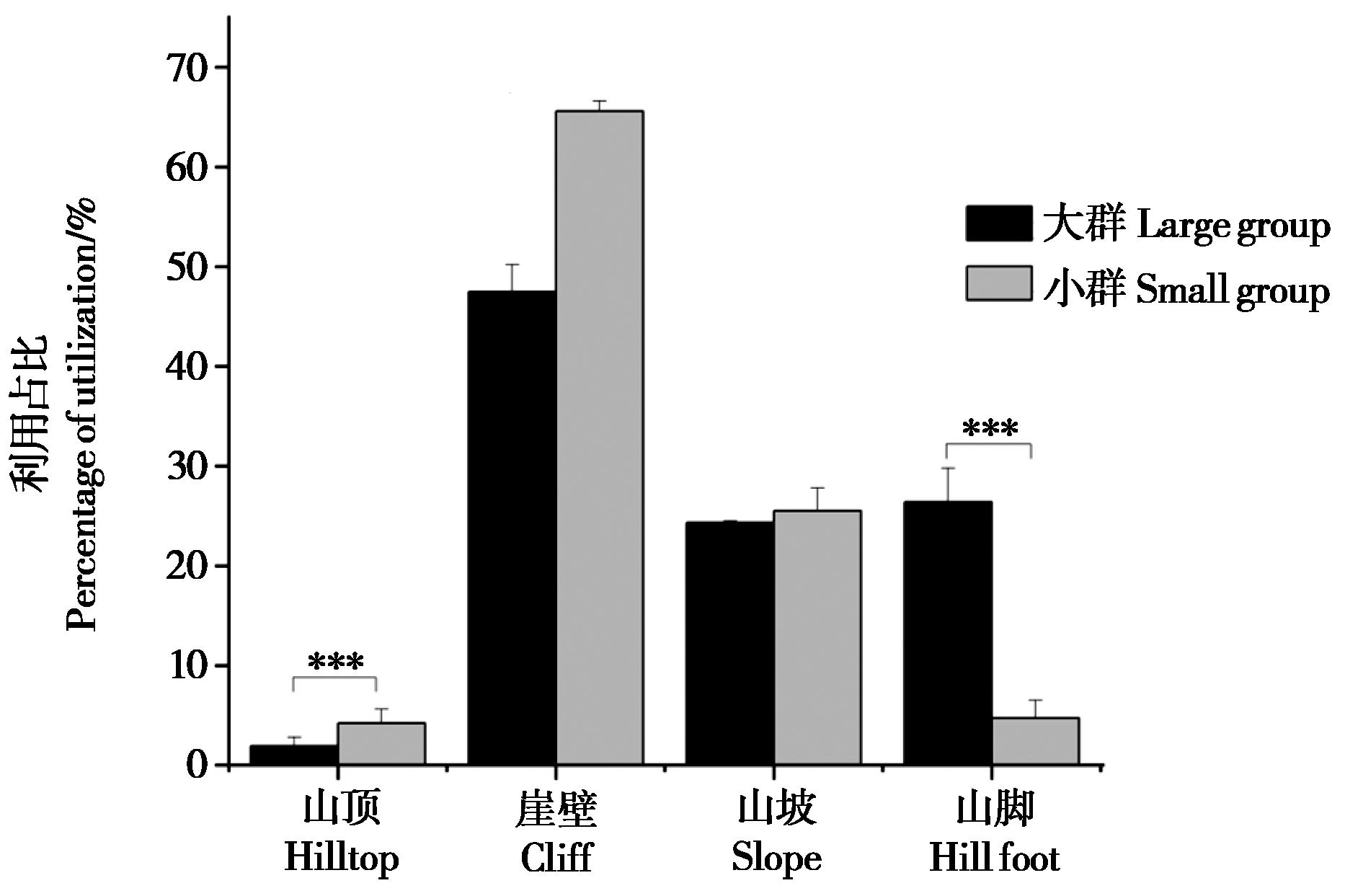
图6 白头叶猴对山体不同部位利用比例的群间差异. *** P < 0.01表示差异极显著
Fig. 6 Inter-group variations in the percentage of vertical space used of white-headed langurs. *** P < 0.01 indicates highly significant difference
| Aguilar‑Melo A R, Andresen E, Cristóbal‑Azkarate J, Arroyo‑Rodríguez V, Chavira R, Schondube J, Serio‑Silva J C, Cuarón A D,2013. Behavioral and physiological responses to subgroup size and number of people in howler monkeys inhabiting a forest fragment used for nature‐based tourism[J]. American Journal of Primatology,75(11):1108‑1116. DOI:10.1002/ajp.22172 . | |
| Bourlière F Ç,1985. Primate communities:their structure and role in tropical ecosystems[J]. International Journal of Primatology,6(1):1‑26. DOI:10.1007/bf02693694 . | |
| Bettridge C, Lehmann J, Dunbar R I M,2010. Trade‑offs between time,predation risk and life history,and their implications for biogeography:a systems modelling approach with a primate case study[J]. Ecological Modelling,221(5):777‑790. DOI:10.1016/j.ecolmodel. 2009.11.017 . | |
| Chapman C A, Wrangham R W, Chapman L J,1995. Ecological constraints on group size:an analysis of spider monkey and chimpanzee sub‑groups[J]. Behavioral Ecology and Sociobiology,36(1):59‑70. DOI:10.1007/BF00175729 . | |
| Chapman C A, Chapman L J,2000. Determinants of group size in primates:the importance of travel costs[M]//Boinski S,Garber P A eds. On the move:how and why animals travel in groups. Chicago:Chicago University Press,24‑42. | |
| Chen Zhi, Huang Chengming, Zhou Qihai, Li Youbang, Feng Xinliang, Dai Dongliang,2008. Temporal and spatial changes in habitat landscape patterns of white‑headed langurs (Trachypithecus leucocephalus)[J]. Acta Ecologica Sinica,(2):587‑594. DOI:10.3321/j.issn:1000-0933.2008.02.017 (in Chinese with English abstract). | |
| Dasilva G L,1994. Diet of Colobus polykomos on Tiwai Island:selection of food in relation to its seasonal abundance and nutritional quality[J]. International Journal of Primatology,15(5):655‑680. DOI:10. 1007/BF02737426 . | |
| Fashing P J,2001. Activity and ranging patterns of guerezas in the Kakamega forest:intergroup variation and implications for intragroup feeding competition[J]. International Journal of Primatology,22(4):549‑577. DOI:10. 1023/a:1010785517852 . | |
| Fan P F, Garber P, Ma C, Ren G P, Liu C M, Chen X Y, Yang J X,2015. High dietary diversity supports large group size in Indo‑Chinese gray langurs in Wuliangshan,Yunnan,China[J]. American Journal of Primatology,77(5):479‑491. DOI:10. 1002/ajp. 22361 . | |
| Fan P, Lawes M J, Liu R, Zhou Q,2024. Hope for limestone langurs’ conservation[J]. Science,384(6698):855. DOI:10. 1126/science. ado6810 . | |
| Gore M A,1993. Effects of food distribution on foraging competition in rhesus monkeys,Macaca mulatta,and hamadryas baboons,Papio hamadryas [J]. Animal Behaviour,45(4):773‑786. DOI:10.1006/anbe.1993.1091 . | |
| Gillespie T R, Chapman C A,2001. Determinants of group size in the red colobus monkey(Procolobus badius):an evaluation of the generality of the ecological‑constraints model[J]. Behavioral Ecology & Sociobiology,50(4):329‑338. DOI:10. 1007/s002650100371 . | |
| Guan Chaoyi, Chen Zhi, Huang Chengming, Zhou Qihai,2022. Analysis of fragmentation in landscape pattern for the François’langur’s habitats in Guangxi and its influence on population[J]. Acta Ecologica Sinica,42(3):1203‑1212. DOI:10. 5846/stxb202101010003. (in Chinese with English abstract) | |
| Hanya G, Bernard H,2012. Fallback foods of red leaf monkeys(Presbytis rubicunda) in danum valley,Borneo[J]. International Journal of Primatology,33(2):322‑337. DOI:10. 1007/s10764-012-9580-9 . | |
| Harris T R, Chapman C A, Monfort S L,2010. Small folivorous primate groups exhibit behavioral and physiological effects of food scarcity[J]. Behavioral Ecology,21(1):46‑56. DOI:10. 1093/beheco/arp150 . | |
| Huang Chengming, Li Youbang, Zhou Qihai,2016. Adaptation of white‑headed langurs to Karst limestone habitats[J]. Biology Bulletin,51(1):1‑4. DOI:CNKI:SUN:SWXT.0.2016-01-001. (in Chinese with English abstract) | |
| Huang Ying,2021. The research on colony foraging and feeding quantity of white‑headed langur[D]. Guilin:Guangxi Normal University. DOI:10.27036/d.cnki.ggxsu.2021.000201. (in Chinese with English abstract) | |
| Huang Chengming,1998. The research on habitat selection,utilization and feeding biology of white‑headed leaf monkey (Presbytis leucocephalus)[D]. Beijing:Beijing Normal University.(in Chinese with English abstract) | |
| Hill R A, Dunbar R I M,1998. An evaluation of the roles of predation rate and predation risk as selective pressures on primate grouping[J]. Behaviour,135(4):411‑430. DOI:10. 2307/4535537 | |
| Isbell L A,1991. Contest and scramble competition:patterns of female aggression and ranging behavior among primates[J]. Behavioral Ecology,2(2):143‑155. DOI:10.1093/beheco/2.2.143 . | |
| Isbell L A,2012. Re‑evaluating the ecological constraints model with red colobus monkeys(Procolobus rufomitratus tephrosceles)[J]. Behaviour,149(5):493‑529. DOI:10. 1163/156853912X641748 . | |
| Janson C H, Goldsmith M L,1995. Predicting group size in primates:foraging costs and predation risks[J]. Behavioral Ecology,6(3):326‑336. DOI:10.1093/beheco/6.3.326 . | |
| Janson C H,1998. Food competition in brown capuchin monkeys (Cebus apella):quantitative effects of group size and tree productivity[J]. Behaviour,105(1):53‑76. DOI:10. 2307/4534679 . | |
| Janson C H, Crockett C M,2000. Infanticide in red howlers:female group size,male membership,and a possible link to folivory[J]. Infanticide by Males and its Implications,(4):75‑98. DOI:10.1017/cbo9780511542312.006 . | |
| Korstjens A H, Dunbar R I M,2007. Time constraints limit group sizes and distribution in red and black‑and‑white colobus[J]. International Journal of Primatology,28(3):551‑575. DOI:10.1007/S10764-007-9148-2 . | |
| Li Z Y, Rogers M E,2005a. Are limestone hills a refuge or essential habitat for white‑headed langurs in Fusui,China?[J].International Journal of Primatology,26(2):437‑452. DOI:10.1007/S10764-005-2932-y . | |
| Li Z Y, Rogers M E,2005b. Habitat quality and range use of white‑headed langurs in fusui,China[J]. Folia Primatologica,76(4):185‑195. DOI:10. 1159/00086020 . | |
| Li Xingkang, Zhong Xukai, Wei Shaogan, Cui Liangwei, Fan Pengfei, Guan Zhenhua, Ma Changyong,2021. The influence of group size and foraging environment on the daily path length of a critically endangered primate Nomascus nasutus [J]. Acta Theriologica Sinica,41(4):388. DOI:10.16829/j.slxb.150495. (in Chinese with English abstract) | |
| Li D Y, Zhou Q H, Tang X P, Huang H L, Huang C M,2011. Sleeping site use of the white‑headed langur Trachypithecus leucocephalus:the role of predation risk,territorial defense,and proximity to feeding sites[J]. Current Zoology,57(3):260‑268. DOI:10. 1093/czoo1o/57. 3. 260 . | |
| Markham A C, Gesquiere L R,2017. Costs and benefits of group living in primates:an energetic perspective[J]. Philosophical Transactions of the Royal Society B‑Biological Sciences,372(1727):20160239.DOI:10. 1098/rstb. 2016. 0239 . | |
| MacArthur R H, Pianka E R,1966. On optimal use of a patchy environment[J]. The American Naturalist,100(916):603‑609. DOI:10. 2307/2459298 . | |
| Pan W S,2021. The population ecology of white‑headed langur[M]. Peking University Press. Springer Nature Singapore. | |
| Pollard K A, Blumstein D T,2008. Time allocation and the evolution of group size[J]. Animal Behaviour,76(5):1683‑1699. DOI:10.1016/j.anbehav.2008.08.006 . | |
| Sengupta A, Radhakrishna S,2018. The hand that feeds the monkey:mutual influence of humans and rhesus macaques (Macaca mulatta)in the context of provisioning[J]. International Journal of Primatology,39(5):817‑830. DOI:10.1007/s10764-018-0014-1 . | |
| Stephens D W, Krebs J R,1986. Foraging theory (Vol. 6)[M]. Princeton University Press. | |
| Sterck E H M, Watts D P, Van Schaik C P,1997. The evolution of female social relationships in nonhuman primates[J]. Behavioral Ecology and Sociobiology,41(5):291‑309. DOI:10. 1007/s002650050390 . | |
| Tang Zheng,2004. The research on feeding biology and nutrition analysis of the white‑headed leaf monkey(Trachypithecus leucocephallus)[D]. Guilin:Guangxi Normal University. (in Chinese with English abstract) | |
| Tang H X, Huang H L, Wang Z X, Wu J B, Wang A L, Nong D P, Garber P A, Zhou Q H, Huang C M,2024. Population dynamics and conservation status of the white‑headed langur in the Chongzuo forest fragments,Guangxi,China[J]. Oryx,58(2):179‑182. DOI:10.1017/S0030605323000029 . | |
| Teichroeb J A, Sicotte P,2009. Test of the ecological‑constrains model on ursine colobus monkeys(Colobus vellerosus)in Ghana[J]. American Journal of Primatology,71(1):49‑59. DOI:10.1002/ajp.20617 . | |
| Van Schaik C P, Van Noordwijk M A,1989. The special role of male Cebus monkeys in predation avoidance and its effect on group composition[J]. Behavioral Ecology and Sociobiology,24(5):265‑276. DOI:10.1007/bf00290902 . | |
| Wu Manfei, Hu Zhanbo, Zhou Qihai, Wu Jianbao,2021. Habitat suitability assessment of the white‑headed langur(Trachypithecus leucocephalus)based on MaxEnt modeling:a case study of the Chongzuo White‑Headed Langur Nature Reserve,Guangxi[J]. Acta Theriologica Sinica,41(1):20‑31. DOI:10.16829/j. slxb.150416. (in Chinese with English abstract) | |
| Yeager C P, Kirkpatrick R C,1998. Asian colobine social structure:ecological and evolutionary constrains[J]. Primates,39(2):147‑155. DOI:10.1007/BF02557727 . | |
| Zhang Yingyi, Zhu Lizhong, Qin Dagong, Yin Lijie, Wang Dezhi, Ran Wenzhong, Pan Wenshi,2001. Hierarchy,association and grooming pattern in a multi‑male group of white‑headed langurs(Presbytis francoisi leucocephalus)in Luobai,Guangxi,China[J]. Acta Scientiarum Naturalium Universitatis Pekinensis,(6):770‑778. DOI:10. 13209/j. 0479-8023. 2001. 132. (in Chinese with English abstract) | |
| Zhang Kechu, Yuan Peisong, Huang Henglian, Tang Xiaoping, Zhou Qihai, Huang Zhonghao,2017. Inter‑site variation in dietary composition of white‑headed langurs(Trachypithecus leucocephalus)[J]. Journal of Guangxi Normal University(Natural Science Edition),35(1):75‑81. DOI:10. 16088/j. issn. 1001- 6600. 2017. 01. 013. (in Chinese with English abstract) | |
| Zhang Kechu,2018. Effects of group size on feeding behavior of white‑headed langur (Trachypithecus leucocephalus)[D]. Guilin:Guangxi Normal University. DOI:CNKI:CDMD:2.1018.850720. (in Chinese with English abstract) | |
| Zhou Q H, Huang C M, Li Y B, Cai X W,2007. Ranging behavior of the François’ langur (Trachypithecus francoisi) in the Fusui Nature Reserve,China[J]. Primates,48(4):320‑323. DOI:10.1007/S10329-006-0027-9 . | |
| Zhou Q H, Huang C M, Li M, Wei F W,2009. Sleeping site use by François’ langur (Trachypithecus francoisi) at Nonggang Nature Reserve,China[J]. International Journal of Primatology,30(2):353‑365. DOI:10.1007/s10764- 009-9348-z . | |
| Zhou Q H, Huang C M, Li M, Wei F W,2011a. Ranging behavior of the François’ langur (Trachypithecus francoisi) in limestone habitats of Nonggang,China[J]. Integrative Zoology,6(2):157‑164. DOI:10.1111/j.1749-4877.2011.00239. x . | |
| Zhou Q H, Tang X P, Huang H L, Huang C M,2011b. Factors affecting the ranging behavior of white‑headed langurs (Trachypithecus leucocephalus)[J]. International Journal of Primatology,32(2):511‑523. DOI:10.1007/s10764- 010-9486-3 . | |
| Zhou Q H, Tang Z, Li Y B, Huang C M,2013. Food diversity and choice of white‑headed langur in fragmented limestone hill habitat in Guangxi,China[J]. Acta Ecologica Sinica,33(2):109‑113. DOI:10.1016/j.chnaes.2013.01.007 . | |
| Zhou Q H, Wei H, Huang Z H, Huang C M,2011. Diet of the Assamese macaque Macaca assamensis in limestone habitats of Nonggang,China[J]. Current Zoology,57(1):18‑25. DOI:10.1093/czoolo/57.1.18 . | |
| Zhou Q H, Wei F W, Li M, Huang C M, Luo B,2006. Diet and food choice of Trachypithecus francoisi in the Nonggang Nature Reserve,China[J]. International Journal of Primatology,27(5):1441‑1460. DOI:10. 1007/S10764-006-9082-8 . | |
| Zhou Q H, Wei F W, Huang C M,Li,M, Ren B P, Luo B,2007. Seasonal variation in the activity patterns and time budgets of Trachypithecus francoisi in the Nonggang Nature Reserve,China[J]. International Journal of Primatology,28(3):657‑671. DOI:10.1007/s10764-007-9144-6 . | |
| 李兴康,钟旭凯,韦绍干,崔亮伟,范朋飞,管振华,马长勇,2021. 群体大小和觅食环境变化对东黑冠长臂猿日移动距离的影响[J]. 兽类学报,41(4):388. DOI:10.16829/j.slxb.150495 . | |
| 吴曼菲,胡湛波,周岐海,吴坚宝,2021. 基于MaxEnt模式的白头叶猴栖息地评价:以广西崇左白头叶猴保护区为例[J]. 兽类学报,41(1):20‑31. DOI:10.16829/j.slxb.150416 . | |
| 张克处,2018. 群大小对白头叶猴觅食行为的影响[D]. 桂林:广西师范大学. DOI:CNKI:CDMD:2.1018.850720 . | |
| 张克处,袁培松,黄恒连,唐小平,周岐海,黄中豪,2017. 白头叶猴食物组成的地域性差异比较[J]. 广西师范大学学报(自然科学版),35(1):75‑81. DOI:10.16088/j.issn. 1001-6600.2017.01.013 . | |
| 张颖溢,朱里忠,秦大公,殷丽洁,王德智,冉文忠,潘文石,2001. 白头叶猴一个野生多雄多雌群的优势等级、亲密程度和梳理模式[J]. 北京大学学报(自然科学版),(6):770‑778. DOI:10.13209/j.0479-8023.2001.132 . | |
| 陈智,黄乘明,周歧海,李友邦,冯新亮,戴东亮,2008. 白头叶猴(Trachypithecus leucocephalus)栖息地景观格局的时空变化[J]. 生态学报,(2):587‑594. DOI:10.3321/j.issn:1000-0933.2008.02.017 . | |
| 唐政,2004. 白头叶猴(Trachypithecus leucocephalus)的觅食生物学和营养分析[D]. 桂林:广西师范大学. | |
| 黄乘明,1998. 白头叶猴(Presbytis leucocephalus)对栖息地选择利用与觅食生物学[D]. 北京:北京师范大学. | |
| 黄乘明,李友邦,周岐海,2016. 白头叶猴对喀斯特石山生境的适应[J]. 生物学通报,51(1):1‑4. DOI:CNKI:SUN:SWXT. 0.2016-01-001 . | |
| 黄颖,2021. 白头叶猴的觅食量和群体觅食研究[D]. 桂林:广西师范大学. DOI:10.27036/d.cnki.ggxsu.2021.000201 . | |
| 管超毅,陈智,黄乘明,周岐海,2022. 广西黑叶猴栖息地景观格局破碎化分析及其对种群的影响[J]. 生态学报,42(3):1203‑1212. DOI:10.5846/stxb202101010003 . |
| [1] | 宋雨千, 易柏君, 陶梅洁, 农登攀, 周岐海, 范鹏来. 白头叶猴的长距离鸣叫具有防御过夜地的功能[J]. 兽类学报, 2025, 45(6): 820-830. |
| [2] | 余翔, 毕温磊, 侯蓉, 刘家斌, 李祖胜, 付明霞, 吴蔚, 马锐, 陈超, 莫利, 宋心强, 王伟, 杨洪, 张倩, 齐敦武. 大熊猫进入自然环境后适应性研究[J]. 兽类学报, 2025, 45(5): 707-716. |
| [3] | 陈晓露, 刘银树, 易柏君, 周岐海, 刘若爽, 范鹏来. 白头叶猴两性新群形成的两种方式[J]. 兽类学报, 2025, 45(4): 485-491. |
| [4] | 张宇琪, 常诚, 朱文明, 张首威, 李宣池, 张洺瑀, 卢冠军, 许振文. 夏冬季五种同域蝙蝠对洞穴的利用策略[J]. 兽类学报, 2025, 45(2): 193-202. |
| [5] | 刘彦辰, 郭秋艳, 陆媚静, 吴世军, 农登攀, 黄乘明, 范鹏来, 周岐海. 白头叶猴对人工栽培桉树的取食及营养分析[J]. 兽类学报, 2025, 45(1): 119-127. |
| [6] | 李雪阳, 何彦瑾, 陈熙尔, 依严, 黄红, 董正一, 边巴扎西, 赵翔, 史湘莹, 吕植. 西藏丁青县大型食肉动物分布现况、栖息地影响因素及时空生态位关系[J]. 兽类学报, 2024, 44(6): 681-694. |
| [7] | 李家兴, 周颖铭, 黄乘明, 范鹏来, 周岐海. 白头叶猴婴猴月龄和性别对母婴关系的影响[J]. 兽类学报, 2024, 44(1): 58-64. |
| [8] | 李耀宇, 陈昕旸, 赵闪闪, 宋虓, 郭瑞, 徐爱春. 野外放归华南梅花鹿活动节律与家域特征[J]. 兽类学报, 2023, 43(5): 501-512. |
| [9] | 林炜明, 翁悦, 阿家, 王敏, 王琦, 王放. 四川八月林自然保护区大灵猫日活动节律、栖息地利用及其对人类活动响应的初步研究[J]. 兽类学报, 2023, 43(4): 364-377. |
| [10] | 乔江, 龚小丽, 贾伟, 贾国清, 蒋勇, 周华明, 李佳琦, 温安祥, 王杰. 四川贡嘎山狼的分布、群体大小和活动节律[J]. 兽类学报, 2023, 43(3): 248-257. |
| [11] | 周永祥, 薛亚东, 刘少创, 刘建泉, 周多良. 利用不同家域计算方法对野骆驼栖息地空间利用的比较[J]. 兽类学报, 2023, 43(1): 102-108. |
| [12] | 李亚东, 李博文, 王希, 李鹏晖, 李进华. 食物季节性对野生藏酋猴家域利用的影响[J]. 兽类学报, 2022, 42(6): 624-633. |
| [13] | 李兴康, 钟旭凯, 韦绍干, 崔亮伟, 范朋飞, 管振华, 马长勇. 群体大小和觅食环境变化对东黑冠长臂猿日移动距离的影响[J]. 兽类学报, 2021, 41(4): 388-397. |
| [14] | 廖荣, 陆施毅, 黄中豪, 李友邦. 白头叶猴与黑叶猴觅食行为的比较[J]. 兽类学报, 2021, 41(4): 406-415. |
| [15] | 吴曼菲, 胡湛波, 周岐海, 吴坚宝. 基于MaxEnt模式的白头叶猴栖息地评价——以广西崇左白头叶猴保护区为例[J]. 兽类学报, 2021, 41(1): 20-31. |
| 阅读次数 | ||||||
|
全文 |
|
|||||
|
摘要 |
|
|||||
 青公网安备 63010402000199号 青ICP备05000010号-2