

中国核心期刊要目总览
中国科技核心期刊
CSCD数据库源刊
中国科技核心期刊
CSCD数据库源刊
ACTA THERIOLOGICA SINICA ›› 2025, Vol. 45 ›› Issue (6): 797-809.DOI: 10.16829/j.slxb.150966
• ORIGINAL PAPERS • Previous Articles Next Articles
Qiangyun LI1,2, Jinhai WU3, Siriguleng3, Jianping ZHANG4, Yumin LIU5, Zhishu XIAO2,6, Junhu SU1( ), Wei LIU2,6()
Received:2024-06-06
Accepted:2024-10-15
Online:2025-11-30
Published:2025-12-03
Contact:
Junhu SU, Wei LIU
李强云1,2, 吴金海3, 斯日古楞3, 张建平4, 柳玉民5, 肖治术2,6, 苏军虎1(), 刘伟2,6()
通讯作者:
苏军虎,刘伟
作者简介:李强云 (1996- ),男,硕士研究生,主要从事啮齿动物行为生态学研究.
基金资助:CLC Number:
Qiangyun LI, Jinhai WU, Siriguleng, Jianping ZHANG, Yumin LIU, Zhishu XIAO, Junhu SU, Wei LIU. Ecological adaptations of alarm calls in Brandt’s voles did not support the acoustic adaptation hypothesis[J]. ACTA THERIOLOGICA SINICA, 2025, 45(6): 797-809.
李强云, 吴金海, 斯日古楞, 张建平, 柳玉民, 肖治术, 苏军虎, 刘伟. 布氏田鼠警戒鸣叫的生态适应不支持声音适应假说[J]. 兽类学报, 2025, 45(6): 797-809.
Add to citation manager EndNote|Ris|BibTeX
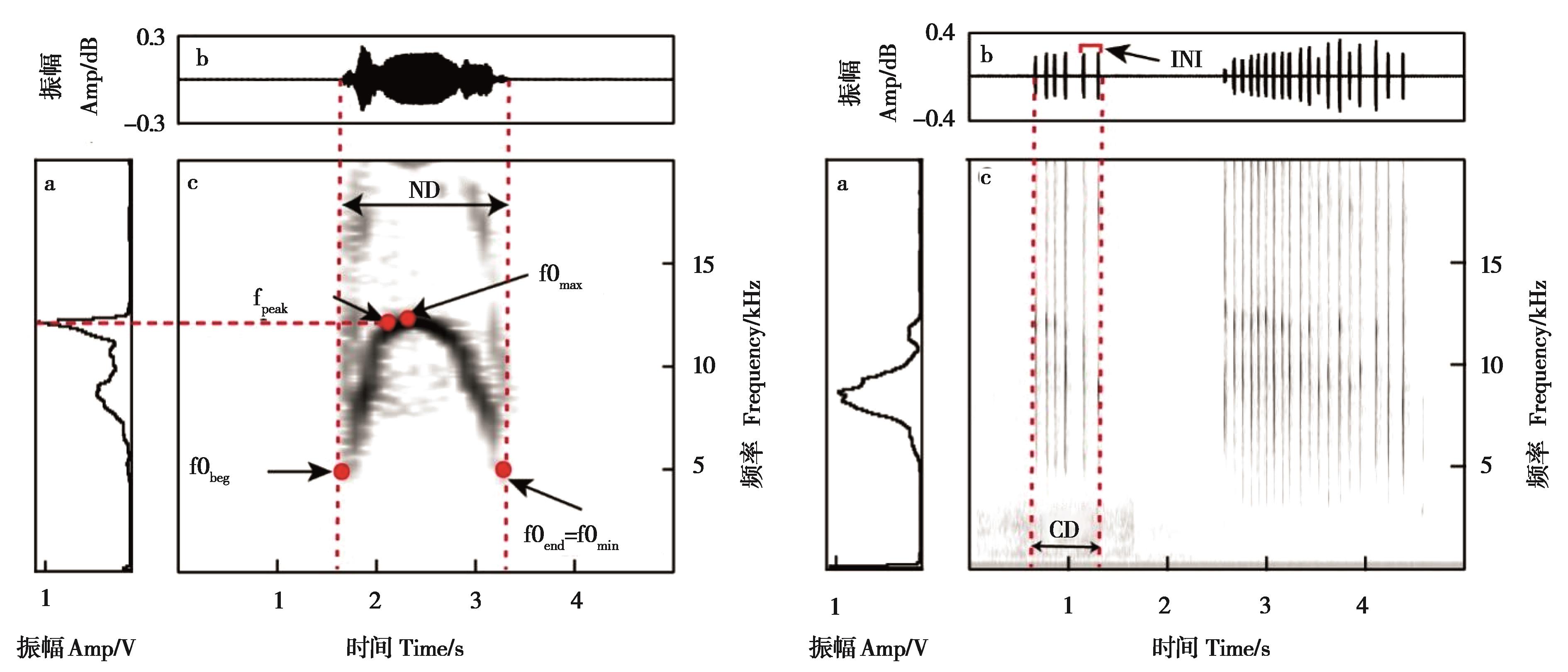
Fig.1 Power spectrum (a), Oscillogram (b) and spectrogram (c) of monosyllabic (left) and multisyllabic (right) alarm calls of Lasiopodomys brandtii. fpeak: Peak frequency; f0max: Maximum fundamental frequency; f0beg: The fundamental frequency at the onset of a call; f0end: The fundamental frequency at the end of a call; f0min: Minimum fundamental frequency; ND: Note duration; INI: Inter-note intervals; CD: Call duration
声学参数 Acoustic parameters | 鸣声类型 Call types | ||||||
|---|---|---|---|---|---|---|---|
| 单音节鸣声 Monosyllabic calls | 多音节鸣声 Multisyllabic calls | ||||||
| 5月May | 7月July | 9月September | 5月May | 7月July | 9月September | ||
| 频域参数Frequency domain parameter | |||||||
峰值频率 fpeak/Hz | 8 382.25 ± 777.44 a | 9 704.81 ± 314.83 a | 9 879.63 ± 486.61 a | 8 714.14 ± 195.06b | 10 400.38 ± 969.21a | 8 892.55 ± 62.34 b | |
最大基频 f0max/Hz | 11 143.50 ± 646.75 a | 12 454.22 ± 967.41a | 11 951.25 ± 161.05 a | 10 806.93 ± 136.47 c | 11 200.35 ± 178.22b | 11 974.53 ± 82.79a | |
开始基频 f0beg/Hz | 4 931.00 ± 530.66 a | 4 232.80 ± 707.55 a | 3 934.13 ± 443.32 a | 4 073.77 ± 79.90 a | 4 231.12 ± 89.72a | 3 558.94 ± 56.73 b | |
结束基频 f0end/Hz | 4 963.50 ± 478.40 a | 4 556.82 ± 976.24 a | 5 679.13 ± 850.86 a | 3 813.53 ± 187.02 a | 3 811.16 ± 99.86a | 3 281.93 ± 66.56 b | |
最小基频 f0min/Hz | 4 662.00 ± 529.73 a | 4 244.60 ± 665.41 a | 3 735.13 ± 384.61 a | 3 164.51 ± 87.63 b | 3 746.23 ± 96.47a | 3 096.59 ± 45.10 b | |
基频范围 Rangef0/Hz | 6 481.50 ± 916.58 a | 8 209.64 ± 701.36 a | 8 216.13 ± 376.82 a | 7 642.42 ± 182.72 b | 7 454.12 ± 249.26b | 8 877.94 ± 104.09 a | |
| 时域参数 Temporal domain parameter | |||||||
| 音节时长ND/ms | 43.75 ± 10.36 a | 35.12 ± 1.14 a | 38.25 ± 2.88 a | 31.10 ± 0.78 b | 32.46 ± 0.73 ab | 34.05 ± 0.54 a | |
| 音节间隔INI/ms | 218.46 ± 12.14 a | 192.35 ± 6.64 b | 167.56 ± 4.84 c | ||||
音节数 NN | 66.7 ± 8.8 a | 93.8 ± 12.2 a | 70.5 ± 9.00 a | ||||
| 鸣声时长CD/s | 14.66 ± 1.81 a | 20.86 ± 2.73 b | 13.73 ± 1.76 a | ||||
Table1 Types of alarm calls and seasonal variations of acoustic parameters in Lasiopodomys brandtii
声学参数 Acoustic parameters | 鸣声类型 Call types | ||||||
|---|---|---|---|---|---|---|---|
| 单音节鸣声 Monosyllabic calls | 多音节鸣声 Multisyllabic calls | ||||||
| 5月May | 7月July | 9月September | 5月May | 7月July | 9月September | ||
| 频域参数Frequency domain parameter | |||||||
峰值频率 fpeak/Hz | 8 382.25 ± 777.44 a | 9 704.81 ± 314.83 a | 9 879.63 ± 486.61 a | 8 714.14 ± 195.06b | 10 400.38 ± 969.21a | 8 892.55 ± 62.34 b | |
最大基频 f0max/Hz | 11 143.50 ± 646.75 a | 12 454.22 ± 967.41a | 11 951.25 ± 161.05 a | 10 806.93 ± 136.47 c | 11 200.35 ± 178.22b | 11 974.53 ± 82.79a | |
开始基频 f0beg/Hz | 4 931.00 ± 530.66 a | 4 232.80 ± 707.55 a | 3 934.13 ± 443.32 a | 4 073.77 ± 79.90 a | 4 231.12 ± 89.72a | 3 558.94 ± 56.73 b | |
结束基频 f0end/Hz | 4 963.50 ± 478.40 a | 4 556.82 ± 976.24 a | 5 679.13 ± 850.86 a | 3 813.53 ± 187.02 a | 3 811.16 ± 99.86a | 3 281.93 ± 66.56 b | |
最小基频 f0min/Hz | 4 662.00 ± 529.73 a | 4 244.60 ± 665.41 a | 3 735.13 ± 384.61 a | 3 164.51 ± 87.63 b | 3 746.23 ± 96.47a | 3 096.59 ± 45.10 b | |
基频范围 Rangef0/Hz | 6 481.50 ± 916.58 a | 8 209.64 ± 701.36 a | 8 216.13 ± 376.82 a | 7 642.42 ± 182.72 b | 7 454.12 ± 249.26b | 8 877.94 ± 104.09 a | |
| 时域参数 Temporal domain parameter | |||||||
| 音节时长ND/ms | 43.75 ± 10.36 a | 35.12 ± 1.14 a | 38.25 ± 2.88 a | 31.10 ± 0.78 b | 32.46 ± 0.73 ab | 34.05 ± 0.54 a | |
| 音节间隔INI/ms | 218.46 ± 12.14 a | 192.35 ± 6.64 b | 167.56 ± 4.84 c | ||||
音节数 NN | 66.7 ± 8.8 a | 93.8 ± 12.2 a | 70.5 ± 9.00 a | ||||
| 鸣声时长CD/s | 14.66 ± 1.81 a | 20.86 ± 2.73 b | 13.73 ± 1.76 a | ||||
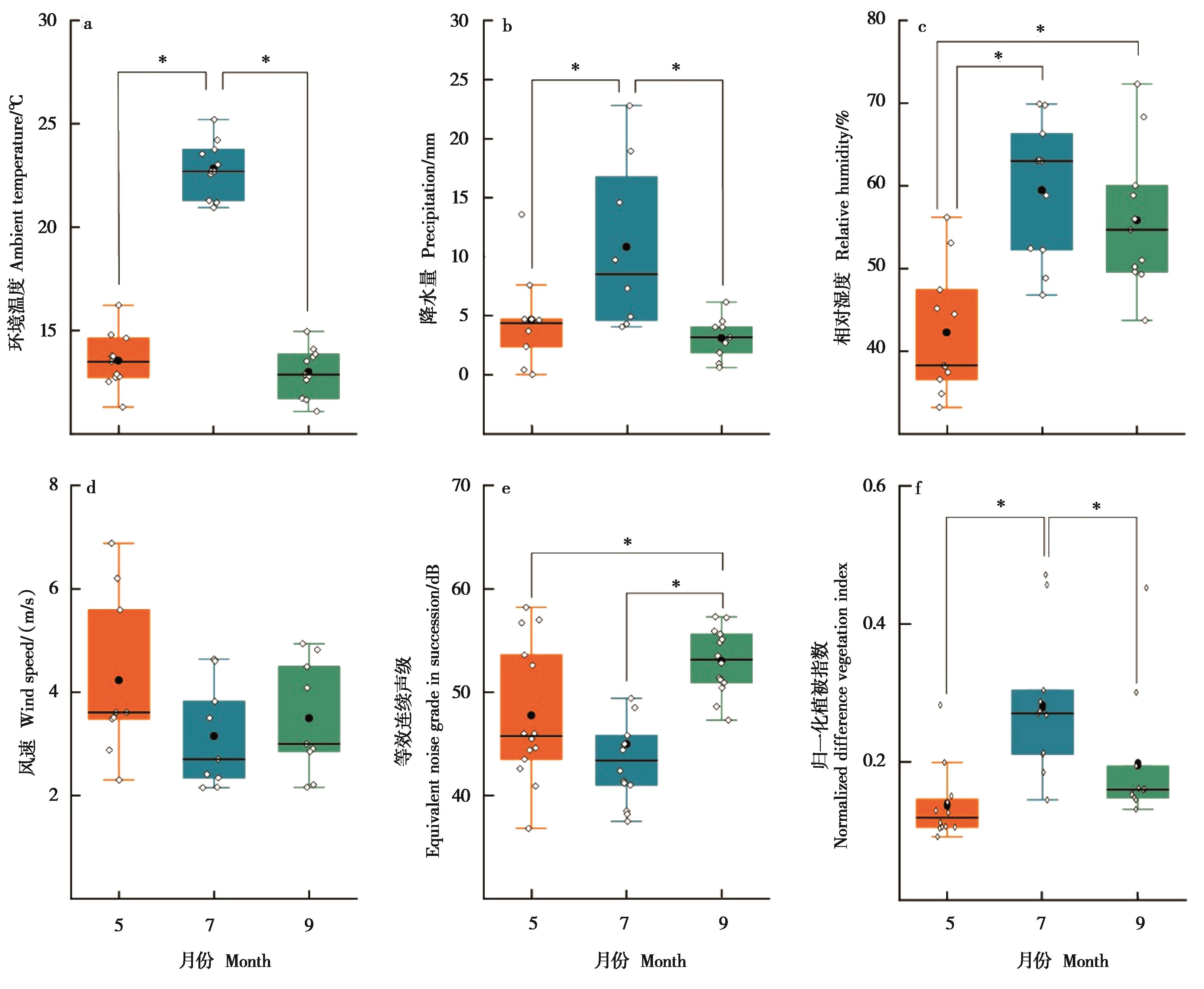
Fig.2 Monthly (seasonal) changes of habitat factors. *P < 0.05
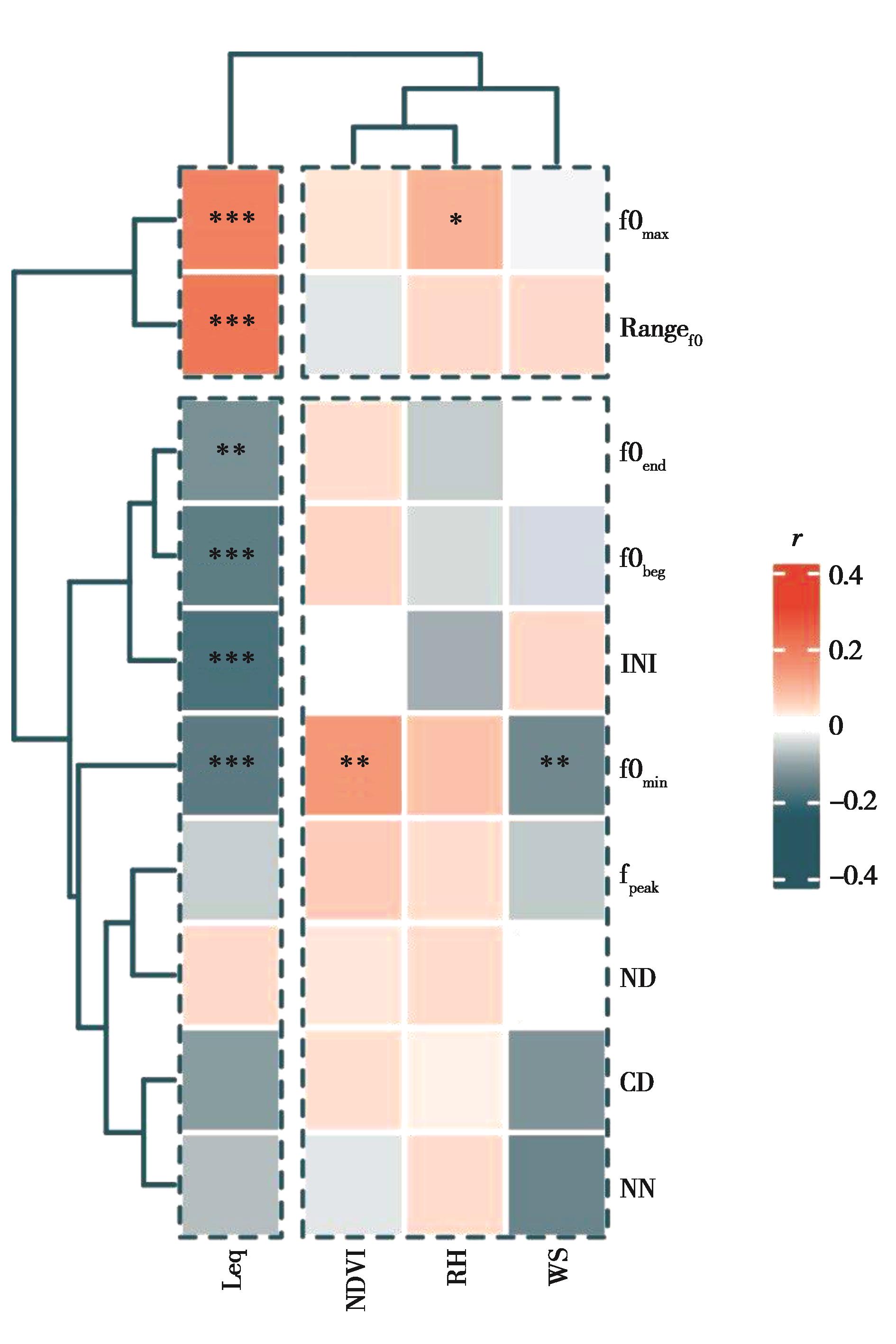
Fig.3 Heatmap correlation between acoustic parameters of multisyllabic alarm calls and habitat parameters in Lasiopodomys brandtii. fpeak: Peak frequency; f0max: Maximum fundamental frequency; f0beg: The fundamental frequency at the onset of a call; f0end: The fundamental frequency at the end of a call; f0min: Minimum fundamental frequency of a call; Rangef0: Range of fundamental frequency of a call; ND: Note duration; INI: Inter-note intervals; NN: Note number; CD: Call duration; RH: Relative humidity; WS: Wind speed; Leq: Equivalent noise grade in succession; NDVI: Normalized difference vegetation index. *P < 0.05, ** P < 0.01, ***P < 0.001
| Blumstein D T, Armitage K B. 1997. Alarm calling in yellow‑bellied marmots: I. The meaning of situationally variable alarm calls [J]. Animal Behaviour, 53: 143-171. | |
| Blumstein D T. 2007. The evolution of alarm communication in rodents: Structure, function, and the puzzle of apparently altruistic calling [A]. In: Wolff J O, Sherman P W eds. Rodent Societies–An Ecological & Evolutionary Perspective [M]. The University of Chicago Press, 317-327. | |
| Boncoraglio G, Saino N. 2007. Habitat structure and the evolution of bird song: a meta‑analysis of the evidence for the acoustic adaptation hypothesis [J]. Functional Ecology, 21 (1): 134-142. | |
| Braune P, Schmidt S, Zimmermann E. 2008. Acoustic divergence in the communication of cryptic species of nocturnal primates (Microcebus ssp.) [J]. BMC Biology, 6 (1): 1-10. | |
| Brown C H, Gomez R, Wasser P M. 1995. Old world monkey vocalizations: adaptation to the local habitat? [J]. Animal Behaviour, 50: 945-961. | |
| Brown T, Handford P. 1996. Acoustic signal amplitude patterns: a computer simulation investigation of the acoustic adaptation hypothesis [J]. Condor, 98: 608-623. | |
| Chu C J, Lutz J A, Kral K, Vrska T, Yin X, Myers J A, Abiem I, Alonso A, Bourg N, Burslem D F R P, Cao M, Chapman H, Condit R, Fang S Q, Fischer G A, Gao L M, Hao Z Q, Hau B C H, He Q, Hector A, Hubbell S P, Jiang M X, Jin G Z, Kenfack D, Lai J S, Li B H, Li X K, Li Y D, Lian J Y, Lin L X, Liu Y K, Liu Y, Luo Y H, Ma K P, McShea W, Memiaghe H, Mi X C, Ni M, O’Brien M J, de Oliveira A A, Orwig D A, Parker G G, Qiao X J, Ren H B, Reynolds G, Sang W G, Shen G C, Su Z Y, Sui X H, Sun I F, Tian S Y, Wang B, Wang X H, Wang X G, Wang Y S, Weiblen G D, Wen S J, Xi N X, Xiang W S, Xu H, Xu K, Ye W H, Zhang B W, Zhang J X, Zhang X T, Zhang Y M, Zhu K, Zimmerman J, Storch D, Baltzer J L, Anderson‑Teixeira K J, Mittelbach G G, He F L. 2018. Direct and indirect effects of climate on richness drive the latitudinal diversity gradient in forest trees [J]. Ecology Letters, 22 (2): 245-255. | |
| Deng K, Wang X P, Zhu B C, Zhao L H, Yang Y, Cai Y L, Sun X Q, Wang T L, Cui J G. 2023. A dataset on the call characteristics of 43 anuran species [J]. Biodiversity Science, 31 (1): 179-182. (in Chinese) | |
| Di Z L, Wu Y N, Song Y T, Huo G W, Zhang F J, Wang X G, Zhang X H. 2017. Variation of temperature and precipitation in the Xin Barag Right Banner of the Hulunbeier Grassland during 1958-2016 [J]. Journal of Desert Research, 37 (5): 1006-1015. | |
| Eddington V M, Nichols H K, Calistri‑Yeh A, Young V K H, Kloepper L N. 2024. Graded alarm call behavior in wild fox squirrels (Sciurus niger) [J]. Journal of the Acoustical Society of America, 155 (2): 1308-1314. | |
| Ey E, Fischer J. 2009. ‘TheAcoustic Adaptation Hypothesis’- a review of the evidence from birds, anurans and mammals [J]. Bioacoustics, 19 (1): 21-48. | |
| Fei H L. 2010. The research on singing behavior of eastern black crested gibbon (Nomascus nasutus) [D]. Master thesis. Changsha: Central South University of Forestry and Technology. (in Chinese) | |
| Fitch T W. 2006. Production of vocalizations in mammals [J]. Encyclopedia of Language & Lingus, 115-121. | |
| Fu H P, Bu S, Yuan S, Wang H L, Li X, NaShun M K, Wang Z H, Wei J, Hu S L. 2022. Advances in population ecology of Brandt’s vole (Lasiopodomys brandtii) in Typical Steppe [J]. Journal of Inner Mongolia Agricultural University (Natural Science Edition), 43 (5): 71-79. (in Chinese) | |
| García‑Navas V, Blumstein D T. 2016. The effect of body size and habitat on the evolution of alarm vocalizations in rodents [J]. Biological Journal of the Linnean Society, 118: 745-751. | |
| Gillard G L, Rowley J J L. 2023. Assessment of the acoustic adaptation hypothesis in frogsusing large‑scale citizen science data [J]. Journal of Zoology, 32 (2): 271-281. | |
| Guo T Y, Ma H J, Han P, Wang Z D, Zhu C Y, Chu Y M R, Zhang L X, Li R X, Qi J R, Li J H, Fan P F. 2024. Spectral characteristics and sex differences in the song of Skywalker hoolock gibbon (Hoolock tianxing) [J]. Acta Theriologica Sinica, 44 (1): 14-25. (in Chinese) | |
| Handford S C L. 1992. Vocal dialects and the structure of geographic variation in morphological and allozymic characters in the rufous‑collared sparrow, Zonotrichia capensis [J]. Evolution, 46 (5): 1443-1456. | |
| Hansen P. 1979. Vocal learning: its role in adapting sound structures to long‑distance propagation and a hypothesis on its evolution [J]. Animal Behaviour, 27: 1270-1271. | |
| Hollén L I, Radford A N. 2009. The development of alarm call behaviour in mammals and birds [J]. Animal Behaviour, 78 (4): 791-800. | |
| Holzmann I, Areta J I. 2020. Reduced geographic variation in roars in different habitats rejects the acoustic adaptation hypothesis in the black‑and‑gold howler monkey (Alouatta caraya) [J]. Ethology, 126 (1): 76-87. | |
| Hua X Z, Zhou R, Ye G H, Hua R, Bao D R H, Hua L M. 2020. The temporal distribution of the long call and its influencing factors in male plateau pika (Ochotona curzoniae) [J]. Acta Theriologica Sinica, 40 (6): 606-614. (in Chinese) | |
| Li M R, Deng Z K, Du J M. 2021.Study on the vegetation cover change in Xin Barag Right Banner [J]. Grassland and Prataculture, 33 (1): 29-34. (in Chinese) | |
| Loannou C C, Tosh C R, Neville L, Krause J. 2008. The confusion effect‑from neural networks to reduced predation risk [J]. Behavioral Ecology, 19 (1): 126-130. | |
| Marten K, Marler P. 1977. Sound transmission and its significance for animal vocalization [J]. Behavioral Ecology and Sociobiology, 2 (3): 271-290. | |
| McRae T R, Green S M. 2017. Gray squirrel alarm call composition differs in response to simulated aerial versus terrestrial predator attacks [J]. Ethology Ecology & Evolution, 29: 54-63. | |
| McRae T R. 2020. A review of squirrel alarm‑calling behavior: What we know and what we do not know about how predator attributes affect alarm calls [J]. Animal Behavior and Cognition, 7 (2): 168-191. | |
| Mikula P, Valcu M, Brumm H, Bulla M, Forstmeier W, Petruskova T, Kempenaers B, Albrecht T. 2021. A global analysis of song frequency in passerines provides no support for the acoustic adaptation hypothesis but suggests a role for sexual selection [J]. Wiley, 24 (3): 477-486. | |
| Morton E S. 1975. Ecological sources of selection on avian sounds [J]. American Naturalist, 109: 17-34. | |
| Pan X Q. 1992. Hulunbuir Grassland, China [M]. Changchun: Jilin Science and Technology Press. (in Chinese) | |
| Pang Y L, Luo B, Wang M, Wu X, Feng J. 2019. Sexual dimorphism in the frequency of echolocation calls facilitates sex recognition in least horseshoe bats [J]. Acta Theriologica Sinica, 39 (2): 155-161. (in Chinese) | |
| Pen N Y. 1987. Discussion on cluster sampling method [J]. The Theory and Practice of Finance and Economics, (1): 65-68. (in Chinese) | |
| Perla B S, Slobodchikoff C N. 2002. Habitat structure and alarm call dialects in Gunnison’s prairie dog (Cynomys gunnisoni) [J]. Behavioral Ecology, 13 (6): 844-850. | |
| Pollard K A, Blumstein D T. 2012. Evolving communicative complexity: insights from rodents and beyond [J]. Philosophical Transactions of the Royal Society B: Biological Sciences, 367 (1597): 1869-1878. | |
| Prestwich K N. 1994. The energetics of acoustic signaling in anurans and insects [J]. American Zoologist, 34 (6): 625-643. | |
| Remeš V, Harmáčková L. 2018. Disentangling direct and indirect effects of water availability, vegetation, and topography on avian diversity [J]. Scientific Reports, 8. DOI: 10.1038/s41598-018-33671-w . | |
| Roca I T, Desrochers L, Giacomazzo M, Bertolo A, Bolduc P, Deschesnes R, Martin C A, Rainville V, Rheault G, Proulx R. 2016. Shifting song frequencies in response to anthropogenic noise: a meta‑analysis on birds and anurans [J]. Behavioral Ecology, 27 (5): 1269-1274. | |
| Shelley E L, Blumstein D T. 2005. The evolution of vocal alarm communication in rodents [J]. Behavioral Ecology, 16 (1): 169-177. | |
| Slabbekoorn H. 2004. Singing in the wild: the ecology of birdsong [A]. In: MarlerP, edsSlabbekoorn H. Nature’s Music. The Science of Birdsong [M]. San Diego, Elsevier Academic Press, 178-205. | |
| Townsend S W, Maria R, Tim C B, Manser M B. 2012. Flexible alarm calling in meerkats: the role of the social environment and predation urgency [J]. Behavioral Ecology, 23 (6): 1360-1364. | |
| Volodin I A, Matrosova V A, Frey R, Kozhevnikova J D, Isaeva I L, Volodina E V. 2018. Altai pika (Ochotona alpina) alarm calls: individual acoustic variation and the phenomenon of call‑synchronous ear folding behavior [J]. The Science of Nature, 105: 1-13. | |
| Volodin I A, Kirilyuk V E, Vasilieva N A, Volodina E V. 2025. Individual identity of alarm calls in wild‑living Brandt’s voles (Lasiopodomys brandtii) [J]. The Science of Nature, 112 (1): 1-15. | |
| Volodin I A, Klenova A V, Kirilyuk V E, Ilchenko O G, Volodina E V. 2024a. Ultrasonic alarm call of Mongolian gerbils (Meriones ungiuculatus) in the wild and in captivity: a potential tool for detecting inhabited colonies during population depression [J]. Mammalian Biology, 104 (4): 407-416. | |
| Volodin I A, Rutovskaya M V, Golenishchev F N, Volodina E V. 2024b. Startle together, shout in chorus: collective bursts of alarm calls in a social rodent, the Harting’s vole (Microtus hartingi) [J]. Behaviour, 161 (8-9): 587-611. | |
| Wan X R, Liu W, Wang G H, Wang M J, Zhong W Q. 2006. Seasonal changes of the activity patternes of Brandt’s voles(Lasiopodomys brandtii) in the typical steppe in Inner Monglia [J]. Acta Agrestia Sinica, 26 (3): 226-234. (in Chinese) | |
| Wan X R, Zhong W Q. 1998. Ecology and management of Brandt’s voles [A]. In: ZhangZ B, WangZ W eds. Ecology and Management of Rodent Pests in Agriculture [M]. Beijing: Ocean Press. (in Chinese) | |
| Wang T T, Baima C R, Hai S Z, Wang D. 2015. Construction for the ethogram of Brandt’s voles (Lasiopodomys brandtii) [J]. Acta Agrestia Sinica, 23 (3): 646-652. (in Chinese) | |
| Wu X D. 1990. A study on the population ecology of Brandt’s voles [J]. Acta Theriologica Sinica, 10 (1): 54-59. (in Chinese) | |
| Xu R G. 2016. Fauna Inner Mongolia, Volume 5 Mammal (Rodentia, Lagomorpha) [M]. Hohhot: Inner Mongolia University Press, 171-181. (in Chinese) | |
| Zhang F, Chen P, Chen Z Q, Zhao J. 2015. Ultrasonic frogs call at a higher pitch in noisier ambiance [J]. Current Zoology, 61 (6): 996-1003. | |
| Zhao L H, Sun X Q, Chen Q H, Yang Y, Wang J C, Ran J H, Brauth S E, Tang Y Z, Cui J G. 2018. Males increase call frequency, not intensity, in response to noise, revealing no Lombard effect in the little torrent frog [J]. Ecology and Evolution, 8 (23): 11733-11741. | |
| Zhao Y C, Su Y J. 2005. Alarm calls of nonhuman primates [J]. Acta Theriologica Sinica, 25 (1): 81-85. (in Chinese) | |
| 王涛涛, 白玛次仁, 海淑珍, 王登. 2015. 布氏田鼠行为谱的构建 [J]. 草地学报, 23 (3): 646-652. | |
| 邓可, 汪小萍, 朱弼成, 赵龙辉, 杨悦, 蔡炎林, 孙晓倩, 王同亮, 崔建国. 2023. 中国43种蛙类鸣声特征数据集 [J]. 生物多样性, 31 (1): 179-182. | |
| 邸择雷, 乌云娜, 宋彦涛, 霍光伟, 张凤杰, 王晓光, 张小红. 2017. 1958—2016 年呼伦贝尔草原新巴尔虎右旗气温和降水变化特征 [J]. 中国沙漠, 37 (5): 1006-1015. | |
| 付和平, 卜凡, 袁帅, 王海龙, 李鑫, 那顺孟克, 王占海, 伟军, 胡斯勒. 2022. 典型草原布氏田鼠种群生态学研究进展 [J]. 内蒙古农业大学学报 (自然科学版), 43 (5): 71-79. | |
| 华铣泽, 周睿, 叶国辉, 花蕊, 包达尔罕, 花立民. 2020. 雄性高原鼠兔长鸣时间分配及其影响因素 [J].兽类学报, 40 (6): 606-614. | |
| 旭日干. 2016. 内蒙古动物志第5卷哺乳纲 (啮齿目、兔形目) [M]. 呼和浩特: 内蒙古大学出版社, 171-181. | |
| 李梦茹, 邓泽坤, 杜佳梦. 2021. 新巴尔虎右旗植被覆盖变化研究 [J]. 草原与草业, 33 (1): 29-34. | |
| 武晓东. 1990. 布氏田鼠种群生态研究 [J]. 兽类学报, 10 (1): 54-59. | |
| 庞育兰, 罗波, 王漫, 吴秀, 冯江. 2019. 菲菊头蝠回声定位声波频率的性二态有利于性别识别 [J]. 兽类学报, 39 (2): 155-161. | |
| 宛新荣, 刘伟, 王广和, 王梦军, 钟文勤. 2006. 典型草原区布氏田鼠的活动节律及其季节变化 [J]. 兽类学报, 26 (3): 226-234. | |
| 宛新荣, 钟文勤. 1998. 布氏田鼠的生态学及控制对策 [A]. 见: 张知彬, 王祖望. 农业重要害鼠的生态学及控制对策 [M]. 北京: 海洋出版社. | |
| 赵迎春, 苏彦捷. 2005. 非人灵长类动物的警报叫声 [J]. 兽类学报, 25 (1): 81-85. | |
| 费汉榄. 2010. 东黑冠长臂猿Nomascus nasutus鸣叫行为研究 [D]. 长沙: 中南林业科技大学硕士学位论文. | |
| 郭亭妍, 马海港, 韩普, 王子荻, 祝常悦, 楚原梦冉, 张利祥, 李如雪, 戚嘉儒, 李家华, 范朋飞. 2024. 天行长臂猿鸣唱的声谱特征与性别差异 [J]. 兽类学报, 44 (1): 14-25. | |
| 彭念一. 1987. 整群抽样法浅谈 [J]. 财经理论与实践, (1): 65-68. | |
| 潘学清. 1992. 中国呼伦贝尔草地 [M] . 长春: 吉林科学技术出版社. |
| [1] | ZHOU Taoxiu, CHEN Lin, WU Yongzhen, YANG Shengmei, WEI Wanhong, WU Ruiyong. Effects of predation risk stress on the reproductive characteristics of male Brandt’s voles and their offspring [J]. ACTA THERIOLOGICA SINICA, 2024, 44(5): 587-597. |
| [2] | LI Hongjuan, WANG Dehua, WANG Zhenshan, ZHANG Xueying. High temperature during lactation shortens the thermoneutral zone in the F1 generation of Brandt’s voles (Lasiopodomys brandtii) [J]. ACTA THERIOLOGICA SINICA, 2023, 43(4): 412-421. |
| [3] | LYU Jinzhen, TANG Liqiu, ZHANG Xueying, WANG Dehua. Effect of temperature acclimation on thermosensitive transient receptor potential channels of liver in Brandt’s voles (Lasiopodomys brandtii) [J]. ACTA THERIOLOGICA SINICA, 2023, 43(1): 1-10. |
| [4] | WANG Lewen, YING Yaqi, LIU Xiaohui, SONG Ying, LI Ning, WANG Dawei. The inhibitory effect of triptolide on reproductive capacity of male Brandt's voles(Lasiopodomys brandtii) [J]. ACTA THERIOLOGICA SINICA, 2021, 41(3): 344-351. |
| [5] | SHI Chao, YANG Dongmei, TAO Shuanglun, HE Qian, LI Shuang, LI Junnian. The effects of dietary diversity on the survival rate and body growth rate of young Brandt's vole [J]. ACTA Theriologica Sinica, 2021, 41(2): 214-223. |
| [6] | ZHAO Yingchun SU Yanjie. Alarm Calls of Nonhuman Primates [J]. , 2005, 25(1): 81-85. |
| Viewed | ||||||
|
Full text |
|
|||||
|
Abstract |
|
|||||
 青公网安备 63010402000199号
青ICP备05000010号-2
青公网安备 63010402000199号
青ICP备05000010号-2