

中国核心期刊要目总览
中国科技核心期刊
CSCD数据库源刊
中国科技核心期刊
CSCD数据库源刊
ACTA THERIOLOGICA SINICA ›› 2026, Vol. 46 ›› Issue (3): 358-378.DOI: 10.16829/j.slxb.151121
• ORIGINAL PAPERS • Previous Articles Next Articles
Hanlan FEI1,2( ), Jianli YANG2, Xingyu LIU2,3, Lingjing LI2, Tingting Zheng2, Dayong Li1,2()
Received:2025-07-03
Accepted:2025-10-09
Online:2026-05-30
Published:2026-06-04
Contact:
Hanlan FEI, Dayong Li
费汉榄1,2(), 杨建溧2, 刘星宇2,3, 李玲婧2, 郑婷婷2, 黎大勇1,2()
通讯作者:
费汉榄,黎大勇
基金资助:CLC Number:
Hanlan FEI, Jianli YANG, Xingyu LIU, Lingjing LI, Tingting Zheng, Dayong Li. Spatiotemporal niche differentiation of Sichuan snub‑nosed monkeys and wild boars in Baihe National Nature Reserve[J]. ACTA THERIOLOGICA SINICA, 2026, 46(3): 358-378.
费汉榄, 杨建溧, 刘星宇, 李玲婧, 郑婷婷, 黎大勇. 四川白河国家级自然保护区川金丝猴与野猪时空生态分化[J]. 兽类学报, 2026, 46(3): 358-378.
Add to citation manager EndNote|Ris|BibTeX
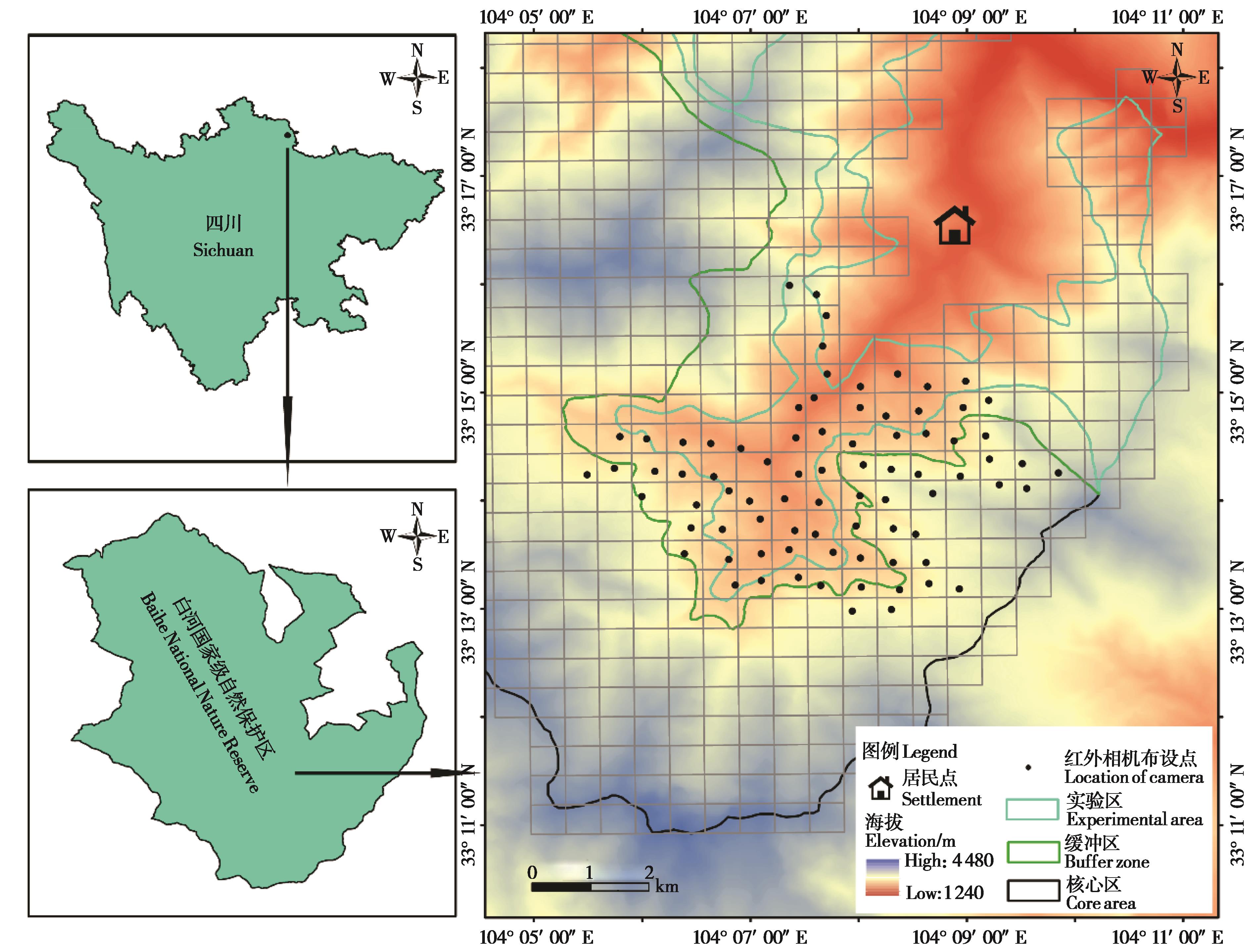
Fig.1 Location of study area and infrared triggered camera

Fig.2 The overlap of daily activity rhythms between Rhinopithecus roxellana and Sus scrofa in different season
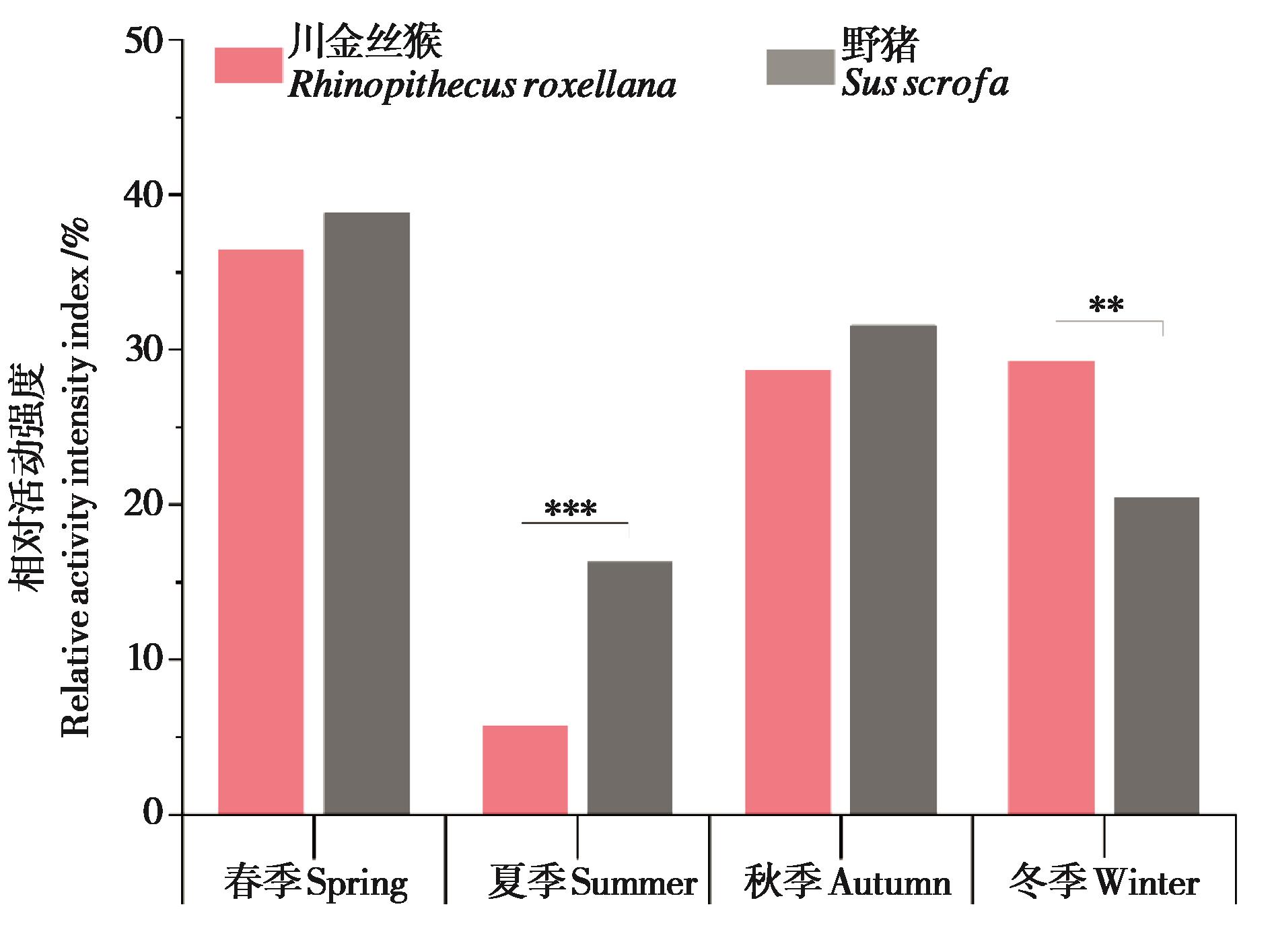
Fig. 3 The season relative activity intensity between Rhinopithecus roxellana and Sus scrofa on the ground.**P < 0.01,***P < 0.001
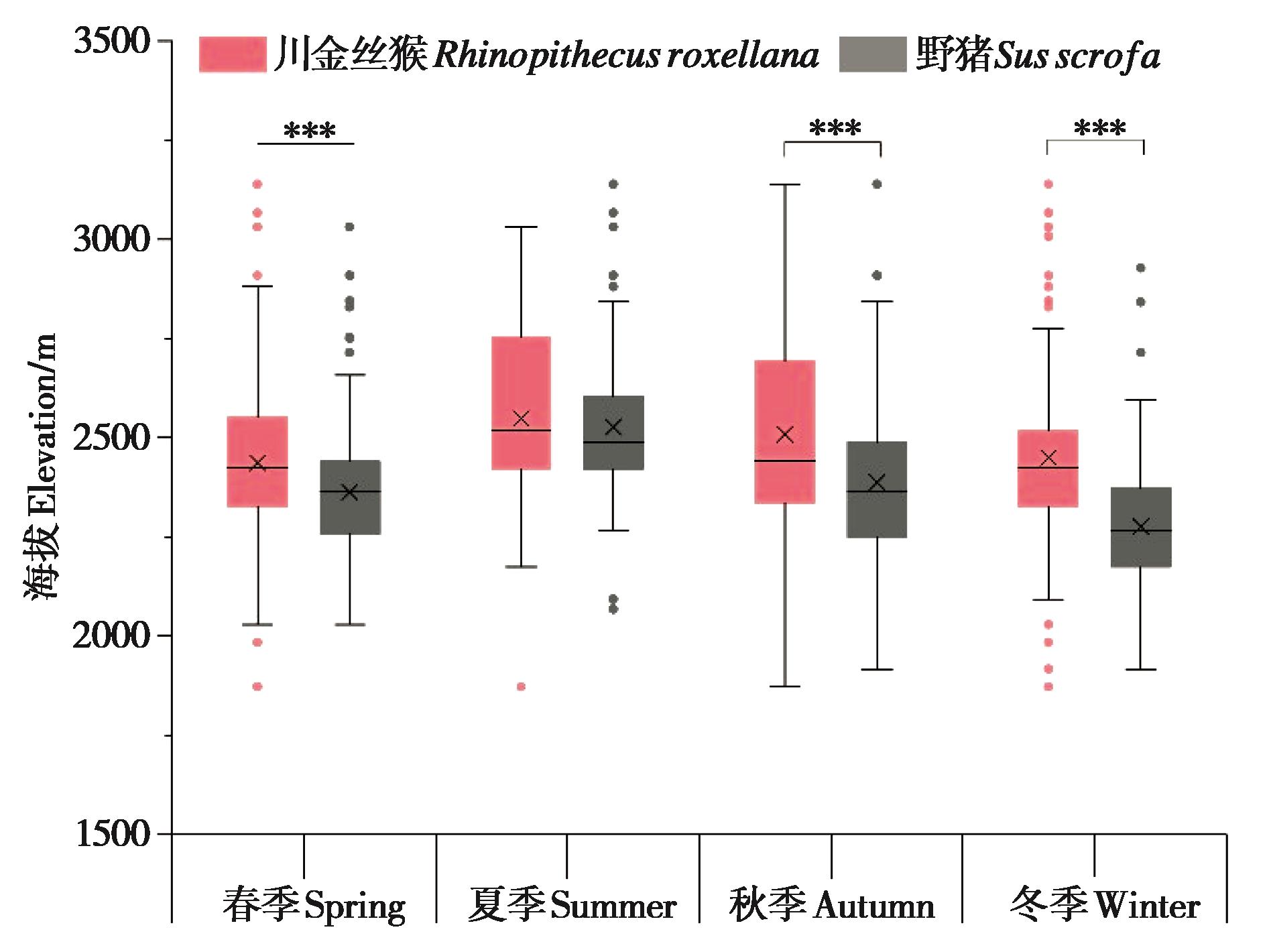
Fig. 4 The seasonal variation in activity elevation ranges between Rhinopithecus roxellana and Sus scrofa.***P < 0.001
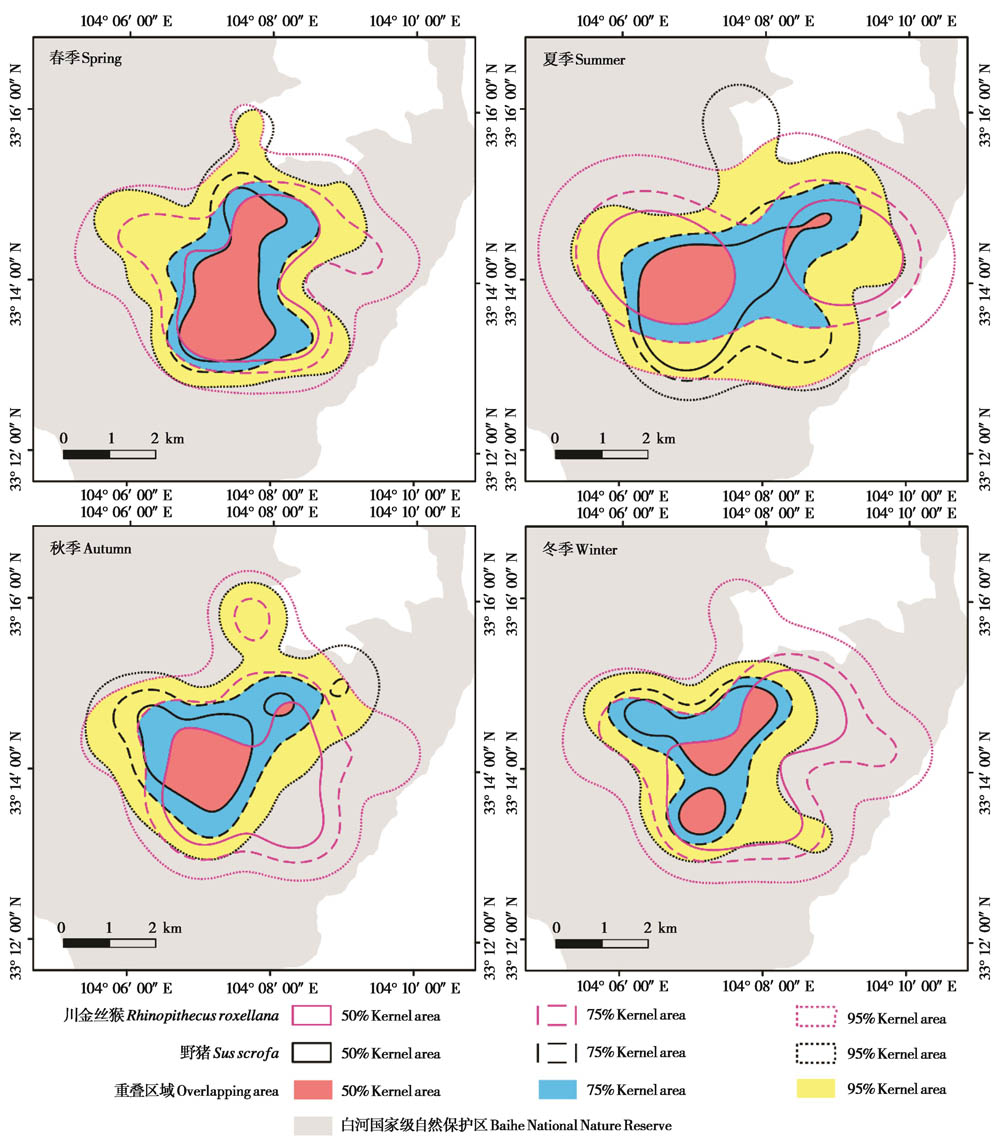
Fig. 5 Seasonal variation in the ranging patterns between Rhinopithecus roxellana and Sus scrofa, and their spatial overlap
| 季节 Season | 物种 Species | 模型 Model | K | AICc | ΔAICc | AIC weight |
|---|---|---|---|---|---|---|
| 春季 Spring | 川金丝猴 R. roxellana | ψ(DIS+Slo+MEVI)) | 5 | 466.834 | 0.000 | 0.497 |
| ψ(Slo+MEVI)) | 4 | 467.958 | 1.123 | 0.284 | ||
| p(MEVI)ψ(DIS+Slo+MEVI) | 6 | 468.475 | 1.641 | 0.219 | ||
野猪 S. scrofa | p(MEVI)ψ(DIS+Ele) | 5 | 447.288 | 0.000 | 0.207 | |
| p(DIS+Ele) | 4 | 447.321 | 0.033 | 0.203 | ||
| p(MEVI)ψ(DIS+MEVI) | 5 | 447.364 | 0.077 | 0.199 | ||
| p(DIS+MEVI) | 4 | 448.500 | 1.212 | 0.113 | ||
| p(Ele+MEVI)ψ(DIS+MEVI) | 6 | 448.709 | 1.422 | 0.101 | ||
| p(Ele)ψ(DIS+MEVI) | 5 | 448.767 | 1.479 | 0.099 | ||
| p(Ele+MEVI)ψ(DIS+Ele) | 6 | 449.218 | 1.930 | 0.079 | ||
| 夏季 Summer | 川金丝猴 R. roxellana | ψ(DIS+Ele+MEVI+Slo) | 6 | 185.803 | 0.000 | 0.726 |
| ψ(Slo) | 3 | 187.751 | 1.948 | 0.274 | ||
野猪 S. scrofa | p(MEVI)ψ(DIS+Ele) | 5 | 362.473 | 0.000 | 0.382 | |
| p(MEVI)ψ(DIS+Ele+Slo) | 6 | 363.325 | 0.853 | 0.249 | ||
| p(MEVI)ψ(DIS+Ele+MEVI+Slo) | 7 | 363.591 | 1.118 | 0.218 | ||
| p(Ele+MEVI)ψ(DIS+Ele) | 6 | 364.331 | 1.858 | 0.151 | ||
| 秋季 Autumn | 川金丝猴 R. roxellana | ψ(DIS+Ele+Slo) | 5 | 481.583 | 0.000 | 0.361 |
| ψ(DIS+Slo) | 4 | 482.059 | 0.476 | 0.285 | ||
| ψ(DIS+MEVI) | 4 | 482.751 | 1.168 | 0.202 | ||
| p(MEVI)ψ(DIS+Ele+Slo) | 6 | 483.313 | 1.730 | 0.152 | ||
野猪 S. scrofa | p(Ele) | 3 | 481.645 | 0.000 | 0.230 | |
| p(Ele)ψ(Ele) | 4 | 481.958 | 0.313 | 0.197 | ||
| p(Ele+MEVI) | 4 | 482.807 | 1.162 | 0.129 | ||
| p(Ele)ψ(Ele+MEVI) | 5 | 483.108 | 1.463 | 0.111 | ||
| p(Ele)ψ(MEVI+Slo) | 5 | 483.216 | 1.571 | 0.105 | ||
| p(DIS+Ele) | 4 | 483.305 | 1.660 | 0.100 | ||
| p(Ele)ψ(DIS) | 4 | 483.677 | 2.032 | 0.083 | ||
| p(Ele+MEVI)ψ(DIS) | 5 | 484.958 | 3.313 | 0.044 | ||
| 冬季 Winter | 川金丝猴 R. roxellana | p(Ele)ψ(Ele) | 4 | 486.812 | 0.000 | 0.566 |
| p(Ele) | 3 | 488.660 | 1.848 | 0.225 | ||
| p(Ele+MEVI)ψ(Ele) | 5 | 488.804 | 1.992 | 0.209 | ||
野猪 S. scrofa | p(DIS+Ele) | 4 | 326.903 | 0.000 | 0.360 | |
| p(Ele)ψ(DIS+Ele) | 5 | 327.546 | 0.643 | 0.258 | ||
| p(Ele)ψ((Ele) | 4 | 327.865 | 0.961 | 0.220 | ||
| p(Ele)ψ(DIS+Ele+Slo) | 6 | 328.449 | 1.546 | 0.165 |
Table 1 Selection results of single species occupation model (model with ΔAICc ≤ 2)
| 季节 Season | 物种 Species | 模型 Model | K | AICc | ΔAICc | AIC weight |
|---|---|---|---|---|---|---|
| 春季 Spring | 川金丝猴 R. roxellana | ψ(DIS+Slo+MEVI)) | 5 | 466.834 | 0.000 | 0.497 |
| ψ(Slo+MEVI)) | 4 | 467.958 | 1.123 | 0.284 | ||
| p(MEVI)ψ(DIS+Slo+MEVI) | 6 | 468.475 | 1.641 | 0.219 | ||
野猪 S. scrofa | p(MEVI)ψ(DIS+Ele) | 5 | 447.288 | 0.000 | 0.207 | |
| p(DIS+Ele) | 4 | 447.321 | 0.033 | 0.203 | ||
| p(MEVI)ψ(DIS+MEVI) | 5 | 447.364 | 0.077 | 0.199 | ||
| p(DIS+MEVI) | 4 | 448.500 | 1.212 | 0.113 | ||
| p(Ele+MEVI)ψ(DIS+MEVI) | 6 | 448.709 | 1.422 | 0.101 | ||
| p(Ele)ψ(DIS+MEVI) | 5 | 448.767 | 1.479 | 0.099 | ||
| p(Ele+MEVI)ψ(DIS+Ele) | 6 | 449.218 | 1.930 | 0.079 | ||
| 夏季 Summer | 川金丝猴 R. roxellana | ψ(DIS+Ele+MEVI+Slo) | 6 | 185.803 | 0.000 | 0.726 |
| ψ(Slo) | 3 | 187.751 | 1.948 | 0.274 | ||
野猪 S. scrofa | p(MEVI)ψ(DIS+Ele) | 5 | 362.473 | 0.000 | 0.382 | |
| p(MEVI)ψ(DIS+Ele+Slo) | 6 | 363.325 | 0.853 | 0.249 | ||
| p(MEVI)ψ(DIS+Ele+MEVI+Slo) | 7 | 363.591 | 1.118 | 0.218 | ||
| p(Ele+MEVI)ψ(DIS+Ele) | 6 | 364.331 | 1.858 | 0.151 | ||
| 秋季 Autumn | 川金丝猴 R. roxellana | ψ(DIS+Ele+Slo) | 5 | 481.583 | 0.000 | 0.361 |
| ψ(DIS+Slo) | 4 | 482.059 | 0.476 | 0.285 | ||
| ψ(DIS+MEVI) | 4 | 482.751 | 1.168 | 0.202 | ||
| p(MEVI)ψ(DIS+Ele+Slo) | 6 | 483.313 | 1.730 | 0.152 | ||
野猪 S. scrofa | p(Ele) | 3 | 481.645 | 0.000 | 0.230 | |
| p(Ele)ψ(Ele) | 4 | 481.958 | 0.313 | 0.197 | ||
| p(Ele+MEVI) | 4 | 482.807 | 1.162 | 0.129 | ||
| p(Ele)ψ(Ele+MEVI) | 5 | 483.108 | 1.463 | 0.111 | ||
| p(Ele)ψ(MEVI+Slo) | 5 | 483.216 | 1.571 | 0.105 | ||
| p(DIS+Ele) | 4 | 483.305 | 1.660 | 0.100 | ||
| p(Ele)ψ(DIS) | 4 | 483.677 | 2.032 | 0.083 | ||
| p(Ele+MEVI)ψ(DIS) | 5 | 484.958 | 3.313 | 0.044 | ||
| 冬季 Winter | 川金丝猴 R. roxellana | p(Ele)ψ(Ele) | 4 | 486.812 | 0.000 | 0.566 |
| p(Ele) | 3 | 488.660 | 1.848 | 0.225 | ||
| p(Ele+MEVI)ψ(Ele) | 5 | 488.804 | 1.992 | 0.209 | ||
野猪 S. scrofa | p(DIS+Ele) | 4 | 326.903 | 0.000 | 0.360 | |
| p(Ele)ψ(DIS+Ele) | 5 | 327.546 | 0.643 | 0.258 | ||
| p(Ele)ψ((Ele) | 4 | 327.865 | 0.961 | 0.220 | ||
| p(Ele)ψ(DIS+Ele+Slo) | 6 | 328.449 | 1.546 | 0.165 |
季节 Season | 假设 Hypothesis | 编号 No. | 模型 Model | AIC | ΔAIC |
|---|---|---|---|---|---|
春季 Spring | M1 | M1‑1 | p(Day,Day,Day),ψ(Ele+DIS+MEVI,DIS+Slo+MEVI,0) | 941.902 | 8.185 |
| M2 | M2‑1 | p(Day,Day,Day),ψ(Ele+DIS+MEVI,DIS+Slo+MEVI,Pr(GM|WB)) | 939.431 | 5.714 | |
| M3 | M3‑1 | p(Day,Day,Day),ψ(Ele+DIS+MEVI,DIS+Slo+MEVI,Pr(GM|WB)*(DIS)) | 933.716 | 0.000 | |
| M3‑2 | p(Day,Day,Day),ψ(Ele+DIS+MEVI,DIS+Slo+MEVI,Pr(GM|WB)*(Slo+DIS)) | 939.000 | 5.283 | ||
| M3‑3 | p(Day,Day,Day),ψ(Ele+DIS+MEVI,DIS+Slo+MEVI,Pr(GM|WB)*(Slo+DIS+MEVI)) | 937.712 | 3.996 | ||
夏季 Summer | M1 | M1‑1 | p(Day,Day,Day),ψ(Ele+Slo+DIS+MEVI,Ele+Slo+DIS+MEVI,0) | 577.394 | 3.013 |
| M2 | M2‑1 | p(Day,Day,Day),ψ(Ele+Slo+DIS+MEVI,Ele+Slo+DIS+MEVI,Pr(GM|WB)) | — | — | |
| M3 | M3‑1 | p(Day,Day,Day),ψ(Ele+Slo+DIS+MEVI,Ele+Slo+DIS+MEVI,Pr(GM|WB)*(DIS)) | 574.381 | 0.000 | |
| M3‑2 | p(Day,Day,Day),ψ(Ele+Slo+DIS+MEVI,Ele+Slo+DIS+MEVI,Pr(GM|WB)*(Ele+MEVI)) | 576.785 | 2.404 | ||
| M3‑3 | p(Day,Day,Day), ψ(Ele+Slo+DIS+MEVI,Ele+Slo+DIS+MEVI,Pr(GM|WB)*(Ele+Slo+DIS+MEVI)) | 584.293 | 9.912 | ||
秋季 Autumn | M1 | M1‑1 | p(Day,Day,Day),ψ(Ele+Slo+DIS+MEVI,Ele+Slo+DIS+MEVI,0) | 989.026 | 13.908 |
| M2 | M2‑1 | p(Day,Day,Day),ψ(Ele+Slo+DIS+MEVI,Ele+Slo+DIS+MEVI,Pr(GM|WB)) | 1001.272 | 26.154 | |
| M3 | M3‑1 | p(Day,Day,Day),ψ(Ele+Slo+DIS+MEVI,Ele+Slo+DIS+MEVI,Pr(GM|WB)*(Ele+DIS)) | 975.119 | 0.000 | |
| M3‑2 | p(Day,Day,Day),ψ(Ele+Slo+DIS+MEVI,Ele+Slo+DIS+MEVI,Pr(GM|WB)*(Slo+DIS) | 983.576 | 8.458 | ||
| M3‑3 | p(Day,Day,Day),ψ(Ele+Slo+DIS+MEVI,Ele+Slo+DIS+MEVI),Pr(GM|WB)*(DIS+MEVI) | 977.507 | 2.389 | ||
冬季 Winter | M1 | M1‑1 | p(Day,Day,Day),ψ(Ele+Slo+DIS,Ele,0) | 827.551 | 1.417 |
| M2 | M2‑1 | p(Day,Day,Day),ψ(Ele+Slo+DIS,Ele,Pr(GM|WB)) | 835.154 | 9.020 | |
| M3 | M3‑1 | p(Day,Day,Day),ψ(Ele+Slo+DIS,Ele,Pr(GM|WB)*(Slo)) | 826.264 | 0.130 | |
| M3‑2 | p(Day,Day,Day),ψ(Ele+Slo+DIS,Ele,Pr(GM|WB)*(Ele+Slo)) | 826.134 | 0.000 | ||
| M3‑3 | p(Day,Day,Day),ψ(Ele+Slo+DIS,Ele,Pr(GM|WB)*(Slo+MEVI)) | 828.200 | 2.065 |
Table 2 Selection results of multi‑species occupancy models
季节 Season | 假设 Hypothesis | 编号 No. | 模型 Model | AIC | ΔAIC |
|---|---|---|---|---|---|
春季 Spring | M1 | M1‑1 | p(Day,Day,Day),ψ(Ele+DIS+MEVI,DIS+Slo+MEVI,0) | 941.902 | 8.185 |
| M2 | M2‑1 | p(Day,Day,Day),ψ(Ele+DIS+MEVI,DIS+Slo+MEVI,Pr(GM|WB)) | 939.431 | 5.714 | |
| M3 | M3‑1 | p(Day,Day,Day),ψ(Ele+DIS+MEVI,DIS+Slo+MEVI,Pr(GM|WB)*(DIS)) | 933.716 | 0.000 | |
| M3‑2 | p(Day,Day,Day),ψ(Ele+DIS+MEVI,DIS+Slo+MEVI,Pr(GM|WB)*(Slo+DIS)) | 939.000 | 5.283 | ||
| M3‑3 | p(Day,Day,Day),ψ(Ele+DIS+MEVI,DIS+Slo+MEVI,Pr(GM|WB)*(Slo+DIS+MEVI)) | 937.712 | 3.996 | ||
夏季 Summer | M1 | M1‑1 | p(Day,Day,Day),ψ(Ele+Slo+DIS+MEVI,Ele+Slo+DIS+MEVI,0) | 577.394 | 3.013 |
| M2 | M2‑1 | p(Day,Day,Day),ψ(Ele+Slo+DIS+MEVI,Ele+Slo+DIS+MEVI,Pr(GM|WB)) | — | — | |
| M3 | M3‑1 | p(Day,Day,Day),ψ(Ele+Slo+DIS+MEVI,Ele+Slo+DIS+MEVI,Pr(GM|WB)*(DIS)) | 574.381 | 0.000 | |
| M3‑2 | p(Day,Day,Day),ψ(Ele+Slo+DIS+MEVI,Ele+Slo+DIS+MEVI,Pr(GM|WB)*(Ele+MEVI)) | 576.785 | 2.404 | ||
| M3‑3 | p(Day,Day,Day), ψ(Ele+Slo+DIS+MEVI,Ele+Slo+DIS+MEVI,Pr(GM|WB)*(Ele+Slo+DIS+MEVI)) | 584.293 | 9.912 | ||
秋季 Autumn | M1 | M1‑1 | p(Day,Day,Day),ψ(Ele+Slo+DIS+MEVI,Ele+Slo+DIS+MEVI,0) | 989.026 | 13.908 |
| M2 | M2‑1 | p(Day,Day,Day),ψ(Ele+Slo+DIS+MEVI,Ele+Slo+DIS+MEVI,Pr(GM|WB)) | 1001.272 | 26.154 | |
| M3 | M3‑1 | p(Day,Day,Day),ψ(Ele+Slo+DIS+MEVI,Ele+Slo+DIS+MEVI,Pr(GM|WB)*(Ele+DIS)) | 975.119 | 0.000 | |
| M3‑2 | p(Day,Day,Day),ψ(Ele+Slo+DIS+MEVI,Ele+Slo+DIS+MEVI,Pr(GM|WB)*(Slo+DIS) | 983.576 | 8.458 | ||
| M3‑3 | p(Day,Day,Day),ψ(Ele+Slo+DIS+MEVI,Ele+Slo+DIS+MEVI),Pr(GM|WB)*(DIS+MEVI) | 977.507 | 2.389 | ||
冬季 Winter | M1 | M1‑1 | p(Day,Day,Day),ψ(Ele+Slo+DIS,Ele,0) | 827.551 | 1.417 |
| M2 | M2‑1 | p(Day,Day,Day),ψ(Ele+Slo+DIS,Ele,Pr(GM|WB)) | 835.154 | 9.020 | |
| M3 | M3‑1 | p(Day,Day,Day),ψ(Ele+Slo+DIS,Ele,Pr(GM|WB)*(Slo)) | 826.264 | 0.130 | |
| M3‑2 | p(Day,Day,Day),ψ(Ele+Slo+DIS,Ele,Pr(GM|WB)*(Ele+Slo)) | 826.134 | 0.000 | ||
| M3‑3 | p(Day,Day,Day),ψ(Ele+Slo+DIS,Ele,Pr(GM|WB)*(Slo+MEVI)) | 828.200 | 2.065 |
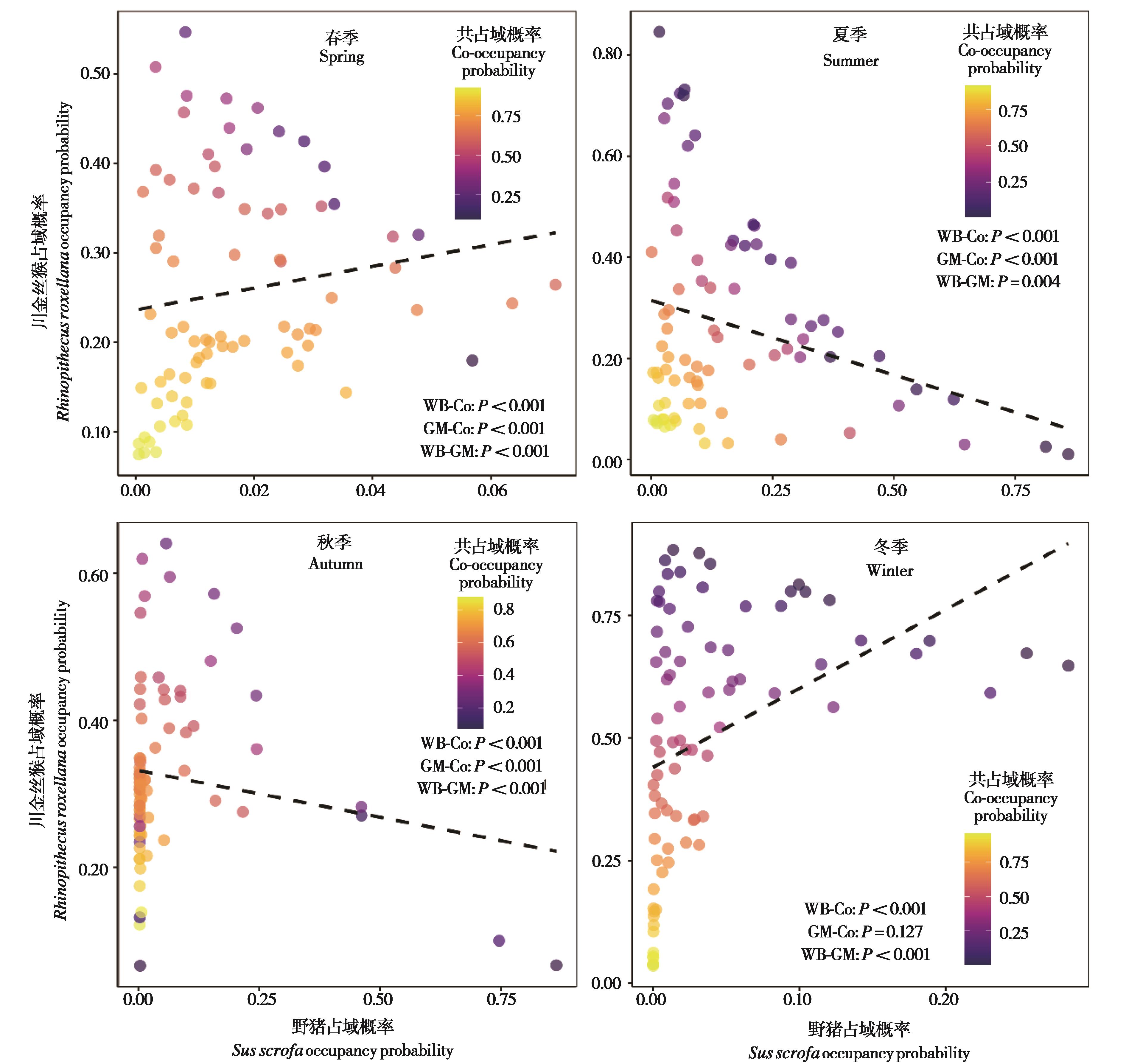
Fig. 6 The species occupancy relationship between Rhinopithecus roxellana and Sus scrofa. WB‑Co: Comparison of only Sus scrofa and Co‑occupancy probability; GM‑Co: Comparison of only Rhinopithecus roxellana and co‑occupancy probability; WB‑GM: Comparison of only Sus scrofa and Rhinopithecus roxellana probability
季节 Season | 模型成分 Model component | 物种 Species | 协变量 Covariates | 估计值 Estimate | 标准误 SE | Z | P |
|---|---|---|---|---|---|---|---|
| 春季Spring | 占域 Occupancy | R. roxellana | 截距(lnt) | 2.460 | 0.474 | 5.194 | < 0.001*** |
| Slo | -0.463 | 0.579 | -0.799 | 0.424 | |||
| DIS | 0.386 | 0.406 | 0.950 | 0.342 | |||
| MEVI | 1.252 | 0.663 | 1.890 | 0.059 | |||
| S. scrofa | 截距(lnt) | -0.566 | 0.348 | -1.625 | 0.104 | ||
| Ele | -0.336 | 0.413 | -0.815 | 0.415 | |||
| DIS | 1.059 | 0.453 | 2.337 | 0.019* | |||
| MEVI | 0.493 | 0.416 | 1.184 | 0.236 | |||
| WB|GM | 截距(lnt) | 1.551 | 0.453 | 3.421 | 0.006 | ||
| DIS | -0.510 | 0.476 | -1.071 | 0.284 | |||
| 探测Detection | R. roxellana | 截距(lnt) | -0.671 | 0.512 | -1.310 | 0.190 | |
| day | -0.242 | 0.513 | -0.471 | 0.637 | |||
| S. scrofa | 截距(lnt) | -1.277 | 0.576 | -2.218 | 0.027 | ||
| day | 1.239 | 0.610 | 2.031 | 0.042 | |||
| 夏季Summer | 占域 Occupancy | R. roxellana | 截距(lnt) | 1.259 | 0.460 | 2.740 | 0.006 |
| Ele | -0.814 | 0.701 | -1.162 | 0.245 | |||
| Slo | -0.111 | 0.752 | -0.147 | 0.883 | |||
| DIS | 0.783 | 0.857 | 0.913 | 0.361 | |||
| MEVI | -0.953 | 0.636 | -1.498 | 0.134 | |||
| S. scrofa | 截距(lnt) | 0.454 | 0.473 | 0.959 | 0.337 | ||
| Ele | 0.806 | 0.569 | 1.416 | 0.157 | |||
| Slo | -0.315 | 0.407 | -0.774 | 0.439 | |||
| DIS | 0.022 | 0.543 | 0.040 | 0.968 | |||
| MEVI | 0.539 | 0.394 | 1.369 | 0.171 | |||
| WB|GM | 截距(lnt) | -0.304 | 2.310 | -0.132 | 0.895 | ||
| DIS | 1.161 | 0.865 | 1.342 | 0.180 | |||
| 探测Detection | R. roxellana | 截距(lnt) | -1.465 | 0.393 | -3.728 | 0.000 | |
| day | -1.065 | 0.376 | -2.831 | 0.005* | |||
| S. scrofa | 截距(lnt) | -1.639 | 0.439 | -3.734 | 0.000 | ||
| day | 0.629 | 0.470 | 1.339 | 0.181 | |||
| 秋季Autumn | 占域 Occupancy | R. roxellana | 截距(lnt) | 4.698 | 1.594 | 2.948 | 0.003 |
| Ele | 0.452 | 1.698 | 0.266 | 0.790 | |||
| Slo | -1.235 | 0.929 | -1.329 | 0.184 | |||
| DIS | -2.284 | 1.665 | -1.372 | 0.170 | |||
| MEVI | 1.709 | 1.599 | 1.069 | 0.285 | |||
| S. scrofa | 截距(lnt) | -0.346 | 1.941 | -0.178 | 0.859 | ||
| Ele | -0.348 | 1.624 | -0.214 | 0.830 | |||
| Slo | -0.109 | 0.499 | -0.219 | 0.827 | |||
| DIS | -5.202 | 2.151 | -2.418 | 0.016* | |||
| MEVI | 0.386 | 0.694 | 0.556 | 0.578 | |||
| WB|GM | 截距(lnt) | -0.693 | 1.057 | -0.655 | 0.512 | ||
| Ele | 0.100 | 1.940 | 0.051 | 0.959 | |||
| DIS | 5.504 | 2.299 | 2.394 | 0.017* | |||
| 探测Detection | R. roxellana | 截距(lnt) | -2.634 | 1.437 | -1.832 | 0.067 | |
| day | 1.568 | 1.464 | 1.071 | 0.284 | |||
| S. scrofa | 截距(lnt) | -2.138 | 1.121 | -1.908 | 0.056 | ||
| day | 1.907 | 1.121 | 1.701 | 0.089 | |||
| 冬季Winter | 占域 Occupancy | R. roxellana | 截距(lnt) | 2.339 | 1.006 | 2.326 | 0.020 |
| Ele | -0.018 | 1.188 | -0.015 | 0.988 | |||
| S. scrofa | 截距(lnt) | -1.526 | 0.815 | -1.871 | 0.061 | ||
| Ele | 1.105 | 1.373 | 0.805 | 0.421 | |||
| DIS | 0.662 | 0.643 | 1.031 | 0.303 | |||
| Slo | -1.118 | 0.808 | -1.384 | 0.166 | |||
| WB|GM | 截距(lnt) | 1.984 | 1.410 | 1.407 | 0.159 | ||
| Ele | -3.097 | 1.347 | -2.299 | 0.002** | |||
| Slo | 1.719 | 0.793 | 2.168 | 0.003** | |||
| 探测Detection | R. roxellana | 截距(lnt) | -3.896 | 0.879 | -4.431 | < 0.001*** | |
| day | 2.963 | 0.922 | 3.213 | 0.001** | |||
| S. scrofa | 截距(lnt) | -2.170 | 0.976 | -2.222 | 0.026 | ||
| day | 1.678 | 0.990 | 1.696 | 0.090 |
Table 3 Influence of environmental variables on occupancy and detection rate in alone and co‑occurrence of R. roxellana and S. scrofa by the optimal model
季节 Season | 模型成分 Model component | 物种 Species | 协变量 Covariates | 估计值 Estimate | 标准误 SE | Z | P |
|---|---|---|---|---|---|---|---|
| 春季Spring | 占域 Occupancy | R. roxellana | 截距(lnt) | 2.460 | 0.474 | 5.194 | < 0.001*** |
| Slo | -0.463 | 0.579 | -0.799 | 0.424 | |||
| DIS | 0.386 | 0.406 | 0.950 | 0.342 | |||
| MEVI | 1.252 | 0.663 | 1.890 | 0.059 | |||
| S. scrofa | 截距(lnt) | -0.566 | 0.348 | -1.625 | 0.104 | ||
| Ele | -0.336 | 0.413 | -0.815 | 0.415 | |||
| DIS | 1.059 | 0.453 | 2.337 | 0.019* | |||
| MEVI | 0.493 | 0.416 | 1.184 | 0.236 | |||
| WB|GM | 截距(lnt) | 1.551 | 0.453 | 3.421 | 0.006 | ||
| DIS | -0.510 | 0.476 | -1.071 | 0.284 | |||
| 探测Detection | R. roxellana | 截距(lnt) | -0.671 | 0.512 | -1.310 | 0.190 | |
| day | -0.242 | 0.513 | -0.471 | 0.637 | |||
| S. scrofa | 截距(lnt) | -1.277 | 0.576 | -2.218 | 0.027 | ||
| day | 1.239 | 0.610 | 2.031 | 0.042 | |||
| 夏季Summer | 占域 Occupancy | R. roxellana | 截距(lnt) | 1.259 | 0.460 | 2.740 | 0.006 |
| Ele | -0.814 | 0.701 | -1.162 | 0.245 | |||
| Slo | -0.111 | 0.752 | -0.147 | 0.883 | |||
| DIS | 0.783 | 0.857 | 0.913 | 0.361 | |||
| MEVI | -0.953 | 0.636 | -1.498 | 0.134 | |||
| S. scrofa | 截距(lnt) | 0.454 | 0.473 | 0.959 | 0.337 | ||
| Ele | 0.806 | 0.569 | 1.416 | 0.157 | |||
| Slo | -0.315 | 0.407 | -0.774 | 0.439 | |||
| DIS | 0.022 | 0.543 | 0.040 | 0.968 | |||
| MEVI | 0.539 | 0.394 | 1.369 | 0.171 | |||
| WB|GM | 截距(lnt) | -0.304 | 2.310 | -0.132 | 0.895 | ||
| DIS | 1.161 | 0.865 | 1.342 | 0.180 | |||
| 探测Detection | R. roxellana | 截距(lnt) | -1.465 | 0.393 | -3.728 | 0.000 | |
| day | -1.065 | 0.376 | -2.831 | 0.005* | |||
| S. scrofa | 截距(lnt) | -1.639 | 0.439 | -3.734 | 0.000 | ||
| day | 0.629 | 0.470 | 1.339 | 0.181 | |||
| 秋季Autumn | 占域 Occupancy | R. roxellana | 截距(lnt) | 4.698 | 1.594 | 2.948 | 0.003 |
| Ele | 0.452 | 1.698 | 0.266 | 0.790 | |||
| Slo | -1.235 | 0.929 | -1.329 | 0.184 | |||
| DIS | -2.284 | 1.665 | -1.372 | 0.170 | |||
| MEVI | 1.709 | 1.599 | 1.069 | 0.285 | |||
| S. scrofa | 截距(lnt) | -0.346 | 1.941 | -0.178 | 0.859 | ||
| Ele | -0.348 | 1.624 | -0.214 | 0.830 | |||
| Slo | -0.109 | 0.499 | -0.219 | 0.827 | |||
| DIS | -5.202 | 2.151 | -2.418 | 0.016* | |||
| MEVI | 0.386 | 0.694 | 0.556 | 0.578 | |||
| WB|GM | 截距(lnt) | -0.693 | 1.057 | -0.655 | 0.512 | ||
| Ele | 0.100 | 1.940 | 0.051 | 0.959 | |||
| DIS | 5.504 | 2.299 | 2.394 | 0.017* | |||
| 探测Detection | R. roxellana | 截距(lnt) | -2.634 | 1.437 | -1.832 | 0.067 | |
| day | 1.568 | 1.464 | 1.071 | 0.284 | |||
| S. scrofa | 截距(lnt) | -2.138 | 1.121 | -1.908 | 0.056 | ||
| day | 1.907 | 1.121 | 1.701 | 0.089 | |||
| 冬季Winter | 占域 Occupancy | R. roxellana | 截距(lnt) | 2.339 | 1.006 | 2.326 | 0.020 |
| Ele | -0.018 | 1.188 | -0.015 | 0.988 | |||
| S. scrofa | 截距(lnt) | -1.526 | 0.815 | -1.871 | 0.061 | ||
| Ele | 1.105 | 1.373 | 0.805 | 0.421 | |||
| DIS | 0.662 | 0.643 | 1.031 | 0.303 | |||
| Slo | -1.118 | 0.808 | -1.384 | 0.166 | |||
| WB|GM | 截距(lnt) | 1.984 | 1.410 | 1.407 | 0.159 | ||
| Ele | -3.097 | 1.347 | -2.299 | 0.002** | |||
| Slo | 1.719 | 0.793 | 2.168 | 0.003** | |||
| 探测Detection | R. roxellana | 截距(lnt) | -3.896 | 0.879 | -4.431 | < 0.001*** | |
| day | 2.963 | 0.922 | 3.213 | 0.001** | |||
| S. scrofa | 截距(lnt) | -2.170 | 0.976 | -2.222 | 0.026 | ||
| day | 1.678 | 0.990 | 1.696 | 0.090 |
| Ballari S A, Barrios‑Garicia M N,2015. A review of wild boar Sus scrofa diet and factors affecting food selection in native and introduced ranges[J]. Mammal Review,44(2):124‑134. DOI:10.1111/mam.12015 . | |
| Barton K,2023. MuMIn:Multi‑Model inference[CP/DK]. R package version 1.47.5. . | |
| Boutin S, Boyce M S, Hebblewhite M,2012. Why are caribou declining in the oil sands?[J]. Frontiers in Ecology and the Environment,10(2):65‑67. DOI:10.1890/12.WB.005 . | |
| Bruce T, Amir Z, Allen B L,et al.,2025. Large‑scale and long‑term wildlife research and monitoring using camera traps:a continental synthesis[J]. Biological Reviews,100(2):530‑555. DOI:10.1111/brv.13152 . | |
| Burgar J M, Burton A C, Fisher J T,2019. The importance of considering multiple interacting species for conservation of species at risk[J]. Conservation Biology,33:709‑715. DOI:10.1111/cobi.13233 . | |
| Calenge C,2006. The package ‘adehabitat’ for the R software:a tool for the analysis of space and habitat use by animals[J]. Ecological Modelling,197:516‑519. DOI:10.1016/j.ecolmodel.2006.03.017 . | |
| Chen Y, Ma C, Yang L, Guan Z H, Jiang X L, Fan P F,2020. Asymmetric competition between sympatric endangered primates affects their population recovery[J]. Biological Conservation,248:108558. DOI:10.1016/j.biocon.2020.108558 . | |
| Chen Zhangmin, Peng Bo, He Fei, He Xingcheng, Wang Wenling, Liu Tianjiao, Li Yuxin, Ran Jianghong,2024. A study on the temporal and spatial patterns of ungulates in the Xiaozhaizigou National Nature Reserve,Sichuan[J]. Sichuan Journal of Zoology,43(4):373‑384. DOI:10. 11984/j. issn. 1000-7083. 20240003. (in Chinese with English abstract) | |
| Chase J M, Leibold M A,2003. Ecological niches:linking classical and contemporary approaches[M]. University of Chicago Press,Chicago,USA. | |
| Chu Y M R, Sha J C M, Kawazoe T, Dong X,2018. Sleeping site and tree selection by Sichuan snub‑nosed monkeys (Rhinopithecus roxellana) in Baihe Nature Reserve,Sichuan,China[J]. American Journal of Primatology,80(12):e22936. DOI:10.1002/ajp.22936 . | |
| Clipp H L, Evans A L, Kessinger B E, Kellner K, Rota C T,2021. A penalized likelihood for multispecies occupancy models improves predictions of species interactions[J]. Ecology,102(12):e03520. DOI:10.1002/ecy.3520 . | |
| Corlatti L, Bonardi A, Bragalanti N, Pedrotti L,2019. Long‑term dynamics of Alpine ungulates suggest interspecific competition[J]. Journal of Zoology,309:241‑249. DOI:10.1111/jzo.12716 . | |
| Cuevas M F, Novillo A, Campos C, Dacar M A, Ojeda R A,2010. Food habits and impact of rooting behavior of the invasive wild boar,Sus scrofa,in a protected area of the Monte Desert,Argentina[J]. Journal of Arid Environments,74:1582‑1585. DOI:10.1016/j.jaridenv.2010.05.008 . | |
| Dhondt A A,2012. Interspecific competition in birds[M]. Oxford University Press,Oxford,UK. | |
| Dong Xin, Lang Jiayu, Mengran Chuyuan, Zhao Shanshan, Zhang Jundong, Bai Wenke,2021. The seasonal characteristics of home range and habitat utilization of Sichuan golden monkeys(Rhinopithecus roxellana)[J]. Ecology and Environment,30(7):1342‑1352. DOI:10.16258/j.cnki.1674-5906. 2021.07.002. (in Chinese with English abstract) | |
| Finnegan S P, Gantchoff M G, Hill J E, Silveira L, Tôrres N M, Jácomo A T, Uzal A,2021. “When the felid’s away,the mesocarnivores play”:seasonal temporal segregation in a neotropical carnivore guild[J]. Mammalian Biology,101:631‑638. DOI:10.1007/s42991-021-00110-9 . | |
| Fiske I, Chandler R,2011. Unmarked:An R package for fitting hierarchical models of wildlife occurrence and abundance[J]. Journal of Statistical Software,43(10):1‑23. DOI:10.18637/jss.v043.i10 . | |
| Focardi S, Capizzi D, Monetti D,2000. Competition for acorns among wild boar (Sus scrofa) and small mammals in a Mediterranean woodland[J]. Journal of Zoology,250(3):329‑334. DOI:10.1111/j.1469-7998.2000.tb00777.x . | |
| Frey S, Fisher J T, Burton A C, Volpe J P,2017. Investigating animal activity patterns and temporal niche partitioning using camera‑trap data:challenges and opportunities[J]. Remote Sensing in Ecology and Conservation,3:123‑132. DOI:10.1002/rse2.60 . | |
| Shuangbao Gun,2003. Study on wild boar resources and population characteristics in Ziwuling forest grassland,Gansu[D]. Lanzhou:Gansu Agricultural University.(in Chinese with English abstract) | |
| Shuangbao Gun, Fu Yikun, Ma Dongwu,2007. Digestibility and digestive tract measurement of wild boar(Sus scrofa)[J]. Journal of Animal Science and Veterinary Medicine,26(3):11‑13. DOI:10.3969/j.issn.1004-6704.2007.03.005. (in Chinese with English abstract) | |
| Shuangbao Gun, Ma Yanping, Wang Gang,2008.Winter foods and digestive function of wild boarin Ziwuling forest grassland of Gansu[J]. Chinese Journal of Animal Nutrition,20(2):200‑205. DOI:10.3969/j.issn.1004-6704.2007.03.005. (in Chinese with English abstract) | |
| Guo Jiaqiang,2018. A comparison of activity rhythm and time budgets of two groups of Rhinopithecus roxellana in Minshan Mountains[D]. Nanchong:China West Normal University. (in Chinese with English abstract) | |
| Guo S T, Hou R, Garber P A, Raubenheimer D, Righini N, Ji W H, Jay O, He S J, Wu F, Li F F, Li B G, 2018. Nutrient‑specific compensation for seasonal cold stress in a free‑ranging temperate colobine monkey[J]. Functional Ecology,32:2170‑2180. DOI:10.1111/1365-2435.13134 . | |
| Hamel S, Killengreen S T, Henden J A, Ims R A,2013. Disentangling the importance of interspecific competition,food availability,and habitat in species occupancy:recolonization of the endangered Fennoscandian arctic fox[J]. Biological Conservation,160:114‑120. DOI:10.1016/j.biocon.2013.01.011 . | |
| Han Yimin, Xiao Mei, He Mengnan, Li Mingfu, Hou Rong, Wu Pengcheng, He Fang, Shen Limin, Hu Jie, Chen Peng,2024.The activity rhythm and space utilization among six species of ungulates in Tangjiahe National Nature Reserve,Sichuan,China[J]. Acta Theriologica Sinica,44(5):598‑610. DOI:10.16829/j.slxb.150844. (in Chinese with English abstract) | |
| Harihar A, Pandav B, Goyal S P,2011. Responses of leopard Panthera pardus to the recovery of a tiger Panthera tigris population[J]. Journal of Applied Ecology,48:806‑814. DOI:10.1111/j.1365-2664.2011.01981.x . | |
| He Fei, Xu Ge, Wang Xin, Liu Yang, Liu Baiyu, Fei Yuxiang,2023. Habitat selection characteristics of wild boar in Xiaozhaizigou National Nature Reserve,Sichuan Province[J]. Journal of Sichuan Forestry Science and Technology,44(2):13‑20. DOI:10.12172/202206140001. (in Chinese with English abstract) | |
| Hou Rong,2014. Nutritional requirements and feeding strategy of golden snub‑nosed monkeys (Rhinopithecus roxellana) in Qinling Mountains[D]. Xi’an:Northwest University.(in Chinese with English abstract) | |
| Hou R, Chapman C A, Rothman J M, Zhang H, Huang K, Guo S T, Li B G, Raubenheimer D,2021. The geometry of resource constraint:an empirical study of the golden snub‑nosed monkey[J]. Jounal of Animal Ecology,90:751‑765. DOI:10.1111/1365-2656.13408 . | |
| Hou R, He S, Wu F, Chapman C A, Pan R L, Garber P A, Guo S T, Li B G,2018. Seasonal variation in diet and nutrition of the northern‑most population of Rhinopithecus roxellana [J]. American Journal of Primatology,80:e22755. DOI:10.1002/ajp.22755. (in Chinese with English abstract) | |
| Hu Qiang, Lin Hongqiang, Dai Qiang, Yang Zhisong, He Liuyang, Zhang Wen, Shi Xiaogang,2020. Niche differentiation among three middle‑sized carnivores in Wolong Nature Reserve[J]. Chinese Journal of Zoology,55(6):685‑691. DOI:10.13859/j.cjz.202006001. (in Chinese with English abstract) | |
| Huang Kai,2022. Comparative study on behavioral patterns of Yunnan snub‑nosed monkey (Rhinopithecus bieti) and Sichuan snub‑nosed monkey (R . roxellana) based on infrared cameras[D]. Nanchong:China West Normal University. (in Chinese with English abstract) | |
| Huang Kai, Wan Yaqiong, Li Jiaqi, Zhu Yujing, Sun Zhiyu, Xia Wancai, Li Dayong, Ren Baoping,2021.Camera‑trapping survey on mammals and birds in Baihe National Nature Reserve,Sichuan Province[J]. Biodiversity Science,29(4):554‑559. DOI:10.17520/biods.2020270. (in Chinese with English abstract) | |
| Jin Guixiang, Deng Hao, Ou Pinggui, Li Qian, Tang Xiaoqiang, Lin Jie,2015. Investigation on rare plant species in Baihe Nature Reserve in Sichuan Province[J]. Journal of Sichuan Forestry Science and Technology,36(5):41‑55. DOI:10.16779/j.cnki.1003-5508.2015.05.009. (in Chinese with English abstract) | |
| Karanth K U, Nichols J D,1998. Estimation of tiger densities in India using photographic captures and recaptures[J]. Ecology,79:2852‑2862. DOI:10.1890/0012-9658(1998)079 [2852:EOTDII]2.0.CO;2. | |
| Kellner K F, Smith A D, Royle J A, Kéry M, Belant J L, Chandler R B,2023. The unmarked R package:twelve years of advances in occurrence and abundance modelling in ecology[J]. Methods in Ecology and Evolution,14(6):1408‑1415. DOI:10.1111/2041-210X.14123 . | |
| Kronfeld‑Schor N, Dayan T,2003. Partitioning of time as an ecological resource[J]. Annual Review of Ecology,Evolution,and Systematics,34:153‑181. DOI:10.1146/annurev.ecolsys.34.011802.132435 . | |
| Lemel J, Truvé J, Söderberg B,2003. Variation in ranging and activity behaviour of European wild boar Sus scrofa in Sweden[J]. Wildlife Biology,9:29‑36. DOI:10.2981/wlb.2003.061 . | |
| Li B, Chen C, Ji W H, Ren B P,2001. Seasonal home range changes of the Sichuan snub‑nosed nonkey (Rhinopithecus roxellana) in the Qinling Mountains of China[J]. Folia Primatologica,71(6):375‑386. DOI:10.1159/000052734 . | |
| Li J, Xue Y D, Liao M F, Wu D, Wu B, Li D Q,2022. Temporal and spatial activity patterns of sympatric wild ungulates in Qinling Mountains,China[J]. Animals,12(13):1666. DOI:10.3390/ani12131666 . | |
| Li Sheng, Wang Dajun, Xiao Zhishu, Li Xinhai, Wang Tianming, Feng Limin, Wang Yun,2014. Camera‑trapping in wildlife research and conservation in China:review and outlook[J]. Biodiversity Science,22(6):685‑695. DOI:10.3724/SP.J. 1003.2014.14203. (in Chinese with English abstract) | |
| Li Y M,2007. Terrestriality and tree stratum use in a group of Sichuan snub‑nosed monkeys[J]. Primates,48:197‑207. DOI:10.1007/s10329-006-0035-9 . | |
| Li Yiwei. 2016. Research on home range and diet of Sichuan snub‑nosed monkeys (Rhinopithecus roxellana) in Baihe Nature Reserve[D]. Nanchong:China West Normal University. (in Chinese with English abstract) | |
| Li Yanzhong, Dong Xin, Liu Xuehua,2016. Habitat pattern dynamics of the golden snub‑nosed monkey in Baihe Nature Reserve,Minshan Mountains,China,over the past 40 years[J].Acta Ecologica Sinica,36(7):1803‑1814.DOI:10.5846 /stxb201409231885. (in Chinese with English abstract) | |
| Liu X H, Wu P F, Songer M, Cai Q, He X B, Zhu Y, Shao X M,2013. Monitoring wildlife abundance and diversity with infrared camera traps in Guanyinshan Nature Reserve of Shaanxi Province,China[J]. Ecological Indicators,33(10):121‑128. DOI:10.1016/j.ecolind.2012.09.022 . | |
| Lovari S, Pokheral C P, Jnawali S R, Fusani L, Ferretti F,2015. Coexistence of the tiger and the common leopard in a prey‑rich area:the role of prey partitioning[J]. Journal of Zoology,295:122‑131. DOI:10.1111/jzo.12192 . | |
| Lu Zhantao, Lan Guanwei, Li Ruiyuan, Si Xurui, Liu Xingyu, Mo Cheng, Yao Hui, Qi Dunwu, Xiang Zuofu,2024. The impact of climate on the birth pattern of Rhinopithecus roxellana in different regions[J]. Acta Theriologica Sinica,44(1):26‑36. DOI:10.16829/j.slxb.150858. (in Chinese with English abstract) | |
| Lv Jiuquan, Li Baoguo,2006. Diurnal activity budgets of the Sichuan snub‑nosed monkey (Rhinopithecus roxellana) in the Qinling Mountains of China[J]. Acta Theriologica Sinica,26(1):26‑32. DOI:10.16829/j.slxb.2006.01.005. (in Chinese with English abstract) | |
| Mackenzie D I, Nichols J D, Royle J A, Pollock K H, Bailey L L, Hines J E,2017. Occupancy estimation and modeling:inferring patterns and dynamics of species occurrence[M]. 2nd edition. London,UK:Academic Press. | |
| Mazzamuto M V, Bisi F, Wauters L A, Preatoni D G, Martinoli A,2017. Interspecific competition between alien Pallas’s squirrels and Eurasian red squirrels reduces density of the native species[J]. Biological Invasions,19:723‑735. DOI:10.1007/s10530-016-1310-3 . | |
| Mctigue L E, Lassiter E V, Shaw M, Emily J, Wilson K, Degregorio B A,2024. Does daily activity overlap of seven mesocarnivores vary based on human development?[J]. PLoS ONE,19(1):e288477. DOI:10.1371/journal.pone.0288477 . | |
| Miettinen E, Melin M, Holmala K, Meller A, Väänänen V M, Huitu O, Kunnasranta M,2023. Home ranges and movement patterns of wild boars (Sus scrofa) at the northern edge of the species’ distribution range[J]. Mammal Research,68:611‑623. DOI:10.1007/s13364-023-00710-5 . | |
| Monterroso P, Paulo‑Célio A, Pablo F,2014. Plasticity in circadian activity patterns of mesocarnivores in Southwestern Europe:implications for species coexistence[J]. Behavioral Ecology and Sociobiology,68:1403‑1417. DOI:10.1007/s00265-014-1748-1 . | |
| Mori E, Bagnato S, Serroni P, Sangiuliano A, Rondonaro F, Marchiano V, Cascini V, Poerio L, Ferretti F,2020. Spatiotemporal mechanisms of coexistence in an European mammal community in a protected area of southern Italy[J]. Journal of Zoology,310(3):232‑245. DOI:10.1111/jzo.12743 . | |
| Muhly T, Semeniuk C, Massolo A, Hickman L, Musiani M,2011. Human activity helps prey win the predator‑prey space race[J]. PLoS ONE,6(3):e17050. DOI:10.1371/journal.pone.0017050 . | |
| M’soka J, Creel S, Becker M S, Droge E,2016. Spotted hyaena survival and density in a lion depleted ecosystem:The effects of prey availability,humans and competition between large carnivores in African savannahs[J]. Biological Conservation,201:348‑355. DOI:10.1016/j.biocon.2016.07.011 . | |
| Namgail T, Mishra C, De Jong C B, Van Wieren S E, Prins H H T,2009. Effects of herbivore species richness on the niche dynamics and distribution of blue sheep in the Trans‑Himalaya[J]. Diversity and Distributions,15:940‑947. DOI:10.1111/j.1472-4642.2009.00611.x . | |
| Nie Y G, Zhang Z J, Rabenhamer D, Elser J J, Wei W, Wei F W,2015. Obligate herbivory in an ancestrally carnivorous lineage:the giant panda and bamboo from the perspective of nutritional geometry[J]. Functional Ecology,29:26‑34. DOI:10.1111/1365-2435.12302 . | |
| Nie Y G, Zhou W L, Gao K, Swaisgood R R, Wei F W,2019. Seasonal competition between sympatric species for a key resource:implications for conservation management[J]. Biological Conservation,234:1‑6. DOI:10.1016/j.biocon. 2019.03.013 . | |
| O’Brien T G, Kinnaird M F, Wibisono H T,2003. Crouching tigers, hidden prey:Sumatran tiger and prey populations in a tropical forest landscape[J]. Animal Conservation,6(2):131‑139. DOI:10.1017/S1367943003003172 . | |
| Qi X G, Garber P A, Ji W H, Huang Z P, Huang K, Zhang P, Guo S T, Wang X W, He G, Zhang P, Li B G,2014. Satellite telemetry and social modeling offer new insights into the origin of primate multilevel societies[J]. Nature Communication,5:5296. DOI:10.1038/ncomms6296 . | |
| Qi X G, Li B G, Garber P A, Ji W, Watanabe K,2009. Social dynamics of the golden snub‐nosed monkey (Rhinopithecus roxellana):female transfer and one‑male unit succession[J]. American Journal of Primatology,71(8):670‑679. DOI:10.1002/ajp.20702 . | |
| Rayan D M, Linkie M,2016. Managing conservation flagship species in competition:tiger,leopard and dhole in Malaysia[J]. Biological Conservation,204:360‑366. DOI:10.1016/j.biocon.2016.11.009 . | |
| Ren Baoping, Li Baoguo, Zhang Shuyi, Li Ming, Liang Bing,2000. Preliminary study on the go‑to‑ground activity by Sichuan golden monkeys (Rhinopithecus roxellana)[J]. Acta Theriologica Sinica,20(1):79‑80. DOI:10.16829/j.slxb.2000.01.010. (in Chinese with English abstract) | |
| Ridout M S, Linkie M,2009. Estimating overlap of daily activity patterns from camera trap data[J]. Journal of Agricultural,Biological,and Environmental Statistics,14:322‑337. DOI:10.1198/jabes.2009.08038 . | |
| Rowcliffe J M, Kays R, Kranstauber B, Carbone C, Jansen P A,2014. Quantifying levels of animal activity using camera trap data[J]. Methods in Ecology and Evolution,5:1170‑1179. DOI:10.1111/2041-210X.12278 . | |
| Rota C T, Ferreira M A R, Kays R W, Forrester T D, Kalies E L, Mcshea W J, Parsons A W, Millspaugh J J,2016. A multispecies occupancy model for two or more interacting species[J]. Methods in Ecology and Evolution,7(10):1164‑1173. DOI:10.1111/2041-210X.12587 . | |
| Ruf T, Vetter S G, Painer‑Gigler J, Stalder G, Bieber C,2023. Thermoregulation in the wild boar (Sus scrofa)[J]. Journal of Comparative Physiology B,193:689‑697. DOI:10.1007/s00360-023-01512-6 . | |
| Schreier B M, Harcourt A H, Coppeto S A, Somi M F,2009. Interspecific competition and niche separation in primates:a global analysis[J]. Biotropica,41:283‑291. DOI:10.1111/j. 1744-7429.2008.00486.x . | |
| Seaman D E, Powell R A,1996. An evaluation of the accuracy of kernel density estimators for home range analysis[J]. Ecology,77(7):2075‑2085. DOI:10.2307/2265701 . | |
| Serrouya R, Seip D R, Hervieux D, Mclellan B N, Mcnay R S, Steenweg R, Heard D C, Hebblewhite M, Gillingham M, Boutin S,2019. Saving endangered species using adaptive management[J]. Proceedings of the National Academy of Sciences of the United States of America,116:6181‑6186. DOI:10.1073/pnas.1816923116 . | |
| Singh M, Roy K, Singh M,2011. Resource partitioning in sympatric langurs and macaques in tropical rainforests of the central western Ghats,south India[J]. American Journal of Primatology,73:335‑346. DOI:10.1002/ajp.20900 . | |
| Stokes V L, Banks P B, Pech R P, Spratt D M,2009. Competition in an invaded rodent community reveals black rats as a threat to native bush rats in littoral rainforest of south‑eastern Australia[J]. Journal of Applied Ecology,46:1239‑1247. DOI:10.1111/j. 1365-2664.2009.01715.x . | |
| Tang Dongyan, Zhou Xuehong, Zhang Wei,2019. Management of interactions between wild boar and people[J]. Chinese Journal of Wildlife,40(4):1043‑1049. DOI:10.19711/j.cnki.issn2310-1490.2019.04.033. (in Chinese with English abstract) | |
| Tobler M W, Carrillo‑Percastegui S E, Pitman R L, Mares R, Powell G,2008. An evaluation of camera traps for inventorying large‑ and medium‑sized terrestrial rainforest mammals[J]. Animal Conservation,11:169‑178. DOI:10.1111/j. 1469-1795.2008.00169.x . | |
| Tokeshi M,1999. Species coexistence:ecological and evolutionary perspectives[M]. Blackwell Scientific Publications,Oxford,UK. | |
| Vanak T A, Fortin D, Thaker M, Ogden M, Owen C, Greatwood S, Slotow R,2013. Moving to stay in place:behavioral mechanisms for coexistence of African large carnivore[J]. Ecology,94(11):2619‑2631. DOI:10.1890/13-0217.1 . | |
| Wang J F, Xu K, Yao S, Liu T, Yu B, Huang X Q, Xiao Z S, Xia D P,2024. Temporal niche partitioning among sympatric wild and domestic ungulates between warm and cold seasons[J]. Scientific Reports,14:10570. DOI:10.1038/s41598-024-61463-y . | |
| Wang Changping, Liu Xuehua, Wu Pengfeng, Cai Qiong, Shao Xiaoming, Zhu Yun, Melissa Songer,2015. Research on behavior and abundance of wild boar (Sus scrofa) via infrared camera in Guanyinshan Nature Reserve in Qinling Mountains,China[J]. Acta Theriologica Sinica,35(2):147‑156. DOI:10.16829/j.slxb.2015.02.004. (in Chinese with English abstract) | |
| Wang T M, Feng L M, Yang H T, Han B Y, Zhao Y H, Juan L, Lv X Y, Zhou L, Xiao W H, Mou P, Smith J L D, Ge J P,2017. A science‑based approach to guide Amur leopard recovery in China[J]. Biological Conservation,210:47‑55. DOI:10.1016/j.biocon.2016.03.014 . | |
| Wang Wei, Mengran Chuyuan, Hu Gang,2013. Habitat selection of golden snub‑nosed monkey (Rhinopithecus roxellana) of Baihe Nature Reserve in autumn[J]. Journal of China West Normal University(Natural Sciences),34(1):16‑21. DOI:10.16246/j.issn.1673-5072.2013.01.015. (in Chinese with English abstract) | |
| Wang Wen, Ma Jianzhang, Li Jian, Wang Zhiping,2005. Winter food habits of wild boars in Tonghe,Heilongjiang[J]. Acta Theriologica Sinica,25(4):407‑409. DOI:10.16829/j.slxb.2005.04.017. (in Chinese with English abstract) | |
| Worton B J,1989. Kernel methods for estimating the utilization distribution in home‑range studies[J]. Ecology,70(1):164‑168. DOI:10.2307/1938423 . | |
| Woodgate Z, Distiller G, O’riain M J,2021. Hare today,gone tomorrow:the role of interspecific competition in shaping riverine rabbit occurrence[J]. Endangered Species Research,44:351‑361. DOI:10.3354/esr01106 . | |
| Wu Pengfeng, Liu Xuehua, Cai Qiong, He Xiangbo, Songer M, Zhu Yun, Shao Xiaoming,2012. The application of infrared camera in mammal research in Guanyinshan Nature Reserve,Shaanxi[J]. Acta Theriologica Sinica,32(1):67‑71. DOI:10.16829/j.slxb.2012.01.009. (in Chinese with English abstract) | |
| Xiao Wenhong, Shu Zufei, Chen Lijun, Yao Wutao, Ma Yong, Zhang Yingming, Xiao Zhishu,2019. Using occupancy models in wildlife camera‑trapping monitoring and the study case[J]. Biodiversity Science,27(3):249‑256. DOI:10.17520/biods.2018195. (in Chinese with English abstract) | |
| Xiao Zhishu, Xiao Wenhong, Wang Tianming, Li Sheng, Lian Xinming, Song Dazhao, Deng Xueqin, Zhou Qihai,2022. Wildlife monitoring and research using camera‑trapping technology across China:the current status and future issues[J]. Biodiversity Science,30:22451. DOI:10.17520/biods.2022451. (in Chinese with English abstract) | |
| Zhang Long, Deng Yue, Zhong Xue, Bai Wenke, Zhou Caiquan, Wang Bing,2019. Ground activities of the Sichuan snub‑nosed monkey (Rhinopithecus roxellana) revealed by infrared‑triggered cameras[J]. Ecology and Environmental Monitoring of Three Gorges,4(3):68‑73. DOI:10.19478/j.cnki.2096-2347.2019.03.09. (in Chinese with English abstract) | |
| Zhao L, Ji S N, Du X B, Liu J H, Zhang B L, Li P H, Yi J U, Li B G, Guo Y Q, Qi X G,2024. Dynamic foraging strategy adaptation to heterogeneous environments contributes to social aggregation in snub‑nosed monkeys[J]. Zoological Research,45(1):39‑54. DOI:10.24272/j.issn.2095-8137.2023.047 . | |
| 王长平,刘雪华,武鹏峰,蔡琼,邵小明,朱云, Melissa Songer,2015. 应用红外相机技术研究秦岭观音山自然保护区内野猪的行为和丰富度[J].兽类学报,35(2):147‑156. DOI:10.16829/j.slxb.2015.02.004 . | |
| 王文,马建章,李健,王志平,2005. 黑龙江省通河乌龙狩猎场野猪冬季食性的初步研究[J]. 兽类学报,25(4):407‑409. DOI:10.16829/j.slxb.2005.04.017 . | |
| 王伟,楚原梦冉,胡刚,2013. 白河自然保护区川金丝猴秋季生境的选择性[J]. 西华师范大学学报(自然科学版),34(1):16‑21. DOI:10.16246/j.issn.1673-5072.2013.01.015 . | |
| 吕九全,李保国,2006. 秦岭川金丝猴的昼间活动时间分配[J]. 兽类学报,26(1):26‑32. DOI:10.16829/j.slxb. 2006.01.005 . | |
| 朱宇静,李沂韦,俞丹莉,孙治宇,金贵祥,夏万才,黎大勇,2020. 基于MaxEnt模型的川金丝猴栖息地评价:以白河国家级自然保护区为例[J]. 普洱学院学报,36(6):1‑4. | |
| 任宝平,李保国,张树义,李明,梁冰,2000. 秦岭川金丝猴下地活动的初步调查[J]. 兽类学报,20(1):79‑80. DOI:10.16829/j.slxb.2000.01.010 . | |
| 刘少英,吴毅,李晟,2022. 中国兽类图鉴[M].第3版.福州:海峡书局. | |
| 李沂伟,2016. 四川白河川金丝猴(Rhinopithecus roxellana)的生态学研究—家域利用与食物选择[D]. 南充:西华师范大学. | |
| 李艳忠,董鑫,刘雪华,2016. 40年岷山地区白河自然保护区川金丝猴的生境格局动态[J].生态学报,36(7) :1803‑1814.DOI:10.5846 /stxb201409231885 . | |
| 李晟,王大军,肖治术,李欣海,王天明,冯利民,王云,2014. 红外相机技术在我国野生动物研究与保护中的应用与前景[J].生物多样性,22(6):685‑695. DOI:10.3724/SP.J. 1003.2014.14203 . | |
| 肖文宏,束祖飞,陈立军,姚武涛,马勇,张应明,肖治术,2019. 占域模型的原理及在野生动物红外相机研究中的应用案例[J]. 生物多样性,27(3):249‑256. DOI:10.17520/biods.2018195 . | |
| 肖治术,肖文宏,王天明,李晟,连新明,宋大昭,邓雪琴,周岐海,2022. 中国野生动物红外相机监测与研究:现状及未来[J]. 生物多样性,30(10):22451. DOI:10.17520/biods.2022451 . | |
| 张龙,邓玥,钟雪,白文科,周材权,王彬,2019. 基于红外相机技术的川金丝猴地面活动监测[J]. 三峡生态环境监测,4(3):68‑73. DOI:10.19478/j.cnki.2096-2347. 2019.03.09 . | |
| 陆展涛,兰官伟,李瑞源,司旭蕊,刘星宇,莫诚,姚辉,齐敦武,向左甫,2024. 气候对不同地区川金丝猴出生模式的影响[J]. 兽类学报,44(1):26‑36. DOI:10.16829/j.slxb.150858 . | |
| 陈章敏,彭波,贺飞,何兴成,王文玲,刘天娇,李雨芯,冉江洪,2024. 四川小寨子沟国家级自然保护区有蹄类的时空格局研究[J].四川动物,43(4):373‑384. DOI:10. 11984/j. issn. 1000 - 7083. 20240003 . | |
| 金贵祥,邓浩,欧平贵,李谦,唐小强,林浩,2015. 四川白河自然保护区珍稀植物种类调查初报[J]. 四川林业科技,36(5):41‑55. DOI:10.16779/j.cnki.1003-5508.2015.05.009 . | |
| 金贵祥,李沂韦,孙治宇,任宝平,冷志成,黎大勇,2020. 白河国家级自然保护区川金丝猴的分布和数量[J]. 普洱学院学报,36(3):17‑21. | |
| 武鹏峰,刘雪华,蔡琼,何祥博, Melissa Songer,朱云,邵小明,2012. 红外相机技术在陕西观音山自然保护区兽类监测研究中的应用[J]. 兽类学报,32(1):67‑71. DOI:10.16829/j.slxb.2012.01.009 . | |
| 胡强,林红强,戴强,杨志松,何流洋,张文,施小刚,2020. 卧龙保护区三种中型食肉动物的生态位差异[J]. 动物学杂志,55(6):685‑691. DOI:10.13859/j.cjz.202006001 . | |
| 贺飞,许戈,王鑫,刘洋,刘白宇,费宇翔,2023. 四川小寨子沟国家级自然保护区野猪生境选择特征[J]. 四川林业,44(2):12‑20. DOI:10.12172/202206140001 . | |
| 侯荣,2014. 秦岭金丝猴 (Rhinopithecus roxellana) 的营养需求和摄食策略[D]. 西安:西北大学. | |
| 唐冬艳,周学红,张伟. 2019. 野猪与人冲突及防控[J]. 野生动物学报,40(4):1043‑1049. DOI:10.19711/j.cnki.issn2310-1490.2019.04.033 . | |
| 郭家强,2018. 岷山山系两个川金丝猴种群间活动节律与活动时间分配的比较[D]. 南充:西华师范大学. | |
| 黄凯, 2022. 滇金丝猴和川金丝猴行为模式的比较研究:基于红外相机观测[D]. 南充:西华师范大学. | |
| 黄凯,万雅琼,李佳琦,朱宇静,孙治宇,夏万才,黎大勇,任宝平,2021. 四川白河国家级自然保护区鸟兽红外相机监测[J]. 生物多样性,29(4):554‑559. DOI:10.17520/biods. 2020270 . | |
| 韩一敏,肖梅,何梦楠,李明富,侯蓉,吴鹏程,何芳,谌利民,胡杰,陈鹏,2024. 唐家河国家级自然保护区同域分布六种偶蹄类动物的活动节律与空间利用[J]. 兽类学报,44(5):598‑610. DOI:10.16829/j.slxb.150844 . | |
| 彭振中,朱必清,夏万才,刘星宇,费汉榄,黎大勇,2022. 四川白河国家级自然保护区川金丝猴的食物可获得性研究[J]. 普洱学院学报,38(6):1‑4. | |
| 董鑫,郎嘉钰,楚原梦冉,赵姗姗,张晋东,白文科,2021. 川金丝猴家域的季节性差异[J]. 生态环境学报,30(7):1342‑1352. DOI:10.16258/j.cnki.1674-5906.2021.07.002 . | |
| 滚双宝,2003. 甘肃子午岭森林草地野猪资源及其种群特性的研究[D]. 兰州:甘肃农业大学. | |
| 滚双宝,马艳萍,王刚,2008. 甘肃子午岭森林草地野猪冬季食物及其消化机能研究[J]. 动物营养学报,20(2):200‑205. DOI:10.3969/j.issn.1006-267X.2008.02.014 . | |
| 滚双宝,符义坤,马冬伍, 2007. 野猪消化能力及其消化道结构的研究[J]. 畜牧医学杂志,26(3):11‑13. DOI:10.3969/j.issn.1004-6704.2007.03.005 . |
| [1] | QIN Jianyong, WANG Qin, YAO Hui, YU Yang, XIANG Zuofu. A preliminary study of endozoochorous lichen dispersal by golden snubnosed monkeys (Rhinopithecus roxellana) in Shennongjia, central China [J]. ACTA THERIOLOGICA SINICA, 2025, 45(5): 717-722. |
| [2] | LI Ruiyuan, SI Xurui, YAO Hui, YANG Wanji, YU Yang, XIANG Zuofu. A preliminary report on the reliability of photographic digitization in measuring variation of facial color in golden snub-nosed monkeys (Rhinopithecus roxellana) [J]. ACTA THERIOLOGICA SINICA, 2024, 44(4): 523-528. |
| [3] | DU Shiping, WU Yihao, LU Qingbin, MA Mingze, DONG Shuang, FANG Ruyi, SU Xiu. Distribution of wild boar and its influencing factors in the hilly forest production areas of Zhejiang Province [J]. ACTA THERIOLOGICA SINICA, 2024, 44(4): 466-477. |
| [4] | CAI Chenglin, LIU Shuai, LI Ping, QI Xuming, ZHOU Zhaoli, CHEN Yuan, LONG Wenxing. Preliminary study on the conflict behavior between sympatric Hainan gibbons and rhesus macaques in the National Park of Hainan Tropical Rainforest [J]. ACTA THERIOLOGICA SINICA, 2024, 44(1): 129-134. |
| [5] | LU Zhantao, LAN Guanwei, LI Ruiyuan, SI Xurui, LIU Xingyu, MO Cheng, YAO Hui, QI Dun, XIANG Zuofu. The impact of climate on the birth pattern of Rhinopithecus roxellana in different regions [J]. ACTA THERIOLOGICA SINICA, 2024, 44(1): 26-36. |
| [6] | HU Qinglang, WU Yue, YAO Hui, YANG Wanji, YU Yang, XIANG Zuofu. Allomaternal nursing by a nulliparous pregnant female just before first parturition in free-ranging golden sub-nosed monkeys [J]. ACTA THERIOLOGICA SINICA, 2022, 42(3): 345-348. |
| [7] | XIE Peigen, HU Juan, LI Tingting, GUO Rui, XU Lijuan, SONG Xiao, LI Jiaqi, XU Aichun. Distribution and activity patterns of wild boar (Sus scrofa) in the Qingliangfeng National Nature Reserve, Zhejiang Province [J]. ACTA THERIOLOGICA SINICA, 2022, 42(2): 168-176. |
| [8] | LI Dan, WANG Xiaojun, ZHAO Xuzhe, ZHOU Hong, HONG Mingsheng, WEI Wei, HAN Han, TANG Junfeng, ZHANG Zejun. The relative role of climate, land-use and spatial structure on spatial distribution pattern of species richness of large and medium mammals sympatric with giant pandas [J]. ACTA THERIOLOGICA SINICA, 2021, 41(4): 377-387. |
| [9] | YANG Xiongwei, PENG Caichun, GUO Qunyi, RAN Jingcheng, WANG Yeying, ZHANG Mingming, HU Canshi, LI Shize, SU Haijun. Diversity and functional characteristics of intestinal microflora of free-living wild boars in the Miaoling Mountain area in Guizhou Province, China [J]. ACTA THERIOLOGICA SINICA, 2021, 41(4): 365-376. |
| [10] | LIU Junshan, ZHU Zunyan, YAO Hui, YANG Wanji, YU Yang, XIANG Zuofu. Maternal benefit and influencing factors of allomaternal behavior of golden snub-nosed monkeys(Rhinopithecus roxellana): a case study at Shennongjia National Park, China [J]. ACTA Theriologica Sinica, 2021, 41(2): 144-155. |
| Viewed | ||||||
|
Full text |
|
|||||
|
Abstract |
|
|||||
 青公网安备 63010402000199号
青ICP备05000010号-2
青公网安备 63010402000199号
青ICP备05000010号-2