

中国核心期刊要目总览
中国科技核心期刊
CSCD数据库源刊
中国科技核心期刊
CSCD数据库源刊
兽类学报 ›› 2026, Vol. 46 ›› Issue (2): 230-239.DOI: 10.16829/j.slxb.151023
罗伟1,2, 章蜜2, 卫长春1, 邓俊3, 张祖福3, 宋育英3( ), 张微微1()
收稿日期:2024-11-06
接受日期:2025-02-20
出版日期:2026-03-30
发布日期:2026-03-06
通讯作者:
宋育英,张微微
作者简介:罗伟(1987- ),男,高级工程师,主要从事野生动物保护研究;基金资助:
Wei LUO1,2, Mi ZHANG2, Changchun WEI1, Jun DENG3, Zufu ZHANG3, Yuying SONG3(), Weiwei ZHANG1()
Received:2024-11-06
Accepted:2025-02-20
Online:2026-03-30
Published:2026-03-06
Contact:
Yuying SONG, Weiwei ZHANG
摘要:
斑林狸(Prionodon pardicolor)曾广泛分布于我国南部、西南部以及接壤的南亚和东南亚地区,但近年来种群数量呈下降趋势。2023年4月至2024年3月,在江西九连山国家级自然保护区通过红外相机法、随机相遇模型和MaxEnt模型,对斑林狸种群密度及当前(2020s)和未来(2050s)的栖息地适宜性进行预测。研究表明:九连山保护区斑林狸种群密度为(2.039 ± 0.243)只/km2;MaxEnt模型对当前和未来两个时期的适宜栖息地预测精度均较高,未来气候条件下保护区内斑林狸适宜栖息地较当前减少了14.44%,保护区外较当前减少了46.61%,其中高适宜栖息地将向保护区内收缩,并向高海拔迁移。影响当前分布的主要环境因子为距河流距离、等温性、植被类型、最干季降水量和坡向,影响未来分布的主要环境因子为距河流距离、最干季均温、植被类型、坡向和降水量的季节性变异系数。本研究初步探究了斑林狸的野外生态习性,为九连山保护区乃至更多区域的斑林狸保护工作提供科学支持。
中图分类号:
罗伟, 章蜜, 卫长春, 邓俊, 张祖福, 宋育英, 张微微. 江西九连山国家级自然保护区斑林狸种群密度估算与栖息地适宜性研究[J]. 兽类学报, 2026, 46(2): 230-239.
Wei LUO, Mi ZHANG, Changchun WEI, Jun DENG, Zufu ZHANG, Yuying SONG, Weiwei ZHANG. Study on species density estimation and habitat suitability prediction of spotted linsang (Prionodon pardicolor) in Jiangxi Jiulianshan National Nature Reserve[J]. ACTA THERIOLOGICA SINICA, 2026, 46(2): 230-239.
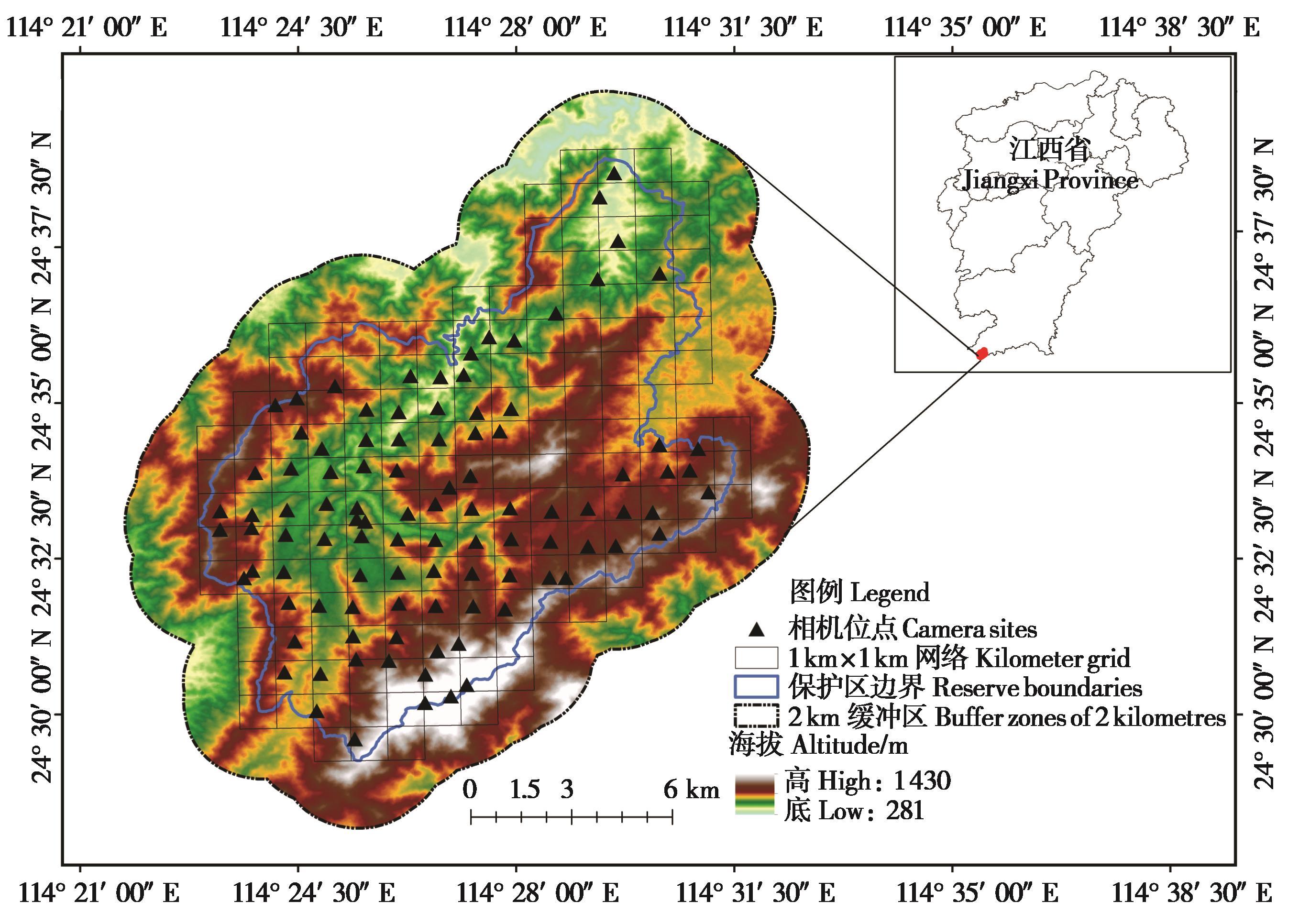
图1 九连山保护区布设的红外相机位点
Fig.1 The distribution of camera sites in Jiulianshan Reserve
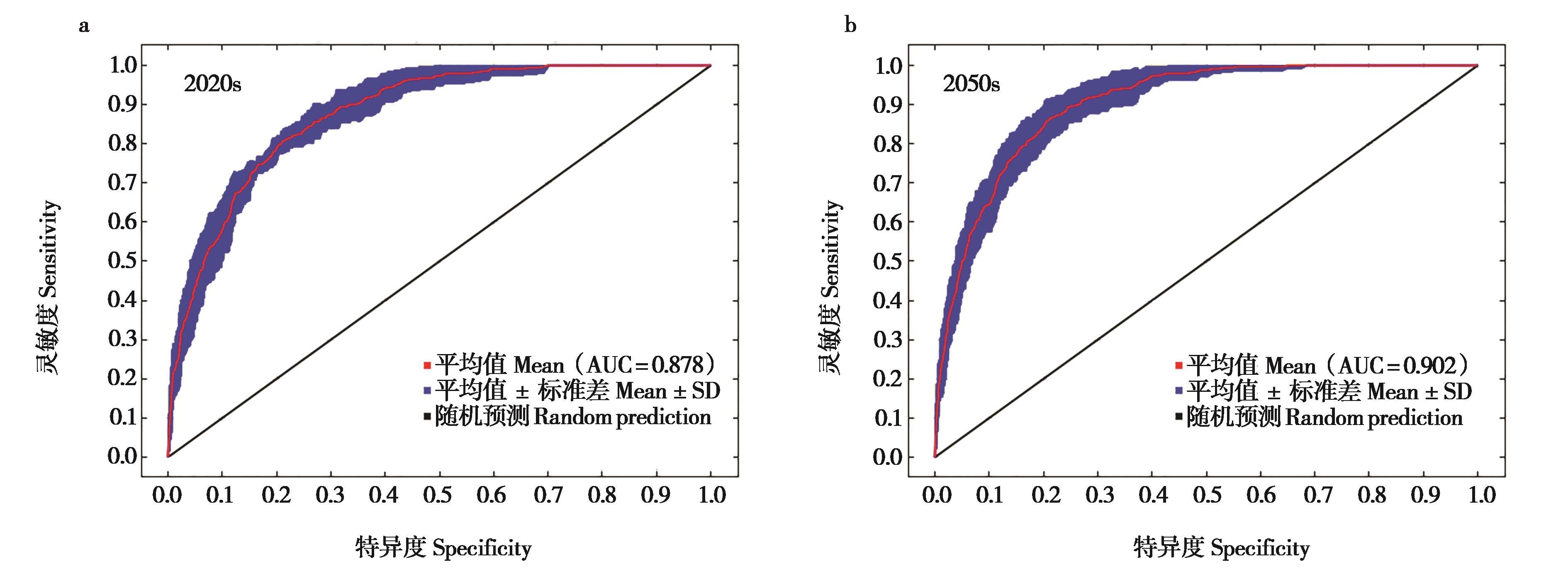
图2 当前(a)和未来(b)MaxEnt结果的ROC曲线
Fig.2 The ROC curves of current (a) and future (b) MaxEnt results
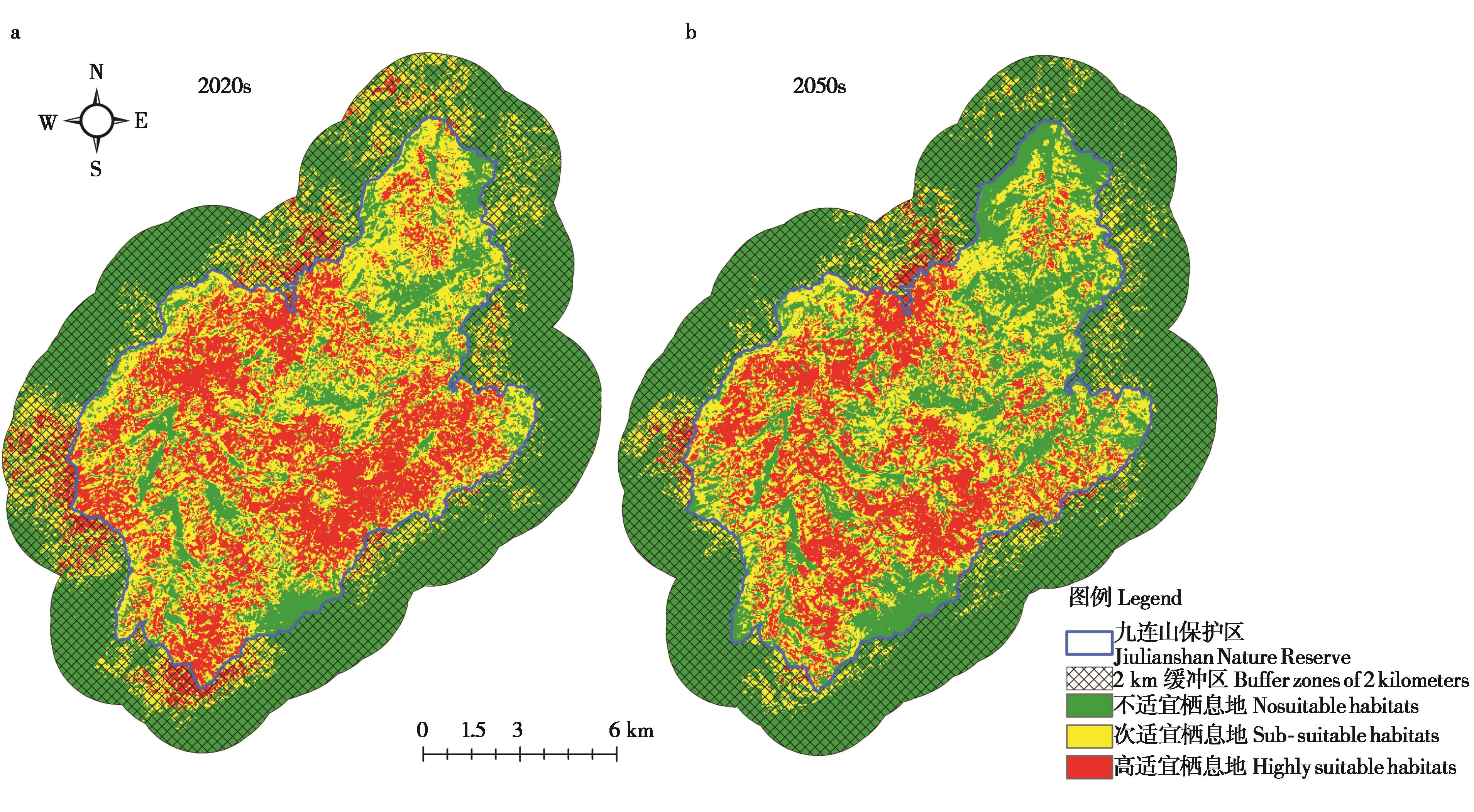
图3 当前(a)和未来(b)斑林狸适宜栖息地分布图
Fig. 3 Distribution of current (a) and future (b) suitable habitat for spotted linsang
变化类型 Change type | 2020s—2050s适宜栖息地变化面积 Area of change in suitable habitat from 2020s to 2050s/hm2 | 2020s—2050s适宜栖息地变化率 Rates of change in suitable habitat from 2020s to 2050s/% | ||
|---|---|---|---|---|
九连山保护区 Jiulianshan Reserve | 2 km缓冲区 Buffer zones of 2 km | 九连山保护区 Jiulianshan Reserve | 2 km缓冲区 Buffer zones of 2 km | |
| 适宜性减少 Suitability decreased | 1 876.86 | 1 827.63 | 17.95 | 52.36 |
| 适宜性稳定 Stability of suitability | 6 504.57 | 1 206.15 | 62.20 | 34.56 |
| 适宜性增加 Suitability increase | 367.02 | 197.73 | 3.51 | 5.67 |
| 适宜性提升 Suitability enhancement | 597.51 | 71.37 | 5.71 | 2.04 |
| 适宜性降低Suitability reduction | 1 478.34 | 385.20 | 14.14 | 11.04 |
表1 当前(2020s)到未来(2050s)斑林狸适宜栖息地变化面积和变化率
Table 1 Area and rate of change in habitat suitability for spotted linsang from current (2020s) to future (2050s)
变化类型 Change type | 2020s—2050s适宜栖息地变化面积 Area of change in suitable habitat from 2020s to 2050s/hm2 | 2020s—2050s适宜栖息地变化率 Rates of change in suitable habitat from 2020s to 2050s/% | ||
|---|---|---|---|---|
九连山保护区 Jiulianshan Reserve | 2 km缓冲区 Buffer zones of 2 km | 九连山保护区 Jiulianshan Reserve | 2 km缓冲区 Buffer zones of 2 km | |
| 适宜性减少 Suitability decreased | 1 876.86 | 1 827.63 | 17.95 | 52.36 |
| 适宜性稳定 Stability of suitability | 6 504.57 | 1 206.15 | 62.20 | 34.56 |
| 适宜性增加 Suitability increase | 367.02 | 197.73 | 3.51 | 5.67 |
| 适宜性提升 Suitability enhancement | 597.51 | 71.37 | 5.71 | 2.04 |
| 适宜性降低Suitability reduction | 1 478.34 | 385.20 | 14.14 | 11.04 |
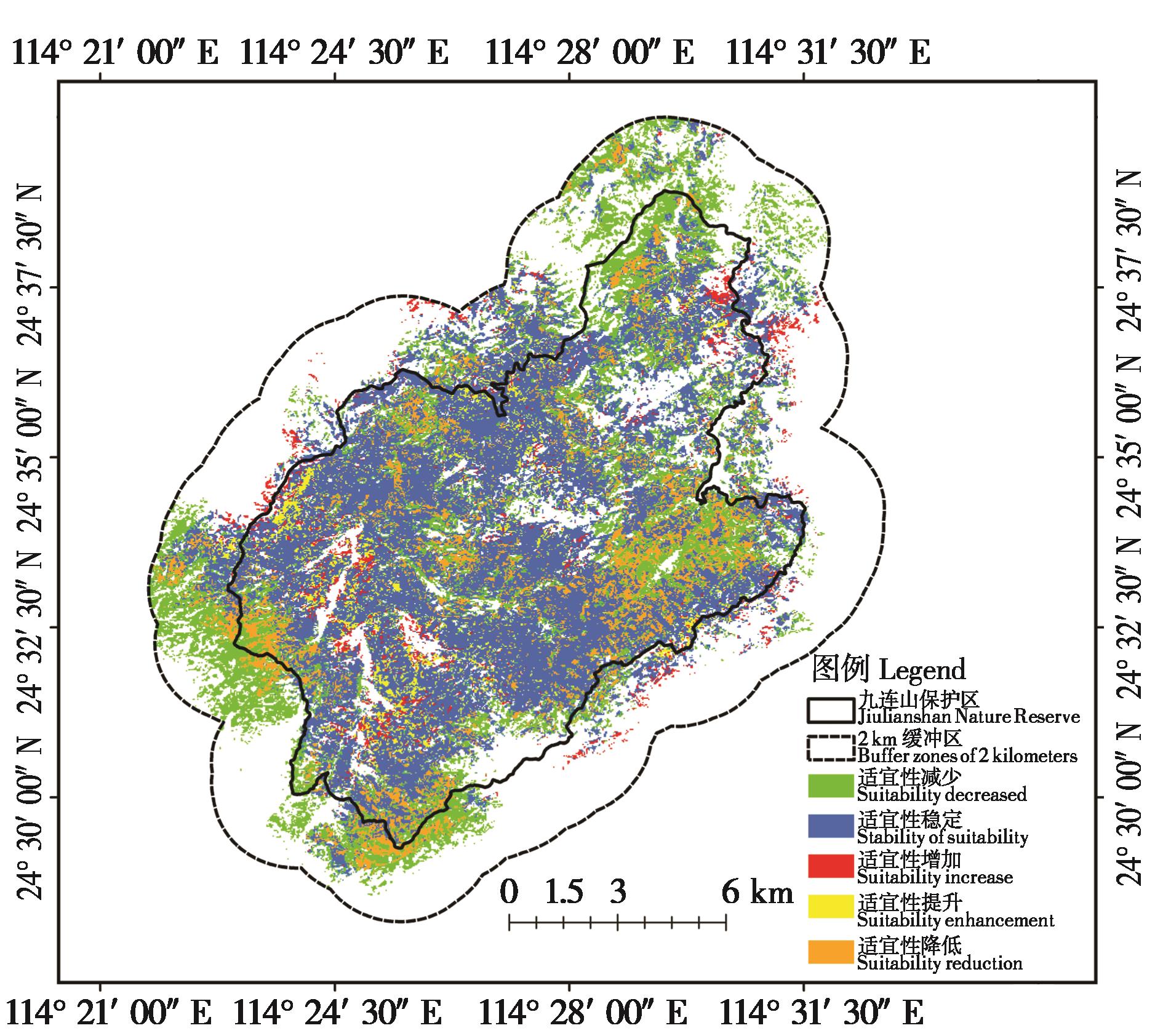
图4 当前(2020s)到未来(2050s)斑林狸适宜栖息地变化
Fig.4 The change of spotted linsang habitat suitability from current (2020s) to future (2050s)
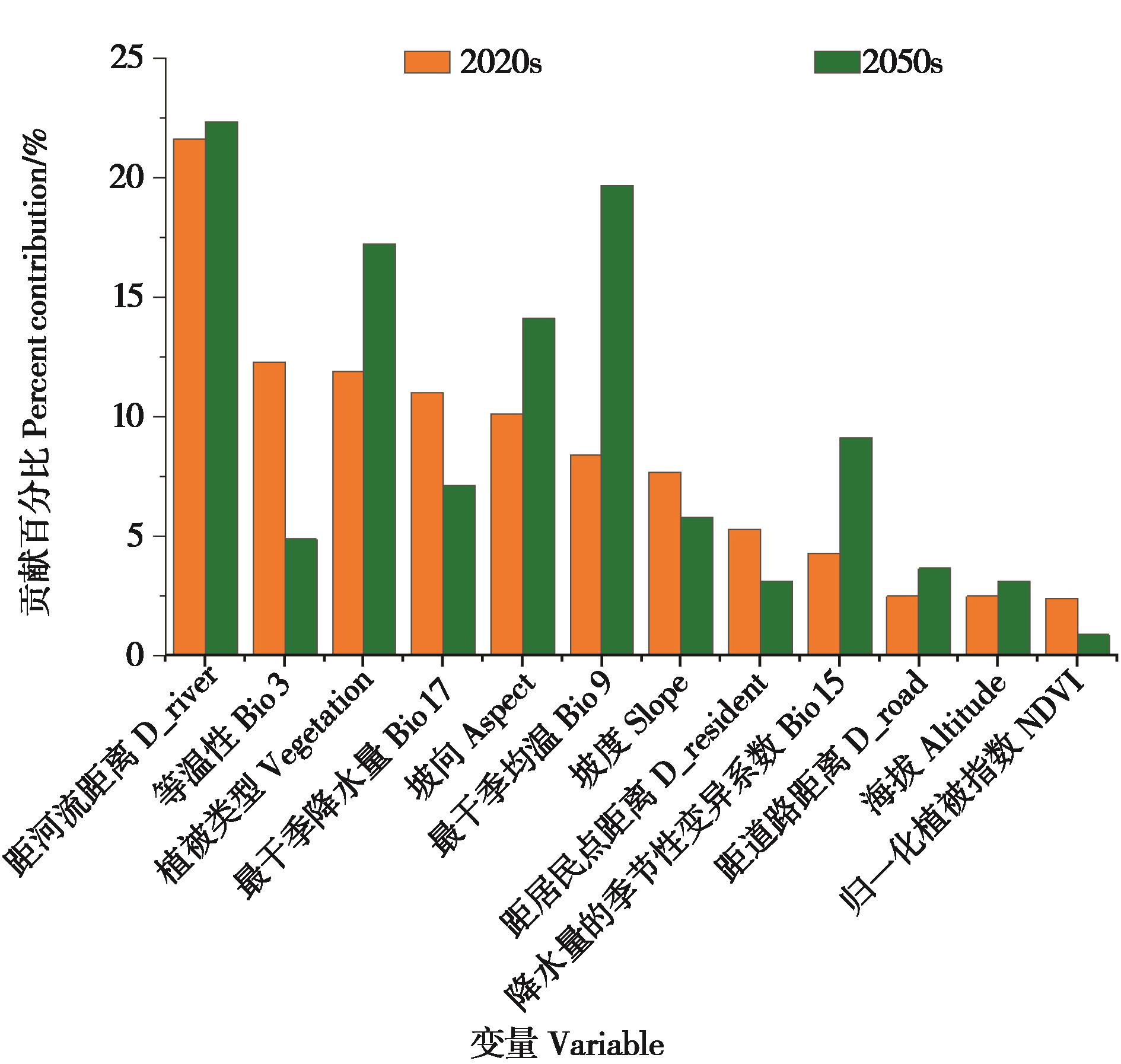
图5 环境变量对斑林狸分布模型的贡献度排序
Fig.5 The percent contribution of different variables to the distribution of spotted linsang
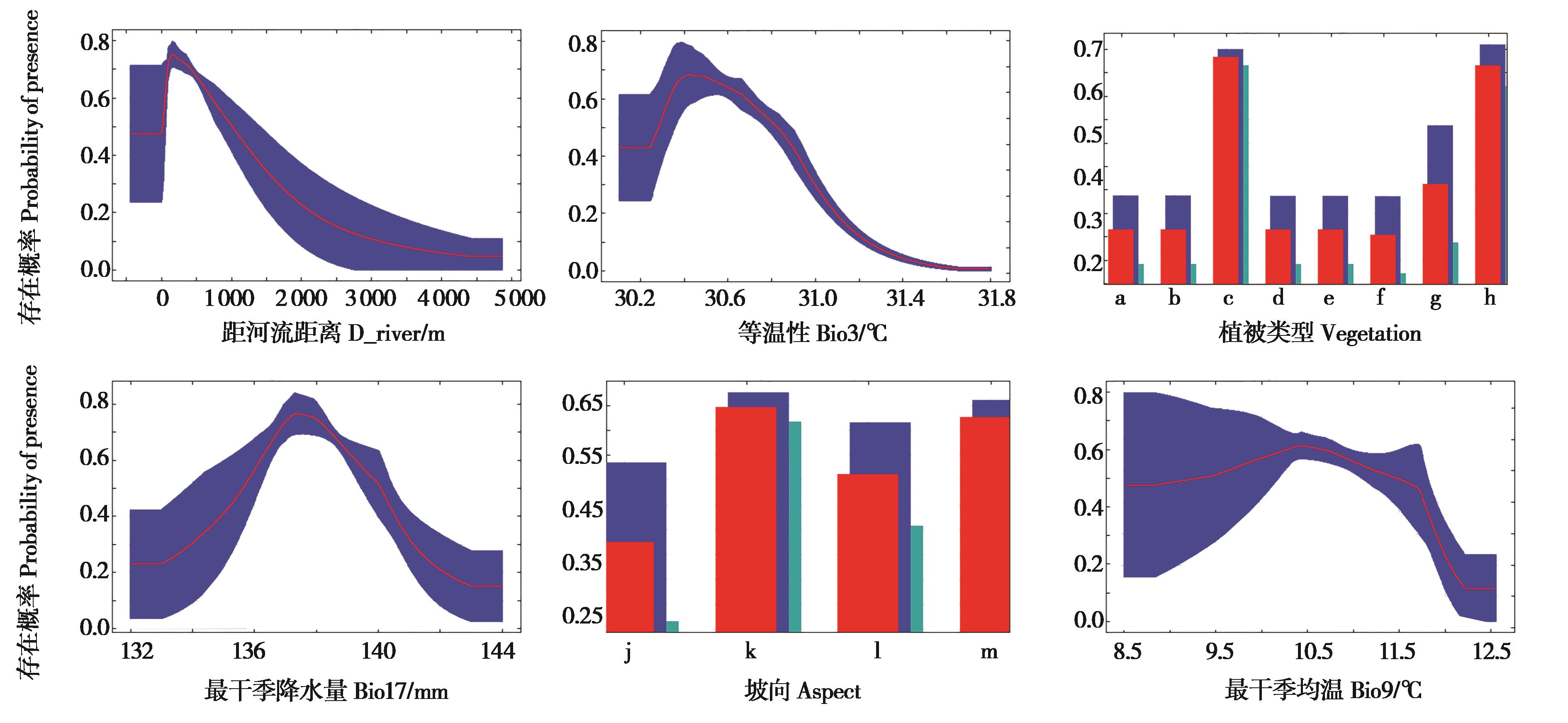
图6 当前环境因子响应曲线. 红色为10次重复的平均响应曲线,蓝色为平均值 ± 标准差(类别变量用两种色调表示). 植被类型,a:建设用地;b:草甸;c:常绿阔叶林;d:耕地;e:水体;f:针阔混交林;g:竹林;h:针叶林. 坡向,j:阴坡;k:半阴坡;l:阳坡;m:半阳坡
Fig.6 Response curve of current environmental factors. Red represents the mean response curve of the 10 replicates and blue represents the mean ± standard deviation (two shades for categorical variables).Vegetation, a: building land; b: grassy marshland; c: broad-leaved evergreen forest; d: cropland; e: water; f: mixed conifer-broad forest; g: bamboo; h: needle-leaved forest. Aspect, j: shady slope; k: semi-shaded slope; l: sunken slope; m: semi-permanent slope
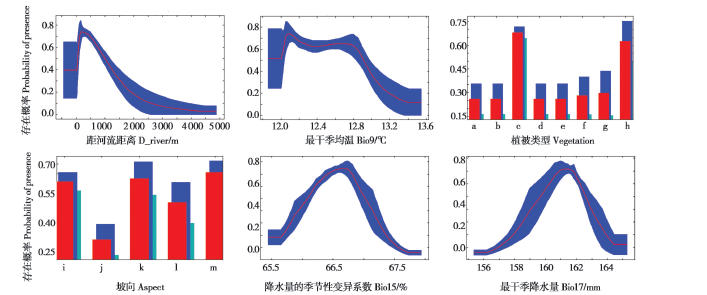
图6 未来环境因子响应曲线. 红色为10次重复的平均响应曲线,蓝色为平均值 ± 标准差(类别变量用两种色调表示). 植被类型,a:建设用地;b:草甸;c:常绿阔叶林;d:耕地;e:水体;f:针阔混交林;g:竹林;h:针叶林.坡向,i:平坡;j:阴坡;k:半阴坡;l:阳坡;m:半阳坡
Fig.7 Response curve for future environmental factors. Red represents the mean response curve of the 10 replicates and blue represents the mean ±standard deviation (two shades for categorical variables). Vegetation, a: building land; b: grassy marshland; c: broad-leaved evergreen forest; d: cropland; e: water; f: mixed conifer-broad forest; g: bamboo; h: needle-leaved forest. Aspect, i: flat slope; j: shady slope; k: semi-shaded slope; l: sunken slope; m: semi-permanent slope
| Aryal A, Brunton D, Raubenheimer D,2014. Impact of climate change on human‑wildlife‑ecosystem interactions in the Trans‑Himalaya region of Nepal[J]. Theoretical & Applied Climatology,115(3‑4):517‑529. DOI:10.1007/s00704-013‐0902-4 . | |
| Bai D F, Chen P J, Atzeni L, Cering L, Li Q, Shi K,2018. Assessment of habitat suitability of the snow leopard (Panthera uncia) in Qomolangma National Nature Reserve based on MaxEnt modeling[J]. Zoological Research,39(6):373‑386. DOI:10.24272/j.issn.2095-8137.2018.057 . | |
| Chen Xinyang, Li Yaoyu, Xie Peigen, Song Xiao, Xu Aichun,2024. Suitable habitat and daily activity patterns of Ursus arctos pruinosus in Dulan County,Qinghai Province[J]. Acta Theriologica Sinica,44(3):321‑332. DOI:10.16829/j.slxb. 150810. (in Chinese with English abstract) | |
| De Satge J, Teichman K, Cristescu B,2017. Competition and coexistence in a small carnivore guild[J]. Oecologia,184(4):873‑884. DOI:10.1007/s00442-017-3916-2 . | |
| Han Keguo, Li Kai, Sun Jing, Rao Jingqiu, Zhou Jia, Yang Yun, Cui Liangwei, Guan Zhenhua,2023. Diversity of birds and mammals in Laojunshan region,Wenshan National Nature Reserve based on infrared cameras[J]. Acta Theriologica Sinica,43(1):89‑101. DOI:10.16829/j.slxb.150588. (in Chinese with English abstract) | |
| Jachowski D S, Marneweck C J, Olfenbuttel C, Harris S N,2024. Support for the size‑mediated sensitivity hypothesis within a diverse carnivore community[J]. The Journal of Animal Ecology,93(1):109‑122. DOI:10.1111/1365-2656.13916 . | |
| Jeong A, Kim M, Lee S,2024. Analysis of priority conservation areas using habitat quality models and MaxEnt models[J]. Animals,14(11):1‑15. DOI:10.3390/ani14111680 . | |
| Li Dan,2022. Impacts of climate change on suitable habitat for giant pandas and their sympatric mammals[D]. Nanchong:West Normal University. (in Chinese with English abstract) | |
| Lin Weiming, Weng Yue, Jia A, Wang Min, Wang Qi, Wang Fang,2023. Preliminary research on daily activity rhythm,habitat use and response to human activity of large Indian civet (Viverra zibetha) in Bayuelin Nature Reserve,Sichuan Province[J]. Acta Theriologica Sinica,43(4):364‑377. DOI:10.16829/j.slxb.150745. (in Chinese with English abstract) | |
| Lin Yufang, Lin Qinwen, Huang Xiaochun,2023. A new record of the Fujianian animal the spotted linsang (Prionodon pardicolor)[J]. Fujian Forestry,2:18.(in Chinese with English abstract) | |
| Liu Binghui,2020. Terrestrial bird and mammal diversity and occupancy modelling of Cengwanglaoshan National Nature Reserve,Guangxi-based on cameral trap[D]. Guilin:Guangxi Normal University.(in Chinese with English abstract) | |
| Liu Ce, Zhang Ri, Du Hairong, Sun Yue, Yan Ziao, Yu Jingjing, Zhang Minghai,2021. Impact of climate change on potential habitat of sika deer in China[J]. Chinese Journal of Wildlife,42(2):329‑340. DOI:10.3969/j.issn.1000-0127. 2021.02.004. (in Chinese with English abstract) | |
| Liu Qin, Wang Yukuan, Peng Peihao, Lu Yafeng, Chen Yingfeng, Wang Shan,2016. Characteristics of distribution and migration of species in Sichuan under the climate change[J]. Mountain Research,34(6):716‑723.DOI:10.16089/j.cnki. 1008‐2786.000178. (in Chinese with English abstract) | |
| Lu Y, Wu T, Li Y, Yang B,2020. Mitigation of the double ITCZ syndrome in BCC CSM2‑MR through improving parameterizations of boundary‑layer turbulence and shallow convection[J]. Geoscientific Model Development,14(8):5183‑5204. DOI:10.5194/gmd-14-5183-2021 . | |
| Luo Yao, Pan Dan, Li Jiaqi, Zhang Bing, Ren Jing, Yang Daode,2024. Camera‑trapping monitoring on species diversity of mammals and birds in Dawei Mountain,Hunan Province,China[J]. Chinese Joumal of Ecology,43(7):2239‑2246. DOI:10.13292/j.1000-4890.202407.004. (in Chinese with English abstract) | |
| Lwin Y H, Wang L, Li G, Maung K W, Swa K, Quan R C,2021. Diversity,distribution and conservation of large mammals in northern Myanmar[J]. Global Ecology and Conservation,29:e01736. DOI:10.1016/j.gecco.2021.e01736 . | |
| Marneweck C J, Allen B L, Butler A R, Do Linh San E, Harris S N, Jensen A J, Saldo E A, Somers M, Titus K L, Muthersbaugh M, Vanak A T, Jachowski D S,2022. Middle‑out ecology:small carnivores as sentinels of global change[J]. Mammal Review,52(4):471‑479. DOI:10.1111/mam.12300 . | |
| Meng Ri, Lv Wenlong, Yang Yuewen, Weng Jinqiu, Liao Yuanfang, Zhu Miaojun, Ding Xiangyun,2023. Infrared camera monitoring and analysis of wildlife in Gutian Provincial Nature Reserve,Huidong,Guangdong,China[J]. South‑Central Agricultural Science and Technology,44(2):49‑53.(in Chinese with English abstract) | |
| Mokhtar A, Alsafadi K, He H, Li Y, He Q,2020. Evapotranspiration as a response to climate variability and ecosystem changes in southwest,China[J]. Environmental Earth Sciences,79(312):1‑21. DOI:10.1007/s12665-020-09007-1 . | |
| Nakashima Y, Inoue E, Inoue‑Murayama M, Sukor J R A,2010. Functional uniqueness of a small carnivore as seed dispersal agents:a case study of the common palm civets in the Tabin Wildlife Reserve,Sabah,Malaysia[J]. Oecologia,164(3):721‑730. DOI:10.1007/s00442-010-1714-1 . | |
| O’Brien T G, Kinnaird M F, Wibisono H T,2003. Crouching tigers,hidden prey:Sumatran and prey populations in a tropical forest landscape[J]. Animal Conservation,6(2):131‑139. DOI:10.1017/S1367943003003172 . | |
| Raimondi F, Sogliani D, Cimini M, Atzeni L, Augugliaro C,2023. Interference competition between wild and domestic ungulates at watering sites of Gobi Desert,Mongolia[J]. Arid Ecosystems,13(3):305‑313. DOI:10.1134/S2079096- 123030101 . | |
| Root T L, Price J T, Hall K R, Schneider S H, Rosenzweig C, Pounds J A,2003. Fingerprints of global warming on wild animals and plants[J]. Nature,421(6918):57‑60. DOI:10.1038/nature01333 . | |
| Rowcliffe J M, Carbone C, Kays R, Kranstauber B, Jansen P A,2014. Density estimation using camera trap surveys:the random encounter model[C]. Camera Trapping in Wildlife Management and Research,317‑324. | |
| Russell J G, Pham V T, Lo T B, Cao N L, Ha V N,2022. Evidence of spotted linsang Prionodon pardicolor post‑weaning parental care[J]. Small Carnivore Conservation,60:e60002. | |
| Santos M J, Thorne J H, Craig M,2015. Synchronicity in elevation range shifts among small mammal and vegetation over the last century is stronger for omnivores[J]. Ecography,38(6):556‑568. DOI:10.1111/ecog.00931 . | |
| Shi Kuan,2014. Dynamically monitoring of vegetation cover by remote sensing in Jiulianshan Nature Reserve of Jiangxi Province[D]. Beijing:Beijing Forestry University.(in Chinese with English abstract) | |
| Shi Xiangying, Li Xueyang, Wei Chunyue, Sun Ge, Liu Zhen, Zhao Xiang, Zhou Jiading, Fan Jian, Li Cheng, Lv Zhi,2023. Avian and mammal diversities and their altitudinal and seasonal distribution patterns in Yarlung Zangbo Grand Canyon,China[J]. Biodiversity Science,31(2):22491. DOI:10.17520/biods.2022491. (in Chinese with English abstract) | |
| Song X, Jiang Y, Zhao L, Jin L, Yan C, Liao W,2023. Predicting the potential distribution of the Szechwan rat snake(Euprepiophis perlacea)and its response to climate change in the Yingjing area of the Giant Panda National Park[J]. Animals,13(24):3828. DOI:10.3390/ani13243828 . | |
| Vasquez A A A, Hernandez R D, Martinez M R,2024. Predicting future climate change impacts on the potential distribution of the black howler monkey(Alouatta pigra):an endangered arboreal primate[J]. Environmental Monitoring and Assessment,196(4):392. DOI:10.1007/s10661-024-12543-z . | |
| Villard M A, Metzger J P,2014. Beyond the fragmentation debate:a conceptual model to predict when habitat configuration really matters[J]. Journal of Applied Ecology,51(2):309‑318. DOI:10.1111/1365-2664.12190 . | |
| Wang Rulin, Li Qing, Feng Chuanhong, Shi Zhaopeng,2017. Predicting potential ecological distribution of Locusta migratoria tibetensis in China using MaxEnt ecological niche modeling[J]. Acta Ecologica Sinica,37(24):8556‑8566. DOI:10.5846/stxb201611152326. (in Chinese with English abstract) | |
| Xiao Shibai,2012. The secret of chongzuo ecological park[J]. Forest & Humankind,3:82‑95. (in Chinese with English abstract) | |
| Yang Guangmei, Li Jiaqi, Zhang Mingming, Hu Canshi, Su Haijun,2022. Camera‑trapping survey and activity pattern analysis on mammals and birds in Pogang Karst Forest Nature Reserve,Guizhou Province,China[J]. Acta Theriologica Sinica,42(3):325‑338. DOI:10.16829/j.slxb.150568. (in Chinese with English abstract) | |
| Yang Haiting,2024. A study on the activity pattern and habitat utilization of the common palm civet in Hainan[D]. Hanzhong:Shanxi University of Technology. (in Chinese with English abstract) | |
| Yang Qijie,2021. Simulating the potential suitable habitats of the relict plant Alsophila spinulosa in different periods based on MaxEnt model[D]. Hangzhou:Zhejiang University.(in Chinese with English abstract) | |
| Yang Ziwen, Han Shuyi, Li Yi, Wang Jiamin, He Hongxuan,2023. Impacts and assessment of climate change on the global distribution of potentially suitable habitats for Panthera uncia [J]. Acta Ecologica Sinica,43(4):1412‑1425. DOI:10.5846/stxb202202240433. (in Chinese with English abstract) | |
| Yuan Jingxi, Zhang Changyou, Xie Wenhua, Huang Xiaoqun, Xiao Zhishu,2016. Using camera traps to investigate mammal and bird diversity in the Jiulianshan National Nature Reserve,Jiangxi Province[J]. Acta Theriologica Sinica,36(3):367‑372. DOI:10.16829/j.slxb.201603013. (in Chinese with English abstract) | |
| Yumlam B B, Aditya P,2023. A daytime observation of a spotted linsang Prionodon pardicolor in Namdapha Tiger Reserve,Arunachal Pradesh,India[J]. Small Carnivore Conservation,61:e61002. | |
| Zhang Mingjun, Wang Hesheng, Yan Wenbo, Fu Yunnan, Wang Qi, Zeng Zhigao,2024. Diel activity and habitat selection of small Indian civets(Viverricula indica) in Hainan Datian National Nature Reserve[J]. Biodiversity Science,32(6):75‑84. DOI:10.17520/biods.2023420. (in Chinese with English abstract) | |
| Zhao X, Garber P A, Ye X, Li M. 2023. The impact of climate change and human activities over the past 2 000 years has increased the spatial‑temporal extinction rate of gibbons[J]. Biological Conservation,281:109998. DOI:10.1016/j.biocon.2023. 109998 . | |
| Zheng Xiang, Bao Yixin, Ge Baoming, Zheng Rongquan,2006. Seasonal changes in habitat use of black muntjac(Muntiacus crinifrons)in Zhejiang[J]. Acta Theriologica Sinica,26(2):201‑205. DOI:10.16829/j.slxb.2006.02.016. (in Chinese with English abstract) | |
| Smith,解焱,2009. 中国兽类野外手册[M]. 长沙:湖南教育出版社. | |
| 王茹琳,李庆,封传红,石朝鹏,2017. 基于MaxEnt的西藏飞蝗在中国的适生区预测[J]. 生态学报,37(24): 8556‑8566. DOI:10.5846/stxb201611152326 . | |
| 石宽,2014. 江西九连山自然保护区植被覆盖动态遥感监测[D]. 北京:北京林业大学. | |
| 史湘莹,李雪阳,魏春玥,孙戈,刘震,赵翔,周嘉鼎,樊简,李成,吕植,2023. 雅鲁藏布大峡谷鸟兽多样性及其海拔和季节分布[J]. 生物多样性,31(2):22491. DOI:10.17520/biods.2022491 . | |
| 刘少英,吴毅,李晟,2022.中国兽类图鉴[M].第三版. 福州:海峡出版发行集团. | |
| 刘信中,肖忠优,马建华,2002. 江西九连山自然保护区科学考察与森林生态系统研究[M]. 北京:中国林业出版社. | |
| 刘炳辉,2020. 广西岑王老山保护区哺乳类和鸟类分布、多样性及占域模型研究:基于红外相机数据[D]. 桂林:广西师范大学. | |
| 刘策,张日,杜海荣,孙悦,袁子奥,于晶晶,张明海,2021. 气候变化对中国梅花鹿潜在栖息地影响[J]. 野生动物学报,42(2):329‑340.DOI:10.3969/j.issn.1000-0127. 2021.02.004 . | |
| 刘勤,王玉宽,彭培好,逯亚峰,陈颖锋,王跚,2016. 气候变化下四川省物种的分布规律及迁移特征[J]. 山地学报,34(6):716‑723.DOI:10.16089/j.cnki. 1008-2786.000178 . | |
| 李丹,2022. 气候变化对大熊猫及其同域分布兽类适宜栖息地的影响[D]. 南充:西华师范大学. | |
| 杨子文,韩姝伊,李壹,王嘉敏,何宏轩,2023. 气候变化对雪豹全球潜在适生区分布的影响与评估[J]. 生态学报,43(4):1412‑1425.DOI:10.5846/stxb202202240433 . | |
| 杨光美,李佳琦,张明明,胡灿实,粟海军,2022. 贵州坡岗喀斯特森林自然保护区红外相机兽类和鸟类监测及活动节律分析[J]. 兽类学报,42(3):325‑338.DOI:10.16829/j.slxb.150568 . | |
| 杨启杰,2021. 基于MaxEnt模型的孑遗植物桫椤在不同时期的潜在适生区研究[D]. 杭州:浙江大学. | |
| 杨海婷,2024. 海南椰子狸的活动规律和栖息地利用研究[D]. 汉中:陕西理工大学. | |
| 肖诗白,2012. 崇左生态公园的秘境[J]. 森林与人类,3:82‑95. | |
| 张明军,王合升,颜文博,符运南,王琦,曾治高,2024. 海南大田国家级自然保护区小灵猫的活动节律与栖息地选择[J]. 生物多样性,32(6):75‑84. DOI:10.17520/biods. 2023420 . | |
| 陈昕旸,李耀宇,谢培根,宋虓,徐爱春,2024. 青海省都兰县棕熊适宜栖息地与日活动节律[J]. 兽类学报,44(3):321‑332.DOI:10.16829/j.slxb. 150810 . | |
| 林炜明,翁悦,阿家,王敏,王琦,王放,2023. 四川八月林自然保护区大灵猫日活动节律、栖息地利用及其对人类活动响应的初步研究[J]. 兽类学报,43(4):364‑377.DOI:10.16829/j.slxb.150745 . | |
| 林裕芳,林沁文,黄晓春,2023. 福建兽类新纪录:斑林狸[J]. 福建林业,2:18. | |
| 罗堯,潘丹,李佳琦,张冰,任静,杨道德,2024. 湖南大围山鸟兽物种多样性红外相机监测[J]. 生态学杂志,43(7):2239‑2246.DOI:10.13292/j.1000-4890.202407.004 . | |
| 郑祥,鲍毅新,葛宝明,郑荣泉,2006. 黑麂栖息地利用的季节变化[J]. 兽类学报,26(2):201‑205. DOI:10.16829/j.slxb. 2006.02.016 . | |
| 孟蕊,吕文龙,杨越文,翁锦泅,廖远芳,朱妙君,丁向运,2023. 广东惠东古田省级自然保护区野生动物红外相机监测分析[J]. 中南农业科技,44(2):49‑53. | |
| 袁景西,张昌友,谢文华,黄小群,肖治术,2016. 利用红外相机技术对九连山国家级自然保护区兽类和鸟类资源的初步调查[J]. 兽类学报,36(3):367‑372. DOI:10.16829/j.slxb. 201603013 . | |
| 韩克国,李凯,孙婧,饶静秋,周佳,杨云,崔亮伟,管振华,2023. 基于红外相机技术对文山国家级自然保护区老君山片区地栖鸟兽多样性的调查[J]. 兽类学报,43(1):89‑101. DOI:10.16829/j.slxb.150588 . | |
| 魏辅文,杨奇森,吴毅,蒋学龙,刘少英,2022. 中国兽类分类与分布[M]. 北京:科学出版社. |
| [1] | 陈婷, 李斌强, 廖正杭, 李伟, 彭灿. 云南昭通亚洲黑熊适宜栖息地与日活动节律[J]. 兽类学报, 2025, 45(5): 641-654. |
| [2] | 刘振山, 赵耕, 潘佳滢, 彭霞, 杨明. 不同放牧强度对达乌尔黄鼠种群密度、体重、血糖和血脂的影响[J]. 兽类学报, 2024, 44(3): 360-369. |
| [3] | 蒙秉顺, 黄小龙, 谢波, 王维熙, 黄继池, 张涛, 冉景丞, 张明明. 贵州梵净山国家级自然保护区有蹄类动物适宜栖息地分布[J]. 兽类学报, 2023, 43(6): 664-675. |
| [4] | 刘轲, 刘炎林, 李晟. 欧亚猞猁在中国的分布现状与适宜栖息地预测[J]. 兽类学报, 2023, 43(6): 652-663. |
| [5] | 陈小南, 田佳, 刘鸣章, 申云逸, 余建平, 刘锋, 申小莉, 李晟. 基于红外相机数据估算浙江省开化县野猪种群数量[J]. 兽类学报, 2023, 43(5): 523-532. |
| [6] | 马兵, 潘国梁, 李雷光, 陈颖, 李祎斌, 刘一正, 巴力克·杰克义, 孙世为, 时坤. 天山中部雪豹栖息地适宜性研究初报[J]. 兽类学报, 2021, 41(1): 1-10. |
| [7] | 左涛 孙坚强 时永强 王俊. 渤海江豚种群现状初探[J]. 兽类学报, 2018, 38(6): 551-561. |
| [8] | 周延山 花立民 楚彬 刘丽 姬程鹏 田永亮. 高原鼢鼠繁殖特性与其栖息草地质量的关系[J]. 兽类学报, 2017, 37(1): 87-96. |
| [9] | 袁景西 张昌友 谢文华 黄小群 肖治术. 利用红外相机技术对九连山国家级自然保护区兽类和鸟类资源的初步调查[J]. 兽类学报, 2016, 36(3): 367-. |
| [10] | 冯利民 王利繁 王斌 James LD Smith 张立. 西双版纳尚勇自然保护区野生印支虎及其三种主要有蹄类猎物种群现状调查[J]. , 2013, 33(4): 308-318. |
| [11] | 徐峰,马鸣,吴逸群. 新疆托木尔峰国家级自然保护区雪豹的种群密度[J]. , 2011, 31(2): 205-210. |
| [12] | 周绍春, 张明海, 孙海义, 尹远新, 黄海娇, 于洪伟,卢向东, 葛东宁, 田家龙. 完达山东部林区野猪种群数量和栖息地特征的初步分析[J]. 兽类学报, 2010, 30(1): 28-34. |
| [13] | 吴雁 边疆晖 曹伊凡. 围栏条件下母体社群应激对根田鼠子代免疫力的影响[J]. , 2008, 28(3): 250-259. |
| [14] | 边疆晖,吴雁,周抗抗. 繁殖期根田鼠种群密度对其种群统计参数及个体皮质酮水平作用[J]. , 2008, 28(2): 135-143. |
| [15] | 赵天飙, 杨持, 周立志, 张忠兵, 靳飞虎, 邬建平, 宁恕龙. 大沙鼠种群密度与降水量的关系[J]. , 2007, 27(2): 195-199. |
| 阅读次数 | ||||||
|
全文 |
|
|||||
|
摘要 |
|
|||||
 青公网安备 63010402000199号 青ICP备05000010号-2