

中国核心期刊要目总览
中国科技核心期刊
CSCD数据库源刊
中国科技核心期刊
CSCD数据库源刊
兽类学报 ›› 2026, Vol. 46 ›› Issue (2): 264-277.DOI: 10.16829/j.slxb.151029
邓健成1,2, 王思凯2,3( ), 张洋2, 贾金涛2, 张婷婷2,3, 赵峰1,2,3()
收稿日期:2024-11-25
接受日期:2025-05-08
出版日期:2026-03-30
发布日期:2026-03-06
通讯作者:
王思凯,赵峰
作者简介:邓健成(1998- ),男,硕士研究生,主要从事鲸豚类资源调查与保护研究.
基金资助:
Jiancheng DENG1,2, Sikai WANG2,3(), Yang ZHANG2, Jintao JIA2, Tingting ZHANG2,3, Feng ZHAO1,2,3()
Received:2024-11-25
Accepted:2025-05-08
Online:2026-03-30
Published:2026-03-06
Contact:
Sikai WANG, Feng ZHAO
摘要:
对鲸类动物进行有效的保护和完善的管理需要详细的物种及其分布信息。地方生态知识 (local ecological knowledge,LEK) 通常可以提供关于重点物种和生物资源的丰富信息,并越来越多地用于评估海洋哺乳动物的研究中。本研究于2023年11—12月,在东海附近海域沿岸地区进行了大规模的LEK走访调查,分析鲸类动物的多样性和分布状况、种群变化趋势及其可能面临的威胁。调查共涉及到59个港口码头,走访了534名渔民。本次走访调查共访问到了11种鲸类,包括东亚江豚(Neophocaena sunameri)、瓶鼻海豚(Tursiops truncatus)、印太瓶鼻海豚(Tursiops aduncus)、中华白海豚(Sousa chinensis)、糙齿海豚(Steno bredanensis)、弗氏海豚(Lagenodelphis hosei)、热带点斑原海豚(Stenella attenuata)、伪虎鲸(Pseudorca crassidens)、小虎鲸(Feresa attenuata)、短肢领航鲸(Globicephala macrorhynchus)和虎鲸(Orcinus orca),没有收集到大型鲸类的记录。普遍认为8—9月是最常见到鲸类的时间段,目击热点区域主要在海州湾、东海大桥、长江口渔场中下部、洞头以及南麂列岛北部海域。有超一半(50.19%)的受访者认为鲸类动物数量正在下降。调查显示,20.22%的受访者曾经误捕过鲸类动物,主要使用的网具是拖网和刺网。这些结果为东海海域鲸类动物的分布状况和所面临的威胁提供了研究基础。
中图分类号:
邓健成, 王思凯, 张洋, 贾金涛, 张婷婷, 赵峰. 我国东海附近海域鲸类分布及面临的威胁:基于地方生态知识(LEK)分析[J]. 兽类学报, 2026, 46(2): 264-277.
Jiancheng DENG, Sikai WANG, Yang ZHANG, Jintao JIA, Tingting ZHANG, Feng ZHAO. Distribution and threats of cetaceans near the East China Sea: an analysis based on local ecological knowledge (LEK)[J]. ACTA THERIOLOGICA SINICA, 2026, 46(2): 264-277.

图1 本研究开展走访调查的沿岸城市及港口示意图
Fig. 1 Schematic diagram of the cities and ports surveyed along the coast in this study
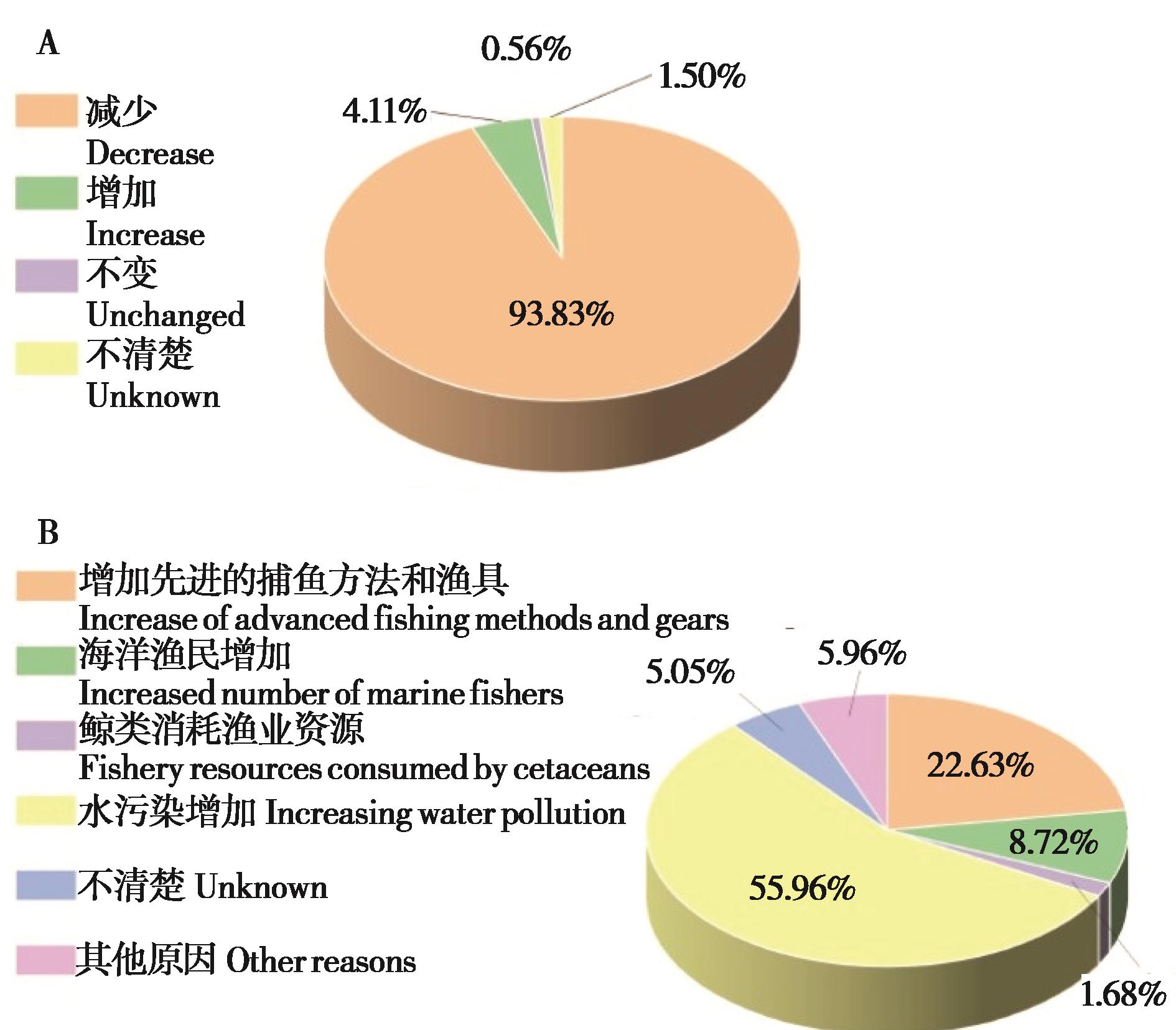
图2 受访者回答渔业资源变化状况(A) 及其减少原因(B) 的百分比. 其他包括过度捕捞、核污水影响、禁用渔具仍在使用、气候影响、禁渔期无牌船作业、围垦、紫菜养殖
Fig. 2 Percentage of answers given by the respondents to the changes in cetacean resources (A) and reasons for decline (B). Other factors include overfishing, Japanese nuclear wastewater, the impact of forbidden fishing gear, climate change, illegal fishing during closed seasons, land reclamation, and seaweed farming
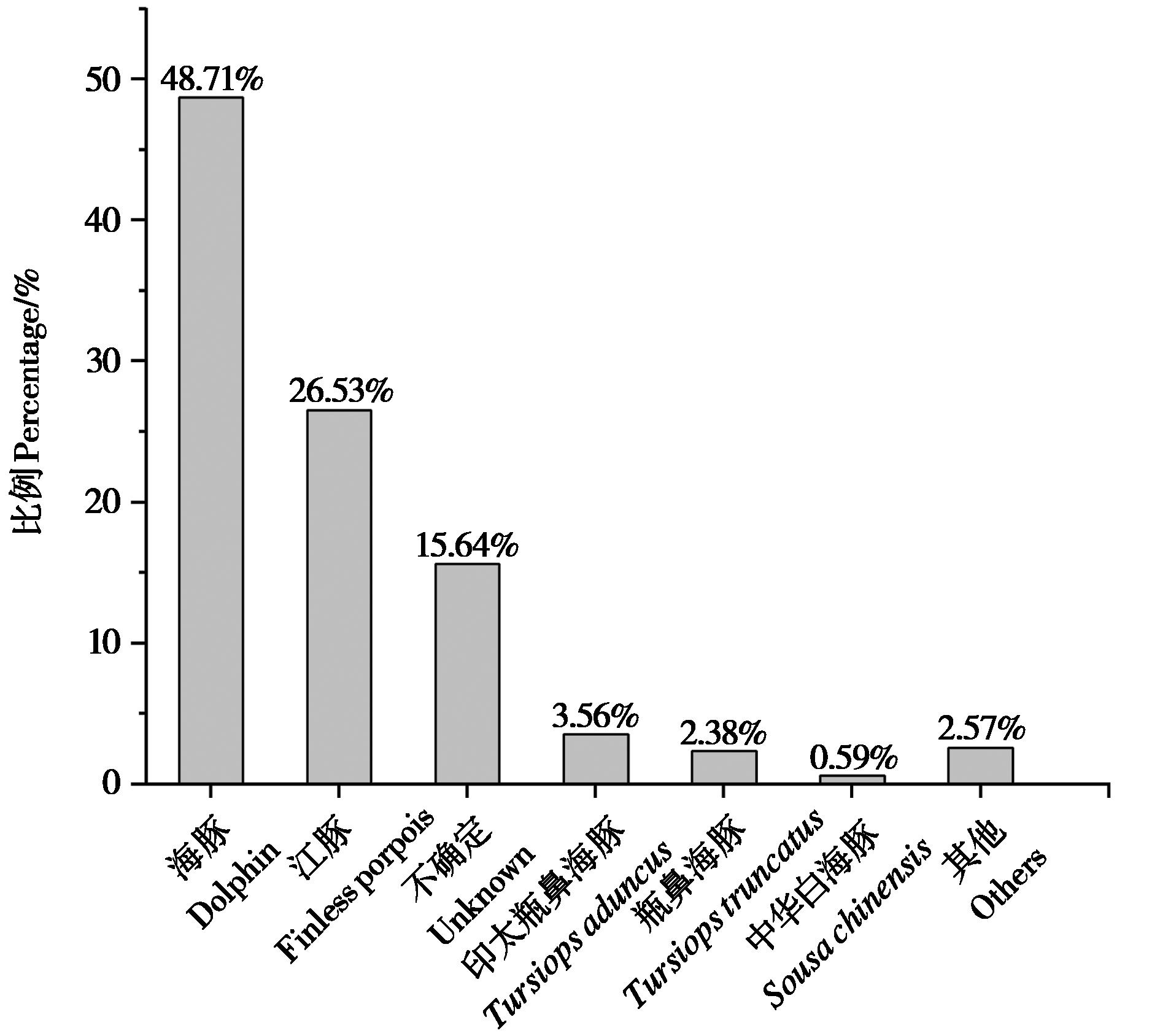
图3 受访者报告中不同鲸类物种的比例.其他包括糙齿海豚、短肢领航鲸、弗氏海豚、热带点斑原海豚、伪虎鲸、小虎鲸、虎鲸和须鲸亚目
Fig. 3 Percentage of different cetacean species reported by respondents. Other species include Steno bredanensis, Globicephala macrorhynchus, Lagenodelphis hosei, Stenella attenuata, Pseudorca crassidens, Feresa attenuata, Orcinus orca, and Mysticeti
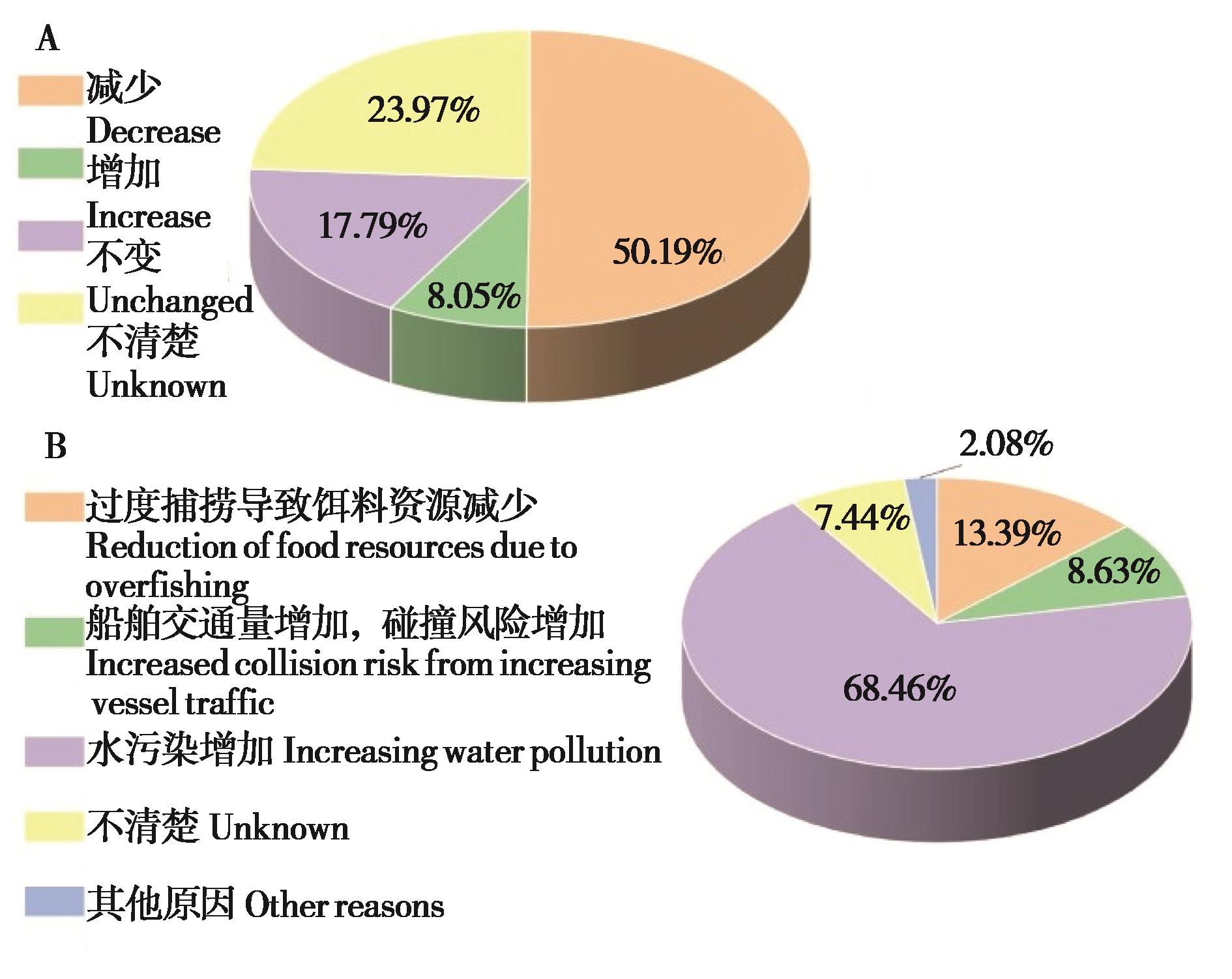
图4 受访者回答鲸类资源变化状况(A)及其减少原因(B)的百分比.其他主要指大桥建设、水闸建设、紫菜养殖、气候、洋流、网具误捕、化工厂排污水
Fig. 4 Changes in cetacean populations (A) and reasons for decline (B). Other factors include bridge and sluice construction, seaweed farming, climate change, ocean currents, accidental bycatch, and wastewater discharge from chemical plants
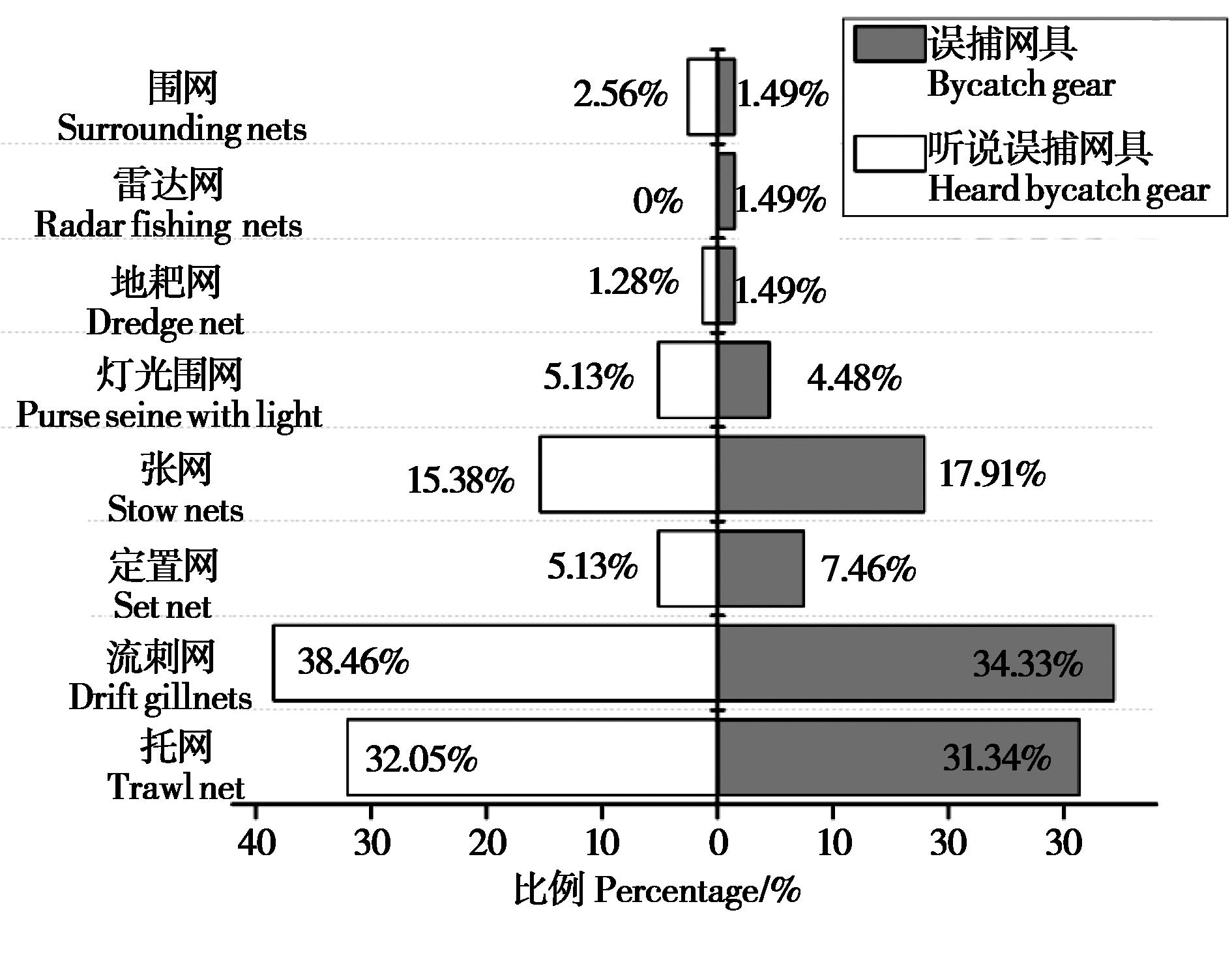
图5 渔民报告中误捕网具的占比
Fig. 5 Percentage of bycatch gear reported by respondents

图6 受访者报告中最后一次目击到鲸类动物的地点(数字代表答案的数量)
Fig. 6 Location of last cetacean sighting reported by respondents (Numbers represent the amount of answers)

图7 受访者报告中认为鲸类动物频繁出现的地点(数字代表答案的数量)
Fig. 7 Location of frequent cetacean sighting reported by respondents (Numbers represent the amount of answers)
人口统计信息 Demographic information | 受访人数(占比) No. of respondents(Percentage) |
|---|---|
| 年龄分组Age class | |
| 青年Young(< 30岁) | 7(1.31%) |
| 中年 Middle aged [30,60] 岁 | 457(85.58%) |
| 老年Old(> 60岁) | 70(13.11%) |
| 平均年龄Average age | 50.56 ± 9.70 |
| 渔业经验Fishing experience | |
| < 10年 | 33(6.18%) |
| [10,20) 年 | 71(13.30%) |
| [20,30) 年 | 146(27.34%) |
| [30,40] 年 | 189(35.39%) |
| > 40 年 | 95(17.79%) |
| 平均渔业经验Average fishing experience | 29.63 ± 11.59 |
| 学历Educational level | |
| 大学 University/college | 5(0.94%) |
| 高中Senior middle school | 34(6.37%) |
| 初中Junior middle school | 265(49.63%) |
| 小学Elementary school | 216(40.45%) |
| 其他(无学历) Other(No formal education) | 14(2.62%) |
| 船长Vessel size | |
| < 20 m | 97(18.16%) |
| > 20 m | 410(76.78%) |
| 其他(不清楚) Other(Unknown) | 27(5.06%) |
| 平均船长Average vessel length | 33.32 ± 12.45 |
表1 受访者人口统计数据(n = 534)
Table 1 Respondent demographic data (n = 534)
人口统计信息 Demographic information | 受访人数(占比) No. of respondents(Percentage) |
|---|---|
| 年龄分组Age class | |
| 青年Young(< 30岁) | 7(1.31%) |
| 中年 Middle aged [30,60] 岁 | 457(85.58%) |
| 老年Old(> 60岁) | 70(13.11%) |
| 平均年龄Average age | 50.56 ± 9.70 |
| 渔业经验Fishing experience | |
| < 10年 | 33(6.18%) |
| [10,20) 年 | 71(13.30%) |
| [20,30) 年 | 146(27.34%) |
| [30,40] 年 | 189(35.39%) |
| > 40 年 | 95(17.79%) |
| 平均渔业经验Average fishing experience | 29.63 ± 11.59 |
| 学历Educational level | |
| 大学 University/college | 5(0.94%) |
| 高中Senior middle school | 34(6.37%) |
| 初中Junior middle school | 265(49.63%) |
| 小学Elementary school | 216(40.45%) |
| 其他(无学历) Other(No formal education) | 14(2.62%) |
| 船长Vessel size | |
| < 20 m | 97(18.16%) |
| > 20 m | 410(76.78%) |
| 其他(不清楚) Other(Unknown) | 27(5.06%) |
| 平均船长Average vessel length | 33.32 ± 12.45 |
选项 Option | 选择次数 Number | 百分比 Percentage/% |
|---|---|---|
| 放生Release | 529 | 88.16 |
| 出售Sell | 1 | 0.17 |
通知当地渔业管理部门 Notify local fisheries authorities | 66 | 11.00 |
| 食用Eat | 1 | 0.17 |
| 忽略Ignore | 3 | 0.50 |
| 其他Other | 0 | 0.00 |
表2 如何处理搁浅或误捕的鲸类
Table 2 How to handle stranded or accidentally caught Cetaceans
选项 Option | 选择次数 Number | 百分比 Percentage/% |
|---|---|---|
| 放生Release | 529 | 88.16 |
| 出售Sell | 1 | 0.17 |
通知当地渔业管理部门 Notify local fisheries authorities | 66 | 11.00 |
| 食用Eat | 1 | 0.17 |
| 忽略Ignore | 3 | 0.50 |
| 其他Other | 0 | 0.00 |
选项 Option | 是Yes (占比Percentage) | 否No (占比Percentage) |
|---|---|---|
食用过吗 Have consumed cetaceans | 10(1.87%) | 524(98.13%) |
见别人食用过吗 Seen others consume cetaceans | 23(4.31%) | 511(95.69%) |
出售过吗 Have sold cetaceans | 5(0.94%) | 529(99.06%) |
见别人出售过吗 Seen others sell cetaceans | 7 (1.31%) | 527 (98.69%) |
表3 受访者行为
Table 3 Respondents’ behaviors
选项 Option | 是Yes (占比Percentage) | 否No (占比Percentage) |
|---|---|---|
食用过吗 Have consumed cetaceans | 10(1.87%) | 524(98.13%) |
见别人食用过吗 Seen others consume cetaceans | 23(4.31%) | 511(95.69%) |
出售过吗 Have sold cetaceans | 5(0.94%) | 529(99.06%) |
见别人出售过吗 Seen others sell cetaceans | 7 (1.31%) | 527 (98.69%) |
选项 Option | 是Yes(占比Percentage) | 否No(占比Percentage) |
|---|---|---|
生态系统中是否扮演重要角色 Play an important role in the ecosystem | 455(85.21%) | 79(14.79%) |
是否应该受到保护 Should be protected | 486(91.01%) | 48(8.99%) |
是否是国家保护动物 Are national protected animals | 509(95.32%) | 25(4.68%) |
猎杀或出售鲸类是否违法 Hunting or selling cetaceans is illegal | 511(95.69%) | 23(4.31%) |
表4 受访者对鲸类的看法
Table 4 Respondents’ opinions on Cetaceans
选项 Option | 是Yes(占比Percentage) | 否No(占比Percentage) |
|---|---|---|
生态系统中是否扮演重要角色 Play an important role in the ecosystem | 455(85.21%) | 79(14.79%) |
是否应该受到保护 Should be protected | 486(91.01%) | 48(8.99%) |
是否是国家保护动物 Are national protected animals | 509(95.32%) | 25(4.68%) |
猎杀或出售鲸类是否违法 Hunting or selling cetaceans is illegal | 511(95.69%) | 23(4.31%) |
| Andresen L, Everatt K T, Somers M J,2014. Use of site occupancy models for targeted monitoring of the cheetah[J]. Journal of Zoology,292(3):212‑220.DOI:10.1111/jzo.12098 . | |
| Barragán‑Barrera D C, Luna‑Acosta A, May‑Collado L J, Polo‑Silva C J, Riet‑Sapriza F G, Bustamante P, Hernández‑Ávila M P, Vélez N, Farías‑Curtidor N, Caballero S,2019. Foraging habits and levels of mercury in a resident population of bottlenose dolphins(Tursiops truncatus)in Bocas del Toro Archipelago,Caribbean Sea,Panama[J]. Marine Pollution Bulletin,145:343‑356.DOI:10.1016/j.marpolbul.2019.04.076 . | |
| Bearzi G, Agazzi S, Gonzalvo J, Costa M, Bonizzoni S, Politi E, Piroddi C, Reeves R R,2008. Overfishing and the disappearance of short‑beaked common dolphins from western Greece[J]. Endangered Species Research,5(1):1‑12.DOI:10.3354/esr00103 . | |
| Bearzi G, Fortuna C M, Reeves R R,2009. Ecology and conservation of common bottlenose dolphins(Tursiops truncatus)in the Mediterranean Sea[J]. Mammal Review,39(2):92‑123.DOI:10.1111/j.1365-2907.2008.00133.x . | |
| Bearzi G, Politi E, Agazzi S, Azzellino A,2006. Prey depletion caused by overfishing and the decline of marine megafauna in eastern Ionian Sea coastal waters(central Mediterranean)[J]. Biological Conservation,127(4):373‑382.DOI:10.1016/j.biocon.2005.08.017 . | |
| Bearzi G, Reeves R R, Notarbartolo‑Di‑Sciara G, Politi E, Cañadas A, Frantzis A, Mussi B,2003. Ecology,status and conservation of short‑beaked common dolphins Delphinus delphis in the Mediterranean Sea[J]. Mammal Review,33(3‑4):224‑252.DOI:10.1046/j.1365-2907.2003.00032.x . | |
| Buckland S, Anderson D, Burnham K, Laake J,1993. Distance sampling:estimating abundance of biological populations[J]. Biometrics,50(3):891‑892.DOI:10.2307/2404172 . | |
| Ceballos G, Ehrlich P R, Dirzo R,2017. Biological annihilation via the ongoing sixth mass extinction signaled by vertebrate population losses and declines[J]. Proceedings of the National Academy of Sciences of the United States of America,114(30):E6089‑E6096.DOI:10.1073/pnas.1704949114 . | |
| Chang N N, Shiao J C, Gong G C,2012. Diversity of demersal fish in the East China Sea:implication of eutrophication and fishery[J]. Continental Shelf Research,47:42‑54.DOI:10.1016/j.csr.2012.06.011 . | |
| Cheng Z, Pine M K, Li Y, Zuo T, Niu M, Wan X, Zhao X, Wang K, Wang J,2021. Using local ecological knowledge to determine ecological status and threats of the East Asian finless porpoise,Neophocaena asiaeorientalis sunameri,in south Bohai Sea,China[J]. Ocean & Coastal Management,203. DOI:10.1016/j.ocecoaman.2021.105516 . | |
| Chen Weizhong,1994. Current situation of major economic fish resources in the East China Sea region[J]. Marine Fisheries,(4):163‑167.(in Chinese with English abstract) | |
| Corsolini S, Focardi S, Kannan K, Tanabe S, Borrell A, Tatsukawa R,1995. Congener profile and toxicity assessment of polychlorinated biphenyls in dolphins,sharks and tuna collected from Italian coastal waters[J]. Marine Environmental Research,40(1):33‑53.DOI:10.1016/0141-1136(94)00003-8 . | |
| Daniel Anadon J, Gimenez A, Ballestar R, Perez I,2009. Evaluation of local ecological knowledge as a method for collecting extensive data on animal abundance[J]. Conservation Biology,23(3):617‑625.DOI:10.1111/j.1523-1739.2008.01145.x . | |
| Ding H, Xu H, Wu J, Le Quesne W, Sweeting C, Polunin N,2008. An overview of spatial management and marine protected areas in the East China Sea[J]. Coastal Management,36(5):443‑457.DOI:10.1080/08920750802445916 . | |
| Fearnbach H, Durban J, Parsons K, Claridge D,2012. Photographic mark‑recapture analysis of local dynamics within an open population of dolphins[J]. Ecological Applications,22(5):1689‑1700. | |
| Findlay C R, Ripple H D, Coomber F, Froud K, Harries O, van Geel N C F, Calderan S V, Benjamins S, Risch D, Wilson B,2018. Mapping widespread and increasing underwater noise pollution from acoustic deterrent devices[J]. Marine Pollution Bulletin,135:1042‑1050.DOI:10.1016/j.marpolbul.2018.08.042 . | |
| Gu W D, Swihart R K,2004. Absent or undetected? Effects of non‑detection of species occurrence on wildlife‑habitat models[J]. Biological Conservation,116(2):195‑203. | |
| Gui D, Yu R, He X, Tu Q, Chen L, Wu Y,2014. Bioaccumulation and biomagnification of persistent organic pollutants in Indo‑Pacific humpback dolphins(Sousa chinensis) from the Pearl River Estuary,China[J]. Chemosphere,114:106‑113.DOI:10.1016/j.chemosphere.2014.04.028 . | |
| Hoyt E,2011. Marine protected areas for whales dolphins and porpoises:a world handbook for cetacean habitat conservation[M]. Second edition. London:Earthscan,19‑35. | |
| Jaramillo‑Legorreta A M, Cardenas‑Hinojosa G, Nieto‑Garcia E, Rojas‑Bracho L, Thomas L, Ver Hoef J M, Moore J, Taylor B, Barlow J, Tregenza N,2019. Decline towards extinction of Mexico’s vaquita porpoise(Phocoena sinus)[J]. Royal Society Open Science,6(7):11.DOI:10.1098/rsos.190598 . | |
| Jiang Hong, Cheng Heqin, Arreguín‑Sánchez F,2010. Exploring fisheries strategies for multi‑criteria decision making:a case study of the East China Sea[J]. Resources Science,32:612‑619.(in Chinese with English abstract) | |
| Karanth K U, Gopalaswamy A M, Kumar N S, Vaidyanathan S, Nichols J D, MacKenzie D I,2011. Monitoring carnivore populations at the landscape scale:occupancy modelling of tigers from sign surveys[J]. Journal of Applied Ecology,48(4):1048‑1056.DOI:10.1111/j.1365-2664.2011.02002.x . | |
| Lewison R L, Crowder L B, Wallace B P, Moore J E, Cox T, Zydelis R, McDonald S, DiMatteo A, Dunn D C, Kot C Y, Bjorkland R, Kelez S, Soykan C, Stewart K R, Sims M, Boustany A, Read A J, Halpin P, Nichols W J, Safina C,2014. Global patterns of marine mammal,seabird,and sea turtle bycatch reveal taxa‑specific and cumulative megafauna hotspots[J]. Proceedings of the National Academy of Sciences of the United States of America,111(14):5271‑5276.DOI:10.1073/pnas.1318960111 . | |
| Li S, Akamatsu T, Dong L, Wang K, Wang D, Kimura S,2010. Widespread passive acoustic detection of Yangtze finless porpoise using miniature stereo acoustic data‑loggers:a review[J]. Journal of the Acoustical Society of America,128(3):1476‑1482.DOI:10.1121/1.3455829 . | |
| Lin M L, Xing L R, Fang L, Huang S L, Yao C J, Turvey S T, Gozlan R E, Li S H,2019. Can local ecological knowledge provide meaningful information on coastal cetacean diversity? A case study from the northern South China Sea[J]. Ocean & Coastal Management,172:117‑127.DOI:10.1016/j.ocecoaman. 2019.02.004 . | |
| Liu C Y, Wang R, Gao H, Wu X H, Yin D Q,2022. Transport of trace metals and their bioaccumulation in zooplankton from Changjiang(Yangtze River) to the East China Sea[J]. Science of the Total Environment,851. DOI:10.1016/j.scitotenv.2022.158156 . | |
| Liu J, Chen B, Jefferson T A, Wang H, Yang G,2017a. Trace element concentrations,risks and their correlation with metallothionein genes polymorphism:a case study of narrow‑ridged finless porpoises(Neophocaena asiaeorientalis)in the East China Sea[J]. Science of the Total Environment,575:628‑638.DOI:10.1016/j.scitotenv.2016.09.062 . | |
| Liu M, Lin M, Turvey S T, Li S,2017b. Fishers’ knowledge as an information source to investigate bycatch of marine mammals in the South China Sea[J]. Animal Conservation,20(2):182‑192.DOI:10.1111/acv.12304 . | |
| Liu M, Lin M, Li S,2022. Species diversity and spatiotemporal patterns based on cetacean stranding records in China,1950‑2018[J]. Science of the Total Environment,822. DOI:10.1016/j.scitotenv.2022.153651 . | |
| MacKenzie D I, Nichols J D,2004. Occupancy as a surrogate for abundance estimation[J]. Animal Biodiversity and Conservation,27(1):461‑467. | |
| MacKenzie D I, Nichols J D, Hines J E, Knutson M G, Franklin A B,2003. Estimating site occupancy,colonization,and local extinction when a species is detected imperfectly[J]. Ecology,84(8):2200‑2207.DOI:10.1890/02-3090 . | |
| Magera A M, Flemming J E M, Kaschner K, Christensen L B, Lotze H K,2013. Recovery trends in marine mammal populations[J]. PLoS ONE,8(10). DOI:DOI10.1371/journal.pone. 0077908 . | |
| Malcolm E G, Coleman S E, Smith E M, Cooke M E, Jeff H R, Ellick R M, Volker K M,2023. The potential use of skin and liver as biomarkers to estimate mercury in the brain,kidney,and muscle of bottlenose dolphins(Tursiops truncatus)[J]. Marine Pollution Bulletin,191.DOI:10.1016/j.marpolbul.2023.114903 . | |
| Mallory M L, Gilchrist H G, Fontaine A J, Akearok J A,2003. Local ecological knowledge of ivory gull declines in Arctic Canada[J]. Arctic,56(3):293‑298. | |
| Mellinger D K, Stafford K M, Moore S E, Dziak R P, Matsumoto H,2007. An overview of fixed passive acoustic observation methods for Cetaceans[J]. Oceanography,20(4):36‑45.DOI:10.5670/oceanog.2007.03 . | |
| Moan A, Bjorge A,2023. Pingers reduce harbour porpoise bycatch in Norwegian gillnet fisheries,with little impact on day‑to‑day fishing operations[J]. Fisheries Research,259. DOI:10.1016/j.fishres.2022.106564 . | |
| Noble M M, Harasti D, Fulton C J, Doran B,2020. Identifying spatial conservation priorities using traditional and local ecological knowledge of iconic marine species and ecosystem threats[J]. Biological Conservation,249. DOI:10.1016/j.biocon.2020.108709 . | |
| Parsons E C M, Jefferson T A,2000. Post‑mortem investigations on stranded dolphins and porpoises from Hong Kong waters[J]. Journal of Wildlife Diseases,36(2):342‑356.DOI:10.7589/0090-3558-36.2.342 . | |
| Pauly D, Christensen V, Dalsgaard J, Froese R, Torres F. 1998. Fishing down marine food webs[J]. Science,279(5352):860‑863.DOI:10.1126/science.279.5352.860 . | |
| Piroddi C, Bearzi G, Gonzalvo J, Christensen V,2011. From common to rare:the case of the Mediterranean common dolphin[J]. Biological Conservation,144(10):2490‑2498.DOI:10.1016/j.biocon.2011.07.003 . | |
| Puente E, Citores L, Cuende E, Krug I, Basterretxea M,2023. Bycatch of short‑beaked common dolphin(Delphinus delphis) in the pair bottom trawl fishery of the Bay of Biscay and its mitigation with an active acoustic deterrent device(pinger)[J]. Fisheries Research,267:106819.DOI:10.1016/j.fishres.2023.106819 . | |
| Read A J, Drinker P, Northridge S,2006. Bycatch of marine mammals in US and global fisheries[J]. Conservation Biology,20(1):163‑169.DOI:10.1111/j.1523-1739.2006.00338.x . | |
| Ripple W J, Estes J A, Beschta R L, Wilmers C C, Ritchie E G, Hebblewhite M, Berger J, Elmhagen B, Letnic M, Nelson M P, Schmitz O J, Smith D W, Wallach A D, Wirsing A J,2014. Status and ecological effects of the World’s Largest Carnivores[J]. Science,343(6167). DOI:10.1126/science.1241484 . | |
| Sanchez‑Carnero N, Rodriguez‑Perez D, Counago E, Le Barzik F, Freire J,2016. Species distribution models and local ecological knowledge in marine protected areas:the case of Os Minarzos(Spain)[J]. Ocean & Coastal Management,124:66‑77.DOI:10.1016/j.ocecoaman.2016.02.008 . | |
| Segan D B, Bottrill M C, Baxter P W J, Possingham H P,2011. Using conservation evidence to guide management[J]. Conservation Biology,25(1):200‑202.DOI:10.1111/j.1523-1739. 2010.01582.x . | |
| Song K J,2018. Bycatch of cetaceans in Korea fisheries in the East Sea[J]. Fisheries Research,197:7‑9.DOI:10.1016/j.fishres.2017.10.002 . | |
| Storelli M M, Marcotrigiano G,2002. Subcellular distribution of heavy metals in livers and kidneys of Stenella coeruleoalba and Tursiops truncatus from the Mediterranean Sea[J]. Marine Pollution Bulletin,44(1):74‑79.DOI:10.1016/S0025-326X(01)00221-1 . | |
| Sutherland W J, Pullin A S, Dolman P M, Knight T M,2004. The need for evidence‑based conservation[J]. Trends in Ecology & Evolution,19(6):305‑308.DOI:10.1016/j.tree. 2004. 03.018 . | |
| Turvey S T, Barrett L A, Hart T, Collen B, Hao Y, Zhang L, Zhang X, Wang X, Huang Y, Zhou K, Wang D,2010. Spatial and temporal extinction dynamics in a freshwater cetacean[J]. Proceedings of the Royal Society B‑Biological Sciences,277(1697):3139‑3147.DOI:10.1098/rspb.2010.0584 . | |
| Turvey S T, Pitman R L, Taylor B L, Barlow J, Akamatsu T, Barrett L A, Zhao X, Reeves R R, Stewart B S, Wang K,2007. First human‑caused extinction of a cetacean species?[J]. Biology Letters,3(5):537‑540.DOI:10.1098/rsbl.2007.0292 . | |
| Turvey S T, Risley C L, Moore J E, Barrett L A, Hao Y, Zhao X, Zhou K, Wang D,2013. Can local ecological knowledge be used to assess status and extinction drivers in a threatened freshwater cetacean?[J]. Biological Conservation,157:352‑360.DOI:10.1016/j.biocon.2012.07.016 . | |
| Xiong Yiran, Cui Ruifei, Peng Fei, Wang Qian,2022. Concentrations and dietary risk of heavy metals in the seafood from the coastal area of the East China Sea and remote ocean areas[J]. Journal of Anhui Agricultural Sciences,50:147‑151.DOI:10.3969/j.issn.0517-6611.2022.05.037. (in Chinese with English abstract) | |
| Yang Guang, Xu Shixia, Chen Bingyao, Shan Lei,2018.Advances in marine mammal research in China[J]. Acta Theriologica Sinica,38(6):572-585.DOI:10.16829/j.slxb.150254. (in Chinese with English abstract) | |
| Yang S B, Li S F, Jin Y, Liu Z L,2023. Changing trends in cetacean strandings in the East China Sea:identifying relevant variables and implications for conservation and management[J]. Diversity‑Basel,15(10).DOI:10.3390/d15101082 . | |
| Zhai Y, Li P, Zhang Q, Zhang P, Li S,2024. Geographic and tissue‑specific variations of the trace elements and trophic niches of three offshore cetaceans in Chinese waters[J]. Journal of Hazardous Materials,465:133380.DOI:10.1016/j.jhazmat. 2023.133380 . | |
| 王丕烈,2012. 中国鲸类[M].第一版. 北京:化学工业出版社. | |
| 江红,程和琴, Arreguín‑Sánchez F,2010. 多准则渔业管理政策优选研究:以东海为例[J]. 资源科学,32(4):612‑619. | |
| 杨光,徐士霞,陈炳耀,单磊,2018. 中国海兽研究进展[J]. 兽类学报,38(6):572‑585.DOI:10.16829/j.slxb.150254 . | |
| 陈卫忠,1994. 东海区主要经济鱼类资源近况[J]. 海洋渔业,(4):163‑167. | |
| 周开亚,2004. 中国动物志兽纲第九卷·鲸目、食肉目海豹总科、海牛目[M]. 北京:科学出版社,1‑326. | |
| 熊怡然,崔芮菲,彭菲,王茜,2022. 东海近海及远洋捕捞水产品中重金属污染特征及膳食风险[J]. 安徽农业科学,50(5):147‑151.DOI:10.3969/j.issn.0517-6611.2022.05.037 . |
| [1] | 陈希, 徐卓, 肖尤盛, 王庆玲, 罗丁昱, 刘逸飞, 汪楠, 唐习开, 杨思瀚, 吴玉萍, 孙显, 张朝明. 中国鲸类资源保护现状及对策建议[J]. 兽类学报, 2026, 46(4): 1-. |
| [2] | 吴中锐, 雍李明, 曾千慧, 陈美颖, 祝茜. 基于主流网络短视频平台的鲸类搁浅及误捕记录分析[J]. 兽类学报, 2025, 45(3): 378-387. |
| [3] | 李毅, 王奕凯, 骆畅, 叶秀林, 吴忠荣, 匡中帆, 赵序茅. 贵阳市人猴冲突及其时空分布[J]. 兽类学报, 2024, 44(4): 449-455. |
| [4] | 刘瑞, 曹阳, 刘兴, 田然, 徐士霞. 鲸类低氧耐受的分子机制初探:基于HIF1α和TSC1基因的生物信息学分析[J]. 兽类学报, 2021, 41(3): 296-309. |
| [5] | 李奎 章纬菁 柴思敏 徐士霞 杨光. 鲸类二次水生生境适应Epac1和Epac2基因的分子进化[J]. 兽类学报, 2018, 38(6): 535-542. |
| [6] | 牛旭 梁琰琰 朱康丽 赵俊鹏 徐士霞 杨光. 鲸类视觉退化分子机制的研究:基于GNAT2和CNGB3基因的进化分析[J]. 兽类学报, 2018, 38(6): 525-534. |
| [7] | 王京真,于学颖,郭爱环,郝玉江,王丁. 鲸豚类的渗透调节研究进展[J]. , 2012, 32(2): 156-167. |
| [8] | 王丕烈, 姚秋如, 韩家波, 马志强, 王召会. 中国大陆海域沿岸搁浅和误捕的喙鲸类调查[J]. , 2011, 31(1): 37-45. |
| [9] | 马牧, 祝茜, 李响, 孙玉苗, 刘莹莹, 刘亚楠, 陶翠花. 利用Cyt b 基因由未知鲸骨鉴定出大村鲸[J]. , 2007, 27(3): 288-292. |
| [10] | 王加连 杨光 周开亚 魏辅文 严洁. PCR 扩增Sry 基因进行鲸类动物性别的鉴定[J]. , 2005, 25(1): 20-23. |
| [11] | 杨光 季国庆 周开亚 魏辅文. 鲸类c - mos 基因的序列变异性及在系统发生分析中应用的初步研究[J]. , 2003, 23(4): 277-282. |
| [12] | 刘仁俊 杨健 陈德勤. 人工饲养鲸类动物的繁殖[J]. , 2003, 23(3): 245-249. |
| 阅读次数 | ||||||
|
全文 |
|
|||||
|
摘要 |
|
|||||
 青公网安备 63010402000199号 青ICP备05000010号-2