

中国核心期刊要目总览
中国科技核心期刊
CSCD数据库源刊
中国科技核心期刊
CSCD数据库源刊
兽类学报 ›› 2026, Vol. 46 ›› Issue (2): 251-263.DOI: 10.16829/j.slxb.151015
张健嵩1,2, 王继山1,2, 杨子诚1,2, 保明伟4,5, 王斌6, 熊朝永6, 苏锐7, 陈飞1,2,3( )
)
收稿日期:2024-09-19
接受日期:2024-12-25
出版日期:2026-03-30
发布日期:2026-03-06
通讯作者:
陈飞
作者简介:张健嵩(1995- ),男,硕士,工程师,主要从事生物多样性保护研究.
基金资助:
Jiansong ZHANG1,2, Jishan WANG1,2, Zicheng YANG1,2, Mingwei BAO4,5, Bin WANG6, Chaoyong XIONG6, Rui SU7, Fei CHEN1,2,3()
Received:2024-09-19
Accepted:2024-12-25
Online:2026-03-30
Published:2026-03-06
Contact:
Fei CHEN
摘要:
野生动物活动节律研究需要长时间、连续的数据收集,对于那些数量稀少、行踪隐秘和对人类干扰敏感的动物很难做到持续监测,导致对其活动节律了解不足。卫星定位追踪项圈因其高效性、便利性和可靠性等多方面优点,被广泛用于野生动物的跟踪监测,卫星项圈数据也逐渐用于野生动物活动节律分析。本研究以国家一级重点保护野生动物亚洲象(Elephas maximus)为研究对象,于2023年6月至2024年5月利用北斗卫星项圈对其进行了卫星跟踪。分别利用活动量数据和移动速率数据对亚洲象活动节律进行分析,并对两类数据所得到的活动节律模式进行对比。结果表明:佩戴项圈的亚洲象累积有效追踪天数共366 d,回传数据13 520条,跟踪期间亚洲象日均移动距离为(4.114 ± 0.10)km,日最大移动距离为12.79 km。亚洲象的日活动节律呈现明显双峰模式,属晨昏活动类型,活动高峰期主要出现于上午07: 00—09: 00和晚上19: 00—21: 00。各月份间亚洲象活动强度存在显著差异(χ2 = 490.303,df = 11,P < 0.01),1—7月活动频率保持在较高水平,4月达到峰值,8月开始活动强度逐渐下降,9—12月是亚洲象的活动低谷期。季节间活动强度存在差异,活动强度从大到小依次为夏季、冬季、春季和秋季;干湿季间活动强度也存在显著差异,雨季下午的活动强度低于旱季。基于活动量数据和移动速率数据所得到的活动节律曲线走势基本相同,但各时间段内两种数据识别出的亚洲象活动低谷期和高峰期时间有所差异。研究揭示了被追踪亚洲象个体活动节律及季节差异,对比了基于不同项圈数据的活动节律,可为未来更深入、全面的亚洲象管理和研究工作提供借鉴与参考。
中图分类号:
张健嵩, 王继山, 杨子诚, 保明伟, 王斌, 熊朝永, 苏锐, 陈飞. 卫星项圈数据揭示亚洲象的双峰活动节律[J]. 兽类学报, 2026, 46(2): 251-263.
Jiansong ZHANG, Jishan WANG, Zicheng YANG, Mingwei BAO, Bin WANG, Chaoyong XIONG, Rui SU, Fei CHEN. Satellite collar data reveals dual-peak activity rhythm of Asian elephant (Elephas maximus)[J]. ACTA THERIOLOGICA SINICA, 2026, 46(2): 251-263.
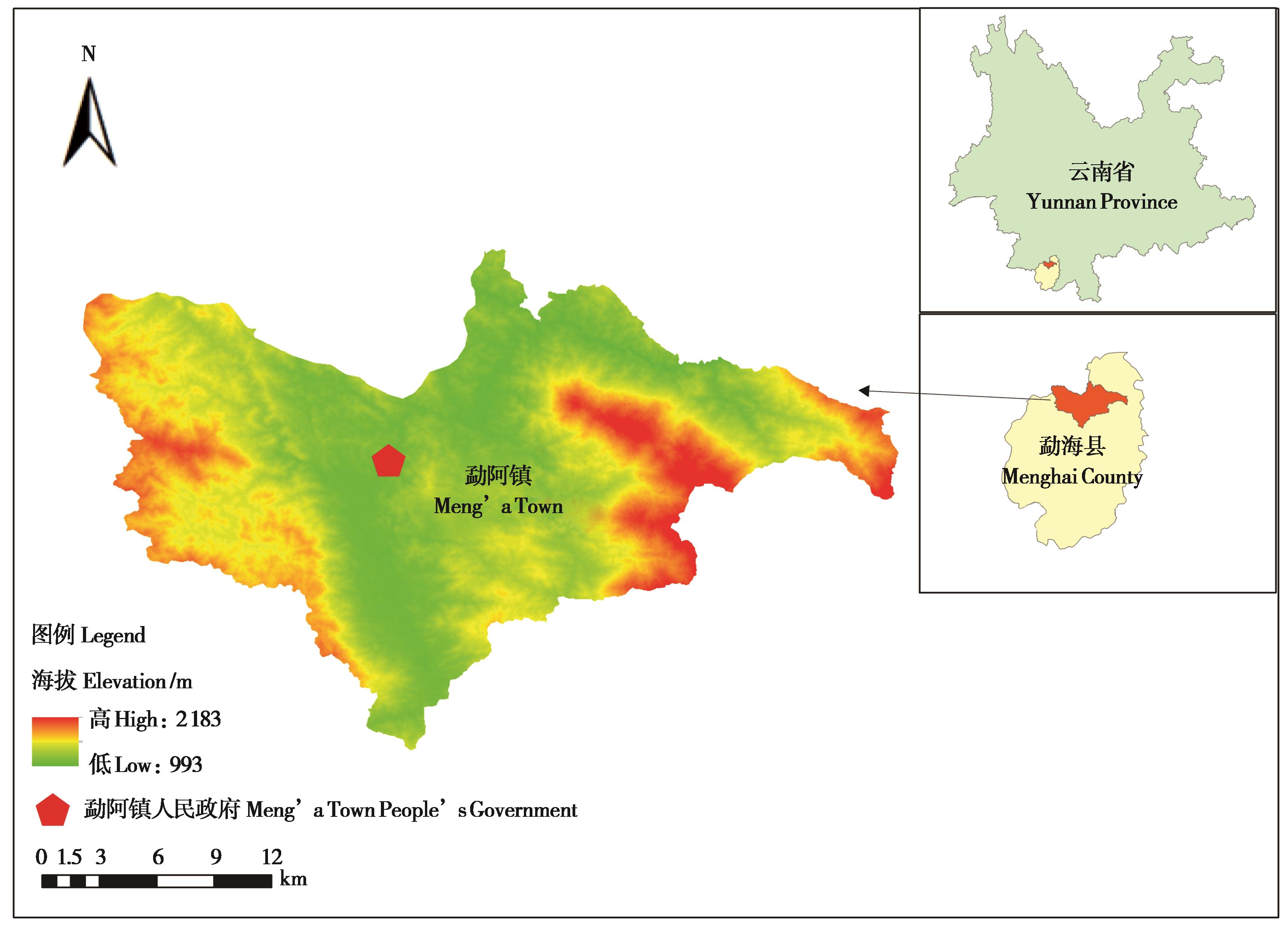
图1 研究区示意图
Fig. 1 Sketch of the study area
项目 Item | 定位精度 Position accuracy | |||||
|---|---|---|---|---|---|---|
| A | B | C | D | E | 不可用 Unavailable | |
偏差 Deviation | 5 m | 10 m | 20 m | 100 m | 2 000 m | 定位失败 Localization failure |
表1 卫星定位精度等级和偏差
Table 1 Satellite positioning accuracy levels and deviations
项目 Item | 定位精度 Position accuracy | |||||
|---|---|---|---|---|---|---|
| A | B | C | D | E | 不可用 Unavailable | |
偏差 Deviation | 5 m | 10 m | 20 m | 100 m | 2 000 m | 定位失败 Localization failure |
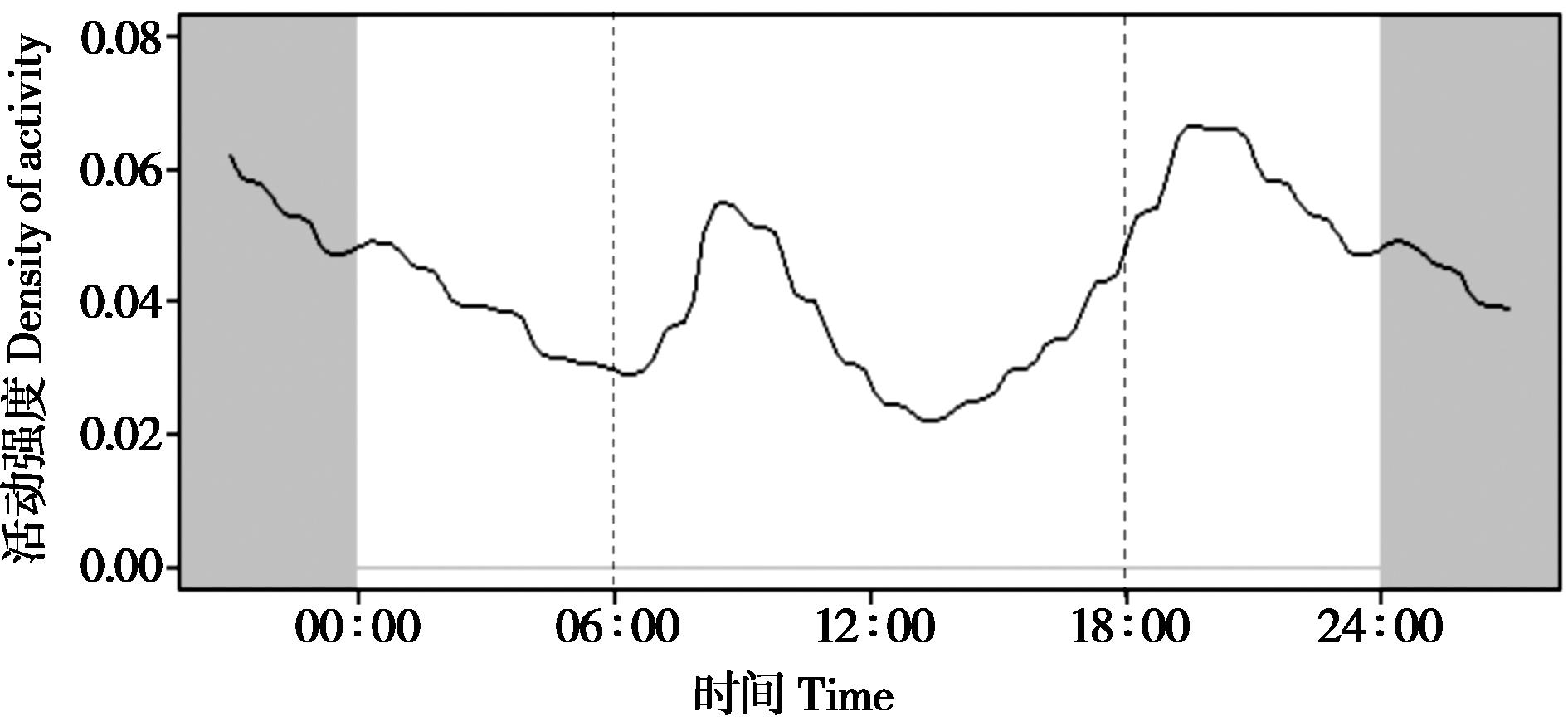
图2 基于活动量数据的全年亚洲象日活动节律
Fig. 2 Asian elephant daily activity rhythms throughout the year based on activity level data
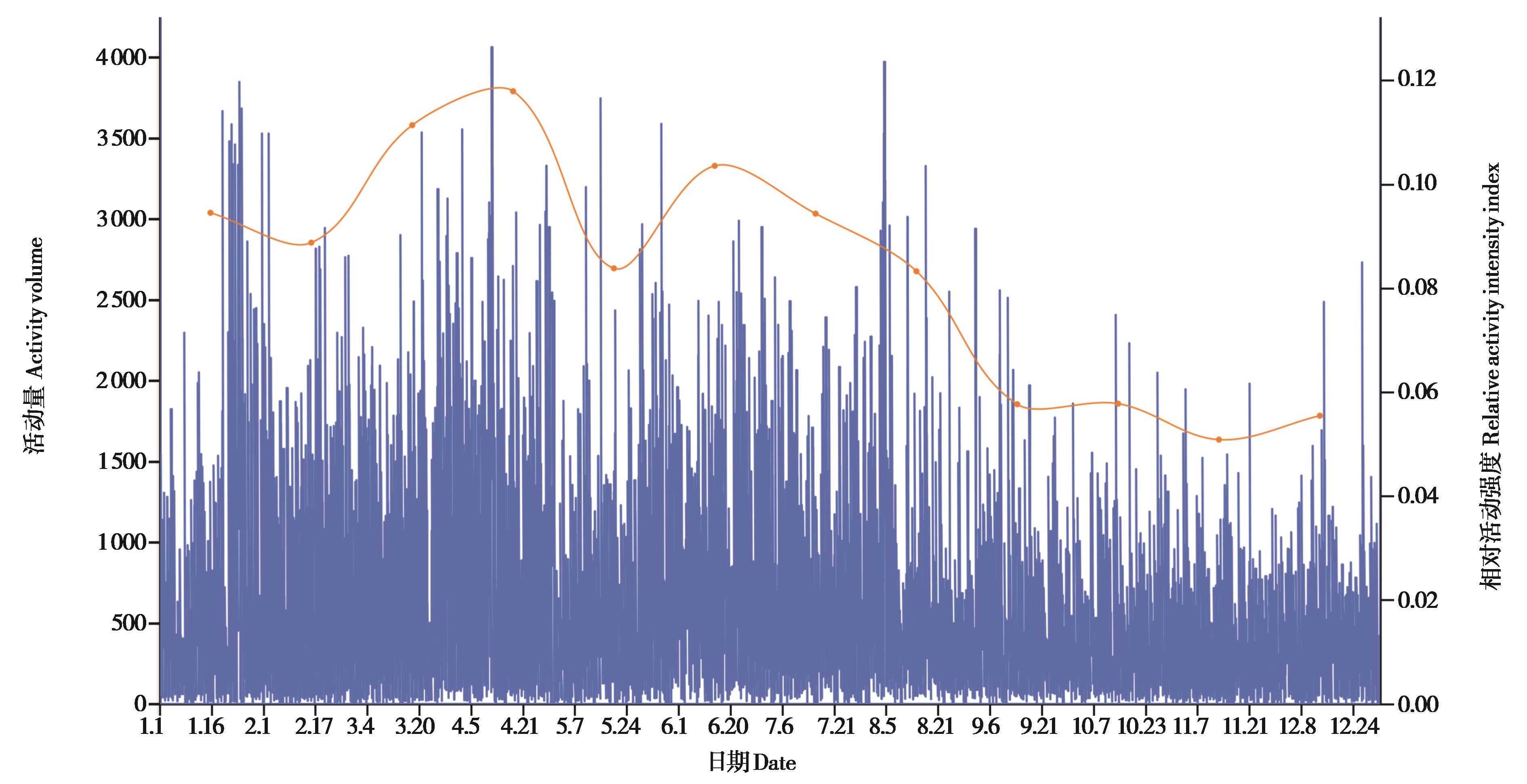
图3 基于活动量数据的亚洲象月活动节律
Fig. 3 Monthly activity rhythms of Asian elephant based on activity level data
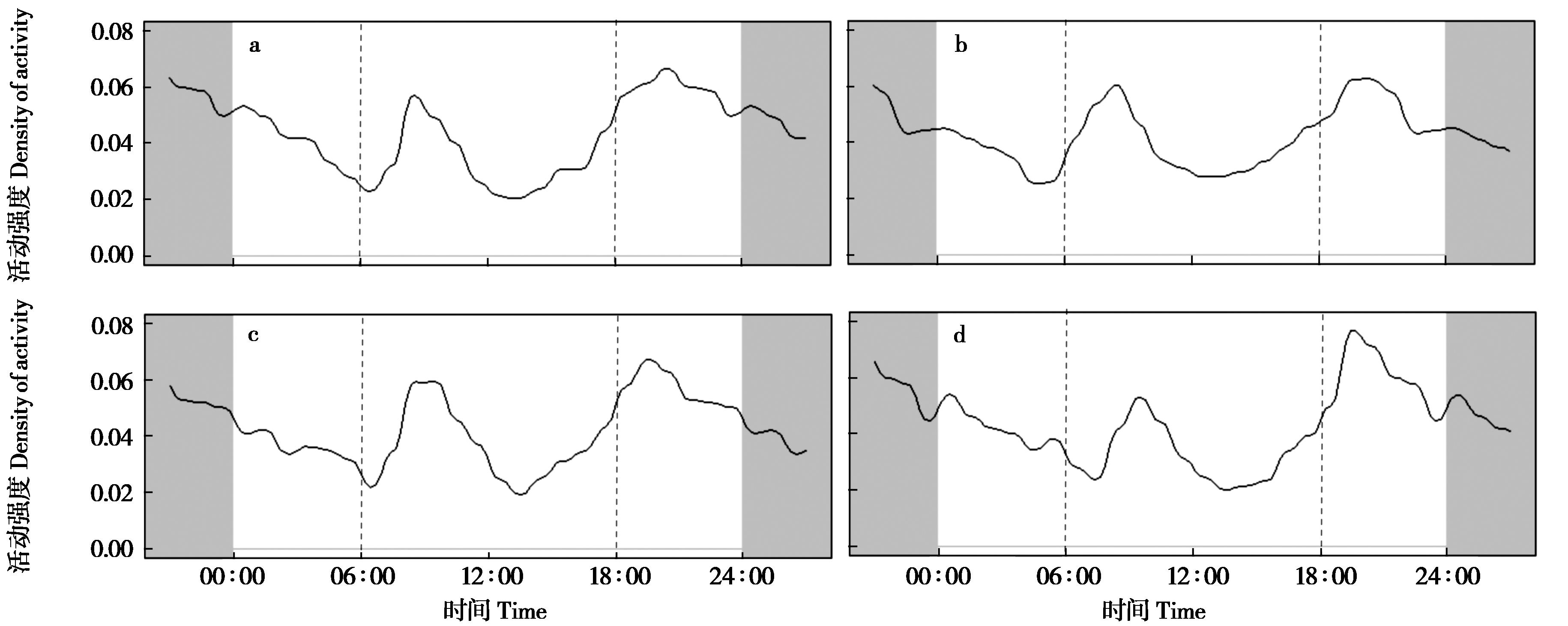
图4 基于活动量数据的不同季节亚洲象日活动节律. a:春季;b:夏季;c:秋季;d:冬季
Fig. 4 Daily activity rhythms of Asian elephant in different seasons based on activity level data. a: spring; b: summer; c: autumn; d: winter
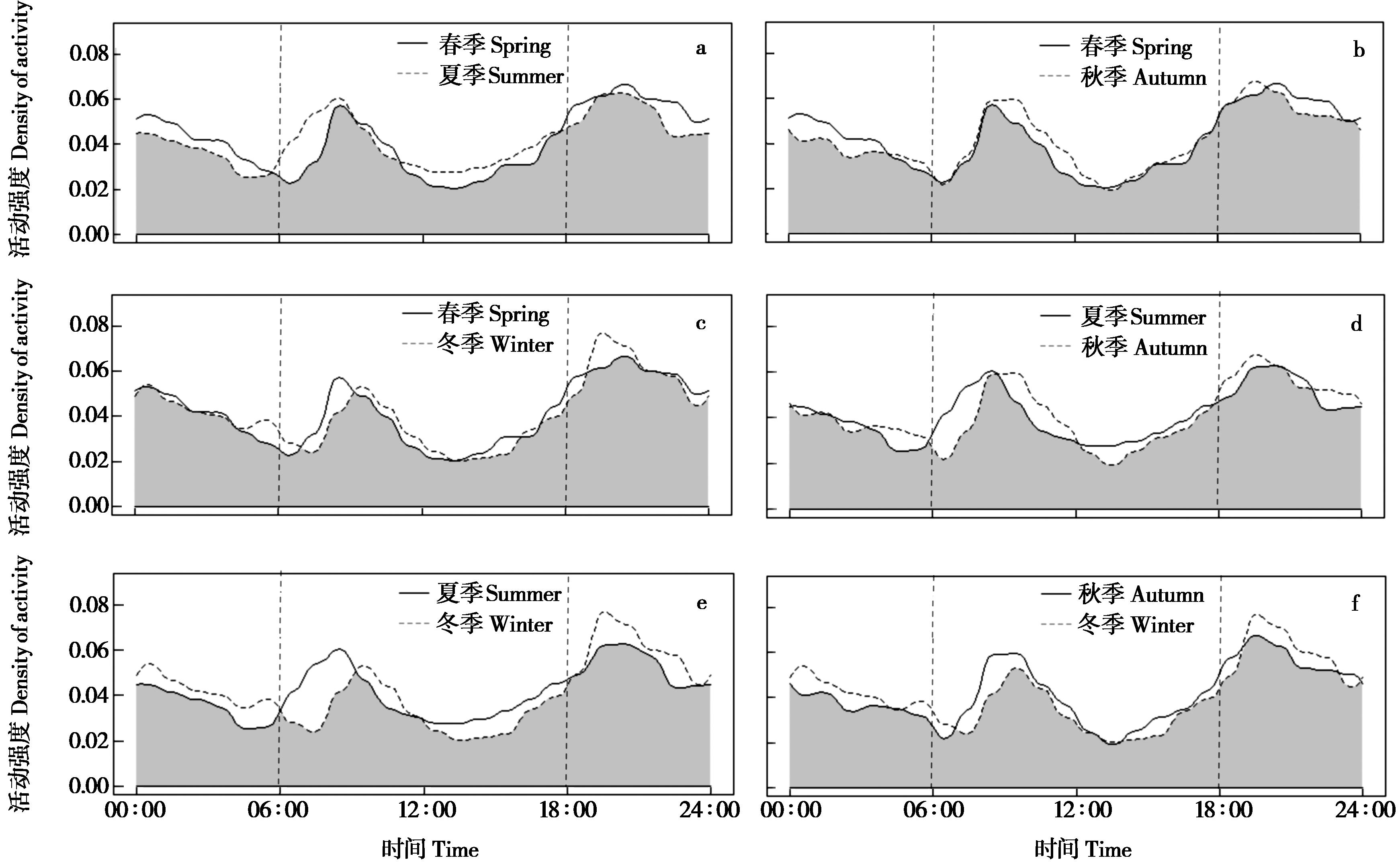
图5 不同季节亚洲象日活动节律比较
Fig.5 Comparison of daily activity rhythms of Asian elephant in different seasons
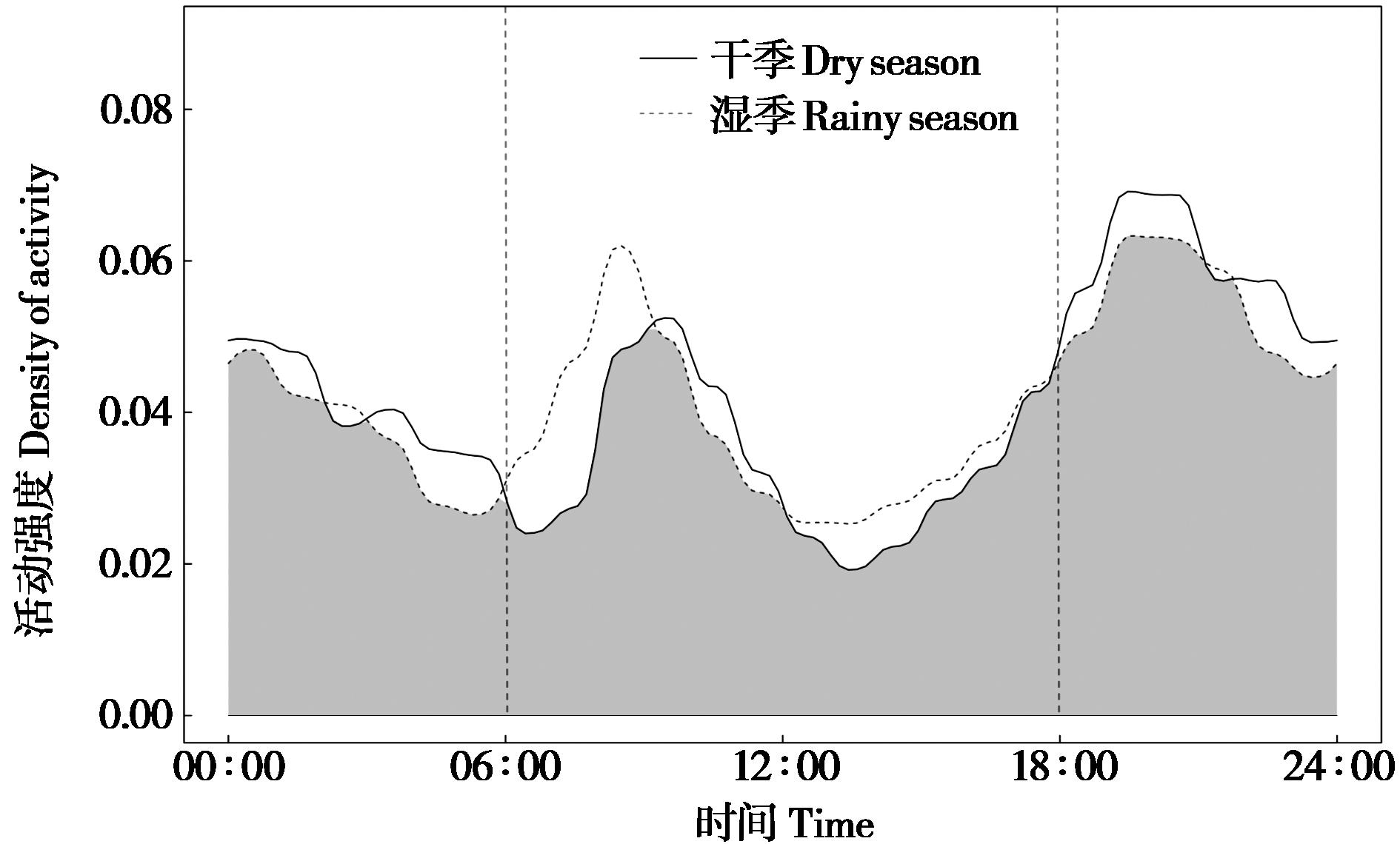
图6 基于活动量数据的亚洲象干湿季节日活动节律
Fig. 6 Daily activity rhythms of Asian elephant in dry and rainy seasons based on activity level data
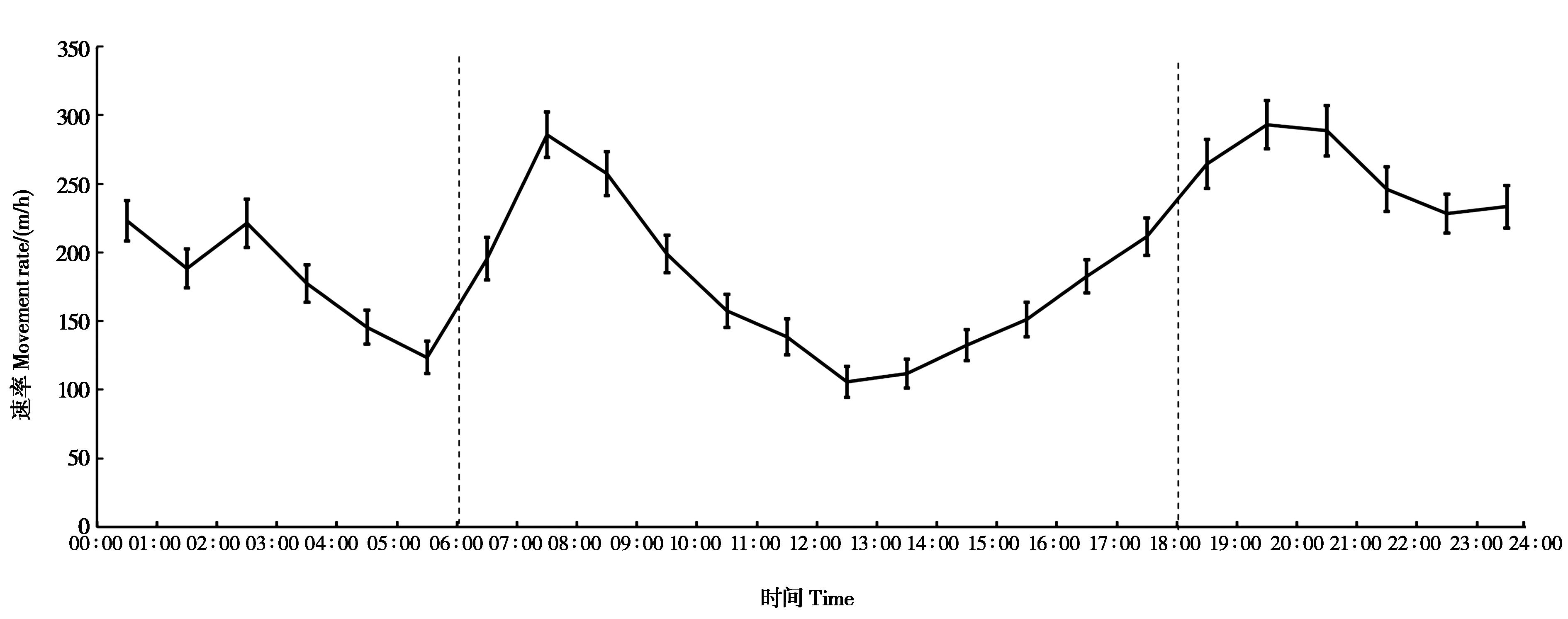
图7 基于速率数据的亚洲象日活动节律
Fig. 7 Daily activity rhythm of Asian elephant based on movement rates
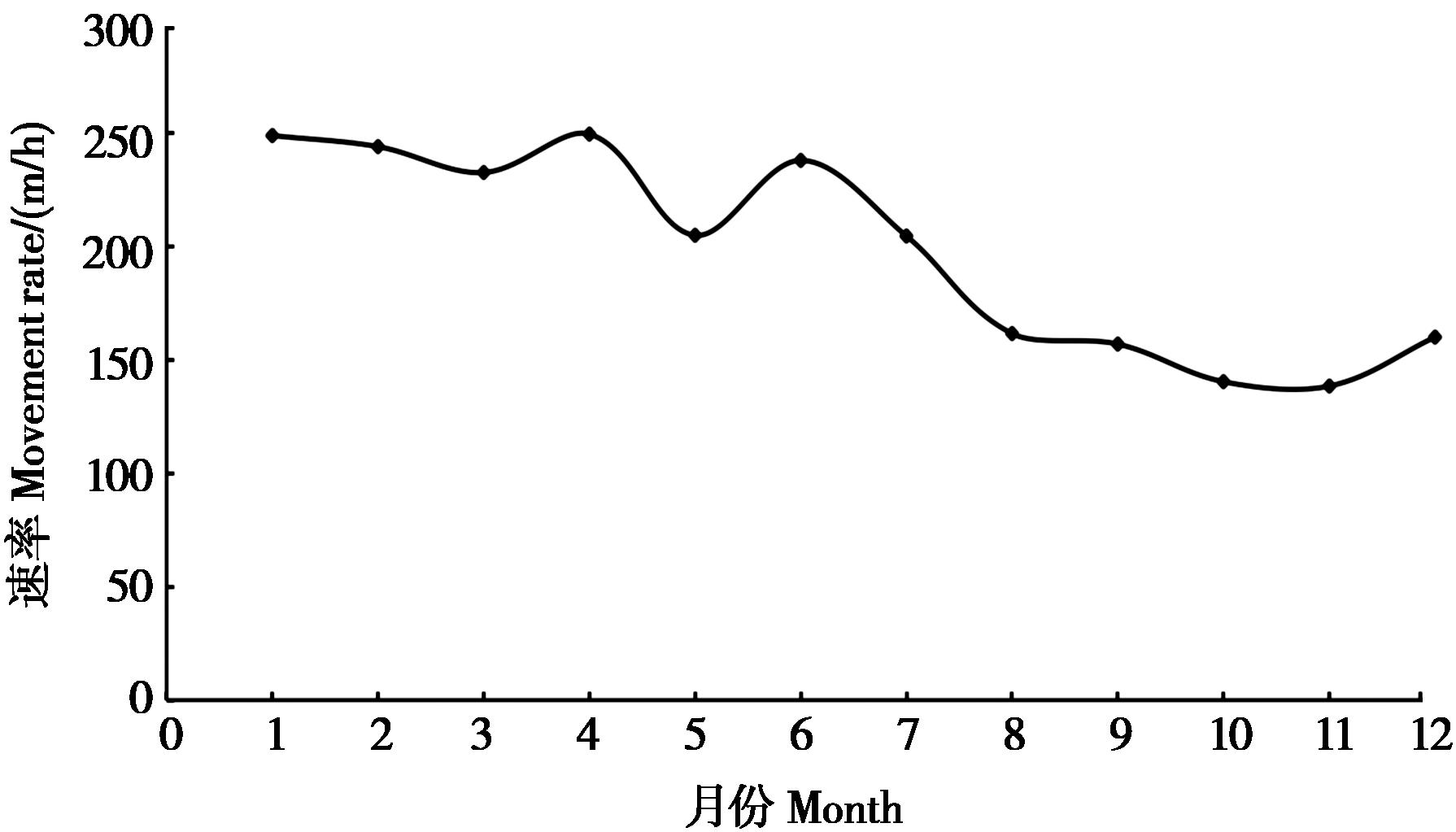
图8 基于速率数据的亚洲象月活动节律
Fig. 8 Monthly activity rhythms of Asian elephant based on movement rates

图9 基于速率数据的不同季节亚洲象日活动节律. a:春季;b:夏季;c:秋季;d:冬季
Fig. 9 Daily activity rhythms of Asian elephant in different seasons based on movement rates. a: spring; b: summer; c: autumn; d: winter
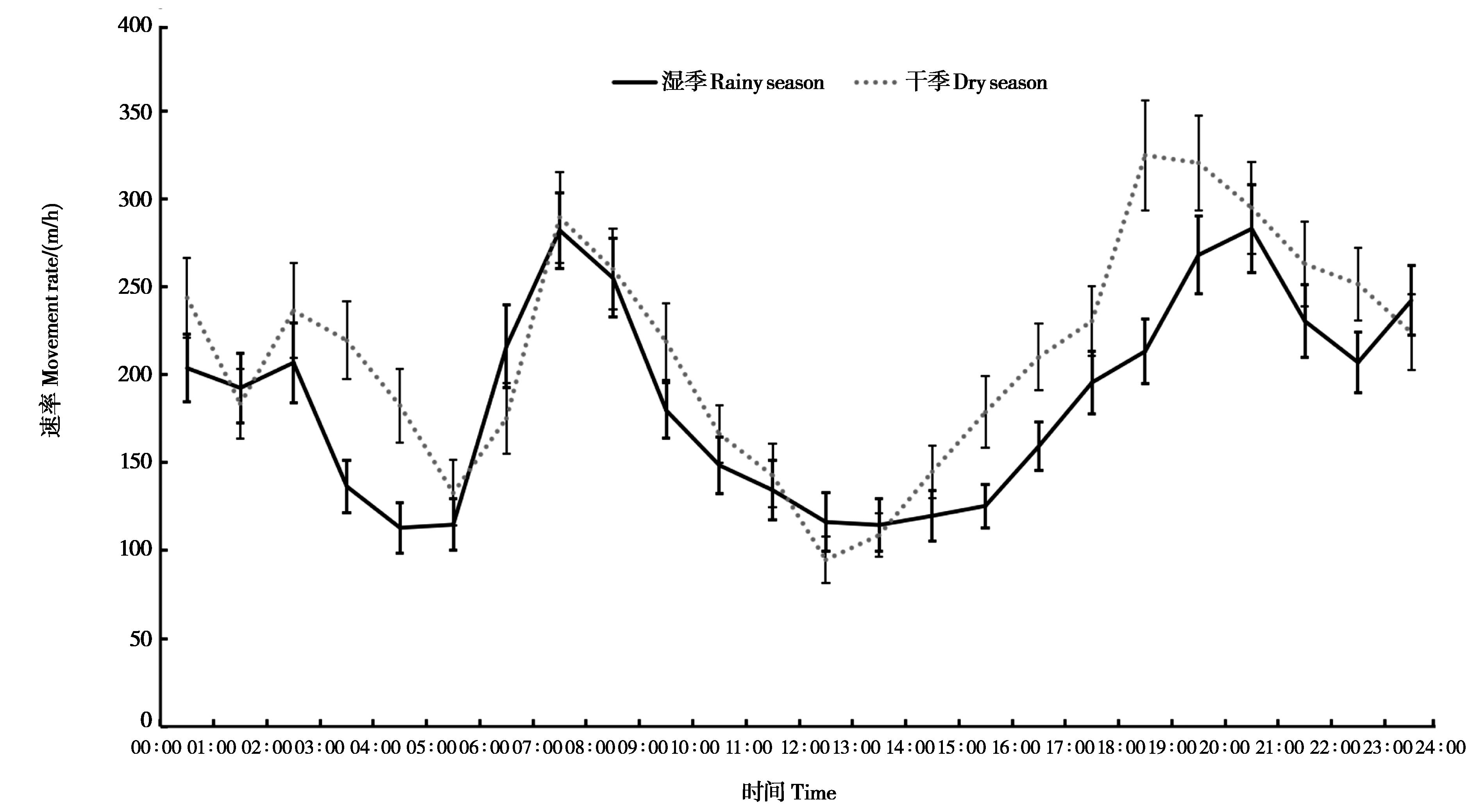
图10 基于速率数据的亚洲象干湿季节日活动节律
Fig. 10 Daily activity rhythms of Asian elephant in dry and rainy seasons based on on movement rates
时间 Time | 上午活动低谷 Low morning activity | 上午活动高峰 Peak morning activity | 中午活动低谷 Low noon activity | 下午活动高峰 Peak afternoon activity | ||||
|---|---|---|---|---|---|---|---|---|
活动量 Activity level | 速率 Movement rate | 活动量 Activity level | 速率 Movement rate | 活动量 Activity level | 速率 Movement rate | 活动量 Activity level | 速率 Movement rate | |
全年 All year | 06: 00—07: 00 | 05: 00—06: 00 | 08: 00—09: 00 | 07: 00—08: 00 | 13: 00—14: 00 | 12: 00—14: 00 | 19: 00—21: 00 | 19: 00—21: 00 |
春季 Spring | 06: 00—07: 00 | 05: 00—06: 00 | 08: 00—09: 00 | 07: 00—09: 00 | 12: 00—14: 00 | 12: 00—13: 00 | 20: 00—21: 00 | 19: 00—20: 00 |
夏季 Summer | 04: 00—06: 00 | 04: 00—06: 00 | 08: 00—09: 00 | 07: 00—08: 00 | 12: 00—14: 00 | 12: 00—14: 00 | 19: 00—21: 00 | 19: 00—21: 00 |
秋季 Autumn | 06: 00—07: 00 | 05: 00—06: 00 | 08: 00—10: 00 | 07: 00—08: 00 | 13: 00—14: 00 | 12: 00—16: 00 | 19: 00—20: 00 | 20: 00—21: 00 |
冬季 Winter | 07: 00—08: 00 | 05: 00—07: 00 | 09: 00—10: 00 | 07: 00—09: 00 | 13: 00—16: 00 | 12: 00—14: 00 | 19: 00—20: 00 | 18: 00—19: 00 |
干季 Dry season | 06: 00—07: 00 | 05: 00—06: 00 | 09: 00—10: 00 | 07: 00—08: 00 | 13: 00—14: 00 | 12: 00—14: 00 | 19: 00—21: 00 | 18: 00—20: 00 |
湿季 Rainy season | 05: 00—06: 00 | 04: 00—06: 00 | 08: 00—09: 00 | 07: 00—08: 00 | 12: 00—14: 00 | 12: 00—15: 00 | 19: 00—21: 00 | 19: 00—21: 00 |
表2 不同数据下日活动节律差异
Table 2 Differences in daily activity rhythms with different data
时间 Time | 上午活动低谷 Low morning activity | 上午活动高峰 Peak morning activity | 中午活动低谷 Low noon activity | 下午活动高峰 Peak afternoon activity | ||||
|---|---|---|---|---|---|---|---|---|
活动量 Activity level | 速率 Movement rate | 活动量 Activity level | 速率 Movement rate | 活动量 Activity level | 速率 Movement rate | 活动量 Activity level | 速率 Movement rate | |
全年 All year | 06: 00—07: 00 | 05: 00—06: 00 | 08: 00—09: 00 | 07: 00—08: 00 | 13: 00—14: 00 | 12: 00—14: 00 | 19: 00—21: 00 | 19: 00—21: 00 |
春季 Spring | 06: 00—07: 00 | 05: 00—06: 00 | 08: 00—09: 00 | 07: 00—09: 00 | 12: 00—14: 00 | 12: 00—13: 00 | 20: 00—21: 00 | 19: 00—20: 00 |
夏季 Summer | 04: 00—06: 00 | 04: 00—06: 00 | 08: 00—09: 00 | 07: 00—08: 00 | 12: 00—14: 00 | 12: 00—14: 00 | 19: 00—21: 00 | 19: 00—21: 00 |
秋季 Autumn | 06: 00—07: 00 | 05: 00—06: 00 | 08: 00—10: 00 | 07: 00—08: 00 | 13: 00—14: 00 | 12: 00—16: 00 | 19: 00—20: 00 | 20: 00—21: 00 |
冬季 Winter | 07: 00—08: 00 | 05: 00—07: 00 | 09: 00—10: 00 | 07: 00—09: 00 | 13: 00—16: 00 | 12: 00—14: 00 | 19: 00—20: 00 | 18: 00—19: 00 |
干季 Dry season | 06: 00—07: 00 | 05: 00—06: 00 | 09: 00—10: 00 | 07: 00—08: 00 | 13: 00—14: 00 | 12: 00—14: 00 | 19: 00—21: 00 | 18: 00—20: 00 |
湿季 Rainy season | 05: 00—06: 00 | 04: 00—06: 00 | 08: 00—09: 00 | 07: 00—08: 00 | 12: 00—14: 00 | 12: 00—15: 00 | 19: 00—21: 00 | 19: 00—21: 00 |
| Cai Ziliang, Qiu Shiping,2019. Seasonal variation of soil respiration and its impact factors in tropical seasonal rainforest in Xishuangbanna,Yunnan[J].Ecology and Environmental Sciences,28(2):283‑290.DOI:10.16258/j.cnki.1674-5906. 2019.02.009. (in Chinese with English abstract) | |
| Chen Hao, Wang Gang, Wang Cheng, Xue Fei, Cheng Hai, Zhang Yanan,2024. Acivity mhyhms,home range characterisics,and habitat selection of reintroduced red‑crowned crane[J].Acta Ecologica Sinica,44(4):1526‑1538. DOI:10.20103/j.stxb.202302230315. (in Chinese with English abstract) | |
| Chen Lijun, Shu Zufei, Xiao Zhishu,2019. Application of camera‑trapping data to study daily activity patterns of Galliformes in Guangdong Chebaling National Nature Reserve[J].Biodiversity Science,27(3):266‑272. DOI:10.17520/biods. 2018178. (in Chinese with English abstract) | |
| Edwards S, Noack J, Heyn L, Rodenwoldt D,2021. Are camera traps a reliable method for estimating activity patterns? A case study comparing technologies for estimating brown hyaena activity curves[J].Remote Sensing in Ecology and Conservation,7:129‑138. DOI:10.1002/rse2.175 . | |
| Ensing E P, Ciuti S, Wijs F A L M, Lentferink D H, Ten H A, Boyce M S, Hut R A,2014. GPS based daily activitypatterns in European red deer and North American elk(Cervus elaphus):indication for a weak circadian clock in ungulates[J]. PLoS ONE,9(9):e106997. DOI:10.1371/journal.pone. 0106997 . | |
| Goldingay R L,2015. A review of home‑range studies on Australian terrestrial vertebrates:a dequacy of studies testing of hypotheses,and relevance to conservation and international studies[J]. Australian Journal of Zoology,63:136‑146. DOI:10.1071/ZO14060 . | |
| Guan Lei, Wang Yun, Chen Bing, Wang Ji, Xu Jingjiang, Zheng Hongmin, Zhao Kun,2020. Activity rhythm of Asian elephants at wild elephant valley section of Simao‑Xiaomengyang expressway[J]. Transport Research,6(4):52‑59. DOI:10.16503/j.cnki.2095-9931.2020.04.007. (in Chinese with English abstract) | |
| Hertel A G, Swenson J E, Bischof R,2017. A case for considering individual variation in diel activity patterns[J].Behavioral Ecology,28:1524‑1531. DOI:10.1093/beheco/arx122 . | |
| Hu Yuanfang, Li Binqiang, Liang Dan, Li Xingquan, Liu Lanxiang, Yang Jiawei, Luo Xu,2022. Effect of anthropogenic disturbance on Lady Amherst’s pheasant(Chrwolopius amhersiae)activity[J].Biodiversity Science,30(8):100‑113. DOI:10.17520/biods.2021484. (in Chinese with English abstract) | |
| Kong Yueqiao, Liu Yanlin, He Chengwu, Li Tianti, Li Quanliang, Ma Cunxin, Wang Dajun, Li Sheng,2022. Determining the daily activity pattern of Chinese mountain cat(Felis bieli):Acomparative study based on camera‑trapping and satellite collar tracking data[J].Biodiversity Science,30(9):151‑162. DOI:10.17520/biods.2022081. (in Chinese with English abstract) | |
| Lashley M A, Cove M V, Chitwood M C, Penido G, Gardner B, Deperno C S, Moorman C E,2018. Estimating wildlife activity curves:comparison of methods and sample size[J].Scientific Reports,8:4173. DOI:10.1038/s41598-018-22638-6 . | |
| Li Jianliang, Li Jiaqi, Wang Liang, Pei Pengzu, Ma Donghui, Zhuo Mengya, Bao Xinkang,2020. The analysis on activity rhythms of several ungulates in extreme arid desert region based on infrared camera data[J].Acta Theriologica Sinica,40(2):120‑128. DOI:10.16829/j.slxb.150319. (in Chinese with English abstract) | |
| Li Sheng, Wang Dajun, Xiao Zhishu, Li Xinhai, Wang Tianming, Feng Limin, Wang Yun,2019. Camera‑trapping in wildlife research and conservation in China:review and outlook[J]. Biodiversity Science,22(6):685‑695. DOI:10.3724/SP.J.1003.2014.14203. (in Chinese with English abstract) | |
| Li Yaoyu, Chen Xinyang, Zhao Shanshan, Song Xiao, Guo Rui, Xu Aichun,2023. Activity rhythm and home range of released sika deer(Cervus nipponkopschi)[J].Acta Theriologica Sinica,43(5):501‑512. DOI:10.16829/j.slxb.150762. (in Chinese with English abstract) | |
| Liu Jiaqi, Wang Yihan, Zhang Lei, Cui Ning, Ting Lyu, Huang Yuan, Dai Rong, Li Zhengling, Chen Mingyong,2022. Potential effect on migration of Asian elephants and human‑elephant conflict by the Meng’a reservoir in Menghai County,Xishuangbanna[J].Acta Theriologica Sinica,42(3):227‑239. DOI:10.16829/j.slxb.150578. (in Chinese with English abstract) | |
| Ma Ruijun, Jiang Zhigang,2005. Impact of global climate change on wildlife[J].Acta Ecologica Sinica,11(3):269‑274.(in Chinese with English abstract) | |
| Matthews A, Ruykys L, Ellis B,2013. The success of GPS collar deployments on mammals in Australia[J].Australian Mammalogy,35:65‑83. DOI:10.1071/AM12021 . | |
| Meredith M, Ridout M,2014. Overlap:estimates of coefficient of overlapping for animal activity patterns[EB/OL].. | |
| Meredith M,Ridout,2021. MOverlap:Estimates of coefficient of over lapping for animal activity patterns[CP].Version 0.3.4. . | |
| Norris D, Michalski F, Peres C A,2010. Habitat patch size modul at esterres trial mammal activity patterns in Amazonian forest fragments[J].Journal of Mammalogy,9l:551‑560. | |
| Ridout M S, Linkie M,2009. Estimating overlap of daily activity patterns from camera trap data[J].Journal of Agricultural,Biological and Environmental Statistics,14:322‑337.DOI:10.1198/jabes.2009.08038 . | |
| Rowcliffe M,2016. Activity:animal activity statistics.Version 1.3.1[CP]. . | |
| Seri H, Chammem M, Ferreira L M M, Kechnebou M, Khorchani T, Silva S R,2018. Effects of seasonal variation,group size and sex on the activity bud get and diet composition of the addax antelope[J].African Journal of Range & Forage Science,9l:551‑560. DOI:10.2989/10220119.2018.1477831 . | |
| Sun Feida, Zhang Qiaoqiao, Huo Fei, Chen Deyi, Zhou Su, Tang Mingkun, Yang Tingyong,2023. Seasonal changes of flavonoids and polyphenols contents of plants in zoige alpine grassland of Ruoergai and their effects on feeding habits of plateau pika[J].Journal of Sichuan Agricultural University,41(5):925‑934. DOI:10.16036/j.issn.1000-2650.202212231. (in Chinese with English abstract) | |
| Tang Yongjing, Yang Cong, Yang Zicheng, Chen Fei,2023. Population dynamics of wild Asian elephants over the past fifty years[J].Acta Theriologica Sinica,43(5):593‑607. DOI:10.16829/j.slxb.150768. (in Chinese with English abstract) | |
| Wolfson D W, Schlichting P E, Boughton R K, Miller R S, VerCauteren K C, Lewis J S,2023. Comparison of daily activity patterns across seasons using GPS telemetry and camera trap data for a widespread mammal[J].Ecosphere,14(12):e4728. DOI:10.1002/ecs2.4728 . | |
| Xiao Yijun, Zhong Leifa,2018. Regulation of mammalian circadian rhythms and their molecular mechanisms[J].Biological Information,53(5):2‑4.(in Chinese with English abstract) | |
| Xiao Zhishu,2019. Application of camera trapping to species inventory and assessment of wild animals across China’s protected areas[J].Biodiversity Science,27(3):235‑236. DOI:10.17520/biods.2018329. (in Chinese with English abstract) | |
| Yuan Shengdong, Deng Yun, Luo Aaidong, Guo Xianming, Wen Mangcai, Wang Bin,Zede, Yang Fan, Wen Shirong,2019.A preliminary study of wireless infrared camera technology in alleviating the human‑elephant conflict[J]. Forestry Construction,12(6):61‑66.(in Chinese with English abstract) | |
| Zahoor B, Liu X H, Wu P F, Sun W L, Jia X D, Lv Z X, Zhao X Y, He X B, He B S, Cai Q, Songer M,2021. Activity pattern study of Asiatic black bear(Ursus thibetanus)in the Qinling Mountains,China,by using infrared camera traps[J]. Environmental Scienceand Pollution Research International,28(20):25179‑25186. DOI:10.1007/s11356-020-12325-3 . | |
| Zhao Chenguang, Chen Fei, Yan Zaikui, Liu Xingyuan, Liu Luming, Li Weiwei, Duan Yubao,2021. Activity rhythm and interspeciic association of sympatrie Lady Amherst’s pheasant and Temminek’s tragopan in the Yaoshan Mountains[J]. Chinese Journal of Ecology,40(12):4008‑4014. DOI:10.13292/j.1000-4890.202112.016. (in Chinese with English abstract) | |
| Zhao Chenguang, He Mingchao, Su Jinfen, Luo Rui, Gao Shunyong, Lu Yuanmin, Li Xu, Duan Yubao,2022. Activity rhythms research of Chinese goral(Naemorhedus griseus)revealed with infrared camera[J].Chinese Journal of Wildlife,43(1):32‑37. DOI:10.19711/j.cnki.issn 2310-1490. 2022.01.016. (in Chinese with English abstract) | |
| Zhao Lianjun, Liu Mingzhang, Luo Chunping, Bu Hongliang, Ma Dongyuan, Shang Xiaotong, Li Sheng,2020. Daily activity rhythm of blood pheasant(Lthaginis cruentus)in the Wanglang National Nature Reserve,Sichuan[J].Sichuan Journal of Zoology,39(2):121‑128.DOI:10.11984/j.issn. 1000-7083.20190177. (in Chinese with English abstract) | |
| 马瑞俊,蒋志刚,2005.全球气候变化对野生动物的影响[J]. 生态学报,11(3):269‑274. | |
| 孔玥峤,刘炎林,贺成武,李天醍,李全亮,马存新,王大军,李晟,2022. 评估荒漠猫的日活动节律:基于红外相机与卫星颈圈数据的对比[J].生物多样性,30(9):151‑162.DOI:10.17520/biods.2022081 . | |
| 刘嘉琦,王怡涵,张磊,崔宁,吕婷,黄元,戴蓉,李正玲,陈明勇,2022. 西双版纳勐海县勐阿水库对亚洲象迁移活动和人‑象冲突的潜在影响[J].兽类学报,42(3):227‑239. DOI:10.16829/j.slxb.150578 . | |
| 关磊,王云,陈兵,王冀,徐景江,郑宏民,赵琨,2020. 思小高速公路野象谷段路域亚洲象活动规律[J].交通运输研究,6(4):52‑59. DOI:10.16503/j.cnki.2095-9931.2020.04.007 . | |
| 汤永晶,杨聪,杨子诚,陈飞,2023. 近五十年来野生亚洲象的种群动态[J].兽类学报,43(5):593‑607. DOI:10.16829/j.slxb.150768 . | |
| 孙飞达,张荞荞,霍霏,陈德炜,周俗,唐明坤,杨廷勇,2023. 若尔盖高寒草地植物黄酮、多酚含量季节性变化及其对高原鼠兔食性的影响[J].四川农业大学学报,41(5):925‑934. DOI:10.16036/j.issn.1000-2650.202212231 . | |
| 孙儒泳,2001. 动物生态学原理[M]. 第三版. 北京:北京师范大学出版社. | |
| 李晟,王大军,肖治术,李欣海,王天明,冯利民,王云,2014. 红外相机技术在我国野生动物研究与保护中的应用与前景[J].生物多样性,22(6):685‑695. DOI:10.3724/SP.J.1003.2014.14203 . | |
| 李建亮,李佳琦,王亮,裴鹏祖,马东辉,禚孟雅,包新康,2020. 基于红外相机技术分析极旱荒漠有蹄类动物的活动节律[J].兽类学报,40(2):120‑128. DOI:10.16829/j.slxb.150319 . | |
| 李耀宇,陈听旸,赵闪闪,宋虓,郭瑞,徐爱春,2023. 野外放归华南梅花鹿活动节律与家域特征[J].兽类学报,43(5):501‑512. DOI:10.16829/j.slxb.150762 . | |
| 肖义军,钟磊发,2018. 哺乳动物昼夜节律的调控及其分子机制[J]. 生物学通报,53(5):2‑4. | |
| 肖治术,2019. 红外相机技术在我国自然保护地野生动物清查与评估中的应用[J]. 生物多样性,27(3):235‑236. DOI:10.17520/biods.2018329 . | |
| 陈立军,束祖飞,肖治术,2019. 应用红外相机数据研究动物活动节律:以广东车八岭保护区鸡形目鸟类为例[J]. 生物多样性,27(3):266‑272. DOI:10.17520/biods.2018178 . | |
| 陈浩,王刚,王成,薛菲,成海,张亚楠,2024. 野化放归丹顶鹤活动节律、家域特征和栖息地选择[J]. 生态学报,44(4):1526‑1538. DOI:10.20103/j.stxb.202302230315 . | |
| 赵晨光,何明超,苏晋芬,罗蕊,高顺勇,陆元敏,李旭,段玉宝,2022. 基于红外相机技术对中华斑羚活动节律的研究[J]. 野生动物学报,43(1):32‑37. DOI:10.19711/j.cnki.issn2310-1490.2022.01.016 . | |
| 赵晨光,陈飞,颜再奎,刘兴元,刘鲁明,李维薇,段玉宝,2021. 同域分布的白腹锦鸡和红腹角雉的活动节律及种间联结关系[J]. 生态学杂志,40(12):4008‑4014. DOI:10.13292/j.1000-4890.202112.016 . | |
| 赵联军,刘鸣章,罗春平,卜红亮,马东源,尚晓彤,李晟,2020. 四川王朗国家级自然保护区血雉的日活动节律[J]. 四川动物,39(2):121‑128. DOI:10.11984/j.issn. 1000-7083.20190177 . | |
| 胡远芳,李斌强,梁丹,李兴权,刘兰香,杨家伟,罗旭,2022. 人为干扰对白腹锦鸡活动节律的影响[J]. 生物多样性,30(8):100‑113. DOI:10.17520/biods.2021484 . | |
| 袁盛东,邓云,罗爱东,郭贤明,文芒才,王斌,则得,杨帆,文世荣,2019. 尝试利用无线红外相机技术缓解人‑象冲突[J]. 林业建设,12(6):61‑66. | |
| 蒋志刚,吴毅,刘少英,蒋学龙,周开亚,胡慧建,2021. 中国生物多样性红色名录‑脊椎动物(第一卷):哺乳动物[M]. 北京:科学出版社. | |
| 蔡子良,邱世平,2019. 西双版纳热带季节雨林土壤呼吸季节动态及驱动因素[J].生态环境学报,28(2):283‑290. DOI:10.16258/j.cnki.1674-5906.2019.02.009 . |
| [1] | 邹明江, 钱前, 田瑶瑶, 邓春韩, 高本旺, 朱凯, 刘益平, 周友兵, 彭刚志. 湖北大老岭同域中型食肉类动物的时间生态位分化[J]. 兽类学报, 2026, 46(4): 1-. |
| [2] | 陈文琦, 陈晓冰, 张婉婷, 张雪涟, 周一凡, 李迎春, 卢宪旺, 关洪武, 赵大鹏. 天津盘山同域分布野生豹猫与貉时空活动规律研究[J]. 兽类学报, 2026, 46(4): 1-. |
| [3] | 钱宗亮, 陈星, 晋雨漪, 蒋欣芮, 蒋勇, 杨志松, 杨彪. 贡嘎山国家级自然保护区中华小熊猫的栖息地适宜性与活动节律[J]. 兽类学报, 2026, 46(4): 1-. |
| [4] | 李金美, 吴涛, 汤恩泽, 廖金屏, 张格菲, 刘志霄. 洞栖性大蹄蝠PAE行为谱、繁育行为及活动节律研究[J]. 兽类学报, 2026, 46(3): 404-419. |
| [5] | 薛熠琳, 杜海荣, 王哲禹, 杨恩泽, 常峥, 徐刚林, 张明海. 云南西双版纳半散放肇事雄性亚洲象行为特征[J]. 兽类学报, 2026, 46(3): 420-432. |
| [6] | 汪靖山, 郭强, 段文光, 李旭, 王卫斌, 王志胜, 杨绍兵. 基于时空分析南滚河国家级自然保护区亚洲象的集群特点[J]. 兽类学报, 2026, 46(2): 240-250. |
| [7] | 申思嘉, 王璐, 赵旭, 刘涛, 刘学锋, 刘定震. 亚洲象对同类隆叫声和无人机次声录音回放的行为反应无显著差异[J]. 兽类学报, 2025, 45(6): 842-850. |
| [8] | 吕永磊, 王伟波, 崔雅倩, 刘郢, 周薇, 王渊, 刘锋, 王广龙, 扈晶晶, 普布顿珠, 边巴多吉, 旦增, 胡开, 王小川, 温知新, 杨奇森. 雅鲁藏布江流域亚洲黑熊适生区与活动节律[J]. 兽类学报, 2025, 45(5): 629-640. |
| [9] | 陈婷, 李斌强, 廖正杭, 李伟, 彭灿. 云南昭通亚洲黑熊适宜栖息地与日活动节律[J]. 兽类学报, 2025, 45(5): 641-654. |
| [10] | 桂俭, 曹越, 潘丹, 李佳琦, 李克源, 刘相, 李视儒, 杨梦蝶, 杨道德. 湖南都庞岭国家级自然保护区红外相机兽类和鸟类监测及日活动节律分析[J]. 兽类学报, 2025, 45(4): 513-526. |
| [11] | 潘连红, 贾功雪, 杨其恩, 王绪敏. 哺乳动物季节性精子发生的分子调控研究进展[J]. 兽类学报, 2025, 45(3): 271-282. |
| [12] | 李明慧, 黄莘钧, 常劲, 莫志民, 万冬梅, 蒋一婷. 辽西地区狍的相对多度、集群模式及日活动节律[J]. 兽类学报, 2025, 45(3): 356-367. |
| [13] | 马雪君, 高峰, 穆玉琴, 严晗, 王克春, 杨维康, 徐峰. 性别和季节对天山马鹿日活动节律的影响[J]. 兽类学报, 2025, 45(3): 368-377. |
| [14] | 于秋鹏, 胡哲畅, 徐同美, 杨雄伟, 李杰, 王洪娇, 李学友, 蒋学龙. 思茅亚洲象食源地建设成效评估[J]. 兽类学报, 2025, 45(3): 388-398. |
| [15] | 袁宝, 张博皓, 李建富, 陈文丽, 张勇, 赵兴绪, 张全伟. 发情和非发情期雄性双峰驼尿液差异代谢物及其功能预测[J]. 兽类学报, 2025, 45(3): 399-408. |
| 阅读次数 | ||||||
|
全文 |
|
|||||
|
摘要 |
|
|||||
 青公网安备 63010402000199号 青ICP备05000010号-2