

中国核心期刊要目总览
中国科技核心期刊
CSCD数据库源刊
中国科技核心期刊
CSCD数据库源刊
ACTA THERIOLOGICA SINICA ›› 2026, Vol. 46 ›› Issue (2): 199-208.DOI: 10.16829/j.slxb.151020
• ORIGINAL PAPERS • Previous Articles Next Articles
Jie LAN1, Hongfeng LI1, Xuemin WEI1, Yuhao WANG1, Wenqiang ZHANG2, Yifei XU1( )
)
Received:2024-10-14
Accepted:2025-02-27
Online:2026-03-30
Published:2026-03-06
Contact:
Yifei XU
兰洁1, 李红凤1, 韦雪敏1, 王玉昊1, 张文强2, 许一菲1()
通讯作者:
许一菲
作者简介:兰洁(2000- ),女,硕士研究生,主要从事病原生态学研究.
基金资助:CLC Number:
Jie LAN, Hongfeng LI, Xuemin WEI, Yuhao WANG, Wenqiang ZHANG, Yifei XU. Comparison of rodents, bats, and non-human primates as reservoirs and vectors of microbes[J]. ACTA THERIOLOGICA SINICA, 2026, 46(2): 199-208.
兰洁, 李红凤, 韦雪敏, 王玉昊, 张文强, 许一菲. 啮齿类、蝙蝠类和非人灵长类动物作为疫病病原体储存与传播宿主的比较[J]. 兽类学报, 2026, 46(2): 199-208.
Add to citation manager EndNote|Ris|BibTeX
共享网络 Sharing networks | 目 Order | 标准化系数 Standardized regression coefficient | t值 t value | P值 P value | 多元相关平方 R² |
|---|---|---|---|---|---|
病原共享网络 Microbe-sharing networks | 啮齿目 Rodentia | 4.06e-05 | 62.37 | P < 0.001 | 0.17 |
| 翼手目 Chiroptera | 2.70e-02 | 45.20 | P < 0.001 | 0.07 | |
| 灵长目 Primates | 2.13e-04 | 15.97 | P < 0.001 | 0.03 | |
人类相关病原共享网络 Human-associated microbe-sharing networks | 啮齿目 Rodentia | 2.61e-05 | 50.99 | P < 0.001 | 0.17 |
| 翼手目 Chiroptera | 1.32e-02 | 42.09 | P < 0.001 | 0.09 | |
| 灵长目 Primates | 1.43e-04 | 16.01 | P < 0.001 | 0.03 |
Table 1 Regression results of the number of shared microbes and sampling efforts in different microbe-sharing networks
共享网络 Sharing networks | 目 Order | 标准化系数 Standardized regression coefficient | t值 t value | P值 P value | 多元相关平方 R² |
|---|---|---|---|---|---|
病原共享网络 Microbe-sharing networks | 啮齿目 Rodentia | 4.06e-05 | 62.37 | P < 0.001 | 0.17 |
| 翼手目 Chiroptera | 2.70e-02 | 45.20 | P < 0.001 | 0.07 | |
| 灵长目 Primates | 2.13e-04 | 15.97 | P < 0.001 | 0.03 | |
人类相关病原共享网络 Human-associated microbe-sharing networks | 啮齿目 Rodentia | 2.61e-05 | 50.99 | P < 0.001 | 0.17 |
| 翼手目 Chiroptera | 1.32e-02 | 42.09 | P < 0.001 | 0.09 | |
| 灵长目 Primates | 1.43e-04 | 16.01 | P < 0.001 | 0.03 |
经校正的加权节点统计指标 Weighted nodal statistics indicators have been adjusted | 病原共享网络 Microbe-sharing networks | 人类相关病原共享网络 Human-associated microbe-sharing networks | ||||
|---|---|---|---|---|---|---|
啮齿类 (啮齿目) Rodents(Rodentia) | 蝙蝠类 (翼手目) Bats(Chiroptera) | 非人灵长类 Non-human primates | 啮齿类 (啮齿目) Rodents(Rodentia) | 蝙蝠类 (翼手目) Bats(Chiroptera) | 非人灵长类 Non-human primates | |
| 度数 Degree | -0.51 | 0.50 | -0.50 | 0.51 | 0.50 | -0.50 |
| 接近中心性 Closeness | -0.48 | 0.50 | -0.50 | 0.50 | 0.50 | -0.50 |
| 特征向量中心性 Eigen | -0.50 | 0.50 | -0.50 | 0.49 | 0.50 | -0.50 |
| PR中心性 Pr_evcent | -0.50 | 0.50 | -0.50 | 0.50 | 0.50 | -0.50 |
PC1方差贡献率 Variance contribution rate of PC1 | 94.82% | 98.27% | 98.69% | 96.72% | 98.15% | 99.08% |
Table 2 Results of PC1 from principal component analysis of centrality indicators in different microbe-sharing networks
经校正的加权节点统计指标 Weighted nodal statistics indicators have been adjusted | 病原共享网络 Microbe-sharing networks | 人类相关病原共享网络 Human-associated microbe-sharing networks | ||||
|---|---|---|---|---|---|---|
啮齿类 (啮齿目) Rodents(Rodentia) | 蝙蝠类 (翼手目) Bats(Chiroptera) | 非人灵长类 Non-human primates | 啮齿类 (啮齿目) Rodents(Rodentia) | 蝙蝠类 (翼手目) Bats(Chiroptera) | 非人灵长类 Non-human primates | |
| 度数 Degree | -0.51 | 0.50 | -0.50 | 0.51 | 0.50 | -0.50 |
| 接近中心性 Closeness | -0.48 | 0.50 | -0.50 | 0.50 | 0.50 | -0.50 |
| 特征向量中心性 Eigen | -0.50 | 0.50 | -0.50 | 0.49 | 0.50 | -0.50 |
| PR中心性 Pr_evcent | -0.50 | 0.50 | -0.50 | 0.50 | 0.50 | -0.50 |
PC1方差贡献率 Variance contribution rate of PC1 | 94.82% | 98.27% | 98.69% | 96.72% | 98.15% | 99.08% |

Fig. 1 Average number of microbes and human-associated microbes species carried by per species of the host order (A), proportion of human-associated microbes carried by per species of the host order (B) and results of NMDS analyses of the richness of microbes (C) and human-associated microbes among three host orders (D)
| 项目Item | 宿主‑病原网络 Host-microbe networks | 宿主-人类相关病原网络 Host-human-associated microbe networks | ||||
|---|---|---|---|---|---|---|
啮齿类 (啮齿目) Rodents(Rodentia) | 蝙蝠类 (翼手目) Bats(Chiroptera) | 非人灵长类 Non-human primates | 啮齿类 (啮齿目) Rodents(Rodentia) | 蝙蝠类 (翼手目) Bats(Chiroptera) | 非人灵长类 Non-human primates | |
| 宿主 Host | 650 | 514 | 219 | 432 | 350 | 194 |
| 病原 Microbe | 4 535 | 4 618 | 1 588 | 617 | 285 | 362 |
| 病毒 Viruses | 2 218 | 3 581 | 991 | 202 | 126 | 146 |
| 细菌 Bacteria | 1 766 | 621 | 332 | 382 | 122 | 185 |
| 原生生物 Protists | 420 | 128 | 247 | 27 | 11 | 27 |
| 真菌 Fungi | 131 | 288 | 18 | 6 | 26 | 4 |
每个宿主物种的病原种类 Number of microbes per host species | 12.91 | 17.09 | 19.07 | 6.40 | 5.02 | 9.54 |
每个病原的宿主物种数量 Number of host species per microbe | 1.85 | 1.90 | 2.63 | 4.48 | 6.17 | 5.11 |
Table 3 Network statistics of Host-microbe networks
| 项目Item | 宿主‑病原网络 Host-microbe networks | 宿主-人类相关病原网络 Host-human-associated microbe networks | ||||
|---|---|---|---|---|---|---|
啮齿类 (啮齿目) Rodents(Rodentia) | 蝙蝠类 (翼手目) Bats(Chiroptera) | 非人灵长类 Non-human primates | 啮齿类 (啮齿目) Rodents(Rodentia) | 蝙蝠类 (翼手目) Bats(Chiroptera) | 非人灵长类 Non-human primates | |
| 宿主 Host | 650 | 514 | 219 | 432 | 350 | 194 |
| 病原 Microbe | 4 535 | 4 618 | 1 588 | 617 | 285 | 362 |
| 病毒 Viruses | 2 218 | 3 581 | 991 | 202 | 126 | 146 |
| 细菌 Bacteria | 1 766 | 621 | 332 | 382 | 122 | 185 |
| 原生生物 Protists | 420 | 128 | 247 | 27 | 11 | 27 |
| 真菌 Fungi | 131 | 288 | 18 | 6 | 26 | 4 |
每个宿主物种的病原种类 Number of microbes per host species | 12.91 | 17.09 | 19.07 | 6.40 | 5.02 | 9.54 |
每个病原的宿主物种数量 Number of host species per microbe | 1.85 | 1.90 | 2.63 | 4.48 | 6.17 | 5.11 |
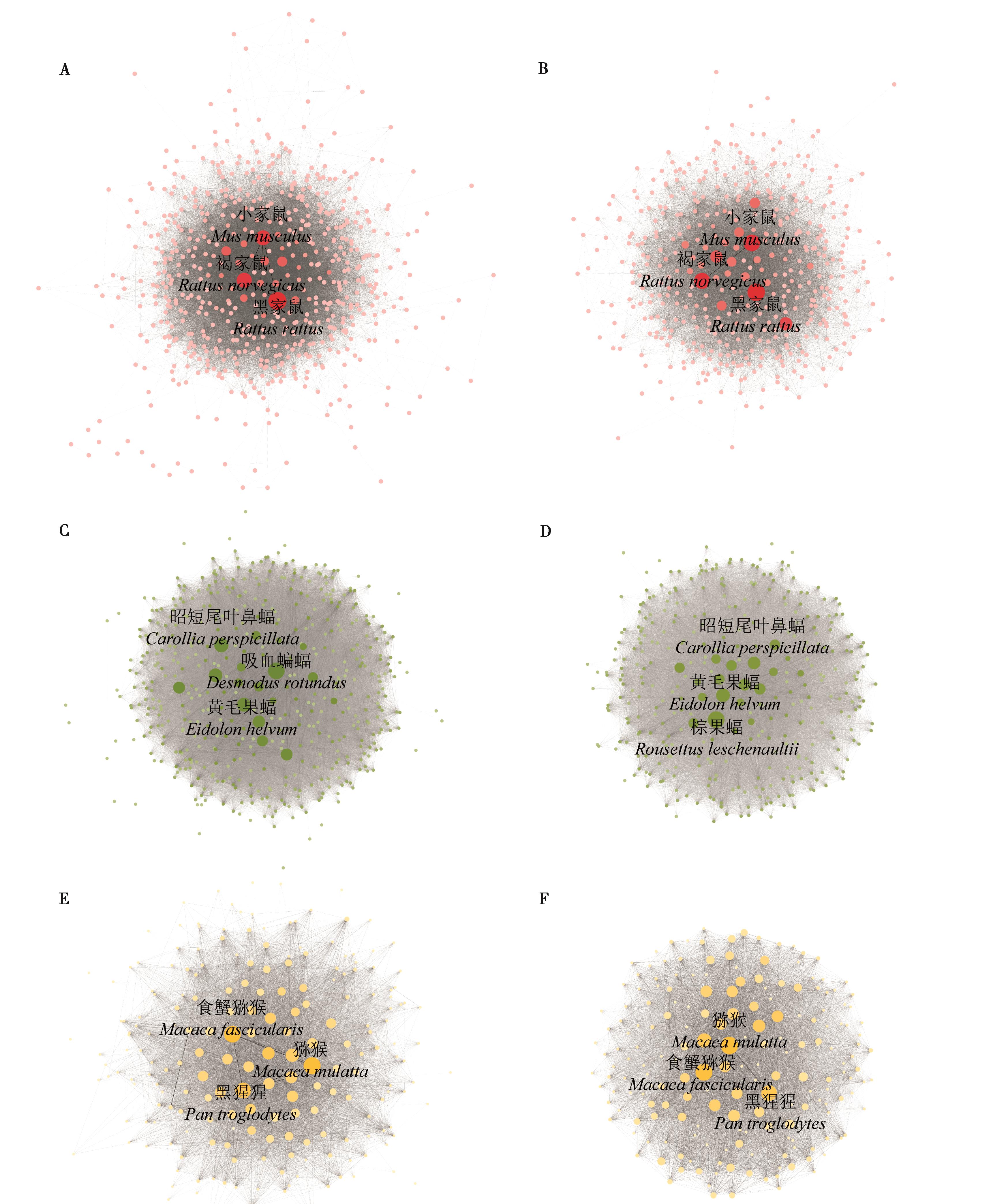
Fig. 2 Microbe-sharing networks. Rodents (Rodentia) (A) total and human-associated (B) microbe-sharing networks; Rats (Chiroptera) (C) total and human-associated (D) microbe-sharing networks; Non-human primates (E) total and human-associated (F) microbe-sharing networks
网络统计指标 Network statistical indicators | 病原共享网络 Microbe-sharing networks | 人类相关病原共享网络 Human-associated microbe-sharing networks | |||||||
|---|---|---|---|---|---|---|---|---|---|
啮齿类 (啮齿目) Rodents (Rodentia) | 蝙蝠类 (翼手目) Bats (Chiroptera) | 非人灵长类 Non-human primates | P值 P value | 啮齿类 (啮齿目) Rodents (Rodentia) | 蝙蝠类 (翼手目) Bats (Chiroptera) | 非人灵长类 Non-human primates | P值 P value | ||
| 同配系数 Assortativity | -0.19 | -0.20 | -0.19 | -0.19 | -0.12 | -0.19 | |||
| 聚类系数 Transitivity | 0.47 | 0.60 | 0.72 | 0.50 | 0.72 | 0.74 | |||
| 网络密度 Density | 0.11 | 0.22 | 0.42 | 0.14 | 0.28 | 0.48 | |||
| 平均度 Mean degree | 64.73 | 106.98 | 88.42 | 59.49 | 98.23 | 90.66 | |||
平均加权度 Mean weighted degree | 121.83 | 219.41 | 248.35 | P < 0.000 1 | 105.90 | 144.43 | 207.84 | P < 0.000 1 | |
校正后的平均加权度 Corrected mean weighted degree | 3 919.03 | 4 211.73 | 1 767.55 | P < 0.000 1 | 2 150.66 | 1 149.16 | 1 255.70 | P < 0.000 1 | |
Table 4 Statistical indicators and P-values for microbe-sharing networks
网络统计指标 Network statistical indicators | 病原共享网络 Microbe-sharing networks | 人类相关病原共享网络 Human-associated microbe-sharing networks | |||||||
|---|---|---|---|---|---|---|---|---|---|
啮齿类 (啮齿目) Rodents (Rodentia) | 蝙蝠类 (翼手目) Bats (Chiroptera) | 非人灵长类 Non-human primates | P值 P value | 啮齿类 (啮齿目) Rodents (Rodentia) | 蝙蝠类 (翼手目) Bats (Chiroptera) | 非人灵长类 Non-human primates | P值 P value | ||
| 同配系数 Assortativity | -0.19 | -0.20 | -0.19 | -0.19 | -0.12 | -0.19 | |||
| 聚类系数 Transitivity | 0.47 | 0.60 | 0.72 | 0.50 | 0.72 | 0.74 | |||
| 网络密度 Density | 0.11 | 0.22 | 0.42 | 0.14 | 0.28 | 0.48 | |||
| 平均度 Mean degree | 64.73 | 106.98 | 88.42 | 59.49 | 98.23 | 90.66 | |||
平均加权度 Mean weighted degree | 121.83 | 219.41 | 248.35 | P < 0.000 1 | 105.90 | 144.43 | 207.84 | P < 0.000 1 | |
校正后的平均加权度 Corrected mean weighted degree | 3 919.03 | 4 211.73 | 1 767.55 | P < 0.000 1 | 2 150.66 | 1 149.16 | 1 255.70 | P < 0.000 1 | |

Fig. 3 Statistical indicators for microbes (A) and human-associated (B) microbe-sharing network nodes, and statistical indicators for microbes (C) and human-associated (D) microbe-sharing network nodes of the central species
| Benson D A, Cavanaugh M, Clark K, Karsch‑Mizrachi I, Lipman D J, Ostell J, Sayers E W,2013. GenBank[J].Nucleic Acids Research,41(Database issue):D36‑42. | |
| Bordes F, Caron A, Blasdell K, de Garine‐Wichatitsky M, Morand S, du Toit J,2016. Forecasting potential emergence of zoonotic diseases in South‑East Asia: network analysis identifies key rodent hosts[J].Journal of Applied Ecology,54(3):691‑700. DOI:10.1111/1365-2664.12804 . | |
| Calisher C H, Childs J E, Field H E, Holmes K V, Schountz T,2006. Bats:important reservoir hosts of emerging viruses[J].Clinical Microbiology Reviews,19(3):531‑545. DOI:10.1128/CMR.00017-06 . | |
| Calvignac‑Spencer S, Leendertz S A, Gillespie T R, Leendertz F H,2012. Wild great apes as sentinels and sources of infectious disease[J].Linical Microbiology and Infection,18(6):521‑527. DOI:10.1111/j.1469-0691.2012.03816.x . | |
| Cooper N, Griffin R, Franz M, Omotayo M, Nunn C L, Fryxell J,2012. Phylogenetic host specificity and understanding parasite sharing in primates[J].Ecology Letters,15(12):1370‑1377. DOI:10.1111/j.1461-0248.2012.01858.x . | |
| Daszak P, Cunningham A A, Hyatt A D,2000. Emerging infectious diseases of wildlife‑threats to biodiversity and human health[J].Science,287(5452):443‑449. DOI:10.1126/science.287.5452.443 . | |
| Ecke F, Han B A, Hornfeldt B, Khalil H, Magnusson M, Singh N J, Ostfeld R S,2022. Population fluctuations and synanthropy explain transmission risk in rodent‑borne zoonoses[J].Nature Communications,13(1):7532. DOI:10.1038/s41467-022-35273-7 . | |
| Gomez J M, Nunn C L, Verdu M,2013. Centrality in primate‑parasite networks reveals the potential for the transmission of emerging infectious diseases to humans[J].Proceedings of the National Academy of Sciences of the United States of America,110(19):7738‑7741. DOI:10.1073/pnas. 1220716110 . | |
| Han B A, Schmidt J P, Bowden S E, Drake J M,2015. Rodent reservoirs of future zoonotic diseases[J].Proceedings of the National Academy of Sciences of the United States of America,112(22):7039‑7044. DOI:10.1073/pnas.1501598112 . | |
| Johnson P T, de Roode J C, Fenton A,2015. Why infectious disease research needs community ecology[J].Science,349(6252):1259504. DOI:10.1126/science.1259504 . | |
| Jones K E, Patel N G, Levy M A, Storeygard A, Balk D, Gittleman J L, Daszak P,2008. Global trends in emerging infectious diseases[J].Nature,451(7181):990‑993. DOI:10.1038/nature06536 . | |
| Karesh W B, Dobson A, Lloyd‑Smith J O, Lubroth J, Dixon M A, Bennett M, Aldrich S, Harrington T, Formenty P, Loh E H, Machalaba C C, Thomas M J, Heymann D L,2012. Ecology of zoonoses: natural and unnatural histories[J].Lancet,380(9857):1936‑1945. DOI:10.1016/S0140-6736(12)61678-X . | |
| Li B G, Zhang H, Li M, Jiang X L, Fan P F, Zhou J, Guo S T, Qi X G, Li J H, Lu J Q, Xia D P, Cui L W, Xiang Z F, Zhou Q H, Huang Z P, Huang C M, Xiao W, Hu H J, Zhou Z X, Chen M Y, Li D Y, Fan P L, Yang Y, Pan R L,2024. Achievements and challenges of primate conservation in China[J].Zoological Research:Diversity and Conservation,1(1):66‑74. | |
| Li H, Chen Y, Machalaba C C, Tang H, Chmura A A, Fielder M D, Daszak P,2021. Wild animal and zoonotic disease risk management and regulation in China:examining gaps and One Health opportunities in scope,mandates,and monitoring systems[J].One Health,13. DOI:10.1016/j.onehlt. 2021. 100301 . | |
| Liu W, Worobey M, Li Y, Keele B F, Bibollet‑Ruche F, Guo Y, Goepfert P A, Santiago M L, Ndjango J B, Neel C, Clifford S L, Sanz C, Kamenya S, Wilson M L, Pusey A E, Gross‑Camp N, Boesch C, Smith V, Zamma K, Huffman M A, Mitani J C, Watts D P, Peeters M, Shaw G M, Switzer W M, Sharp P M, Hahn B H,2008. Molecular ecology and natural history of simian foamy virus infection in wild‑living chimpanzees[J].PLoS Pathog,4(7).DOI:10.1371/journal.ppat. 1000097 . | |
| Luis A D, Hayman D T, O’Shea T J, Cryan P M, Gilbert A T, Pulliam J R, Mills J N, Timonin M E, Willis C K, Cunningham A A, Fooks A R, Rupprecht C E, Wood J L, Webb C T,2013. A comparison of bats and rodents as reservoirs of zoonotic viruses:are bats special?[J].Proceedings of the Royal Society B:Biological Sciences,280(1756). DOI: 10.1098/rspb. 2012.2753 . | |
| Luis A D, O’Shea T J, Hayman D T S, Wood J L N, Cunningham A A, Gilbert A T, Mills J N, Webb C T,2015. Network analysis of host‑virus communities in bats and rodents reveals determinants of cross‑species transmission[J].Ecology Letters,18(11):1153‑1162. DOI:10.1111/ele.12491 . | |
| Mammal Diversity Database,2024. Mammal diversity database[DB/OL].DOI:10.5281/zenodo.12738010.(Accessed on 2024‑12‑06) | |
| Mou X, Qian Y, Li M, Li B, Luo X, Li S,2024. A new species of Murina(Chiroptera:Vespertilionidae) from Yunnan,China[J].Animals(Basel),14(16).DOI:10.3390/ani 14162371 . | |
| Olival K J, Hosseini P R, Zambrana‑Torrelio C, Ross N, Bogich T L, Daszak P,2017. Host and viral traits predict zoonotic spillover from mammals[J].Nature,546(7660):646‑650. DOI:10.1038/nature22975 . | |
| Schoch C L, Ciufo S, Domrachev M, Hotton C L, Kannan S, Khovanskaya R, Leipe D, McVeigh R, O’Neill K, Robbertse B, Sharma S, Soussov V, Sullivan J P, Sun L, Turner S, Karsch‑Mizrachi I,2020. NCBI Taxonomy:a comprehensive update on curation,resources and tools[EB/OL]. Database(Oxford). DOI:10.1093/database/baaa062 . | |
| Shang Yuchang,2016. Status and advance on study of behavior and ecology in primates(IV):primate society[J].Chinese Journal of Nature,38(5):367‑370.DOI:10.3969/j.issn. 0253-9608.2016.05.007. (in Chinese with English abstract) | |
| Shannon P, Markiel A, Ozier O, Baliga N S, Wang J T, Ramage D, Amin N, Schwikowski B, Ideker T,2003. Cytoscape: a software environment for integrated models of biomolecular interaction networks[J].Genome Research,13(11):2498‑2504. DOI:10.1101/gr.1239303 . | |
| Simmons N B, Cirranello A L,2024. Bat species of the world: A taxonomic and geographic database [DB/OL]. Version 1.6. DOI:10.5281/zenodo.12802826.(Accessed on 2024‑12‑06) | |
| Taylor L H, Latham S M, Woolhouse M E,2001. Risk factors for human disease emergence[J].Philosophical Transactions of the Royal Society B:Biological Sciences,356(1411):983‑989. DOI:10.1098/rstb.2001.0888 . | |
| Wang L F, Walker P J, Poon L L,2011. Mass extinctions,biodiversity and mitochondrial function:are bats ‘special’ as reservoirs for emerging viruses?[J].Current Opinion in Virology,1(6):649‑657. DOI:10.1016/j.coviro.2011.10.013 . | |
| Wang X, Han X, Csorba G, Wu Y, Chen H, Zhao X, Dong Z, Yu W, Lu Z, Moratelli R,2024. A new species of tube‑nosed bat(Chiroptera:Vespertilionidae:Murina)from Qinghai‑Xizang Plateau,China[J]. Journal of Mammalogy,106(1):178‑186. DOI:10.1093/jmammal/gyae104 . | |
| Wardeh M, Risley C, McIntyre M K, Setzkorn C, Baylis M,2015. Database of host‑microbe and related species interactions,and their global distribution[J].Scientific Data,2:150049. | |
| White L A, Forester J D, Craft M E,2017. Using contact networks to explore mechanisms of parasite transmission in wildlife[J]. Biological Reviews of the Cambridge Philosophical Society,92(1):389‑409. DOI:10.1111/brv.12236 . | |
| 尚玉昌,2016. 灵长动物行为与生态学的研究现状与进展(四):灵长动物的社会性[J].自然杂志,38(5):367‑370. DOI:10.3969/j.issn.0253-9608.2016.05.007 . | |
| 魏辅文,杨奇森,吴毅,蒋学龙,刘少英,2022. 中国兽类分类与分布[M]. 北京:科学出版社. |
| [1] | QIN Jiahao, HE Xiangyang, HUANG Zeshuang, ZHU Junyu, YAN Aoran, Shen Tiantian, ZHAO Huabin, ZHANG Libiao. A new record of Hypsugo alaschanicus from Shaanxi and Jiangsu provinces in China [J]. ACTA THERIOLOGICA SINICA, 2026, 46(3): 444-452. |
| [2] | HUANG Taihan, FU Xiaoxue, LI Jian, WANG Tao, LIU Hao, ZHANG Lian, JIANG Xiawei, LI Xue, LING Zhengwen, ZHANG Zejun, SHI Hongyan. New bat record in Sichuan Province, China: Murina feae [J]. ACTA THERIOLOGICA SINICA, 2026, 46(3): 453-462. |
| [3] | LIU Peiying, HE Xiangyang, WANG Longxiang, DENG Jin, HUANG Zeshuang, CHEN Chuangjie, QIU Yuan, ZHANG Libiao. New record of Myotis horsfieldii and M. indochinensis in Guangxi Zhuang Autonomous Region, China [J]. ACTA THERIOLOGICA SINICA, 2025, 45(2): 243-250. |
| [4] | SU Haohui, DIAO Haixin, ZHAN Xiaqin, HE Minyi, HUANG Zefeng, WU Yi, LIN Lianggong, CHEN Zhongzheng, JIANG Xuelong, WANG Xiaoyun, YU Wenhua. Characteristics of Hipposideros armiger armiger (Chiroptera: Hipposideridae) from Xizang, and a reevaluation of H. armiger subspecies taxonomy [J]. ACTA THERIOLOGICA SINICA, 2025, 45(2): 175-184. |
| [5] | ZHAN Xiaqin, SU Haohui, HE Minyi, CAI Bin, YONG Fan, CUI Peng, WU Yi, YU Wenhua, WANG Xiaoyun. New chiropteran records of Murina shuipuensis in Hunan and Fujian provinces, China, and habitat suitability prediction [J]. ACTA THERIOLOGICA SINICA, 2025, 45(2): 209-217. |
| [6] | DU Jianying, GUO Dongge, CHEN Yu, WANG Xufan, FAN Qiaodan, XU Yanyan, LIU Sen. New record of Barbastella beijingensis in Hebei Province and preliminary studies on its acoustic and dietary characteristics [J]. ACTA THERIOLOGICA SINICA, 2025, 45(2): 218-227. |
| [7] | LI Yihang, LI Yannan, LI Zhongle, FENG Jiang, LIN Aiqing. Rediscovery of Kozlovi’s long-eared bat (Plecotus kozlovi, Chiroptera, Vespertilionidea) in China [J]. ACTA THERIOLOGICA SINICA, 2025, 45(2): 228-235. |
| [8] | DING Jingjing, WANG Zhiqiang, SI Man, ZHAI Feifei, WANG Xuan, ZHAO Yongqiang, SUN Wenjie, HUANG Zhenglanyi, WANG Lei, JIANG Tinglei. New records of Myotis siligorensis and Miniopterus fuliginosus in Jiangsu Province, China [J]. ACTA THERIOLOGICA SINICA, 2025, 45(2): 236-242. |
| [9] | SUN Hao, ZHAI Ruiqing, WANG Qiying, LING Huafan, WU Xiaobing, PAN Tao. New records of Kerivoula furva for Anhui Province [J]. ACTA THERIOLOGICA SINICA, 2025, 45(2): 265-270. |
| [10] | LI Yi, WANG Yikai, LUO Chang, YE Xiulin, WU Zhongrong, KUANG Zhongfan, ZHAO Xumao. Spatiotemporal distribution of human-monkey conflict in Guiyang [J]. ACTA THERIOLOGICA SINICA, 2024, 44(4): 449-455. |
| [11] | LI Nianlong, ZHAO Haitao, LI Wei, WANG Xiaowei, WANG Chengliang, MOU Junjie, LI Baoguo. Advances in personality research in non-human primates [J]. ACTA THERIOLOGICA SINICA, 2024, 44(1): 118-128. |
| [12] | LIN Jinhuang, YAO Hui, WU Feng, XIANG Zuofu. The roles of color signals in the sexual selection of non-human primates [J]. ACTA THERIOLOGICA SINICA, 2024, 44(1): 103-117. |
| [13] | HUANG Zefeng, LIAO Yaqing, WANG Xiaoyun, ZHANG Huiguang, CAI Bin, YONG Fan, CUI Peng, YU Wenhua, WU Yi. New records of two tube-nosed bats (CHIROPTERA: Vespertilionidae: Murina) from Fujian Province, China [J]. ACTA THERIOLOGICA SINICA, 2023, 43(4): 472-478. |
| [14] | Weiwei SHAO, Fen QIAO, Wei CAI, Zhihua LIN, Li WEI. Characteristics of microsatellite distributions in genomes of Hipposideros armiger (Chiroptera) [J]. ACTA THERIOLOGICA SINICA, 2023, 43(2): 182-192. |
| [15] | Qiuyan GUO, Xiao WEI, Meijing LU, Penglai FAN, Qihai ZHOU. Advances and prospects of the gut microbiome in non-human primate [J]. ACTA THERIOLOGICA SINICA, 2023, 43(1): 69-81. |
| Viewed | ||||||
|
Full text |
|
|||||
|
Abstract |
|
|||||
 青公网安备 63010402000199号
青ICP备05000010号-2
青公网安备 63010402000199号
青ICP备05000010号-2