

中国核心期刊要目总览
中国科技核心期刊
CSCD数据库源刊
中国科技核心期刊
CSCD数据库源刊
兽类学报 ›› 2025, Vol. 45 ›› Issue (6): 797-809.DOI: 10.16829/j.slxb.150966
李强云1,2, 吴金海3, 斯日古楞3, 张建平4, 柳玉民5, 肖治术2,6, 苏军虎1( ), 刘伟2,6()
收稿日期:2024-06-06
接受日期:2024-10-15
出版日期:2025-11-30
发布日期:2025-12-03
通讯作者:
苏军虎,刘伟
作者简介:李强云 (1996- ),男,硕士研究生,主要从事啮齿动物行为生态学研究.
基金资助:
Qiangyun LI1,2, Jinhai WU3, Siriguleng3, Jianping ZHANG4, Yumin LIU5, Zhishu XIAO2,6, Junhu SU1(), Wei LIU2,6()
Received:2024-06-06
Accepted:2024-10-15
Online:2025-11-30
Published:2025-12-03
Contact:
Junhu SU, Wei LIU
摘要:
警戒鸣叫是动物重要的生存策略之一,生境植被郁闭度、气候因子、噪声和鸣叫功能等可能对动物鸣叫适应性调整发挥作用,动物警戒鸣声如何适应栖息地结构的时序变化是一个有待探究的问题。其中声音适应性假说认为动物的鸣声信号应该朝有利于在其所处环境中高效传播的方向进化,然而并非所有研究支持其预测。布氏田鼠 (Lasiopodomys brandtii) 的警戒鸣叫是其重要的反捕食行为,为检测其警戒鸣叫的声学特征和功能适应性,本研究于2023年5月、7月和9月在内蒙古新巴尔虎右旗典型草原区,采集布氏田鼠的警戒鸣叫,并结合当地历年气候参数和实时环境噪声指标,分析其警戒鸣叫特征与生境间的关系。结果发现布氏田鼠警戒鸣叫具有单音节 (占比13.1%) 和多音节 (占比86.9%) 的声学特征,且多音节鸣叫的最小基频或最大基频与生境植被指数或环境相对湿度呈显著正相关,但与风速呈显著负相关,最大基频和基频范围与环境噪声呈显著正相关,但最小基频等其他频域参数以及音节间隔与之呈负相关。夏季 (7月) 相对高温多雨、低噪声的环境条件下,布氏田鼠警戒鸣声表现为音频相对集中的长脉冲、音节松散的高频音;而在相对干燥、风急嘈杂的春季 (5月) 和秋季 (9月),尤其是9月,鸣声调整为短脉冲、音节密集的宽带低频音,布氏田鼠警戒鸣声响应了相对湿度、风速和噪声等非植被郁闭度的季节性变化,但不支持声音适应性假说,这种差异也是其权衡反捕食风险和收益的结果,与其幼仔或家族亲缘个体扩散紧密关联。本研究为布氏田鼠适应集群和季节性繁殖生活相关的反捕食声讯对策提供了依据。
中图分类号:
李强云, 吴金海, 斯日古楞, 张建平, 柳玉民, 肖治术, 苏军虎, 刘伟. 布氏田鼠警戒鸣叫的生态适应不支持声音适应假说[J]. 兽类学报, 2025, 45(6): 797-809.
Qiangyun LI, Jinhai WU, Siriguleng, Jianping ZHANG, Yumin LIU, Zhishu XIAO, Junhu SU, Wei LIU. Ecological adaptations of alarm calls in Brandt’s voles did not support the acoustic adaptation hypothesis[J]. ACTA THERIOLOGICA SINICA, 2025, 45(6): 797-809.
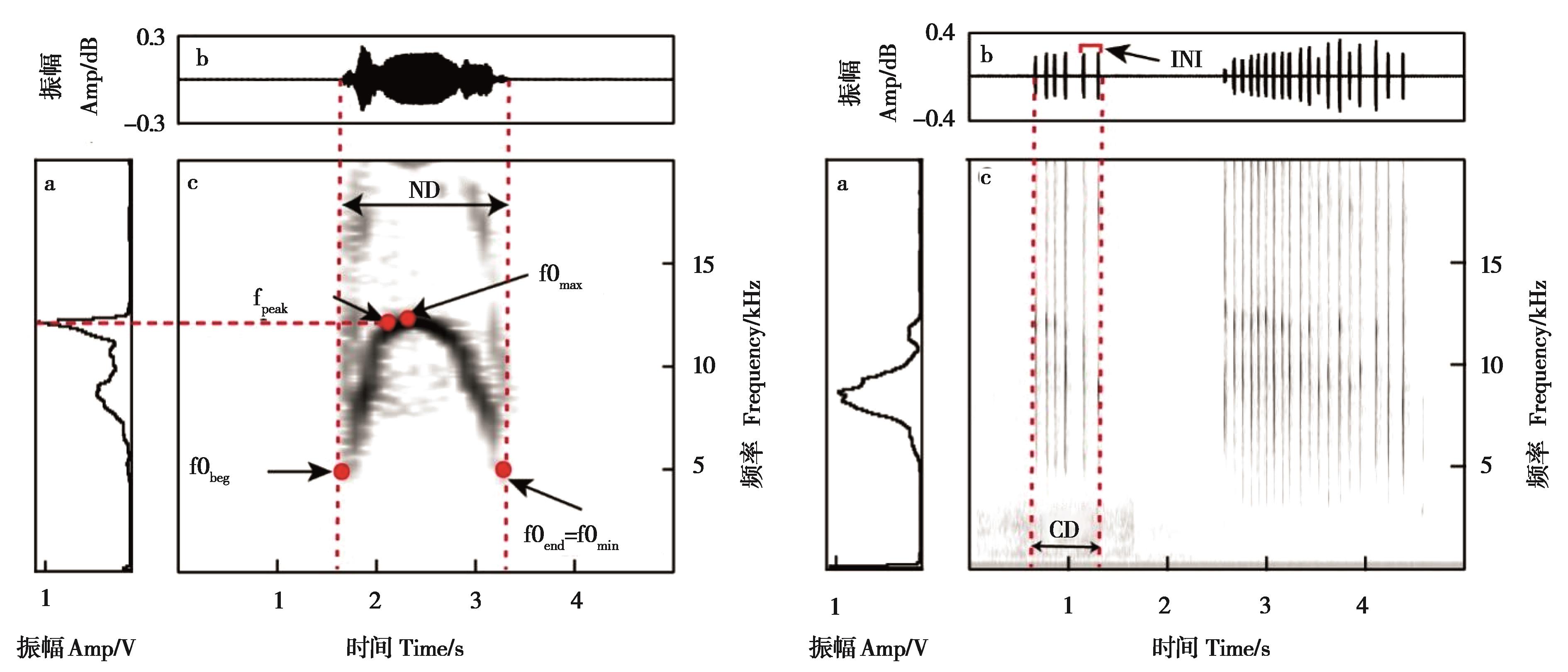
图1 布氏田鼠单音节 (左) 和多音节 (右) 警戒鸣声频谱图 (a)、波形图 (b) 和语图 (c). fpeak:峰值频率;f0max:最大基频;f0beg:开始基频;f0end:结束基频;f0min:最小基频;ND: 音节时长;INI: 音节间隔;CD: 鸣声时长
Fig.1 Power spectrum (a), Oscillogram (b) and spectrogram (c) of monosyllabic (left) and multisyllabic (right) alarm calls of Lasiopodomys brandtii. fpeak: Peak frequency; f0max: Maximum fundamental frequency; f0beg: The fundamental frequency at the onset of a call; f0end: The fundamental frequency at the end of a call; f0min: Minimum fundamental frequency; ND: Note duration; INI: Inter-note intervals; CD: Call duration
声学参数 Acoustic parameters | 鸣声类型 Call types | ||||||
|---|---|---|---|---|---|---|---|
| 单音节鸣声 Monosyllabic calls | 多音节鸣声 Multisyllabic calls | ||||||
| 5月May | 7月July | 9月September | 5月May | 7月July | 9月September | ||
| 频域参数Frequency domain parameter | |||||||
峰值频率 fpeak/Hz | 8 382.25 ± 777.44 a | 9 704.81 ± 314.83 a | 9 879.63 ± 486.61 a | 8 714.14 ± 195.06b | 10 400.38 ± 969.21a | 8 892.55 ± 62.34 b | |
最大基频 f0max/Hz | 11 143.50 ± 646.75 a | 12 454.22 ± 967.41a | 11 951.25 ± 161.05 a | 10 806.93 ± 136.47 c | 11 200.35 ± 178.22b | 11 974.53 ± 82.79a | |
开始基频 f0beg/Hz | 4 931.00 ± 530.66 a | 4 232.80 ± 707.55 a | 3 934.13 ± 443.32 a | 4 073.77 ± 79.90 a | 4 231.12 ± 89.72a | 3 558.94 ± 56.73 b | |
结束基频 f0end/Hz | 4 963.50 ± 478.40 a | 4 556.82 ± 976.24 a | 5 679.13 ± 850.86 a | 3 813.53 ± 187.02 a | 3 811.16 ± 99.86a | 3 281.93 ± 66.56 b | |
最小基频 f0min/Hz | 4 662.00 ± 529.73 a | 4 244.60 ± 665.41 a | 3 735.13 ± 384.61 a | 3 164.51 ± 87.63 b | 3 746.23 ± 96.47a | 3 096.59 ± 45.10 b | |
基频范围 Rangef0/Hz | 6 481.50 ± 916.58 a | 8 209.64 ± 701.36 a | 8 216.13 ± 376.82 a | 7 642.42 ± 182.72 b | 7 454.12 ± 249.26b | 8 877.94 ± 104.09 a | |
| 时域参数 Temporal domain parameter | |||||||
| 音节时长ND/ms | 43.75 ± 10.36 a | 35.12 ± 1.14 a | 38.25 ± 2.88 a | 31.10 ± 0.78 b | 32.46 ± 0.73 ab | 34.05 ± 0.54 a | |
| 音节间隔INI/ms | 218.46 ± 12.14 a | 192.35 ± 6.64 b | 167.56 ± 4.84 c | ||||
音节数 NN | 66.7 ± 8.8 a | 93.8 ± 12.2 a | 70.5 ± 9.00 a | ||||
| 鸣声时长CD/s | 14.66 ± 1.81 a | 20.86 ± 2.73 b | 13.73 ± 1.76 a | ||||
表1 布氏田鼠警戒鸣声类型及鸣声参数季节变化
Table1 Types of alarm calls and seasonal variations of acoustic parameters in Lasiopodomys brandtii
声学参数 Acoustic parameters | 鸣声类型 Call types | ||||||
|---|---|---|---|---|---|---|---|
| 单音节鸣声 Monosyllabic calls | 多音节鸣声 Multisyllabic calls | ||||||
| 5月May | 7月July | 9月September | 5月May | 7月July | 9月September | ||
| 频域参数Frequency domain parameter | |||||||
峰值频率 fpeak/Hz | 8 382.25 ± 777.44 a | 9 704.81 ± 314.83 a | 9 879.63 ± 486.61 a | 8 714.14 ± 195.06b | 10 400.38 ± 969.21a | 8 892.55 ± 62.34 b | |
最大基频 f0max/Hz | 11 143.50 ± 646.75 a | 12 454.22 ± 967.41a | 11 951.25 ± 161.05 a | 10 806.93 ± 136.47 c | 11 200.35 ± 178.22b | 11 974.53 ± 82.79a | |
开始基频 f0beg/Hz | 4 931.00 ± 530.66 a | 4 232.80 ± 707.55 a | 3 934.13 ± 443.32 a | 4 073.77 ± 79.90 a | 4 231.12 ± 89.72a | 3 558.94 ± 56.73 b | |
结束基频 f0end/Hz | 4 963.50 ± 478.40 a | 4 556.82 ± 976.24 a | 5 679.13 ± 850.86 a | 3 813.53 ± 187.02 a | 3 811.16 ± 99.86a | 3 281.93 ± 66.56 b | |
最小基频 f0min/Hz | 4 662.00 ± 529.73 a | 4 244.60 ± 665.41 a | 3 735.13 ± 384.61 a | 3 164.51 ± 87.63 b | 3 746.23 ± 96.47a | 3 096.59 ± 45.10 b | |
基频范围 Rangef0/Hz | 6 481.50 ± 916.58 a | 8 209.64 ± 701.36 a | 8 216.13 ± 376.82 a | 7 642.42 ± 182.72 b | 7 454.12 ± 249.26b | 8 877.94 ± 104.09 a | |
| 时域参数 Temporal domain parameter | |||||||
| 音节时长ND/ms | 43.75 ± 10.36 a | 35.12 ± 1.14 a | 38.25 ± 2.88 a | 31.10 ± 0.78 b | 32.46 ± 0.73 ab | 34.05 ± 0.54 a | |
| 音节间隔INI/ms | 218.46 ± 12.14 a | 192.35 ± 6.64 b | 167.56 ± 4.84 c | ||||
音节数 NN | 66.7 ± 8.8 a | 93.8 ± 12.2 a | 70.5 ± 9.00 a | ||||
| 鸣声时长CD/s | 14.66 ± 1.81 a | 20.86 ± 2.73 b | 13.73 ± 1.76 a | ||||
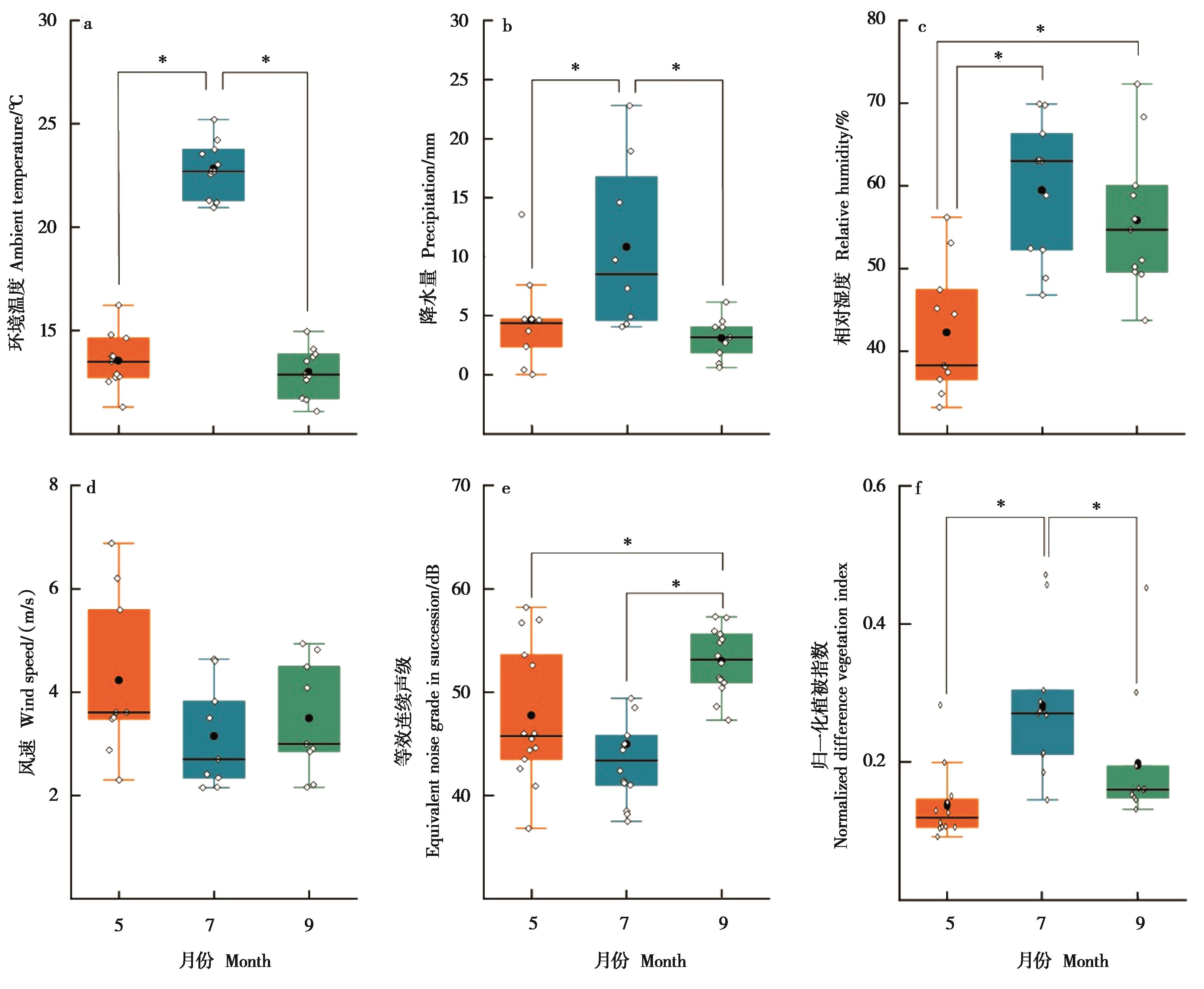
图2 研究样区生境因子. *P < 0.05
Fig.2 Monthly (seasonal) changes of habitat factors. *P < 0.05
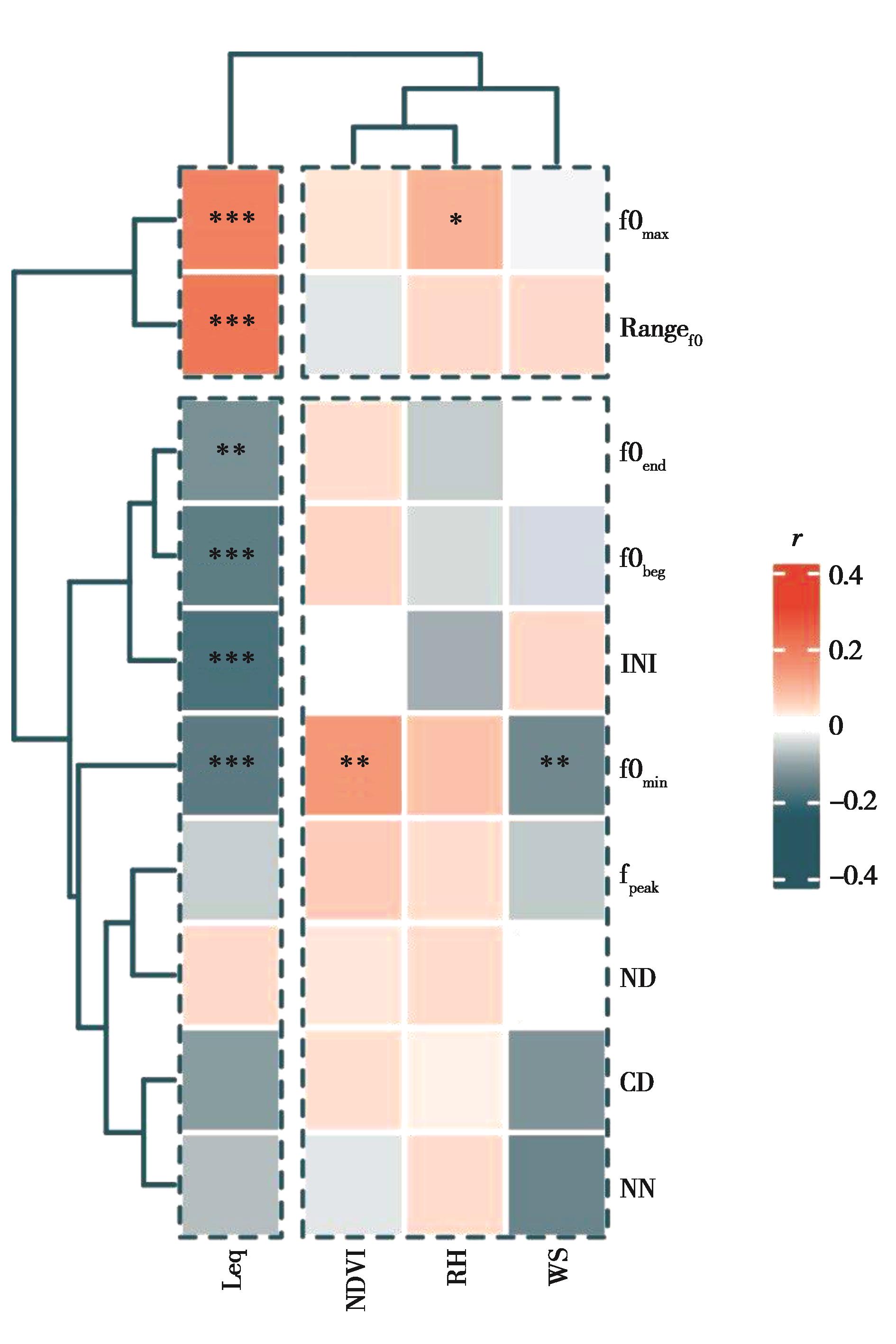
图3 布氏田鼠多音节警戒鸣声声学参数和生境参数相关性热图. fpeak:峰值频率;f0max:最大基频;f0beg:开始基频;f0end:结束基频;f0min:最小基频;Rangef0:基频范围;ND:音节时长;INI:音节间隔;NN:音节数;CD:鸣声时长;RH:相对湿度;WS:风速;Leq:等效连续声级;NDVI:归一化植被指数. *P < 0.05, **P < 0.01, *** P < 0.001
Fig.3 Heatmap correlation between acoustic parameters of multisyllabic alarm calls and habitat parameters in Lasiopodomys brandtii. fpeak: Peak frequency; f0max: Maximum fundamental frequency; f0beg: The fundamental frequency at the onset of a call; f0end: The fundamental frequency at the end of a call; f0min: Minimum fundamental frequency of a call; Rangef0: Range of fundamental frequency of a call; ND: Note duration; INI: Inter-note intervals; NN: Note number; CD: Call duration; RH: Relative humidity; WS: Wind speed; Leq: Equivalent noise grade in succession; NDVI: Normalized difference vegetation index. *P < 0.05, ** P < 0.01, ***P < 0.001
| Blumstein D T, Armitage K B. 1997. Alarm calling in yellow‑bellied marmots: I. The meaning of situationally variable alarm calls [J]. Animal Behaviour, 53: 143-171. | |
| Blumstein D T. 2007. The evolution of alarm communication in rodents: Structure, function, and the puzzle of apparently altruistic calling [A]. In: Wolff J O, Sherman P W eds. Rodent Societies–An Ecological & Evolutionary Perspective [M]. The University of Chicago Press, 317-327. | |
| Boncoraglio G, Saino N. 2007. Habitat structure and the evolution of bird song: a meta‑analysis of the evidence for the acoustic adaptation hypothesis [J]. Functional Ecology, 21 (1): 134-142. | |
| Braune P, Schmidt S, Zimmermann E. 2008. Acoustic divergence in the communication of cryptic species of nocturnal primates (Microcebus ssp.) [J]. BMC Biology, 6 (1): 1-10. | |
| Brown C H, Gomez R, Wasser P M. 1995. Old world monkey vocalizations: adaptation to the local habitat? [J]. Animal Behaviour, 50: 945-961. | |
| Brown T, Handford P. 1996. Acoustic signal amplitude patterns: a computer simulation investigation of the acoustic adaptation hypothesis [J]. Condor, 98: 608-623. | |
| Chu C J, Lutz J A, Kral K, Vrska T, Yin X, Myers J A, Abiem I, Alonso A, Bourg N, Burslem D F R P, Cao M, Chapman H, Condit R, Fang S Q, Fischer G A, Gao L M, Hao Z Q, Hau B C H, He Q, Hector A, Hubbell S P, Jiang M X, Jin G Z, Kenfack D, Lai J S, Li B H, Li X K, Li Y D, Lian J Y, Lin L X, Liu Y K, Liu Y, Luo Y H, Ma K P, McShea W, Memiaghe H, Mi X C, Ni M, O’Brien M J, de Oliveira A A, Orwig D A, Parker G G, Qiao X J, Ren H B, Reynolds G, Sang W G, Shen G C, Su Z Y, Sui X H, Sun I F, Tian S Y, Wang B, Wang X H, Wang X G, Wang Y S, Weiblen G D, Wen S J, Xi N X, Xiang W S, Xu H, Xu K, Ye W H, Zhang B W, Zhang J X, Zhang X T, Zhang Y M, Zhu K, Zimmerman J, Storch D, Baltzer J L, Anderson‑Teixeira K J, Mittelbach G G, He F L. 2018. Direct and indirect effects of climate on richness drive the latitudinal diversity gradient in forest trees [J]. Ecology Letters, 22 (2): 245-255. | |
| Deng K, Wang X P, Zhu B C, Zhao L H, Yang Y, Cai Y L, Sun X Q, Wang T L, Cui J G. 2023. A dataset on the call characteristics of 43 anuran species [J]. Biodiversity Science, 31 (1): 179-182. (in Chinese) | |
| Di Z L, Wu Y N, Song Y T, Huo G W, Zhang F J, Wang X G, Zhang X H. 2017. Variation of temperature and precipitation in the Xin Barag Right Banner of the Hulunbeier Grassland during 1958-2016 [J]. Journal of Desert Research, 37 (5): 1006-1015. | |
| Eddington V M, Nichols H K, Calistri‑Yeh A, Young V K H, Kloepper L N. 2024. Graded alarm call behavior in wild fox squirrels (Sciurus niger) [J]. Journal of the Acoustical Society of America, 155 (2): 1308-1314. | |
| Ey E, Fischer J. 2009. ‘TheAcoustic Adaptation Hypothesis’- a review of the evidence from birds, anurans and mammals [J]. Bioacoustics, 19 (1): 21-48. | |
| Fei H L. 2010. The research on singing behavior of eastern black crested gibbon (Nomascus nasutus) [D]. Master thesis. Changsha: Central South University of Forestry and Technology. (in Chinese) | |
| Fitch T W. 2006. Production of vocalizations in mammals [J]. Encyclopedia of Language & Lingus, 115-121. | |
| Fu H P, Bu S, Yuan S, Wang H L, Li X, NaShun M K, Wang Z H, Wei J, Hu S L. 2022. Advances in population ecology of Brandt’s vole (Lasiopodomys brandtii) in Typical Steppe [J]. Journal of Inner Mongolia Agricultural University (Natural Science Edition), 43 (5): 71-79. (in Chinese) | |
| García‑Navas V, Blumstein D T. 2016. The effect of body size and habitat on the evolution of alarm vocalizations in rodents [J]. Biological Journal of the Linnean Society, 118: 745-751. | |
| Gillard G L, Rowley J J L. 2023. Assessment of the acoustic adaptation hypothesis in frogsusing large‑scale citizen science data [J]. Journal of Zoology, 32 (2): 271-281. | |
| Guo T Y, Ma H J, Han P, Wang Z D, Zhu C Y, Chu Y M R, Zhang L X, Li R X, Qi J R, Li J H, Fan P F. 2024. Spectral characteristics and sex differences in the song of Skywalker hoolock gibbon (Hoolock tianxing) [J]. Acta Theriologica Sinica, 44 (1): 14-25. (in Chinese) | |
| Handford S C L. 1992. Vocal dialects and the structure of geographic variation in morphological and allozymic characters in the rufous‑collared sparrow, Zonotrichia capensis [J]. Evolution, 46 (5): 1443-1456. | |
| Hansen P. 1979. Vocal learning: its role in adapting sound structures to long‑distance propagation and a hypothesis on its evolution [J]. Animal Behaviour, 27: 1270-1271. | |
| Hollén L I, Radford A N. 2009. The development of alarm call behaviour in mammals and birds [J]. Animal Behaviour, 78 (4): 791-800. | |
| Holzmann I, Areta J I. 2020. Reduced geographic variation in roars in different habitats rejects the acoustic adaptation hypothesis in the black‑and‑gold howler monkey (Alouatta caraya) [J]. Ethology, 126 (1): 76-87. | |
| Hua X Z, Zhou R, Ye G H, Hua R, Bao D R H, Hua L M. 2020. The temporal distribution of the long call and its influencing factors in male plateau pika (Ochotona curzoniae) [J]. Acta Theriologica Sinica, 40 (6): 606-614. (in Chinese) | |
| Li M R, Deng Z K, Du J M. 2021.Study on the vegetation cover change in Xin Barag Right Banner [J]. Grassland and Prataculture, 33 (1): 29-34. (in Chinese) | |
| Loannou C C, Tosh C R, Neville L, Krause J. 2008. The confusion effect‑from neural networks to reduced predation risk [J]. Behavioral Ecology, 19 (1): 126-130. | |
| Marten K, Marler P. 1977. Sound transmission and its significance for animal vocalization [J]. Behavioral Ecology and Sociobiology, 2 (3): 271-290. | |
| McRae T R, Green S M. 2017. Gray squirrel alarm call composition differs in response to simulated aerial versus terrestrial predator attacks [J]. Ethology Ecology & Evolution, 29: 54-63. | |
| McRae T R. 2020. A review of squirrel alarm‑calling behavior: What we know and what we do not know about how predator attributes affect alarm calls [J]. Animal Behavior and Cognition, 7 (2): 168-191. | |
| Mikula P, Valcu M, Brumm H, Bulla M, Forstmeier W, Petruskova T, Kempenaers B, Albrecht T. 2021. A global analysis of song frequency in passerines provides no support for the acoustic adaptation hypothesis but suggests a role for sexual selection [J]. Wiley, 24 (3): 477-486. | |
| Morton E S. 1975. Ecological sources of selection on avian sounds [J]. American Naturalist, 109: 17-34. | |
| Pan X Q. 1992. Hulunbuir Grassland, China [M]. Changchun: Jilin Science and Technology Press. (in Chinese) | |
| Pang Y L, Luo B, Wang M, Wu X, Feng J. 2019. Sexual dimorphism in the frequency of echolocation calls facilitates sex recognition in least horseshoe bats [J]. Acta Theriologica Sinica, 39 (2): 155-161. (in Chinese) | |
| Pen N Y. 1987. Discussion on cluster sampling method [J]. The Theory and Practice of Finance and Economics, (1): 65-68. (in Chinese) | |
| Perla B S, Slobodchikoff C N. 2002. Habitat structure and alarm call dialects in Gunnison’s prairie dog (Cynomys gunnisoni) [J]. Behavioral Ecology, 13 (6): 844-850. | |
| Pollard K A, Blumstein D T. 2012. Evolving communicative complexity: insights from rodents and beyond [J]. Philosophical Transactions of the Royal Society B: Biological Sciences, 367 (1597): 1869-1878. | |
| Prestwich K N. 1994. The energetics of acoustic signaling in anurans and insects [J]. American Zoologist, 34 (6): 625-643. | |
| Remeš V, Harmáčková L. 2018. Disentangling direct and indirect effects of water availability, vegetation, and topography on avian diversity [J]. Scientific Reports, 8. DOI: 10.1038/s41598-018-33671-w . | |
| Roca I T, Desrochers L, Giacomazzo M, Bertolo A, Bolduc P, Deschesnes R, Martin C A, Rainville V, Rheault G, Proulx R. 2016. Shifting song frequencies in response to anthropogenic noise: a meta‑analysis on birds and anurans [J]. Behavioral Ecology, 27 (5): 1269-1274. | |
| Shelley E L, Blumstein D T. 2005. The evolution of vocal alarm communication in rodents [J]. Behavioral Ecology, 16 (1): 169-177. | |
| Slabbekoorn H. 2004. Singing in the wild: the ecology of birdsong [A]. In: MarlerP, edsSlabbekoorn H. Nature’s Music. The Science of Birdsong [M]. San Diego, Elsevier Academic Press, 178-205. | |
| Townsend S W, Maria R, Tim C B, Manser M B. 2012. Flexible alarm calling in meerkats: the role of the social environment and predation urgency [J]. Behavioral Ecology, 23 (6): 1360-1364. | |
| Volodin I A, Matrosova V A, Frey R, Kozhevnikova J D, Isaeva I L, Volodina E V. 2018. Altai pika (Ochotona alpina) alarm calls: individual acoustic variation and the phenomenon of call‑synchronous ear folding behavior [J]. The Science of Nature, 105: 1-13. | |
| Volodin I A, Kirilyuk V E, Vasilieva N A, Volodina E V. 2025. Individual identity of alarm calls in wild‑living Brandt’s voles (Lasiopodomys brandtii) [J]. The Science of Nature, 112 (1): 1-15. | |
| Volodin I A, Klenova A V, Kirilyuk V E, Ilchenko O G, Volodina E V. 2024a. Ultrasonic alarm call of Mongolian gerbils (Meriones ungiuculatus) in the wild and in captivity: a potential tool for detecting inhabited colonies during population depression [J]. Mammalian Biology, 104 (4): 407-416. | |
| Volodin I A, Rutovskaya M V, Golenishchev F N, Volodina E V. 2024b. Startle together, shout in chorus: collective bursts of alarm calls in a social rodent, the Harting’s vole (Microtus hartingi) [J]. Behaviour, 161 (8-9): 587-611. | |
| Wan X R, Liu W, Wang G H, Wang M J, Zhong W Q. 2006. Seasonal changes of the activity patternes of Brandt’s voles(Lasiopodomys brandtii) in the typical steppe in Inner Monglia [J]. Acta Agrestia Sinica, 26 (3): 226-234. (in Chinese) | |
| Wan X R, Zhong W Q. 1998. Ecology and management of Brandt’s voles [A]. In: ZhangZ B, WangZ W eds. Ecology and Management of Rodent Pests in Agriculture [M]. Beijing: Ocean Press. (in Chinese) | |
| Wang T T, Baima C R, Hai S Z, Wang D. 2015. Construction for the ethogram of Brandt’s voles (Lasiopodomys brandtii) [J]. Acta Agrestia Sinica, 23 (3): 646-652. (in Chinese) | |
| Wu X D. 1990. A study on the population ecology of Brandt’s voles [J]. Acta Theriologica Sinica, 10 (1): 54-59. (in Chinese) | |
| Xu R G. 2016. Fauna Inner Mongolia, Volume 5 Mammal (Rodentia, Lagomorpha) [M]. Hohhot: Inner Mongolia University Press, 171-181. (in Chinese) | |
| Zhang F, Chen P, Chen Z Q, Zhao J. 2015. Ultrasonic frogs call at a higher pitch in noisier ambiance [J]. Current Zoology, 61 (6): 996-1003. | |
| Zhao L H, Sun X Q, Chen Q H, Yang Y, Wang J C, Ran J H, Brauth S E, Tang Y Z, Cui J G. 2018. Males increase call frequency, not intensity, in response to noise, revealing no Lombard effect in the little torrent frog [J]. Ecology and Evolution, 8 (23): 11733-11741. | |
| Zhao Y C, Su Y J. 2005. Alarm calls of nonhuman primates [J]. Acta Theriologica Sinica, 25 (1): 81-85. (in Chinese) | |
| 王涛涛, 白玛次仁, 海淑珍, 王登. 2015. 布氏田鼠行为谱的构建 [J]. 草地学报, 23 (3): 646-652. | |
| 邓可, 汪小萍, 朱弼成, 赵龙辉, 杨悦, 蔡炎林, 孙晓倩, 王同亮, 崔建国. 2023. 中国43种蛙类鸣声特征数据集 [J]. 生物多样性, 31 (1): 179-182. | |
| 邸择雷, 乌云娜, 宋彦涛, 霍光伟, 张凤杰, 王晓光, 张小红. 2017. 1958—2016 年呼伦贝尔草原新巴尔虎右旗气温和降水变化特征 [J]. 中国沙漠, 37 (5): 1006-1015. | |
| 付和平, 卜凡, 袁帅, 王海龙, 李鑫, 那顺孟克, 王占海, 伟军, 胡斯勒. 2022. 典型草原布氏田鼠种群生态学研究进展 [J]. 内蒙古农业大学学报 (自然科学版), 43 (5): 71-79. | |
| 华铣泽, 周睿, 叶国辉, 花蕊, 包达尔罕, 花立民. 2020. 雄性高原鼠兔长鸣时间分配及其影响因素 [J].兽类学报, 40 (6): 606-614. | |
| 旭日干. 2016. 内蒙古动物志第5卷哺乳纲 (啮齿目、兔形目) [M]. 呼和浩特: 内蒙古大学出版社, 171-181. | |
| 李梦茹, 邓泽坤, 杜佳梦. 2021. 新巴尔虎右旗植被覆盖变化研究 [J]. 草原与草业, 33 (1): 29-34. | |
| 武晓东. 1990. 布氏田鼠种群生态研究 [J]. 兽类学报, 10 (1): 54-59. | |
| 庞育兰, 罗波, 王漫, 吴秀, 冯江. 2019. 菲菊头蝠回声定位声波频率的性二态有利于性别识别 [J]. 兽类学报, 39 (2): 155-161. | |
| 宛新荣, 刘伟, 王广和, 王梦军, 钟文勤. 2006. 典型草原区布氏田鼠的活动节律及其季节变化 [J]. 兽类学报, 26 (3): 226-234. | |
| 宛新荣, 钟文勤. 1998. 布氏田鼠的生态学及控制对策 [A]. 见: 张知彬, 王祖望. 农业重要害鼠的生态学及控制对策 [M]. 北京: 海洋出版社. | |
| 赵迎春, 苏彦捷. 2005. 非人灵长类动物的警报叫声 [J]. 兽类学报, 25 (1): 81-85. | |
| 费汉榄. 2010. 东黑冠长臂猿Nomascus nasutus鸣叫行为研究 [D]. 长沙: 中南林业科技大学硕士学位论文. | |
| 郭亭妍, 马海港, 韩普, 王子荻, 祝常悦, 楚原梦冉, 张利祥, 李如雪, 戚嘉儒, 李家华, 范朋飞. 2024. 天行长臂猿鸣唱的声谱特征与性别差异 [J]. 兽类学报, 44 (1): 14-25. | |
| 彭念一. 1987. 整群抽样法浅谈 [J]. 财经理论与实践, (1): 65-68. | |
| 潘学清. 1992. 中国呼伦贝尔草地 [M] . 长春: 吉林科学技术出版社. |
| [1] | 周桃秀, 陈琳, 吴涌珍, 杨生妹, 魏万红, 武瑞勇. 捕食风险应激对雄性布氏田鼠及子代繁殖性能的影响[J]. 兽类学报, 2024, 44(5): 587-597. |
| [2] | 李红娟, 王德华, 王振山, 张学英. 哺乳期高温经历导致布氏田鼠F1代的热中性区变窄[J]. 兽类学报, 2023, 43(4): 412-421. |
| [3] | 吕金珍, 唐丽秋, 张学英, 王德华. 温度驯化对布氏田鼠肝脏温敏瞬时受体电位通道蛋白表达的影响[J]. 兽类学报, 2023, 43(1): 1-10. |
| [4] | 范瑞洋, 王慧渊, 王道晨, 戴鑫, 杨生妹. 单宁酸对布氏田鼠抗氧化水平和肝脏自噬相关基因表达的影响[J]. 兽类学报, 2022, 42(1): 76-84. |
| [5] | 宋怡然, 李国梁, 张知彬. 布氏田鼠合作贮食行为及其影响因素[J]. 兽类学报, 2021, 41(6): 658-666. |
| [6] | 彭延, 吴涌珍, 顾晨, 杨生妹, 殷宝法, 魏万红. 猫气味重复暴露对青春期布氏田鼠反捕食和焦虑样行为的影响[J]. 兽类学报, 2021, 41(4): 451-458. |
| [7] | 王乐文, 应亚奇, 刘晓辉, 宋英, 李宁, 王大伟. 雷公藤甲素对雄性布氏田鼠繁殖力的抑制效果[J]. 兽类学报, 2021, 41(3): 344-351. |
| [8] | 石超, 杨冬梅, 陶双伦, 何纤, 李双, 李俊年. 食物多样性对布氏田鼠幼体存活率和生长率的影响[J]. 兽类学报, 2021, 41(2): 214-223. |
| [9] | 岳闯 郭乾伟 张卓然 李鑫 满都呼 袁帅 付和平 武晓东 金国 刘建文 李永善. 内蒙古典型草原布氏田鼠营养生态位及其种间关系[J]. 兽类学报, 2020, 40(5): 424-434. |
| [10] | 赵园春 张学英 王德华. 布氏田鼠哺乳期低温经历抑制成年期神经再生[J]. 兽类学报, 2019, 39(5): 485-495. |
| [11] | 薄亭贝 张学英 王德华. 低温驯化对布氏田鼠小肠黏膜结构和黏膜免疫相关细胞的影响[J]. 兽类学报, 2018, 38(2): 158-165. |
| [12] | 郝伟丽 王大伟 任飞 胡祥发 田林 李宁 刘晓辉. 粪便激素水平反映不同出生时期雄性布氏田鼠的繁殖策略[J]. 兽类学报, 2016, 36(4): 413-421. |
| [13] | 侯祥磊 李国梁 宛新荣 张知彬. 放牧对布氏田鼠主要食物选择的影响[J]. 兽类学报, 2016, 36(2): 152-157. |
| [14] | 王同亮, 张学英, 付荣恕, 王德华. 布氏田鼠双亲低体重导致雄性后代生长和繁殖间的权衡[J]. 兽类学报, 2015, 35(4): 389-397. |
| [15] | 徐萌萌 王德华. 长爪沙鼠和布氏田鼠汗腺的分布和密度[J]. 兽类学报, 2015, 35(1): 80-86. |
| 阅读次数 | ||||||
|
全文 |
|
|||||
|
摘要 |
|
|||||
 青公网安备 63010402000199号 青ICP备05000010号-2