

中国核心期刊要目总览
中国科技核心期刊
CSCD数据库源刊
中国科技核心期刊
CSCD数据库源刊
兽类学报 ›› 2026, Vol. 46 ›› Issue (3): 307-319.DOI: 10.16829/j.slxb.151126
• 研究论文 • 下一篇
唐明坤1( ), 王旭明1, 刘莹洵2, 廖锐1, 彭步青1, 王新1, 刘少英1()
收稿日期:2025-07-16
接受日期:2025-12-30
出版日期:2026-05-30
发布日期:2026-06-04
通讯作者:
刘少英
作者简介:唐明坤(1981- ),男,博士,高级工程师,副研究员,主要从事小型兽类分类及生物多样性保护研究.E‑mail: tmklz@163.com
基金资助:
Mingkun TANG1(), Xuming WANG1, Yingxun LIU2, Rui LIAO1, Buqing PENG1, Xin WANG1, Shaoying LIU1()
Received:2025-07-16
Accepted:2025-12-30
Online:2026-05-30
Published:2026-06-04
Contact:
Shaoying LIU
摘要:
鼹形鼠科(Spalacidae)物种专营地下生活,具有适应地下洞穴环境的系列表型特征,是适应进化研究的重要类群。竹鼠属(Rhizomys)位于该科系统演化的基部分支,近年来分子测序及适应进化研究逐步深入,但受新增标本量限制,属内物种及亚种形态度量比较和系统发育关系研究仍较薄弱、鉴别特征还需厘定。基于国内新采集竹鼠标本和查看的馆藏标本数据,利用形态学和分子系统学方法开展分类研究,结果表明:银星竹鼠(R. pruinosus)、中华竹鼠(R. sinensis)和大竹鼠(R. sumatrensis)可依据体背尖端白色的长柱状毛、脸颊颜色及尾长比例鉴定区分,尾长与头体长之比的均值分别为42.3%、27.9%和34.5%;中华竹鼠四川亚种(R. s. vestitus)个体显著大于福建亚种(R. s. davidi),前者颅全长大于70 mm,体背毛尖粉棕色段较长,脸颊灰白色,后者颅全长小于70 mm,体背灰棕色、毛尖棕色段较短;银星竹鼠云南亚种(R. p. senex)可依据牙齿较粗壮、体背柱状长毛明显稀疏且尖端白色区段较短的特征与华南亚种(R. p. latouchei)相区分;基于Cyt b基因构建的系统发育树显示银星竹鼠与大竹鼠亲缘关系较近,中华竹鼠为竹鼠属内较早分化的类群,种间遗传距离为9.3% ~ 15.9%,中华竹鼠四川亚种与福建亚种、银星竹鼠云南亚种与华南亚种间的遗传距离分别为2.3%和0.4%,揭示不同亚种间的分化程度存在差异。本研究为完善竹鼠属系统分类积累了基础数据,关于暗褐竹鼠(R. wardi)的分类地位有待更全面的采样研究来确定。
中图分类号:
唐明坤, 王旭明, 刘莹洵, 廖锐, 彭步青, 王新, 刘少英. 中国竹鼠属(啮齿目:鼹形鼠科)分类与系统发育研究[J]. 兽类学报, 2026, 46(3): 307-319.
Mingkun TANG, Xuming WANG, Yingxun LIU, Rui LIAO, Buqing PENG, Xin WANG, Shaoying LIU. A taxonomic and phylogenetic study of the genus Rhizomys (Rodentia: Spalacidae) in China[J]. ACTA THERIOLOGICA SINICA, 2026, 46(3): 307-319.
| 文献 Literature | 物种 Species | 亚种 Subspecies |
|---|---|---|
| Gray(1831) | R.sinensis, R.sumatrensis | — |
| Allen(1940) | R.sinensis, R.pruinosus | R.si.sinensis, R.si.latouchei, R.si.vestitus, R.si.wardi; R.pr.senex, R.pr.latouchei |
| Ellerman(1940) | R.davidi, R.vestitus, R.sinensis, R.senex, R.pruinosus, R.pannosus, R.sumatrensis | R.v.vestitus, R.v.wardi; R.pr.pruinosus, R.pr.latouchei; R.pa.pannosus, R.pa.umbriceps; R.su.sumatrensis, R.su.padangensis, R.su.insularis, R.su.cinereus |
| Ellerman和Morrison-Scott(1951) | R.sinensis, R.pruinosus, R.sumatrensis | R.si.sinensis, R.si.vestitus, R.si.davidi, R.si.wardi; R.pr.pruinosus, R.pr.latouchei, R.pr.pannosus; R.su.sumatrensis, R.su.cinereus |
| Musser和Carleton(1993) | R.sinensis, R.pruinosus, R.sumatrensis | — |
| 罗蓉 (1993) | R.sinensis, R.pruinosus, R.wardi, R.sumatrensis | R.si.sinensis,R.si.vestitus,R.si.davidi; R.pr.senex,R.pr.latouchei; R.su.cinereus |
| 王应祥 (2003) | R.sinensis, R.wardi, R.pruinosus, R.sumatrensis | R.si.sinensis, R.si.vestitus, R.si.davidi, R.si.pediculus; R.w.wardi, R.w.neowardi; R.pr.pruinosus, R.pr.senex, R.pr.latouchei; R.su.cinereus |
| Musser和Carleton(2005) | R.sinensis, R.pruinosus, R.sumatrensis | — |
| 潘清华 等(2007) | R.vestitus, R.pruinosus, R.sumatrensis | — |
| Smith和解焱(2009) | R.sinensis, R.pruinosus, R.sumatrensis | R.si.sinensis,R.si.pediculus,R.si.vestitus, R.si.davidi,R.si.wardi; R.pr.latouchei, R.pr.pruinosus,R.pr.senex;R.su.cinereus |
| Holden 等(2017) | R.sinensis, R.pruinosus, R.sumatrensis | R.si.sinensis, R.si.davidi, R.si.pediculus, R.si.reductus, R.si.vestitus, R.si.wardi; R.pr.pruinosus, R.pr.latouchei, R.pr.pannosus, R.pr.senex, R.pr.umbriceps; R.su.sumatrensis, R.su.cinereus, R.su.insularis, R.su.padangensis |
| 魏辅文 等(2022) | R.sinensis, R.pruinosus, R.sumatrensis | R.si.sinensis, R.si.vestitus, R.si.davidi, R.si.wardi; R.pr.latouchei, R.pr.senex |
| 刘少英 等(2023) | R.sinensis, R.pruinosus, R.sumatrensis | R.si.vestitus; R.pr. senex |
表1 关于竹鼠属物种及亚种划分的主要观点
Table 1 Taxonomic history of species and subspecies in the genus Rhizomys
| 文献 Literature | 物种 Species | 亚种 Subspecies |
|---|---|---|
| Gray(1831) | R.sinensis, R.sumatrensis | — |
| Allen(1940) | R.sinensis, R.pruinosus | R.si.sinensis, R.si.latouchei, R.si.vestitus, R.si.wardi; R.pr.senex, R.pr.latouchei |
| Ellerman(1940) | R.davidi, R.vestitus, R.sinensis, R.senex, R.pruinosus, R.pannosus, R.sumatrensis | R.v.vestitus, R.v.wardi; R.pr.pruinosus, R.pr.latouchei; R.pa.pannosus, R.pa.umbriceps; R.su.sumatrensis, R.su.padangensis, R.su.insularis, R.su.cinereus |
| Ellerman和Morrison-Scott(1951) | R.sinensis, R.pruinosus, R.sumatrensis | R.si.sinensis, R.si.vestitus, R.si.davidi, R.si.wardi; R.pr.pruinosus, R.pr.latouchei, R.pr.pannosus; R.su.sumatrensis, R.su.cinereus |
| Musser和Carleton(1993) | R.sinensis, R.pruinosus, R.sumatrensis | — |
| 罗蓉 (1993) | R.sinensis, R.pruinosus, R.wardi, R.sumatrensis | R.si.sinensis,R.si.vestitus,R.si.davidi; R.pr.senex,R.pr.latouchei; R.su.cinereus |
| 王应祥 (2003) | R.sinensis, R.wardi, R.pruinosus, R.sumatrensis | R.si.sinensis, R.si.vestitus, R.si.davidi, R.si.pediculus; R.w.wardi, R.w.neowardi; R.pr.pruinosus, R.pr.senex, R.pr.latouchei; R.su.cinereus |
| Musser和Carleton(2005) | R.sinensis, R.pruinosus, R.sumatrensis | — |
| 潘清华 等(2007) | R.vestitus, R.pruinosus, R.sumatrensis | — |
| Smith和解焱(2009) | R.sinensis, R.pruinosus, R.sumatrensis | R.si.sinensis,R.si.pediculus,R.si.vestitus, R.si.davidi,R.si.wardi; R.pr.latouchei, R.pr.pruinosus,R.pr.senex;R.su.cinereus |
| Holden 等(2017) | R.sinensis, R.pruinosus, R.sumatrensis | R.si.sinensis, R.si.davidi, R.si.pediculus, R.si.reductus, R.si.vestitus, R.si.wardi; R.pr.pruinosus, R.pr.latouchei, R.pr.pannosus, R.pr.senex, R.pr.umbriceps; R.su.sumatrensis, R.su.cinereus, R.su.insularis, R.su.padangensis |
| 魏辅文 等(2022) | R.sinensis, R.pruinosus, R.sumatrensis | R.si.sinensis, R.si.vestitus, R.si.davidi, R.si.wardi; R.pr.latouchei, R.pr.senex |
| 刘少英 等(2023) | R.sinensis, R.pruinosus, R.sumatrensis | R.si.vestitus; R.pr. senex |
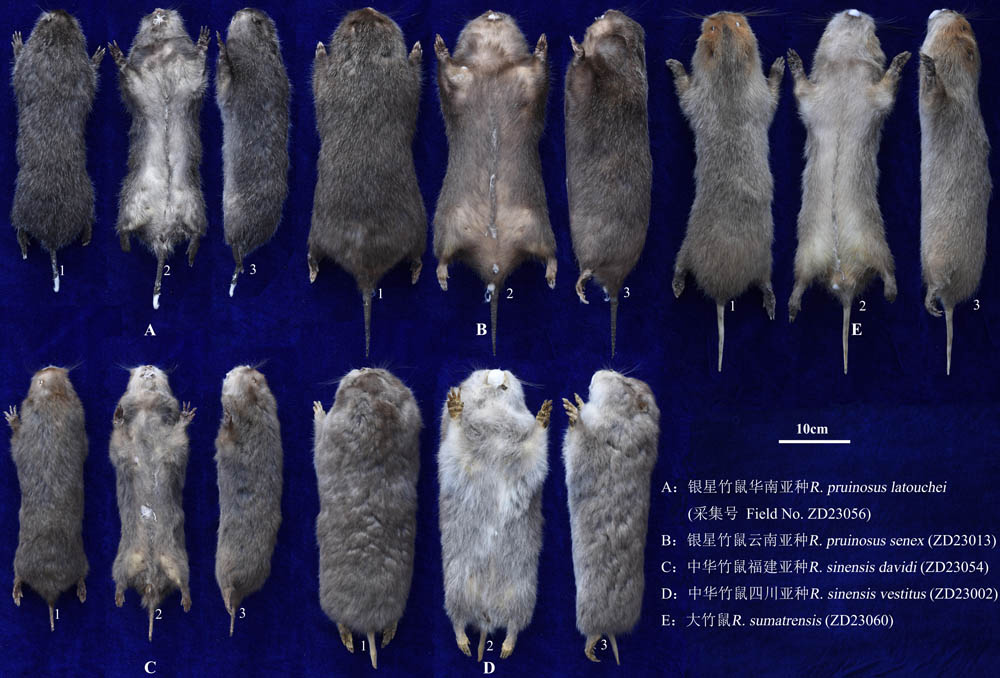
图1 竹鼠属物种及亚种身体比较
Fig. 1 Comparison of fur characteristics among species and subspecies of genus Rhizomys

图2 竹鼠属物种及亚种头骨比较
Fig. 2 Comparison of skull characteristics among species and subspecies of genus Rhizomys
指标 Indices | 银星竹鼠、中华竹鼠与大竹鼠比较 Comparison among Rhizomys pruinosus, Rhizomys sinensis and Rhizomys sumatrensis | 银星竹鼠华南亚种与云南亚种比较 Comparison between Rhizomys pruinosus latouchei and Rhizomys pruinosus senex | 中华竹鼠福建亚种与四川亚种比较 Comparison between Rhizomys sinensis davidi and Rhizomys sinensis vestitus | ||||
|---|---|---|---|---|---|---|---|
| df | F | P | t | P | t | P | |
| 头体长 Head-body length,HBL | 2 | 0.999 | 0.377 | -2.229 | 0.036* | -3.047 | 0.008** |
| 尾长 Tail length,TL | 2 | 64.620 | < 0.001** | 1.248 | 0.225 | -1.787 | 0.093 |
| 后足长 Hind foot length,HFL | 2 | 2.248 | 0.118 | -0.307 | 0.761 | -3.805 | 0.002** |
| 耳长 Ear length,EL | 2 | 10.493 | < 0.001** | -0.465 | 0.646 | -8.232 | < 0.001** |
| 颅全长 Greatest length of skull,GLS | 2 | 1.465 | 0.241 | -1.499 | 0.146 | -9.299 | < 0.001** |
| 颅基长 Condylobasal length,CL | 2 | 1.638 | 0.205 | -1.463 | 0.155 | -8.507 | < 0.001** |
| 眶间宽 Interorbital width,IOB | 2 | 41.536 | < 0.001** | -1.064 | 0.297 | 0.903 | 0.377 |
| 颅高 Skull height,SH | 2 | 3.684 | 0.032* | -1.275 | 0.214 | -4.408 | 0.001** |
| 颧宽 Zygomatic breadth,ZB | 2 | 2.429 | 0.099 | -1.970 | 0.060 | -5.990 | < 0.001** |
| 鼻骨长 Length of nasal bone,LNB | 2 | 11.246 | < 0.001** | -2.092 | 0.046* | -5.020 | < 0.001** |
| 鼻骨宽 Width of nasal bone,WNB | 2 | 3.367 | 0.042* | 1.927 | 0.065 | -5.381 | < 0.001** |
| 上齿列长 Length of upper tooth row,LUTR | 2 | 1.436 | 0.247 | -2.870 | 0.008** | -8.105 | < 0.001** |
| 上齿隙长 Length of upper diastema,LUD | 2 | 3.857 | 0.028* | -3.264 | 0.003** | -9.636 | < 0.001 ** |
| 第一上臼齿外宽 Breadth across the outer edges of the first upper molars,M1-M1 | 2 | 7.510 | 0.001** | -1.595 | 0.122 | -3.645 | 0.002** |
| 冠状突高 Coronoid process height,CPH | 2 | 1.539 | 0.225 | -0.859 | 0.398 | -7.461 | < 0.001** |
第一下臼齿至颌关节突距离 Greatest length of M1 to condyle,LMC | 2 | 1.928 | 0.156 | -0.653 | 0.519 | -8.170 | < 0.001** |
下齿列长 Length of the mandibular toothrow,LMBT | 2 | 3.570 | 0.036* | -2.883 | 0.008** | -10.757 | < 0.001** |
| 下颌长Length of mandible,LM | 2 | 2.744 | 0.074 | -1.862 | 0.074 | -8.795 | < 0.001** |
| 下颌高 Height of mandibular,HM | 2 | 2.894 | 0.065 | -1.712 | 0.098 | -7.209 | < 0.001** |
表3 竹鼠属物种及亚种间形态测量指标差异显著性分析
Table 3 Results of ANOVA and t-tests for morphological comparisons among species and subspecies of genus Rhizomys
指标 Indices | 银星竹鼠、中华竹鼠与大竹鼠比较 Comparison among Rhizomys pruinosus, Rhizomys sinensis and Rhizomys sumatrensis | 银星竹鼠华南亚种与云南亚种比较 Comparison between Rhizomys pruinosus latouchei and Rhizomys pruinosus senex | 中华竹鼠福建亚种与四川亚种比较 Comparison between Rhizomys sinensis davidi and Rhizomys sinensis vestitus | ||||
|---|---|---|---|---|---|---|---|
| df | F | P | t | P | t | P | |
| 头体长 Head-body length,HBL | 2 | 0.999 | 0.377 | -2.229 | 0.036* | -3.047 | 0.008** |
| 尾长 Tail length,TL | 2 | 64.620 | < 0.001** | 1.248 | 0.225 | -1.787 | 0.093 |
| 后足长 Hind foot length,HFL | 2 | 2.248 | 0.118 | -0.307 | 0.761 | -3.805 | 0.002** |
| 耳长 Ear length,EL | 2 | 10.493 | < 0.001** | -0.465 | 0.646 | -8.232 | < 0.001** |
| 颅全长 Greatest length of skull,GLS | 2 | 1.465 | 0.241 | -1.499 | 0.146 | -9.299 | < 0.001** |
| 颅基长 Condylobasal length,CL | 2 | 1.638 | 0.205 | -1.463 | 0.155 | -8.507 | < 0.001** |
| 眶间宽 Interorbital width,IOB | 2 | 41.536 | < 0.001** | -1.064 | 0.297 | 0.903 | 0.377 |
| 颅高 Skull height,SH | 2 | 3.684 | 0.032* | -1.275 | 0.214 | -4.408 | 0.001** |
| 颧宽 Zygomatic breadth,ZB | 2 | 2.429 | 0.099 | -1.970 | 0.060 | -5.990 | < 0.001** |
| 鼻骨长 Length of nasal bone,LNB | 2 | 11.246 | < 0.001** | -2.092 | 0.046* | -5.020 | < 0.001** |
| 鼻骨宽 Width of nasal bone,WNB | 2 | 3.367 | 0.042* | 1.927 | 0.065 | -5.381 | < 0.001** |
| 上齿列长 Length of upper tooth row,LUTR | 2 | 1.436 | 0.247 | -2.870 | 0.008** | -8.105 | < 0.001** |
| 上齿隙长 Length of upper diastema,LUD | 2 | 3.857 | 0.028* | -3.264 | 0.003** | -9.636 | < 0.001 ** |
| 第一上臼齿外宽 Breadth across the outer edges of the first upper molars,M1-M1 | 2 | 7.510 | 0.001** | -1.595 | 0.122 | -3.645 | 0.002** |
| 冠状突高 Coronoid process height,CPH | 2 | 1.539 | 0.225 | -0.859 | 0.398 | -7.461 | < 0.001** |
第一下臼齿至颌关节突距离 Greatest length of M1 to condyle,LMC | 2 | 1.928 | 0.156 | -0.653 | 0.519 | -8.170 | < 0.001** |
下齿列长 Length of the mandibular toothrow,LMBT | 2 | 3.570 | 0.036* | -2.883 | 0.008** | -10.757 | < 0.001** |
| 下颌长Length of mandible,LM | 2 | 2.744 | 0.074 | -1.862 | 0.074 | -8.795 | < 0.001** |
| 下颌高 Height of mandibular,HM | 2 | 2.894 | 0.065 | -1.712 | 0.098 | -7.209 | < 0.001** |
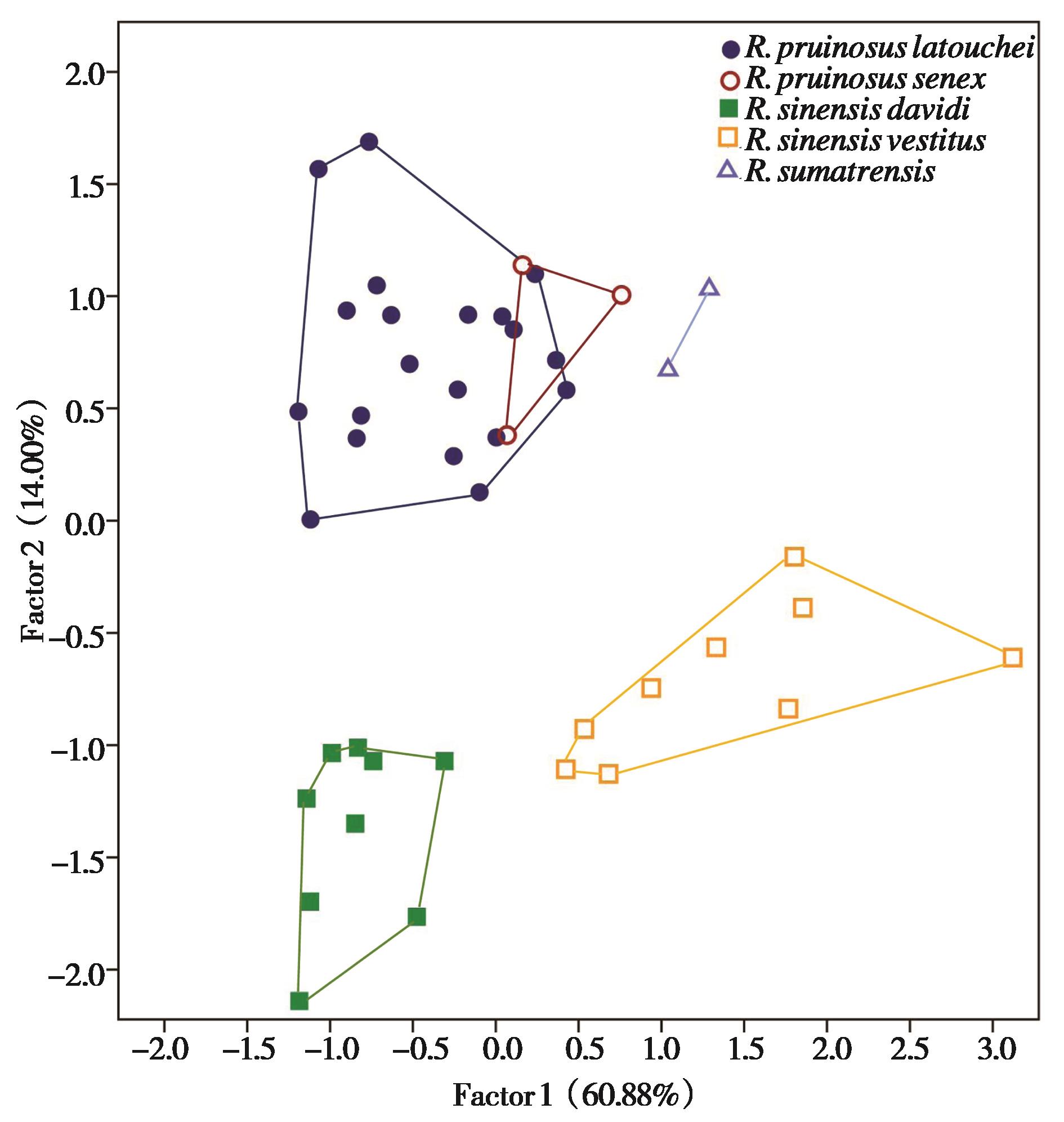
图3 竹鼠属样本因子1—因子2散点图
Fig. 3 Factor1-factor2 scatter plot for specimens of genus Rhizomys
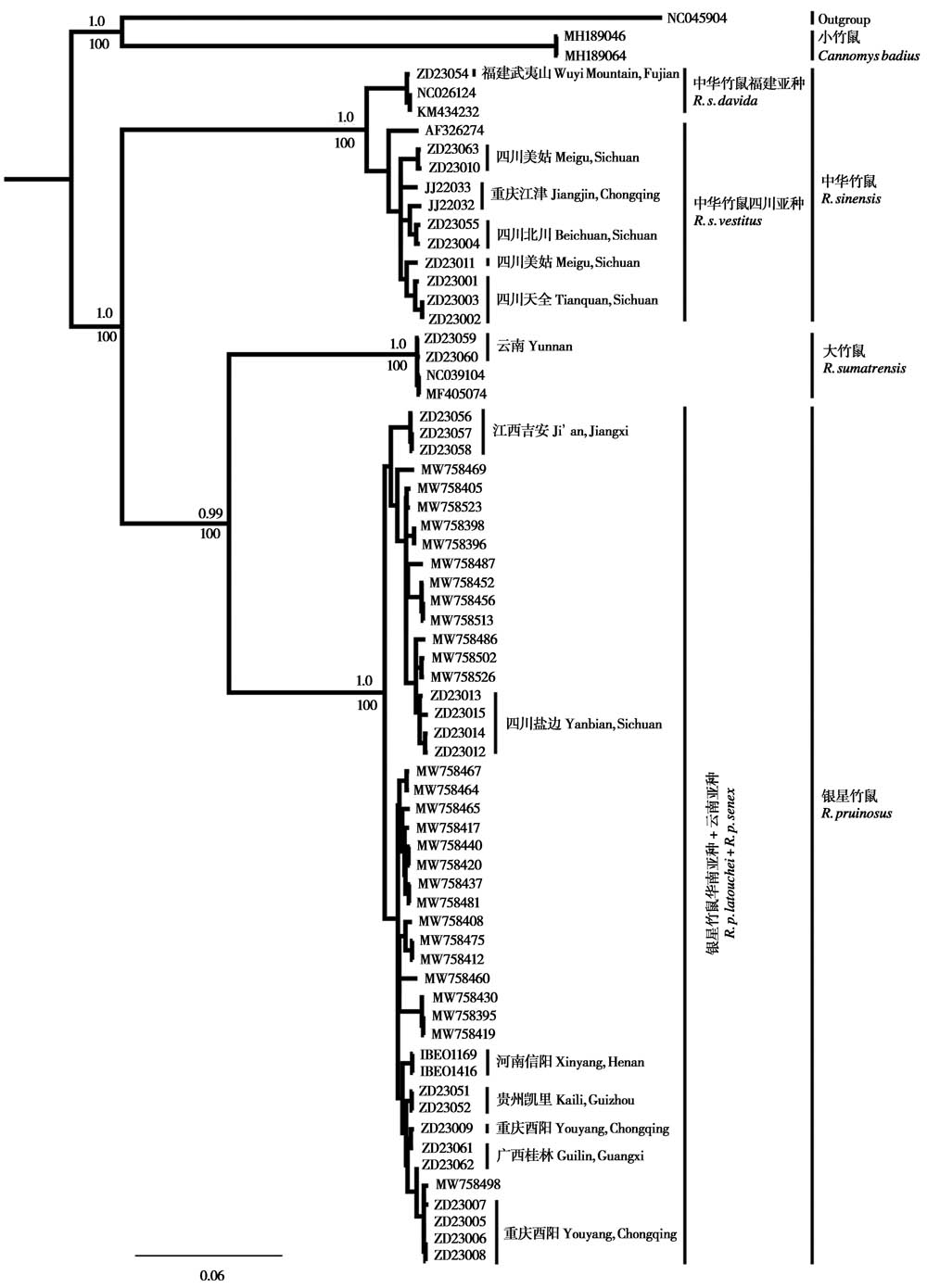
图4 基于Cyt b基因的竹鼠属系统发育树. 节点上下数字表示贝叶斯后验概率和最大似然自举检验值
Fig. 4 Phylogenetic tree of genus Rhizomys based on Cyt b gene. Node numbers represent the Bayesian posterior probabilities (numbers above) and maximum likelihood bootstrap values (numbers below)
| 类群 Taxa | 银星竹鼠华南亚种 Rhizomys pruinosus latouchei | 银星竹鼠云南亚种 Rhizomys pruinosus senex | 中华竹鼠福建亚种 Rhizomys sinensis davidi | 中华竹鼠四川亚种 Rhizomys sinensis vestitus | 大竹鼠 Rhizomys sumatrensis | 小竹鼠 Cannomys badius |
|---|---|---|---|---|---|---|
银星竹鼠云南亚种 Rhizomys pruinosus senex | 0.004 | |||||
中华竹鼠福建亚种 Rhizomys sinensis davidi | 0.153 | 0.154 | ||||
中华竹鼠四川亚种 Rhizomys sinensis vestitus | 0.150 | 0.151 | 0.023 | |||
大竹鼠 Rhizomys sumatrensis | 0.093 | 0.095 | 0.157 | 0.166 | ||
小竹鼠 Cannomys badius | 0.165 | 0.160 | 0.204 | 0.202 | 0.206 | |
中华鼢鼠 Eospalax fontanierii | 0.264 | 0.264 | 0.244 | 0.245 | 0.242 | 0.313 |
表4 本研究各类群间基于Cyt b基因的K2P遗传距离
Table 4 The K2P genetic distances among taxa of this studybased on Cyt b gene sequences
| 类群 Taxa | 银星竹鼠华南亚种 Rhizomys pruinosus latouchei | 银星竹鼠云南亚种 Rhizomys pruinosus senex | 中华竹鼠福建亚种 Rhizomys sinensis davidi | 中华竹鼠四川亚种 Rhizomys sinensis vestitus | 大竹鼠 Rhizomys sumatrensis | 小竹鼠 Cannomys badius |
|---|---|---|---|---|---|---|
银星竹鼠云南亚种 Rhizomys pruinosus senex | 0.004 | |||||
中华竹鼠福建亚种 Rhizomys sinensis davidi | 0.153 | 0.154 | ||||
中华竹鼠四川亚种 Rhizomys sinensis vestitus | 0.150 | 0.151 | 0.023 | |||
大竹鼠 Rhizomys sumatrensis | 0.093 | 0.095 | 0.157 | 0.166 | ||
小竹鼠 Cannomys badius | 0.165 | 0.160 | 0.204 | 0.202 | 0.206 | |
中华鼢鼠 Eospalax fontanierii | 0.264 | 0.264 | 0.244 | 0.245 | 0.242 | 0.313 |
| Allen G M,1940.The mammals of China and Mongolia[M]// Granger W ed. Natural history of central Asia,vol XI Part 2. New York:Central Asiatic Expeditions of the American Museum of Natural History,622‑1289. | |
| Anderson J,1879.Anatomical and zoological researches in western Yunnan[M].London:Quaritch,1‑984. | |
| Blyth E,1851. Notice of a collection of Mammalia,Birds,and Reptiles,procured at or near the station of Chérra Punji in the Khásia hills,north of Sylhet[J].Journal of the Asiatic Society of Bengal,20:519. | |
| Bradley R D, Baker R J,2001.A test of the genetic species concept:cytochrome‑b sequences and mammals[J].Journal of Mammalogy,82(4):960‑973.DOI:10.1644/1545-1542(2001)082<0960:ATOTGS>2.0.CO;2 . | |
| Brongersma L D,1936.On the subspecies of Rhizomys sumatrensis(Raffles)with some notes on related species[J].Zoologische Mededelingen,19(12):137‑164. | |
| Dao V T, Cao V S,1990. Six new Vietnamese rodents[J].Mammalia,54(2):233‑238. DOI:org/10.1515/mamm-1990-0207 . | |
| Ellerman J R, Morrison‑Scott T C S,1951. Checklist of palaearctic and Indian mammals,1758 to 1946[M].London:Trustees of the British Museum(Natural History),550‑553. | |
| Ellerman J R,1940.The Families and Genera of living rodents,Volume I. Rodents other than Muridae[M].London:Printed by Order of the Trustees of the British Museum,644‑651. | |
| Emerling C A, Springer M S,2014. Eyes underground:regression of visual protein networks in subterranean mammals[J].Molecular Phylogenetics and Evolution,78:260‑270. DOI:10.1016/j.ympev.2014.05.016 . | |
| Gray J E,1831. Characters of three new genera,including two new species of mammals from China[J].Proceedings of the Committee of Science and Correspondence of the Zoological Society of London,part I,95:1830‑1831. | |
| Guo Y T, Zhang J, Xu D M, Tang L Z, Liu Z,2021. Phylogenomic relationships and molecular convergences to subterranean life in rodent family Spalacidae[J].Zoological Research,42(5):671‑674. DOI:10.24272/j.issn.2095-8137.2021.240 . | |
| He Y, Hu S, Ge D, Connor T, Zhou C,2019. Evolutionary history of Spalacidae inferred from fossil occurrences and molecular phylogeny[J].Mammal Review,50(1):11‑24.DOI:10.1111/mam.12170 . | |
| Hodgson B H,1842. Notice of the mammals of Xizang,with descriptions and plates of some new species[J].Journal of the Asiatic Society of Bengal,11:275‑289. | |
| Holden M E, Cserkész T, Musser G G,2017. Family Sminthidae,Vol. 7: Rodents II [M]//Wilson D E,Lacher T E,Mittermeier R A eds. Handbook of the mammals of the world. Barecelona: Lynx Ediciones,134‑136. | |
| Huang Xiaofu, Li Jialie,2004. Elementary study on the habitat selection of bamboo rats in Piankou Natural Reserve[J].Journal of China West Normal University(Natural Sciences),25(4):375‑379.DOI:10.16246/j.issn.1673-5072.2004.04.010. (in Chinese with English abstract) | |
| Irwin D M, Kocher T D, Wilson A C,1991. Evolution of the cytochrome b gene of mammals[J].Journal of Molecular Evolution,32(2):128‑144. DOI:10.1007/BF02515385 . | |
| Kimura M,1980. A simple method for estimating evolutionary rates of base substitutions through comparative studies of nucleotide sequences[J].Journal of Molecular Evolution,16:111‑120. DOI:10.1007/BF01731581 . | |
| Lan Xiaoguang,2023. Bamboo forest resources and utilization in Prehistoric in China[J].World Bamboo and Rattan,21(6):12‑21.DOI:10.12168/sjzttx.2023.11.11.001. (in Chinese with English abstract) | |
| Li K X, Liu Y X, Zhang Y H, Fan Z X, Hu X X, Lai X L, Wei F W, Hu Y B,2025. Host genomic convergence,rather than gut microbiome convergence,underlies the convergent evolution of subterranean adaptation in mammals[J].Cell Reports,44(8):116110. DOI:10.1016/j.celrep.2025.116110 . | |
| Lin G H, Wang K, Deng X G, Nevo E, Zhao F, Su J P, Guo S C, Zhang T Z, Zhao H,2014. Transcriptome sequencing and phylogenomic resolution within Spalacidae(Rodentia)[J]. BMC Genomics,15:32. DOI:10.1186/1471-2164-15-32 . | |
| Liu Shaoying, Jin Wei, Liao Rui, Sun Zhiyu, Zeng Tao, Fu Jianrong, Liu Yang,Wangxin, Li Panfeng, Tang Mingkun, Chen Limin, Dong Li, Han Mingde, Gou Dan,2017. Phylogenetic study of Ochotona based on mitochondrial Cyt b and morphology with a description of one new subgenus and five new species[J].Acta Theriologica Sinica,37(1):1‑43. DOI: 10.16829/j.slxb.201701001. (in Chinese with English abstract) | |
| Liu S Y, Liu Y, Guo P, Sun Z Y, Murphy R W, Fan Z X, Fu J R, Zhang Y P,2012. Phylogeny of oriental voles(Rodentia: Muridae:Arvicolinae):Molecular and morphological evidence[J].Zoological Science,29(9):610‑622. DOI:10.2108/zsj.29.610 . | |
| Liu S Y, Sun Z Y, Zeng Z Y, Zhao E,2007. A new vole(Cricetidae:Arvicolinae:Proedromys)from the Liangshan Mountains of Sichuan Province,China[J].Journal of Mammalogy,88(5):1170‑1178. DOI:10.1644/06-MAMM-A-141R2.1 . | |
| Milne‑Edwards A,1868‑1874.Recherches pour servir à l’histoire naturelle des mammifères[M].Paris:Masson,vol. I,1‑ 394. | |
| Musser G G, Carleton M D,1993. Family Muridae[M]//Wilson D E,Reeder D M eds. Mammal species of the world:a taxonomic and geographic reference,2nd Edition. Washington:Smithsonian Institution Press,685‑687. | |
| Musser G G, Carleton M D. 2005. Superfamily Muroidea[M]//Wilson D E,Reeder D M eds. Mammal species of the world:a taxonomic and geographic reference,3rd Edition. Baltimore:Johns Hopkins University Press,894‑1531. | |
| Raffles T S,1821. Descriptive catalogue of a zoological collection,made on account of the honorable East Indian Company,in the island of Sumatra and its vicinity,under the direction of Sir Thomas Stamford Raffles,Lieutenant‑Governor of Fort Marlborough,with additional notices illurstrative of the natural history[J].Transactions of the Linnean Society of London,13:239‑274. | |
| Ronquist F, Huelsenbeck J P,2003. MRBAYES 3: Bayesian phylogenetic inference under mixed models[J].Bioinformatics,19(12):1572‑1574. DOI:10.1093/bioinformatics/btg180 . | |
| Shih C M,1930. Preliminary report on the mammals from Yaoshan,Kwangsi,collected by the Yaoshan expedition,Sun Yatsen University,Canton,China[J].Bulletin of the Department of Biology,College of Science,Sun Yatsen University,4:10. | |
| Stamatakis A, Hoover P, Rougemont J,2008.A rapid bootstrap algorithm for the RAxML web servers[J].Systematic Biology,57(5):758‑771. DOI:10.1080/10635150802429642 . | |
| Swinhoe R,1870.Catalogue of the mammals of China(south of the river Yangtsze)and of the island of Formosa[M]//Proceedings of the scientific meetings of the zoological society of London for the year 1870. London:Messrs.Longmans,Green,Reader and Dyer,637. | |
| Tamura K, Peterson D, Peterson N, Stecher G, Nei M, Kumar S,2011.MEGA5:Molecular evolutionary genetics analysis using maximum likelihood,evolutionary distance,and maximum parsimony methods[J].Molecular Biology and Evolution,28(10):2731‑2739. DOI:10.1093/molbev/msr121 . | |
| Tang Zhonghai, Peng Bo, You Zhangqiang, Liu Hao, Shi Hongyan,2009. Habitation selection and den structure characteristics of Rhizomys sinensis in Piankou Natural Reserve[J]. Chinese Journal of Zoology,44(6):36‑40.DOI:10.13859/j.cjz.2009.06.005 (in Chinese with English abstract) | |
| Temminck C J,1832. Monographie over een nieuw geslacht van Knaagdier,onder den naam van Nyctocleptes [J].Bijdragen tot de Natuuren Sterrenkunde,7:1‑8. | |
| Thomas O,1911. The Duke of Bedford’s zoological exploration of Eastern Asia. ⅩⅢ. On mammals from the provinces of Kan‑su and Sze‑chwan,western China[J].Proceedings of the Zoological Society of London,1911:158‑180.DOI:10.1111/j.1469-7998.1912.tb07008.x . | |
| Thomas O,1915a. VII.-Notes on the Asiatic bamboo‑rats(Rhizomys,etc.)[J]. Annals and Magazine of Natural History,16(91):56‑61. | |
| Thomas O,1915b. XXXVII.-Further notes on Asiatic bamboo‑rats [J]. Annals and Magazine of Natural History,16(94):313‑317. | |
| Thomas O, 1916. L.-A new bamboo‑rat from perak[J].Journal of Natural History,18(107):445‑446.DOI:10.1080/00222931609486894 . | |
| Thomas O,1921.On small mammals from the Kachin Province,Northern Burma[J].Journal of the Bombay Natural History Society,27:499‑505. | |
| Wan N, Chen J Q, Jiang M L, Wu M Z, Li H L, Wen M Z, Shen W Z, Liang X L, Yang X J, Liu Y J, Gao Y G, Nevo E, Li K X,2025. Genomic signatures of subterranean lifestyle and ecological adaptation in Myospalax [J].BMC Biology,23:332. DOI:10.1186/s12915-025-02431-4 . | |
| Wei Fuwen, Yang Qisen, Wu Yi, Jiang Xuelong, Liu Shaoying, Hu Yibo, Ge Deyan,Libaoguo, Yang Guang, Li Ming, Zhou Jiang, Li Song, Li Sheng, Yu Wenhua, Chen Bingyao, Zhang Zejun, Zhou Caiquan, Wu Shibao, Zhang Li, Chen Zhongzheng, Chen Shunde, Deng Huaiqing, Jiang Tinglei, Zhang Libiao, Shi Hongyan, Lu Xueli, Li Quan, Liu Zhu, Cui Yaqian, Li Yuchun, He Kai,2025. Catalogue of mammals in China(2024)[J].Acta Theriologica Sinica,45(1):1‑16.DOI:10.16829/j.slxb.151039. (in Chinese with English abstract) | |
| Xia Lin, Yang Qisen, Ma Yong, Feng Zuojian, Zhou Lizhi,2006. A guide to the measurement of mammal skull Ⅲ:Rodentia and Lagomorpha[J].Chinese Journal of Zoology,41(5):68‑71.DOI:10.13859/j.cjz.2006.05.013. (in Chinese with English abstract) | |
| Xu Longhui,1984.Studies on the biology of the hoary bamboo rat(Rhizomys pruinosus Blyth)[J].Acta Theriologica Sinica,4(2):99‑105.DOI:10.16829/j.slxb.1984.02.005. (in Chinese with English abstract) | |
| Xu Y, Liu X H, Tu F Y,2014. Complete mitochondrial genome of Chinese bamboo rat,Rhizomys sinensis and species divergence comparison[J].Mitochondrial DNA,27(3):1773‑1774. DOI:10.3109/19401736.2014.963806 . | |
| Xu Y, Wen B, Zhu K L, Du Z H, Bai X J,2018. The complete mitochondrial genome of Rhizomys sumatrensis(Rodentia: Spalacidae)and its phylogenetic implications[J].Conservation Genetics Resources,10:685‑688.DOI:10.1007/s12686-017-0901-3 . | |
| Yang Qisen, Xia Lin, Ma Yong, Feng Zuojian, Quan Guoqiang,2005. A guide to the measurement of mammal skull Ⅰ:basic measurement[J].Chinese Journal of Zoology,40(3):50‑56. DOI:10.13859/j.cjz.2005.03.011. (in Chinese with English abstract) | |
| Smith A T,解焱,2009. 中国兽类野外手册[M].长沙:湖南教育出版社,87‑95. | |
| 王酉之,胡锦矗,1999. 四川兽类原色图鉴[M].北京:中国林业出版社,245‑246. | |
| 王应祥,2003.中国哺乳动物种和亚种分类名录与分布大全[M].北京:中国林业出版社,212‑214. | |
| 刘少英,石红艳,李松,陈顺德,徐怀亮,胡杰,刘洋,余文华,孙治宇,李晟,2023. 四川兽类志[M].北京:中国林业出版社,803‑824. | |
| 刘少英,靳伟,廖锐,孙治宇,曾涛,符建荣,刘洋,王新,李盼峰,唐明坤,谌利民,董立,韩明德,苟丹,2017. 基于Cyt b基因和形态学的鼠兔属系统发育研究及鼠兔属1新亚属5新种描述[J].兽类学报,37(1):1‑43. DOI:10.16829/j.slxb.201701001 . | |
| 杨奇森,夏霖,马勇,冯祚建,全国强,2005.兽类头骨测量标准Ⅰ:基本量度[J].动物学杂志,40(3):50‑56.DOI:10.13859/j.cjz.2005.03.011 . | |
| 何业恒,1980.中国竹鼠分布的变迁[J].湘潭大学学报(哲学社会科学版),(3):53‑58.DOI:10.13715/j.cnki.jxupss. 1980.03.009 . | |
| 欧阳新举,1960.中华竹鼠(Rhizomys sinensis vestitus Milne‑Edwards)的初步观察[J].动物学杂志,(5):200‑202. DOI:10.13859/j.cjz.1960.05.004 . | |
| 罗蓉,1993.贵州兽类志[M].贵阳:贵州科技出版社,238‑246. | |
| 夏霖,杨奇森,马勇,冯祚建,周立志,2006.兽类头骨测量标准Ⅲ:啮齿目,兔形目[J].动物学杂志,41(5):68‑71.DOI:10.13859/j.cjz.2006.05.013 . | |
| 徐龙辉,1984.花白竹鼠(Rhizomys pruinosus)的生物学研究[J].兽类学报,4(2):99‑105.DOI:10.16829/j.slxb. 1984.02.005 . | |
| 唐中海,彭波,游章强,刘昊,石红艳,2009.中华竹鼠的洞穴结构及其生境利用特征[J].动物学杂志,44(6):36‑40.DOI:10.13859/j.cjz.2009.06.005 . | |
| 黄小富,李家烈,2004.四川片口自然保护区中华竹鼠对生境选择的初步研究[J].西华师范大学学报(自然科学版),25(4):375‑379. DOI:10.16246/j.issn.1673-5072.2004.04.010 . | |
| 蒋海军,杨耀华,周言言,田军东,路纪琪,2024. 河南发现银星竹鼠[J].四川动物,43(3):345‑346. | |
| 蓝晓光,2023.史前中国竹林资源与利用[J].世界竹藤通讯,21(6):12‑21. DOI:10.12168/sjzttx.2023.11.11.001 . | |
| 潘清华,王应祥,岩崑,2007.中国哺乳动物彩色图鉴[M].北京:中国林业出版社,311‑314. | |
| 魏辅文,杨奇森,吴毅,蒋学龙,刘少英,胡义波,葛德燕,李保国,杨光,李明,周江,李松,李晟,余文华,陈炳耀,张泽钧,周材权,吴诗宝,张立,陈中正,陈顺德,邓怀庆,江廷磊,张礼标,石红艳,卢学理,李权,刘铸,崔雅倩,李玉春,何锴,2025.中国兽类名录(2024版)[J].兽类学报,45(1):1‑16. DOI:10.16829/j.slxb.151039 . | |
| 魏辅文,杨奇森,吴毅,蒋学龙,刘少英,2022. 中国兽类分类与分布[M].北京:科学出版社,78‑87. |
| [1] | 刘庆, 彭步青, 邓榆, 刘霜, 王晶, 郭克疾, 郭祥龙, 刘少英, 陈顺德. 小臭鼩分类地位的探讨及西藏自治区兽类一新纪录属[J]. 兽类学报, 2026, 46(4): 1-. |
| [2] | 钱怡顺, 牟鑫, 罗斌, 李小平, 罗云丽, 李松. 中国西南地区鼠耳蝠属(翼手目:蝙蝠科)两新种[J]. 兽类学报, 2026, 46(3): 320-336. |
| [3] | 李沁芳, 魏楷丽, 张明海, 索朗坚参, 周良俊, 梁晓平, 王琳, 王彬影, 殷长潇, 张玮琪. 短期局部公路修建工程影响下马鹿藏南亚种潜在适宜生境分布区变化[J]. 兽类学报, 2026, 46(3): 379-389. |
| [4] | 孙楠, 李国刚, 薛顺芝, 路纪琪. 青海地区猕猴亚种归属与种群现状[J]. 兽类学报, 2026, 46(1): 47-59. |
| [5] | 蔡振媛, 孔虹颖, 何振邦, 宋鹏飞, 郭凡, 李斌, 梁程博, 胡天石, 徐波, 林中原, 张同作. 基于形态学和DNA条形码的青藏高原东缘鼢鼠物种鉴定[J]. 兽类学报, 2026, 46(1): 116-128. |
| [6] | 刘莹洵, 彭步青, 王旭明, 廖锐, 潘璇, 刘少英. 西藏兽类一新纪录科——蹶鼠科[J]. 兽类学报, 2026, 46(1): 140-147. |
| [7] | 李辉煌, 卓莹莹, 巴图巴艺尔, 窦子微, Sabina Koirala Sharma, 汪沐阳, 杨维康. 气候与土地利用变化对塔里木盆地亚洲野猫适宜生境的影响[J]. 兽类学报, 2025, 45(5): 615-628. |
| [8] | 刘铸, 张璐, 郭秋颖, 张智慧, 蒋纹静, 田新民, 金志民, 张隽晟. 分布于贵州的一种小麝鼩分类地位的厘定[J]. 兽类学报, 2025, 45(4): 537-547. |
| [9] | 马雪君, 高峰, 穆玉琴, 严晗, 王克春, 杨维康, 徐峰. 性别和季节对天山马鹿日活动节律的影响[J]. 兽类学报, 2025, 45(3): 368-377. |
| [10] | 苏浩晖, 刁海欣, 詹夏沁, 何敏怡, 黄泽锋, 吴毅, 林良恭, 陈中正, 蒋学龙, 王晓云, 余文华. 西藏采集大蹄蝠指名亚种特征描述及亚种分类的探讨[J]. 兽类学报, 2025, 45(2): 175-184. |
| [11] | 赵莹, 刘蓓蓓, 甄鑫, 马子驭, 黄巧雯, 宋大昭, 申小莉, 李晟. 太行山中段豹种群繁殖参数及生存动态初探[J]. 兽类学报, 2024, 44(6): 738-748. |
| [12] | 陈顺德, 杨思雨, 青娇, 范荣辉, 唐刻意, 廖锐, 郭克疾, 张梦斐, 吴南飞, 刘少英. 中国西藏发现麝鼩属(劳亚食虫目:鼩鼱科)两新物种[J]. 兽类学报, 2024, 44(5): 529-550. |
| [13] | 刘莹洵, 彭步青, 王旭明, 廖锐, 潘璇, 刘少英. 中国兽类一新纪录:尼泊尔长尾鼩鼱[J]. 兽类学报, 2024, 44(5): 551-557. |
| [14] | 高艺, 吴禹岐, 韩美凤, 郭秋颖, 蔡赫, 张春凤, 金志民, 陈欢, 张隽晟, 刘铸. 长尾蹶鼠形态学和分子系统学初步分析[J]. 兽类学报, 2024, 44(4): 515-522. |
| [15] | 祝常悦, 钟旭凯, 王昱心, 李文永, 齐旭明, 范朋飞. 海南长臂猿的毛色变化[J]. 兽类学报, 2024, 44(1): 1-13. |
| 阅读次数 | ||||||
|
全文 |
|
|||||
|
摘要 |
|
|||||
 青公网安备 63010402000199号 青ICP备05000010号-2