

中国核心期刊要目总览
中国科技核心期刊
CSCD数据库源刊
中国科技核心期刊
CSCD数据库源刊
兽类学报 ›› 2026, Vol. 46 ›› Issue (3): 379-389.DOI: 10.16829/j.slxb.151031
李沁芳1, 魏楷丽2, 张明海1, 索朗坚参null3, 周良俊4, 梁晓平1, 王琳1, 王彬影5, 殷长潇1, 张玮琪1( )
)
收稿日期:2024-11-28
接受日期:2025-04-15
出版日期:2026-05-30
发布日期:2026-06-04
通讯作者:
张玮琪
作者简介:李沁芳(1997- ),女,硕士研究生,主要从事野生动物营养与生态学研究.
基金资助:
Qinfang LI1, Kaili WEI2, Minghai ZHANG1, Suolangjiancan3, Liangjun ZHOU4, Xiaoping LIANG1, Lin WANG1, Binying WANG5, Changxiao YIN1, Weiqi ZHANG1()
Received:2024-11-28
Accepted:2025-04-15
Online:2026-05-30
Published:2026-06-04
Contact:
Weiqi ZHANG
摘要:
乡镇周边公路修建的本质是城市与自然双复杂系统的互相渗透,这种干扰通常会对分布的野生动物造成一定影响。本研究分别于2021年和2023年两年草枯期,利用优化的最大熵模型,对西藏自治区山南市桑日县增期乡一条新路修建前后马鹿藏南亚种(Cervus elaphus wallichii)的潜在适宜栖息地分布进行预测。研究结果显示道路和气候变化是影响马鹿藏南亚种栖息地适宜性的主要环境因子,新路修建后气候和道路的累计贡献率分别达29.5%和47.6%,当气温介于-7 ℃和-9 ~ -11 ℃之间、海拔约3 900 m且靠近河流的区域马鹿藏南亚种的出现概率最高,适宜区主要集中在增期乡中部的公路以及附近山脉,新路修建后,适宜区面积较新路修建前增加了0.83%,适宜生境质心整体向东偏移,但潜在适宜分布区于道路总体无明显变化,马鹿藏南亚种种群并未体现出对道路明显的回避。本研究表明,短期公路修建对增期乡地区马鹿藏南亚种适宜分布区面积并未造成显著影响,但长期影响的监测需持续进行。
中图分类号:
李沁芳, 魏楷丽, 张明海, 索朗坚参null, 周良俊, 梁晓平, 王琳, 王彬影, 殷长潇, 张玮琪. 短期局部公路修建工程影响下马鹿藏南亚种潜在适宜生境分布区变化[J]. 兽类学报, 2026, 46(3): 379-389.
Qinfang LI, Kaili WEI, Minghai ZHANG, Suolangjiancan, Liangjun ZHOU, Xiaoping LIANG, Lin WANG, Binying WANG, Changxiao YIN, Weiqi ZHANG. Changes in potential suitable habitat distribution of Cervus elaphus wallichii affected by short-term local highway construction projects[J]. ACTA THERIOLOGICA SINICA, 2026, 46(3): 379-389.
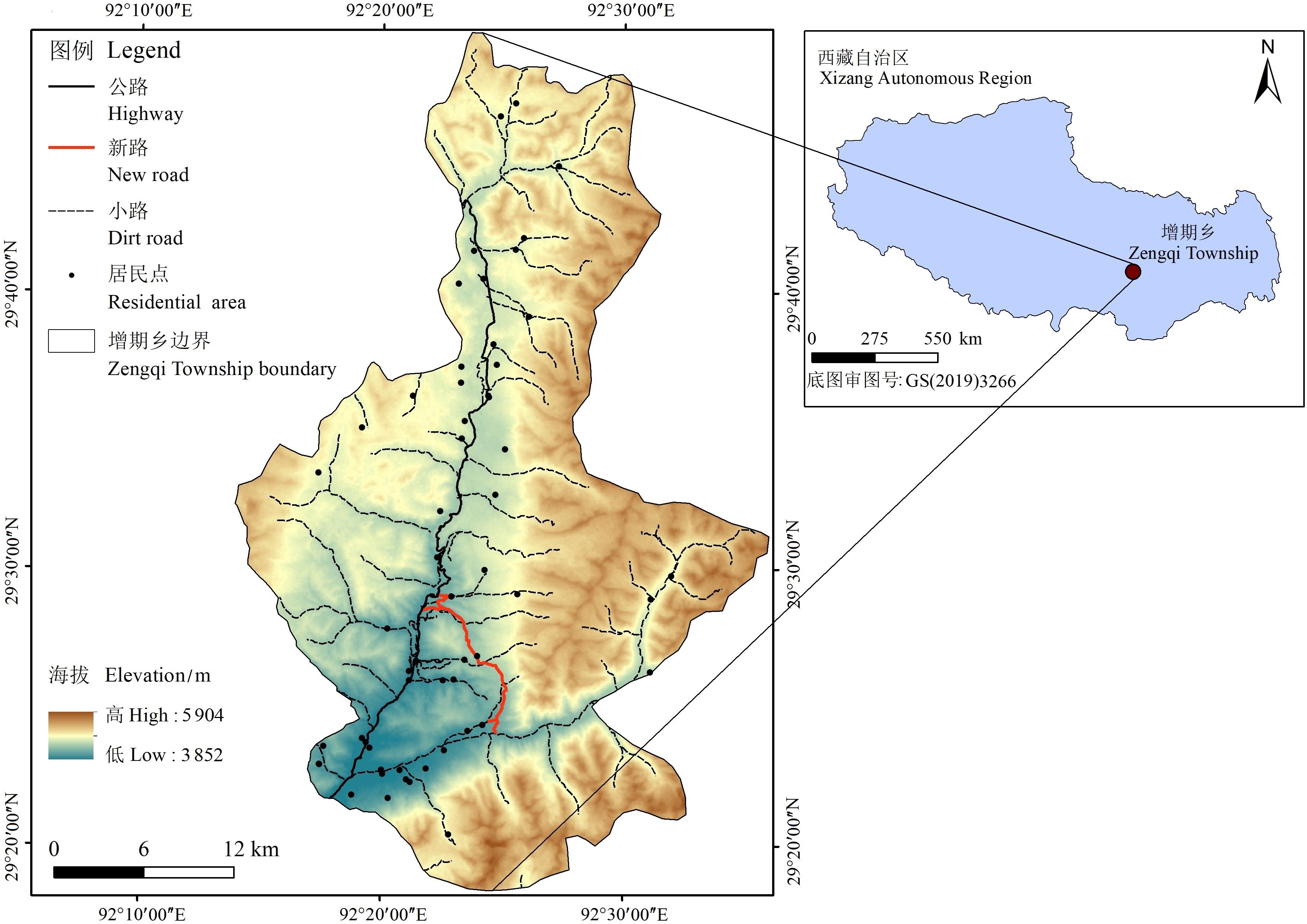
图1 研究区地理位置及人为干扰分布
Fig.1 Geographical location and human interference distribution in study area
数据类型 Data type | 环境因子 Environmental factor | 代码 Code | 数据时间 Data time | 是否参与预测 Participate in prediction (Y/N) |
|---|---|---|---|---|
气候因子 Climatic factor | 温度季节性变异系数 Temperature seasonality | Bio 4 | 1970—2000 | 是 Y |
| 最干季度平均气温 Mean temperature of driest quarter/℃ | Bio 9 | 1970—2000 | 是 Y | |
| 最干月份降水量 Precipitation of driest month/mm | Bio 14 | 1970—2000 | 是 Y | |
地形因子 Terrain factor | 海拔 Elevation/m | Elevation | 2009 | 是 Y |
| 距河流距离 Distance to the stream/m | Dis stream | 2009 | 是 Y | |
| 坡度 Slope/(°) | Slope | 2009 | 是 Y | |
| 坡向 Aspect/(°) | Aspect | 2009 | 是 Y | |
植被因子 Vegetation factor | 归一化植被指数 Normalized difference vegetation index | NDVI | 2021、2023 | 是 Y |
| 土地利用类型 Land use type | Landcover | 2018 | 否 N | |
人类活动因子 Human activity factor | 距公路距离 Distance to the highway/m | Dis highway | 2021 | 是 Y |
| 距小路距离 Distance to the dirt road/m | Dis dirt road | 2021 | 是 Y | |
距柏油路(含新路)距离 Distance to the asphalt road (including the new road)/m | Dis asphalt road | 2023 | 是 Y |
表1 MaxEnt模型利用的环境因子
Table1 The environmental factors used by the MaxEnt model
数据类型 Data type | 环境因子 Environmental factor | 代码 Code | 数据时间 Data time | 是否参与预测 Participate in prediction (Y/N) |
|---|---|---|---|---|
气候因子 Climatic factor | 温度季节性变异系数 Temperature seasonality | Bio 4 | 1970—2000 | 是 Y |
| 最干季度平均气温 Mean temperature of driest quarter/℃ | Bio 9 | 1970—2000 | 是 Y | |
| 最干月份降水量 Precipitation of driest month/mm | Bio 14 | 1970—2000 | 是 Y | |
地形因子 Terrain factor | 海拔 Elevation/m | Elevation | 2009 | 是 Y |
| 距河流距离 Distance to the stream/m | Dis stream | 2009 | 是 Y | |
| 坡度 Slope/(°) | Slope | 2009 | 是 Y | |
| 坡向 Aspect/(°) | Aspect | 2009 | 是 Y | |
植被因子 Vegetation factor | 归一化植被指数 Normalized difference vegetation index | NDVI | 2021、2023 | 是 Y |
| 土地利用类型 Land use type | Landcover | 2018 | 否 N | |
人类活动因子 Human activity factor | 距公路距离 Distance to the highway/m | Dis highway | 2021 | 是 Y |
| 距小路距离 Distance to the dirt road/m | Dis dirt road | 2021 | 是 Y | |
距柏油路(含新路)距离 Distance to the asphalt road (including the new road)/m | Dis asphalt road | 2023 | 是 Y |
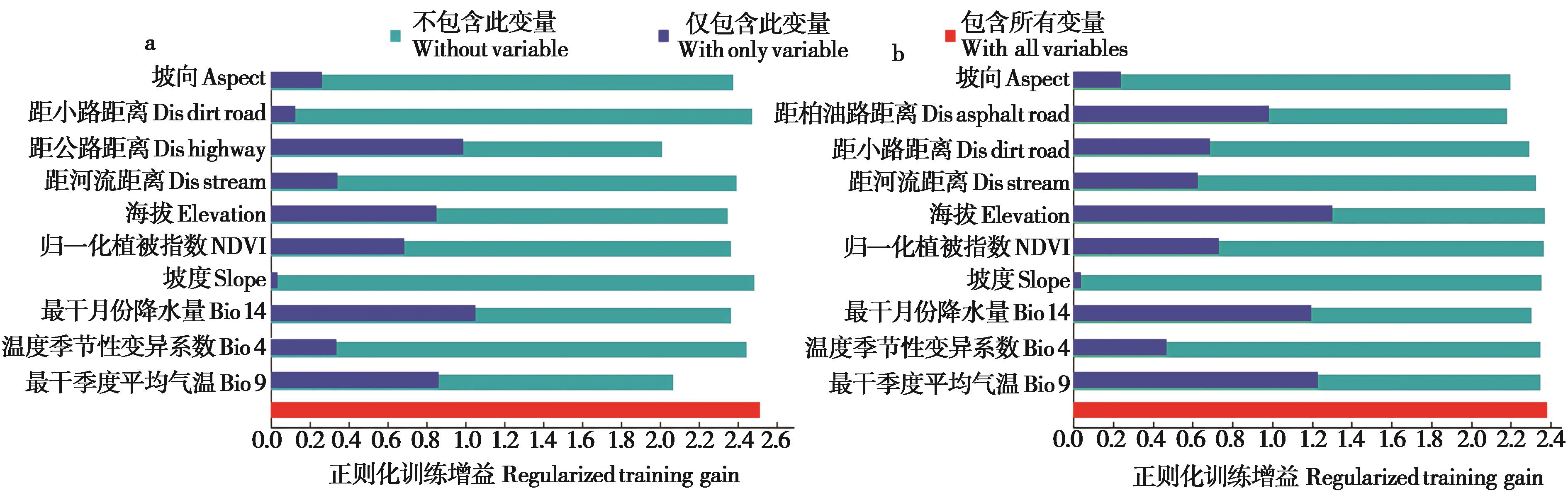
图2 新路修建前(a)后(b)环境变量对马鹿藏南亚种分布的重要性
Fig.2 The importance of environmental variables to the distribution of Cervus elaphus wallichii before (a) and after (b) the construction of the new road
环境变量 Environmental variables | 贡献百分率 Percent contribution/% | |
|---|---|---|
新路修建前 Before the construction of the new road | 新路修建后 After the construction of the new road | |
| 距公路距离 Dis highway | 27.4 | — |
| 距柏油路(含新修建)距离 Dis asphalt road | — | 29 |
| 距小路距离Dis dirt road | 1.3 | 18.6 |
| 温度季节性变异系数 Bio4 | 2.6 | 10 |
| 最干季度平均气温 Bio9 | 13 | 3.9 |
| 最干月份降水量 Bio14 | 26.9 | 15.6 |
| 海拔 Elevation | 3.1 | 2.2 |
| 距河流距离 Dis stream | 6.3 | 6.1 |
| 归一化植被指数 NDVI | 10.7 | 2.6 |
| 坡向 Aspect | 7.5 | 9.6 |
| 坡度 Slope | 1.2 | 2.4 |
表2 影响马鹿藏南亚种分布的环境变量贡献率
Table 2 Percentage of environmental variables affecting the distribution of Cervus elaphus wallichii
环境变量 Environmental variables | 贡献百分率 Percent contribution/% | |
|---|---|---|
新路修建前 Before the construction of the new road | 新路修建后 After the construction of the new road | |
| 距公路距离 Dis highway | 27.4 | — |
| 距柏油路(含新修建)距离 Dis asphalt road | — | 29 |
| 距小路距离Dis dirt road | 1.3 | 18.6 |
| 温度季节性变异系数 Bio4 | 2.6 | 10 |
| 最干季度平均气温 Bio9 | 13 | 3.9 |
| 最干月份降水量 Bio14 | 26.9 | 15.6 |
| 海拔 Elevation | 3.1 | 2.2 |
| 距河流距离 Dis stream | 6.3 | 6.1 |
| 归一化植被指数 NDVI | 10.7 | 2.6 |
| 坡向 Aspect | 7.5 | 9.6 |
| 坡度 Slope | 1.2 | 2.4 |
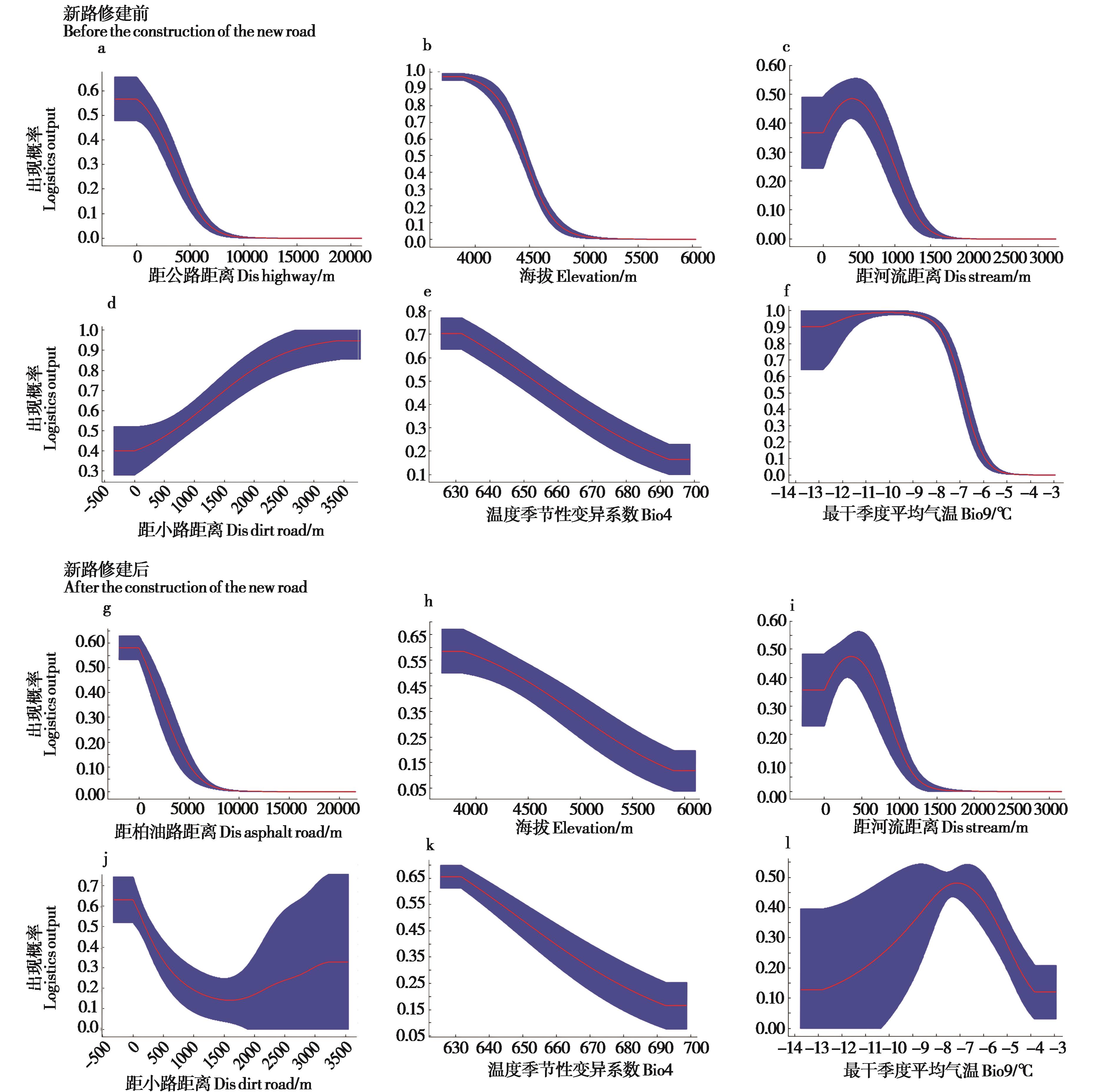
图3 影响马鹿藏南亚种适宜区分布的重要环境变量响应曲线
Fig.3 Response curves of prominent environmental variables affecting the distribution of suitable areas for Cervus elaphus wallichii
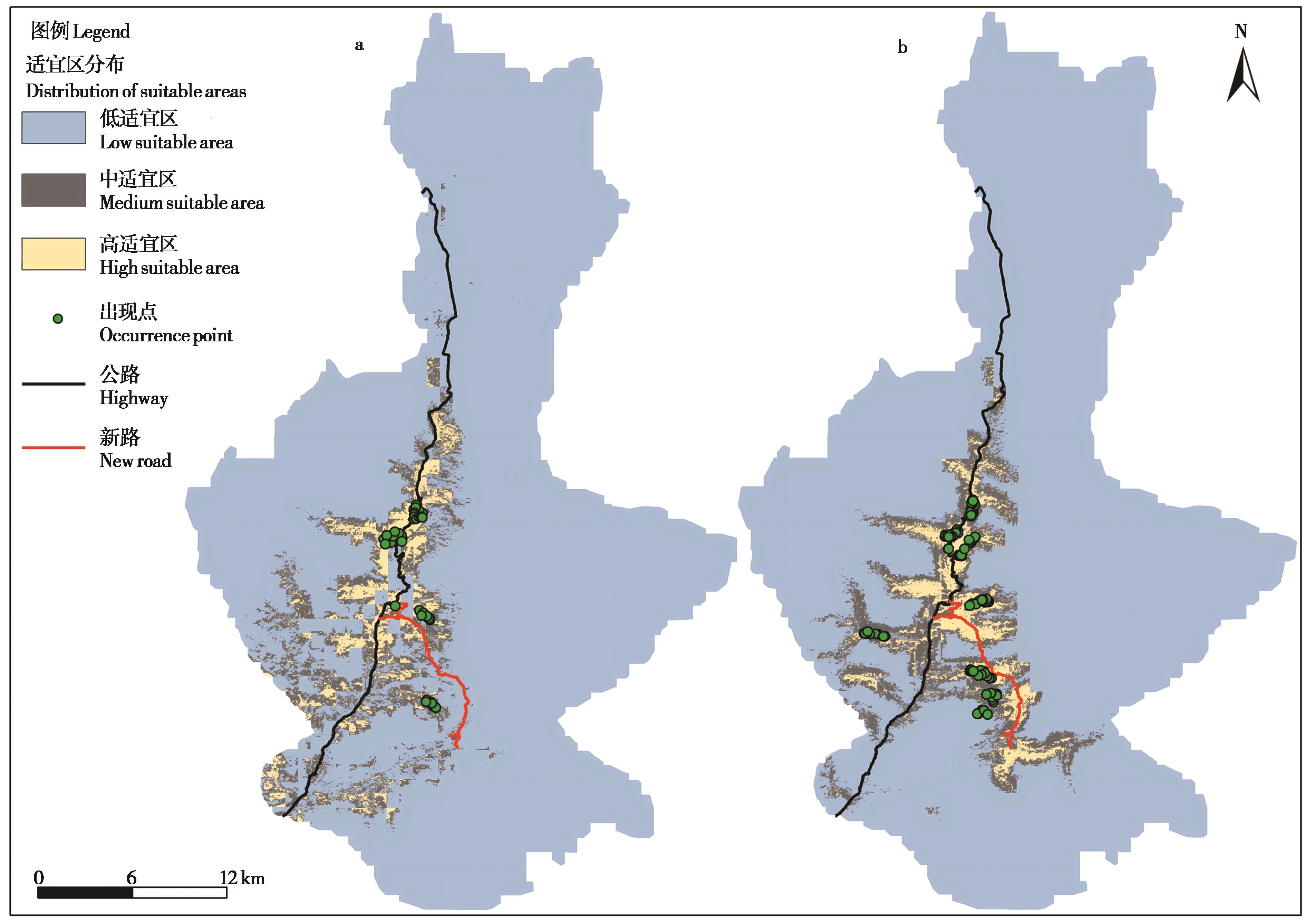
图4 新路修建前(a)后(b)草枯期马鹿藏南亚种适宜区分布
Fig.4 Distribution of suitable areas for Cervus elaphus wallichii during the lean period before (a) and after (b) the construction of the new road

图5 新路修建前后草枯期马鹿藏南亚种适宜生境空间格局变化及质心迁移
Fig.5 Changes in spatial pattern and centroid transfer of suitable habitats for Cervus elaphus wallichii during the lean season before and after the construction of the new road
| Akaike H,1998. Information theory and an extension of the maximum likelihood principle[M]. Springer New York,NY,199‑213. | |
| Beest F M V, Moorter B V, Milner J M,2012. Temperature‑mediated habitat use and selection by a heat‑sensitive northern ungulate[J].Animal Behaviour,84(3):723‑735. DOI:10.1016/j.anbehav.2012.06.032 . | |
| Dai Qiang, Yuan Zuoping, Zhang Jindong, Yang Yong, Zhang Ming, Zhang Qiang, Gu Haijun, Liu Zhujun, Jian Yi, Wang Yuezhao,2006. Road and road construction effects on habitat use of small mammals and birds in Zoige alpine wetland[J]. Biodiversity Science,14(2):121‑127. DOI:10.1360/biodiv.050168. (in Chinese with English abstract) | |
| Evcin Ö,2023. Can highway tunnel construction change the habitat selection of roe deer(Capreolus capreolus Linnaeus,1758)?[J]. Environmental Monitoring and Assessment,195(12):1410. DOI:10.1007/s10661-023-12003-0 . | |
| Evcin O, Kucuk O, Akturk E,2019. Habitat suitability model with maximum entropy approach for European roe deer(Capreolus capreolus)in the Black Sea Region[J]. Environmental Monitoring and Assessment,191(11):1‑13. DOI:10.1007/s10661-019-7853-x . | |
| Fahrig L, Rytwinski T,2009. Effects of roads on animal abundance:an empirical review and synthesis[J]. Ecology and Society,14(1):21. DOI:10.5751/es-02815-140121 . | |
| Fang Ruixin, Tian Xueqi, Zou Chen, Dong Yimeng, Liu Xin, Xing Xiumei,2021. Research advances on the origin,evolution and genetic diversity of red deer(Cervus elaphus)[J]. China Animal Husbandry and Veterinary Medicine,48(12):4575‑4587. DOI:10.16431/j.cnki.1671-7236.2021.12.026. (in Chinese with English abstract) | |
| Found R, St Clair C C,2017. Ambidextrous ungulates have more flexible behaviour,bolder personalities and migrate less[J]. Royal Society Open Science,4(2):160958. DOI:10.1098/rsos.160958 . | |
| Gagnon J W, Theimer T C, Dodd N L, Boe S, Schweinsburg R E,2007. Traffic volume alters elk distribution and highway crossings in Arizona[J]. Journal of Wildlife Management,71(7):2318‑2323. DOI:10.2193/2006-224 . | |
| Han Ruiying, Chang Jiang, Zhao Zhiping, Huang Yuxin,2024. Impacts of climate change on the spatial distribution of suitable habitat for Przewalski’s gazelle[J]. Research of Environmental Sciences,37(10):2260‑2268. DOI:10.13198/j.issn. 1001-6929.2024.08.24. (in Chinese with English abstract) | |
| Hu H J, Xing B, Yang M, Mpemba H, Lyu Z H, Zhang M H,2018. Population and genetic diversity of Tibetan red deer based on fecal DNA[J]. Journal of Forestry Research,29(1):227‑232. DOI:10.1007/s11676-017-0419-2 . | |
| Johnson C J, Russell D E,2014. Long‑term distribution responses of a migratory caribou herd to human disturbance[J]. Biological Conservation,177:52‑63. DOI:10.1016/j.biocon. 2014.06.007 . | |
| Kong Yaping, Wang Yun, Zhang Feng,2011. Review on road‑effect zone of wildlife[J]. Sichuan Journal of Zoology,30(6):986‑991. DOI:10.3969 /j.issn.1000-7083. 2011.06.029. (in Chinese with English abstract) | |
| Li Fangfei, Li Li, Wu Gongsheng, Yuan Lei, Meng Chunlin, Guo Hongyan, Zhou Yue, Ma Cunxin, Gao Yayue, Xue Yadong, Li Diqiang, Dai Yunchuan,2023. Habitat suitability assessment of Panthera uncia in Qilian Mountains of Qinghai based on MAXENT modeling[J]. Acta Ecologica Sinica,43(6):2202‑2209. DOI:10.5846 /stxb202009192440. (in Chinese with English abstract) | |
| Li X Y, Xu D P, Jin Y W, Zhuo Z H, Yang H J, Hu J M, Wang R L,2021. Predicting the current and future distributions of Brontispa longissima(Coleoptera:Chrysomelidae)under climate change in China[J]. Global Ecology and Conservation,25:e01444. DOI:10.1016/j.gecco.2020.e01444 . | |
| Li Yilin, Ding Changqing,2016. Reserve gap analysis of endangered brown eared pheasant(Crossoptilon mantchuricum) through GIS and MaxEnt technology[J]. Journal of Beijing Forestry University,38(11):34‑41. DOI:10.13332/j. 1000-1522.20160134. (in Chinese with English abstract) | |
| Liang X P, Wei K L, Li Q F, Gooley A, Zhang M H, Yu J J, Wang Z B, Yin C X, Zhang W Q,2024. Tibetan red deer(Cervus canadensis wallichi)diet composition patterns and associations during lean seasons in Xizang,China[J]. PeerJ,12:e18614. DOI:10.7717/peerj.18614 . | |
| Liu C R, Berry P M, Dawson T P, Pearson R G,2005. Selecting thresholds of occurrence in the prediction of species distributions[J]. Ecography,28(3):385‑393. DOI:10.1111/j. 0906-7590.2005.03957.x . | |
| Liu Y H, Zhang M H,2017. The genetic diversity of Tibetan red deer populations determined using mitochondrial and microsatellite markers[J]. International Journal of Agriculture and Biology,19(5):1286‑1292. DOI:10.17957/IJAB/15.0453 . | |
| Zhonghai Lyu, Zhang Weiqi, Liu Hao, Zhang Minghai, Li Yiran,2020. Comparison on feeding habits of Cervus wallichii and sympatric ungulates and domestic animals in green grass period[J]. Chinese Journal of Applied Ecology,31(2):651‑658. DOI:10.13287/j.1001-9332.202002.002. (in Chinese with English abstract) | |
| Meisingset E L, Loe L E, Brekkum Ø, Moorter B V, Mysterud A,2013. Red deer habitat selection and movements in relation to roads[J]. The Journal of Wildlife Management,77(1):181‑191. DOI:10.1002/jwmg.469 . | |
| Muscarella R, Galante P J, Soley‑Guardia M, Boria R A, Kass J M, Uriarte M, Anderson R P,2014. ENMeval:An R package for conducting spatially independent evaluations and estimating optimal model complexity for Maxent ecological niche models[J]. Methods in Ecology and Evolution,5(11):1198‑1205. DOI:10.1111/2041-210X.12261 . | |
| Phillips S J, Anderson R P, Schapire R E,2006. Maximum entropy modeling of species geographic distributions[J]. Ecological Modelling,190(3‑4):231‑259. DOI:10.1016/j.ecolmodel.2005.03.026 . | |
| Qin Yu,2009. During green grass period habitat selection and evaluation of Tibetan red deer(Cervus elaphus wallichi)in South‑slop Gangsidili Moutains[D]. Harbin:Northeast Forestry University.(in Chinese with English abstract) | |
| Romero A, O’neill B J, Rauch K, Roscoe A,2024. How African ungulates respond to tourist vehicles in Kruger National Park[J].African Journal of Ecology,62(4):e13335. DOI:10.1111/aje.13335 . | |
| Ru H, Xu J L, Jiang S F,2022. Experimental observation and analysis of traffic impact on Tibetan antelopes on the Qinghai‑Xizang highway[J]. Advances in Civil Engineering,2022(1):1226781. DOI:10.1155/2022/1226781 . | |
| Tian Tian, Li Shaocai, Sun Hailong, Long Feng, Chen Min,2010. Ecological effects and mitigation measures under the disturbance of road construction[J]. Bulletin of Soil and Water Conservation,30(1):199‑204. DOI:10.13961/j.cnki.stbctb. 2010.01.007. (in Chinese with English abstract) | |
| Wang Huaping, Li Taian,2009. The newly research overview of the application of road ecology in animal and plant[J]. Western China Communications Science & Technology,11:107‑116,131. DOI:10.13282/j.cnki.wccst.2009.11.022. (in Chinese with English abstract) | |
| Wang Yun, Guan Lei, Du Lixia, Qu Jiapeng, Wang Mingyue, Han Yongshun, Yang Yangang, Zhou Hongping, Kong Yaping,2021. Overlapping barrier and avoidance effects of the Qinghai‑Xizang highway and railway on four typical ungulates on the Xizang Plateau[J]. Chinese Journal of Ecology,40(4):1091‑1097. DOI:10.13292/j.1000-4890.202104.015. (in Chinese with English abstract) | |
| Wang Yunsheng, Xie Bingyan, Wan Fanghao, Xiao Qiming, Dai Liangying,2007. Application of ROC curve analysis in evaluating the performance of alien species’ potential distribution models[J]. Biodiversity Science,15(4):365‑372. DOI:10.1360/biodiv.060280. (in Chinese with English abstract) | |
| Wang Zhicheng, Wang Yan, Kang Yukun, Tan Yuchen, Pu Qiangsheng, Yao Baohui, Su Junhu,2025. Potential distribution area analysis of Himalayan marmot on the Xizang Plateau under the influence of climate change[J]. Grassland and Turf,45(3):168‑178.(in Chinese with English abstract) | |
| Wei Kaili,2023. Comparison of nutritional strategies of Tibetan red deer during withered grass period and green grass period[D].Harbin:Northeast Forestry University.(in Chinese with English abstract) | |
| Wu Shitao,2021. The impact of road construction on the ecological environment and strategies for ecological road construction[J].Intelligent City,7(2):127‑128. DOI:10.19301/j.cnki.zncs.2021.02.058. (in Chinese with English abstract) | |
| Yang Zhen,2024. Influence of the newly‑built Tianshui‑Longnan railway on wild mammals during the construction period[J]. Shaanxi Forest Science and Technology,52(3):53‑58. DOI:10.3969/j.issn.1001-2117.2024.03.009. (in Chinese with English abstract) | |
| Yamashita T J,2020. The influence of human disturbance on wildlife use of a highway in South Texas[D]. The University of Texas Rio Grande Valley. | |
| Yin Baofa, Huai Huyin, Zhang Yili, Zhou Le, Wei Wanhong,2006. Influence of Qinghai‑Xizang railway and highway on wild animal’s activity[J]. Acta Ecologica Sinica,26(12):3917‑3923.(in Chinese with English abstract) | |
| Yrjölä R A, Santaharju J L M,2015. The impact of road construction on a community of farmland birds[J]. Annales Zoologici Fennici,52(1‑2):33‑44. DOI:10.5735/086.052.0203 . | |
| Zimmermann B, Nelson L, Wabakken P, Sand H, Liberg O,2014. Behavioral responses of wolves to roads:scale‑dependent ambivalence[J]. Behavioral Ecology,25(6):1353‑1364. DOI:10.1093/beheco/aru134 . | |
| Zhang Chen, Ma Wei, Chen Chen, Wang Muyang, Xu Wenxuan, Yang Weikang,2022. Predicting the potential suitable areas of Aythya baeri in the Yangtze River Basin under the climate change scenario based on parameter optimization Maxent model[J]. Biodiversity Science,30(1):63‑75. DOI:10.17520/biods. 2021176. (in Chinese with English abstract) | |
| Zhang Yinbo, Liu Yanlan, Qin Hao, Meng Qingxin,2019. Prediction on spatial migration of suitable distribution of Elaeagnus mollis under climate change conditions in Shanxi Province,China[J]. Chinese Journal of Applied Ecology,30(2):496‑502. DOI:10.13287/j.1001-9332.201902.040 (in Chinese with English abstract) | |
| Zhu Gengping, Qiao Huijie,2016. Effect of the Maxent model’s complexity on the prediction of species potential distributions[J]. Biodiversity Science,24(10):1189‑1196. DOI:10.17520/biods.2016265. (in Chinese with English abstract) | |
| 王云,关磊,杜丽侠,曲家鹏,王明月,韩用顺,杨艳刚,周红萍,孔亚平,2021. 青藏公路和铁路对青藏高原四种典型有蹄类动物的叠加阻隔和回避影响[J].生态学杂志,40(4):1091‑1097. DOI:10.13292/j.1000-4890.202104.015 . | |
| 王化平,李太安,2009. 道路生态学在植物和动物方面的研究动态综述[J].西部交通科技,11:107‑116,131. DOI:10.13282/j.cnki.wccst.2009.11.022 . | |
| 王运生,谢丙炎,万方浩,肖启明,戴良英,2007. ROC曲线分析在评价入侵物种分布模型中的应用[J].生物多样性,15(4):365‑372. DOI:10.1360/biodiv.060280 . | |
| 王志成,王艳,康宇坤,谭宇尘,蒲强胜,姚宝辉,苏军虎,2025. 气候变化影响下青藏高原喜马拉雅旱獭潜在分布区分析[J]. 草原与草坪,45(3):168‑178. | |
| 孔亚平,王云,张峰,2011. 道路建设对野生动物的影响域研究进展[J]. 四川动物,30(6):986‑991. DOI:10.3969 /j.issn. 1000-7083.2011.06.029 . | |
| 田甜,李绍才,孙海龙,龙凤,陈敏,2010. 道路建设扰动下的生态效应分析及其消减对策[J]. 水土保持通报,30(1):199‑204. DOI:10.13961/j.cnki.stbctb.2010.01.007 . | |
| 汉瑞英,常江,赵志平,黄宇欣,2024. 气候变化对普氏原羚适生区空间偏移的影响[J]. 环境科学研究,37(10):2260‑2268. DOI:10.13198/j.issn.1001-6929.2024.08.24 . | |
| 吕忠海,张玮琪,刘浩,张明海,李依然,2020. 西藏马鹿与同域野生有蹄类、家畜草青期食性比较[J]. 应用生态学报,31(2):651‑658. DOI:10.13287/j.1001-9332.202002.002 . | |
| 朱耿平,乔慧捷,2016. Maxent模型复杂度对物种潜在分布区预测的影响[J]. 生物多样性,24(10):1189‑1196. DOI:10.17520/biods.2016265 . | |
| 刘务林,2009. 极度濒危的珍贵动物种群:西藏马鹿[J]. 西藏科技,(6):65‑68. | |
| 李一琳,丁长青,2016. 基于GIS和Maxent技术对濒危物种褐马鸡的保护空缺分析[J]. 北京林业大学学报,38(11):34‑41. DOI:10.13332/j.1000-1522.20160134 . | |
| 李芳菲,李丽,吴巩胜,袁磊,孟春林,国洪艳,周跃,马存新,高雅月,薛亚东,李迪强,代云川,2023. 基于最大熵模型的青海祁连山雪豹生境适宜性评价[J]. 生态学报,43(6):2202‑2209. DOI:10.5846 /stxb202009192440 . | |
| 杨震,2024. 新建天水至陇南铁路建设期对沿线野生兽类的影响[J]. 陕西林业科技,52(3):53‑58. DOI:10.3969/j.issn.1001-2117.2024.03.009 . | |
| 吴诗涛,2021. 道路建设对生态环境产生的影响及生态道路建策略[J]. 智能城市,7(2):127‑128. DOI:10.19301/j.cnki.zncs.2021.02.058 . | |
| 张殷波,刘彦岚,秦浩,孟庆欣,2019. 气候变化条件下山西翅果油树适宜分布区的空间迁移预测[J]. 应用生态学报,30(2):496‑502. DOI:10.13287/j.1001-9332.201902.040 . | |
| 张晨,马伟,陈晨,汪沐阳,徐文轩,杨维康,2022. 重大工程影响下新疆卡拉麦里山有蹄类野生动物自然保护区鹅喉羚的生境格局变化[J]. 生物多样性,30(1):63‑75. DOI:10.17520/biods.2021176 . | |
| 陈少波,1999. 西藏马鹿的保护与管理[J]. 中南林业调查规划,18(3):40‑42. | |
| 房瑞新,田雪琪,邹晨,董依萌,刘欣,邢秀梅,2021. 马鹿的起源进化与遗传多样性研究进展[J]. 中国畜牧兽医,48(12):4575‑4587. DOI:10.16431/j.cnki.1671-7236.2021.12.026 . | |
| 饶春艳,2012. 西藏马鹿的回归[J]. 中国西藏,(4):68‑71. | |
| 秦瑜,2009. 冈斯底里山南坡草青期西藏马鹿生境选择及其适宜性评价[D]. 哈尔滨:东北林业大学. | |
| 殷宝法,淮虎银,张镱锂,周乐,魏万红,2006. 青藏铁路、公路对野生动物活动的影响[J]. 生态学报,26(12):3917‑3923. | |
| 桑日县地方志编纂委员会,中华人民共和国西藏自治区地方志丛书,2008. 桑日县志[M].中国藏学出版社,1‑808. | |
| 戴强,袁佐平,张晋东,杨勇,张明,张强,顾海军,刘志君,蹇依,王跃招,2006. 道路及道路施工对若尔盖高寒湿地小型兽类及鸟类生境利用的影响[J]. 生物多样性,14(2):121‑127. DOI:10.1360/biodiv.050168 . | |
| 魏楷丽,2023. 西藏马鹿草枯期和草青期营养策略比较研究[D]. 哈尔滨:东北林业大学. |
| [1] | 王子涵, 王东, 侯陆一, 李全邦, 李其琴, 魏海娟, 连新明. 气候变化背景下三江源国家公园四种野生有蹄类动物栖息地适宜性分析[J]. 兽类学报, 2025, 45(5): 602-614. |
| [2] | 乔江, 姬朋真, 李倩, 钱宗亮, 李旭琴, 阮光发, 蒋勇, 王杰. 四川贡嘎山狼的栖息地适宜性分析[J]. 兽类学报, 2024, 44(6): 762-770. |
| [3] | 上官周怡, 冯超凡, 王佳宁, 万冬梅, 张雷. 基于MaxEnt模型的辽西地区亚洲狗獾生境适宜性分析[J]. 兽类学报, 2024, 44(5): 611-621. |
| [4] | 黄莘钧, 莫志民, 李明慧, 张雷, 万冬梅, 蒋一婷. 基于MaxEnt模型对燕山山脉东段狍生境适宜性评价[J]. 兽类学报, 2024, 44(4): 478-488. |
| [5] | 王启蕃, 陈红, 牛莹莹, 张子栋, 梁卓, 田新民, 张明海, 周绍春. 黑龙江省老爷岭南部东北梅花鹿栖息地适宜性评价及廊道构建[J]. 兽类学报, 2023, 43(5): 489-500. |
| [6] | 刘嘉琦, 王怡涵, 张磊, 崔宁, 吕婷, 黄元, 戴蓉, 李正玲, 陈明勇. 西双版纳勐海县勐阿水库对亚洲象迁移活动和人—象冲突的潜在影响[J]. 兽类学报, 2022, 42(3): 227-239. |
| [7] | 马兵, 潘国梁, 李雷光, 陈颖, 李祎斌, 刘一正, 巴力克·杰克义, 孙世为, 时坤. 天山中部雪豹栖息地适宜性研究初报[J]. 兽类学报, 2021, 41(1): 1-10. |
| [8] | 石锐 李宗智 高惠 庞博 燕永彬 滕丽微 刘振生. 内蒙古贺兰山啮齿动物群落多样性及其与环境因子关系[J]. 兽类学报, 2019, 39(6): 651-661. |
| [9] | 佐日古丽•伊斯马伊力 先木西努•莫合德 布威海丽且姆•阿巴拜科日 阿尔孜古力•沙塔尔 苏比奴尔•艾力 马合木提•哈力克. 环境因子对新疆鹅喉羚群体遗传多样性的影响[J]. 兽类学报, 2019, 39(3): 276-284. |
| [10] | 柴享贤 付和平 吕世杰 朝克图 武晓东 袁帅 卢志宏 满都呼 兴安 杨素文. 风和光对东北鼢鼠堵洞行为的影响[J]. 兽类学报, 2016, 36(2): 215-220. |
| [11] | 蔡赫 卞少伟. 天津古海岸与湿地保护区啮齿动物群落结构及其与环境因子关系[J]. 兽类学报, 2015, 35(3): 288-296. |
| [12] | 覃雪波, 曾朝辉. 中新天津生态城夏季不同生境中啮齿动物群落与环境因子的关系[J]. , 2011, 31(4): 380-386. |
| [13] | 陈忠 蒙以航 周锋 李玉春. 海南岛棕果蝠的活动节律与食性[J]. , 2007, 27(2): 112-119. |
| [14] | 张恩迪,滕丽微,吴咏蓓. 江苏盐城自然保护区獐栖息地的质量评价[J]. , 2006, 26(4): 368-372. |
| [15] | 吴德林, 奉勇, 窦秦川, 张良佐. 卡氏小鼠种群数量变动特征及其与环境因子的关系[J]. , 1995, 15(1): 60-64. |
| 阅读次数 | ||||||
|
全文 |
|
|||||
|
摘要 |
|
|||||
 青公网安备 63010402000199号 青ICP备05000010号-2