

中国核心期刊要目总览
中国科技核心期刊
CSCD数据库源刊
中国科技核心期刊
CSCD数据库源刊
兽类学报 ›› 2026, Vol. 46 ›› Issue (3): 404-419.DOI: 10.16829/j.slxb.151061
李金美( ), 吴涛, 汤恩泽, 廖金屏, 张格菲, 刘志霄()
收稿日期:2025-01-25
接受日期:2025-04-21
出版日期:2026-05-30
发布日期:2026-06-04
通讯作者:
刘志霄
作者简介:李金美(2002- ),女,本科生,主要从事生物科学研究. E‑mail:3347992963@qq.com
基金资助:
Jinmei LI(), Tao WU, Enze TANG, Jinping LIAO, Gefei ZHANG, Zhixiao LIU()
Received:2025-01-25
Accepted:2025-04-21
Online:2026-05-30
Published:2026-06-04
Contact:
Zhixiao LIU
摘要:
溶洞是特殊的生态系统,洞栖性蝙蝠在溶洞中发挥着“伞护性”的作用。大蹄蝠(Hipposideros armiger)是湘西州及整个武陵山地区占优势的食虫性蝙蝠,其在维护生态系统平衡方面起着不可或缺的作用。2023年4—9月,选择湘西州吉首市白虎洞的大蹄蝠种群作为研究对象,采用现代监控技术系统采集行为学数据,旨在建立其行为谱,并探究其繁育行为生态特征和日活动节律。基于PAE编码系统,大蹄蝠的行为可归为十大基本类型,涵盖12种基本姿势、41种动作、13种环境和51种行为。其中,繁育行为包括分娩行为、教飞行为、舔仔行为、携幼行为和仔蝠寻母行为等,这些行为只出现在6月至8月中上旬。在各类行为的时间分配中,休息行为的占比始终最大,总体呈先减再增的趋势,8月中上旬休息行为的占比最低(27.11%),但是在6月(42.69%)和9月(42.52%)达到最高。大蹄蝠在洞内主要呈现休息行为和繁育行为,进出洞活动存在“整夜不归型”和“晨昏型”。随着月份和季节的变更,其清晨进洞的时间逐渐推迟,从5月的05: 00推迟至9月的06: 00,而傍晚集体出洞的时间则逐渐提前,从5月的19: 45提前至9月的18: 25。总之,大蹄蝠的进出洞活动具有明显的月变化规律,也具有一定的可塑性。
中图分类号:
李金美, 吴涛, 汤恩泽, 廖金屏, 张格菲, 刘志霄. 洞栖性大蹄蝠PAE行为谱、繁育行为及活动节律研究[J]. 兽类学报, 2026, 46(3): 404-419.
Jinmei LI, Tao WU, Enze TANG, Jinping LIAO, Gefei ZHANG, Zhixiao LIU. Investigation into the PAE ethogram, breeding behaviors and activity rhythm of cave-dwelling Hipposideros armiger[J]. ACTA THERIOLOGICA SINICA, 2026, 46(3): 404-419.
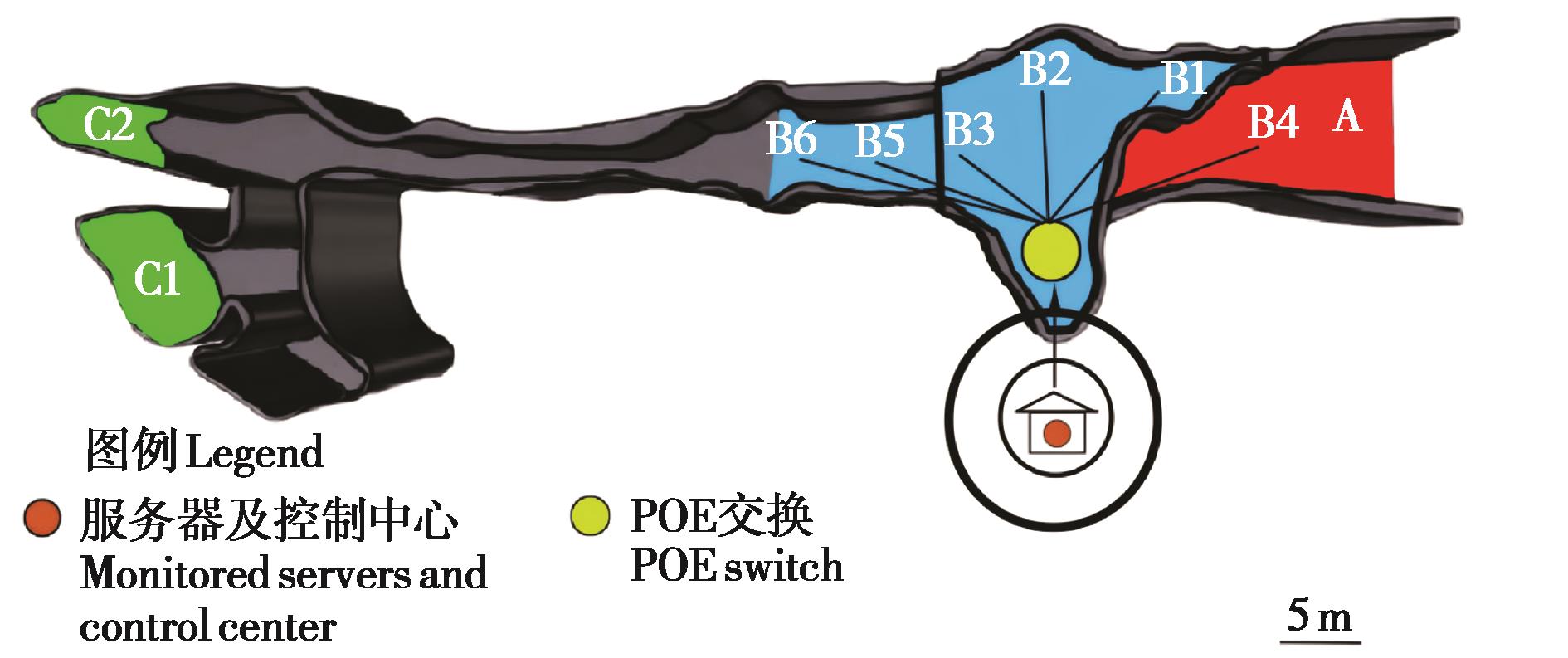
图 1 白虎洞的洞道结构简图. A:洞口;B1 ~ B6:监控设备布设点;C1、C2:大蹄蝠紧急避险位置
Fig. 1 Diagram of tunnel structure of Baihu Cave. A: Cave entrance; B1 - B6: Setting points of monitoring equipments; C1, C2: The emergency shelter position for Hipposideros armiger
| 姿势 Posture | 定义 Definition | 编码 Code |
|---|---|---|
双足倒挂 Hanging upside-down with two feet | 蝙蝠头部朝下,足爪朝上,用双足爪倒扣在岩壁、房梁、树枝等物体上 The bat has its head down and feet up. It uses its feet and claws to invert itself on rock walls, roof beams,branches and other objects | 1 |
单足倒挂 Hanging upside-down with one foot | 蝙蝠头部朝下,足爪朝上,仅用单足爪倒扣在岩壁、房梁、树枝等物体上 The bat has its head down and feet up. It only uses one foot and its claws to upside down on rock walls, roof beams, branches and other objects | 2 |
翼全展 Wings full spreading | 蝙蝠的肱骨、前臂骨、掌骨和指骨两侧或单侧完全伸展使翼展开 The humerus, forearm bones, metacarpals and phalanges of the bat are fully extended on either side or one side to spread the wings | 3 |
翼半展 Wings half-spreading | 蝙蝠的肱骨、前臂骨、掌骨和指骨两侧或单侧没有完全展开 The humerus, forearm, metacarpal and phalanges of the bat are not fully deployed on either side or on one side | 4 |
翼包裹 Wing packing | 蝙蝠的肱骨、前臂骨、掌骨和指骨收拢,使两侧或单侧翼膜收拢 The humerus, forearm bones, metacarpal bones and phalanges of the bat are retracted, allowing the bilateral or unilateral flying membranes to retract | 5 |
匍匐 Lying prone | 蝙蝠整个身体的腹部贴在缝隙里或接触面上不需要双足及前臂承重 The entire abdomen of the bat is attached to the crevice or on the other contact surface without its body weight held by its feet and forearms | 6 |
爬 Creeping | 蝙蝠使用足爪和第一指抓住接触面,腹部贴着接触面,拖拉着身体发生位移 The bat uses its feet and claws and the first finger to grasp the contact surface, and its abdomen is pressed against the contact surface, dragging its body to move | 7 |
飞 Flying | 蝙蝠翼膜完全展开,翼膜不停地拍打以使整个身体悬空 The bat’s wing membrane is fully unfolded, and the membrane is constantly flapping to keep the entire body suspended in the air | 8 |
行 Walking | 蝙蝠仅使用双足承重,左右交替移动身体 The bat only uses the feet to bear its body weight and moves alternately its body left and right | 9 |
抱 Embrace | 两只以上的蝙蝠身体紧贴在一起,其中一只用翼将另一只揽住 Two or more bats are closely attached, one of them holding the others with its wings | 10 |
含挂 Hanging upside-down with fake nipple in mouth | 蝙蝠幼仔用嘴部含住母蝠的假乳头,后肢抓挂于母蝠腋下 The bat young holds one false nipple of its mother with its mouth, while it hangs upside down and grasps the mother’s armpits by its hind legs and claws | 11 |
| 其他 Other | 以上被定义以外的所有姿势 All postures other than those defined above | 12 |
表 1 大蹄蝠的基本姿势及编码
Table 1 Basic postures and their codes of Hipposideros armiger
| 姿势 Posture | 定义 Definition | 编码 Code |
|---|---|---|
双足倒挂 Hanging upside-down with two feet | 蝙蝠头部朝下,足爪朝上,用双足爪倒扣在岩壁、房梁、树枝等物体上 The bat has its head down and feet up. It uses its feet and claws to invert itself on rock walls, roof beams,branches and other objects | 1 |
单足倒挂 Hanging upside-down with one foot | 蝙蝠头部朝下,足爪朝上,仅用单足爪倒扣在岩壁、房梁、树枝等物体上 The bat has its head down and feet up. It only uses one foot and its claws to upside down on rock walls, roof beams, branches and other objects | 2 |
翼全展 Wings full spreading | 蝙蝠的肱骨、前臂骨、掌骨和指骨两侧或单侧完全伸展使翼展开 The humerus, forearm bones, metacarpals and phalanges of the bat are fully extended on either side or one side to spread the wings | 3 |
翼半展 Wings half-spreading | 蝙蝠的肱骨、前臂骨、掌骨和指骨两侧或单侧没有完全展开 The humerus, forearm, metacarpal and phalanges of the bat are not fully deployed on either side or on one side | 4 |
翼包裹 Wing packing | 蝙蝠的肱骨、前臂骨、掌骨和指骨收拢,使两侧或单侧翼膜收拢 The humerus, forearm bones, metacarpal bones and phalanges of the bat are retracted, allowing the bilateral or unilateral flying membranes to retract | 5 |
匍匐 Lying prone | 蝙蝠整个身体的腹部贴在缝隙里或接触面上不需要双足及前臂承重 The entire abdomen of the bat is attached to the crevice or on the other contact surface without its body weight held by its feet and forearms | 6 |
爬 Creeping | 蝙蝠使用足爪和第一指抓住接触面,腹部贴着接触面,拖拉着身体发生位移 The bat uses its feet and claws and the first finger to grasp the contact surface, and its abdomen is pressed against the contact surface, dragging its body to move | 7 |
飞 Flying | 蝙蝠翼膜完全展开,翼膜不停地拍打以使整个身体悬空 The bat’s wing membrane is fully unfolded, and the membrane is constantly flapping to keep the entire body suspended in the air | 8 |
行 Walking | 蝙蝠仅使用双足承重,左右交替移动身体 The bat only uses the feet to bear its body weight and moves alternately its body left and right | 9 |
抱 Embrace | 两只以上的蝙蝠身体紧贴在一起,其中一只用翼将另一只揽住 Two or more bats are closely attached, one of them holding the others with its wings | 10 |
含挂 Hanging upside-down with fake nipple in mouth | 蝙蝠幼仔用嘴部含住母蝠的假乳头,后肢抓挂于母蝠腋下 The bat young holds one false nipple of its mother with its mouth, while it hangs upside down and grasps the mother’s armpits by its hind legs and claws | 11 |
| 其他 Other | 以上被定义以外的所有姿势 All postures other than those defined above | 12 |
| 动作 Act | 定义 Definition | 编码 Code |
|---|---|---|
| 头颈部 Head and neck | ||
| 摆头 Shake head | 以颈部为轴,头向左、右快速摆动 Swing the head quickly to the left and right with the neck as the axis | 1 |
| 抬头 Rise head | 躯干部保持不变,头部上扬,呈仰视状态 Keep the trunk unchanged, head up, looking up | 2 |
| 低头 Lower head | 躯干部保持不变,头部前倾,呈俯视状态 Keep the trunk unchanged, with the head tilting forward, looking down | 3 |
| 左转 Turn left | 以颈部为轴,头向左转动小于90° With the neck as the axis, turn the head to the left by less than 90° | 4 |
| 右转 Turn right | 以颈部为轴,头向右转动小于90° With the neck as the axis, turn the head to the right by less than 90° | 5 |
| 后转 Turn back | 以颈部为轴,头向左或向右转动大于90° With the neck as the axis, rotate the head to the left or right by more than 90° | 6 |
| 顶 Gore | 用头部撞向其他的个体 Hit other individual with the head | 7 |
| 嘴部 Mouth | ||
| 张嘴 Open mouth | 上下颌分开,口腔扩大,露出牙齿 The upper and lower jaws are separated, and the mouth is enlarged, exposing the teeth | 8 |
| 吮吸 Suck | 嘴唇闭合用力把液体或乳汁吸入口腔 Close the lips and forcibly suck liquid or milk into the mouth | 9 |
| 伸舌 Stick out tongue | 把口腔内的舌头从嘴唇中伸出 Extend the tongue in the mouth from the lips | 10 |
| 呲牙 Bare teeth | 上下嘴唇分开,口腔微张,露出牙齿 The upper and lower lips are separated, and the mouth is slightly open to expose the teeth | 11 |
| 舔 Lick | 舌头伸出口腔用以舔触自己的身体或者别的个体 The tongue sticks out of the mouth to lick its own body or another individual | 12 |
| 叫 Yell | 从口腔发出“吱——吱——”的声音 Make a ‘squeaking-squeaking-’ sound from the mouth | 13 |
| 嚼 Chew | 嘴巴微张,用牙齿磨碎食物 Open the mouth slightly and grind food with the teeth | 14 |
| 咬 Bite | 嘴巴张开后,再用力闭合,以咬住或者压碎东西 After opening the mouth, close it hard to bite or crush something | 15 |
| 眼耳鼻部 Eye, nose and ear | ||
| 闭眼 Close eyes | 上下眼睑闭合,将眼球遮盖 The upper and lower eyelids are closed to cover the eyeballs | 16 |
| 睁眼 Open eyes | 上下眼睑分开,使眼球外露 Separate upper and lower eyelids to expose eyeballs | 17 |
| 急促呼吸 Tachypnea | 呼吸速度很快,可见腹部快速起伏 The breathing rate is fast, and the rapid ups and downs of the abdomen can be seen | 18 |
耳前后转动 Ear turn back and forth | 以躯体的前后为方向轴,耳朵向面部或尾部方向转动,常伴随回声定位声波的接收 With the front and back of the body as the direction axis, the ears rotate towards the face or the tail, often accompanied by the reception of echolocation sound waves | 19 |
耳郭收缩 Auricle contraction | 耳缘向前弯曲,耳朵形状变小 The ear margins bend forward and the shape of the ear becomes smaller | 20 |
耳前伏 Ear fold forward | 耳向前对半折,一半耳朵贴着头部 Fold the ear in half forward, with other half of the ear pressed against the head | 21 |
| 耳直立 Ear up-right | 耳朵保持直立状态,没有向前或向后折 Keep the ears upright without folding forward or backward | 22 |
| 四肢 Limbs | ||
后肢弯曲 Bend hind limbs | 后肢弯曲,身体重心后移,常出现在受惊时、起飞前、飞行结束时 The hind limbs are bent and the body's center of gravity moves backward, often occurring during shock, before takeoff, and at the end of flight | 23 |
倒挂式行走 Walk upside down | 双足爪交替变换位置,使完全倒悬着的身体向前或向后发生位移 The feet and their claws alternate positions to displace the completely upside-down body forward or backward | 24 |
倒挂 Hang upside down | 身体倒挂在岩壁上,没有发生位移 The body hangs upside down on the rock wall without displacement | 25 |
| 飞行 Fly | 四肢及腹部离开栖挂点,整个身体呈悬空状,双翼拍打而使身体在空中发生位移 The limbs and abdomen leave the roost, and the entire body floats in the air while the wings flap and the body displaces in the air | 26 |
| 侧移 Move sidesway | 双足爪左右交替移动,使身体向左或向右发生位移 Move the feet and their claws alternately left and right to displace the body to the left or righ | 27 |
| 贴壁 Attach | 躯体贴在岩壁上,没有发生位移 The body was pressed against the rock wall without displacement | 28 |
| 爬行 Creep | 腹部接触附着面,使用双足爪和前臂交替移动,使身体发生位移 When the abdomen touches the attachment surface, use the claws and forearms to move alternately to displace the body | 29 |
| 挠 Scratch | 用足爪或第一指上的爪对自身或其他个体进行抓挠 Scratch itself or another individual with the claws on the feet or the claw on the first finger | 30 |
| 拍 Slap | 用前肢或翼拍打周围的同伴 Slap the companions with the forelimbs or wings | 31 |
| 勾 Hook | 用第一指勾住同伴的身体或者其他物体,帮助移动 Hook its partner’s body or other object with its first finger to help moving | 32 |
| 抱 Hold | 用前肢包裹幼仔 Wrap the young with forelimbs | 33 |
| 腰荐及腹部 Waist sacral and abdomen | ||
左右转身 Turn left or right | 身体向左或向右转动角度小于或等于90° The angle of turning the body to the left or right is less than or equal to 90° | 34 |
| 后转身 Rear pivot | 身体向左或向右转动角度大于90° The angle of turning the body to the left or right is greater than 90° | 35 |
| 直腰 Straight waist | 腰部和后肢在同一平面上 Waist and hind limbs on the same plane | 36 |
| 弯腰 Stoop down | 身体向前倾斜角度等于或大于90° Tilt the body forward at an angle equal to or greater than 90° | 37 |
| 排粪 Defecate | 指蝙蝠将未被消化和吸收的食物残渣、消化道分泌物、无机盐及水等组成的混合物从肛门排出 It refers to the bat discharging a mixture of undigested and unabsorbed food residues, secretions of digestive tract, inorganic salts and water from the anus | 38 |
| 排尿 Urinate | 通过尿道,将自身产生的代谢终产物液体排出体外 Through the urethra, excrete the metabolic product fluid produced by itself | 39 |
腹部收缩 Abdominal contraction | 随着呼气和吸气,腹部肌肉收缩 With exhalation and inhalation, the muscles in the abdomen contract | 40 |
| 整个躯体 Whole body | ||
| 摇晃 Shake body | 栖息时,以爪为支点,身体向左或向右晃动 When resting, it uses its claws as the fulcrum and shake the body to the left or right | 41 |
| 颤动 Tremble | 随着心率加快,腹部起伏带动身体发生颤动 As the heart rate accelerates, the ups and downs of the abdomen cause the body to tremble | 42 |
表2 大蹄蝠的基本动作及其编码
Table 2 Basic acts and their codes of Hipposideros armiger
| 动作 Act | 定义 Definition | 编码 Code |
|---|---|---|
| 头颈部 Head and neck | ||
| 摆头 Shake head | 以颈部为轴,头向左、右快速摆动 Swing the head quickly to the left and right with the neck as the axis | 1 |
| 抬头 Rise head | 躯干部保持不变,头部上扬,呈仰视状态 Keep the trunk unchanged, head up, looking up | 2 |
| 低头 Lower head | 躯干部保持不变,头部前倾,呈俯视状态 Keep the trunk unchanged, with the head tilting forward, looking down | 3 |
| 左转 Turn left | 以颈部为轴,头向左转动小于90° With the neck as the axis, turn the head to the left by less than 90° | 4 |
| 右转 Turn right | 以颈部为轴,头向右转动小于90° With the neck as the axis, turn the head to the right by less than 90° | 5 |
| 后转 Turn back | 以颈部为轴,头向左或向右转动大于90° With the neck as the axis, rotate the head to the left or right by more than 90° | 6 |
| 顶 Gore | 用头部撞向其他的个体 Hit other individual with the head | 7 |
| 嘴部 Mouth | ||
| 张嘴 Open mouth | 上下颌分开,口腔扩大,露出牙齿 The upper and lower jaws are separated, and the mouth is enlarged, exposing the teeth | 8 |
| 吮吸 Suck | 嘴唇闭合用力把液体或乳汁吸入口腔 Close the lips and forcibly suck liquid or milk into the mouth | 9 |
| 伸舌 Stick out tongue | 把口腔内的舌头从嘴唇中伸出 Extend the tongue in the mouth from the lips | 10 |
| 呲牙 Bare teeth | 上下嘴唇分开,口腔微张,露出牙齿 The upper and lower lips are separated, and the mouth is slightly open to expose the teeth | 11 |
| 舔 Lick | 舌头伸出口腔用以舔触自己的身体或者别的个体 The tongue sticks out of the mouth to lick its own body or another individual | 12 |
| 叫 Yell | 从口腔发出“吱——吱——”的声音 Make a ‘squeaking-squeaking-’ sound from the mouth | 13 |
| 嚼 Chew | 嘴巴微张,用牙齿磨碎食物 Open the mouth slightly and grind food with the teeth | 14 |
| 咬 Bite | 嘴巴张开后,再用力闭合,以咬住或者压碎东西 After opening the mouth, close it hard to bite or crush something | 15 |
| 眼耳鼻部 Eye, nose and ear | ||
| 闭眼 Close eyes | 上下眼睑闭合,将眼球遮盖 The upper and lower eyelids are closed to cover the eyeballs | 16 |
| 睁眼 Open eyes | 上下眼睑分开,使眼球外露 Separate upper and lower eyelids to expose eyeballs | 17 |
| 急促呼吸 Tachypnea | 呼吸速度很快,可见腹部快速起伏 The breathing rate is fast, and the rapid ups and downs of the abdomen can be seen | 18 |
耳前后转动 Ear turn back and forth | 以躯体的前后为方向轴,耳朵向面部或尾部方向转动,常伴随回声定位声波的接收 With the front and back of the body as the direction axis, the ears rotate towards the face or the tail, often accompanied by the reception of echolocation sound waves | 19 |
耳郭收缩 Auricle contraction | 耳缘向前弯曲,耳朵形状变小 The ear margins bend forward and the shape of the ear becomes smaller | 20 |
耳前伏 Ear fold forward | 耳向前对半折,一半耳朵贴着头部 Fold the ear in half forward, with other half of the ear pressed against the head | 21 |
| 耳直立 Ear up-right | 耳朵保持直立状态,没有向前或向后折 Keep the ears upright without folding forward or backward | 22 |
| 四肢 Limbs | ||
后肢弯曲 Bend hind limbs | 后肢弯曲,身体重心后移,常出现在受惊时、起飞前、飞行结束时 The hind limbs are bent and the body's center of gravity moves backward, often occurring during shock, before takeoff, and at the end of flight | 23 |
倒挂式行走 Walk upside down | 双足爪交替变换位置,使完全倒悬着的身体向前或向后发生位移 The feet and their claws alternate positions to displace the completely upside-down body forward or backward | 24 |
倒挂 Hang upside down | 身体倒挂在岩壁上,没有发生位移 The body hangs upside down on the rock wall without displacement | 25 |
| 飞行 Fly | 四肢及腹部离开栖挂点,整个身体呈悬空状,双翼拍打而使身体在空中发生位移 The limbs and abdomen leave the roost, and the entire body floats in the air while the wings flap and the body displaces in the air | 26 |
| 侧移 Move sidesway | 双足爪左右交替移动,使身体向左或向右发生位移 Move the feet and their claws alternately left and right to displace the body to the left or righ | 27 |
| 贴壁 Attach | 躯体贴在岩壁上,没有发生位移 The body was pressed against the rock wall without displacement | 28 |
| 爬行 Creep | 腹部接触附着面,使用双足爪和前臂交替移动,使身体发生位移 When the abdomen touches the attachment surface, use the claws and forearms to move alternately to displace the body | 29 |
| 挠 Scratch | 用足爪或第一指上的爪对自身或其他个体进行抓挠 Scratch itself or another individual with the claws on the feet or the claw on the first finger | 30 |
| 拍 Slap | 用前肢或翼拍打周围的同伴 Slap the companions with the forelimbs or wings | 31 |
| 勾 Hook | 用第一指勾住同伴的身体或者其他物体,帮助移动 Hook its partner’s body or other object with its first finger to help moving | 32 |
| 抱 Hold | 用前肢包裹幼仔 Wrap the young with forelimbs | 33 |
| 腰荐及腹部 Waist sacral and abdomen | ||
左右转身 Turn left or right | 身体向左或向右转动角度小于或等于90° The angle of turning the body to the left or right is less than or equal to 90° | 34 |
| 后转身 Rear pivot | 身体向左或向右转动角度大于90° The angle of turning the body to the left or right is greater than 90° | 35 |
| 直腰 Straight waist | 腰部和后肢在同一平面上 Waist and hind limbs on the same plane | 36 |
| 弯腰 Stoop down | 身体向前倾斜角度等于或大于90° Tilt the body forward at an angle equal to or greater than 90° | 37 |
| 排粪 Defecate | 指蝙蝠将未被消化和吸收的食物残渣、消化道分泌物、无机盐及水等组成的混合物从肛门排出 It refers to the bat discharging a mixture of undigested and unabsorbed food residues, secretions of digestive tract, inorganic salts and water from the anus | 38 |
| 排尿 Urinate | 通过尿道,将自身产生的代谢终产物液体排出体外 Through the urethra, excrete the metabolic product fluid produced by itself | 39 |
腹部收缩 Abdominal contraction | 随着呼气和吸气,腹部肌肉收缩 With exhalation and inhalation, the muscles in the abdomen contract | 40 |
| 整个躯体 Whole body | ||
| 摇晃 Shake body | 栖息时,以爪为支点,身体向左或向右晃动 When resting, it uses its claws as the fulcrum and shake the body to the left or right | 41 |
| 颤动 Tremble | 随着心率加快,腹部起伏带动身体发生颤动 As the heart rate accelerates, the ups and downs of the abdomen cause the body to tremble | 42 |
环境 Environment | 生物环境 Biotic | 非生物环境 Abiotic | 编码 Code |
|---|---|---|---|
| 洞顶壁 Cave ceiling | + | 1 | |
| 洞侧壁 Cave side wall | + | 2 | |
| 洞道地面 Cave ground | + | 3 | |
| 钟乳石上 Stalactite | + | 4 | |
| 石缝里 Rock crack | + | 5 | |
| 空中 Air | + | 6 | |
| 雄性 Male | + | 7 | |
| 雌性 Female | + | 8 | |
| 幼仔 Young | + | 9 | |
| 母体与幼仔 Female and young | + | 10 | |
| 混合群 Mixed group | + | 11 | |
| 人类与蝙蝠 Human and bats | + | 12 | |
| 其他Other | + | 13 |
表 3 大蹄蝠行为发生的环境及其编码
Table 3 Behavioral environments and their codes of Hipposideros armiger
环境 Environment | 生物环境 Biotic | 非生物环境 Abiotic | 编码 Code |
|---|---|---|---|
| 洞顶壁 Cave ceiling | + | 1 | |
| 洞侧壁 Cave side wall | + | 2 | |
| 洞道地面 Cave ground | + | 3 | |
| 钟乳石上 Stalactite | + | 4 | |
| 石缝里 Rock crack | + | 5 | |
| 空中 Air | + | 6 | |
| 雄性 Male | + | 7 | |
| 雌性 Female | + | 8 | |
| 幼仔 Young | + | 9 | |
| 母体与幼仔 Female and young | + | 10 | |
| 混合群 Mixed group | + | 11 | |
| 人类与蝙蝠 Human and bats | + | 12 | |
| 其他Other | + | 13 |
| 行为 Behavior | PAE 编码 | ||
|---|---|---|---|
| P 码 | A 码 | E 码 | |
| 一、摄食行为 Feeding behavior | |||
| 1. 倒挂吃食 Feeding upside down | 1,2,3,4 | 14,25 | 1,2,4,5,7,8,10,11,13 |
| 2. 倒挂饮水 Drinking while hanging upside down | 1,2 | 9,12 | 1,2,4,5,7,8,9,10,11,13 |
| 3. 吸乳 Sucking | 1,2,5,6 | 9 | 1,2,10 |
| 4. 咀嚼 Chewing | 1,2,3,4,5 | 14 | 1,2,4,5,7,8,9,10,11,13 |
| 二、排遗与排泄行为 Egestion and excrete behavior | |||
5. 双足倒挂排粪 Defecating while hanging upside down with two feet | 1,3,4 | 25,38 | 1,2,4,5,7,8,9,10,11,12,13 |
6. 单足倒挂排粪 Defecating while hanging upside down with one foot | 2,3,4 | 25,38 | 1,2,4,5,7,8,9,10,11,12,13 |
| 7. 飞行排粪 Defecating while flying | 3,8 | 26,38 | 6 |
| 8. 应激排粪 Defecating while emergency | 1,2,3,4 | 38 | 1,2,4,6,12,13 |
9. 双足倒挂排尿 Urinating while hanging upside down with two feet | 1,3,4 | 25,39 | 1,2,4,5,7,8,9,10, 11,12,13 |
10. 单足倒挂排尿 Urinating while hanging upside down with one foot | 2,3,4 | 25,39 | 1,2,4,5,7,8,9,10, 11,12,13 |
| 11. 飞行排尿 Urinating while flying | 3,8 | 26,39 | 6 |
| 12. 应激排尿 Urinating while emergency | 1,2,3,4 | 39 | 1,2,4,6,12,13 |
| 三、调温行为 Thermo-regulating behavior | |||
| 13. 身体颤动 Body trembling | 1,2,5,6 | 18,41,42 | 1,2,4,6,11,12 |
| 14. 头部摆动 Head shaking | 1,2,5,6,10 | 1 | 1,2,4,6,11,12 |
| 15. 飞行运动 Flying movement | 3,8 | 26 | 6 |
| 16. 倒挂静息 Resting while hanging upside down | 1,2,5,12 | 16,25 | 1,2,4,11 |
| 17. 匍匐静息 Prostrately resting | 6 | 16,28 | 5,10 |
| 四、繁育行为 Breeding behavior | |||
| 18. 哺乳 Suckling | 1,2,3,4,11 | 17,25,34 | 2,4,10 |
| 19. 抱仔 Embracing young | 1,2,5,10,12 | 33,25 | 1,2,4,10 |
| 20. 寻仔 Searching young | 3,4,7,8,9 | 13,24,26,27,29 | 1,2,4,10 |
| 21. 救幼 Saving young | 7,8,10 | 13,26,29 | 3,10 |
| 22. 舔仔 licking young | 1,2,5,10,12 | 3,10,12 | 1,2,4,10 |
| 23. 看护 Guarding young | 1,2 | 25 | 1,2,4,10 |
| 24. 挂仔 Hanging young | 1,2,7,8,9,12 | 25,33 | 1,2,4,10 |
| 25. 交配 Mating | 1,2,10 | 19,25,28,32,33,42 | 2,7,8 |
| 26. 搧翼教飞 Fight-teaching by flapping wings | 1,2,4 | 31,36 | 1,2,4,10 |
| 27. 抖仔教飞 Fight-teaching by shaking young | 1,2,12 | 25,41 | 1,2,4,10 |
| 五、集群行为 Clustering behavior | |||
| 28. 雌雄混合集群 Mix-sex clustering | P | A | 1,2,4,7,8,9,10,11,13 |
| 29. 母幼集群 Mother and young clustering | P | A | 1,2,4,8,10 |
| 30. 单性集群 Single-sex clustering | 1,2,3,4,5,6, 7,8,9,10,12 | 1,2,3,4,5,6,7,8,10, 11,12,13,14,15,16,17, 18,19,20,22,23,24,25, 26,27,28,29,30,31,32, 33,34,35,36,37,38,39, 40,41,42 | 1,2,4,7,8 |
| 六、冲突行为 Conflicting behavior | |||
| 31. 扭斗 Wrestling | 1,2,5 | 19,20,25,34,35 | 1,2,4,11,13 |
| 32. 拍翼 Flapping wings | 1,2,4 | 25,31 | 1,2,4,10,11,13 |
| 33. 冲撞 Bumping | 7,8,9 | 7,26 | 6 |
| 34. 咬 Biting | 1,2,3,4 | 15,25 | 1,2,3,4,11,12,13 |
| 35. 逃飞 Flying off | 8 | 24,26,27,29 | 6,11,13 |
| 36. 前臂拳击 Boxing with forearms | 1,2,5 | 30,32 | 1,2,4,11,13 |
| 37. 撞击警告 Alerting by collision | 8 | 7,26 | 1,2,4 |
| 38. 转头 Turning head | 1,2,5 | 2,3,4,5,6 | 1,2,4,7,8,9,10,11,12,13 |
| 39. 吼叫警示 Warning by yelling | 1,2 | 8,11,13 | 1,2,3,4,11,12,13 |
| 七、通讯行为 Communication behavior | |||
| 40. 耳动 Ear movement | 1,2,6 | 19,20,21,22 | 1,2,3,4,7,8,9,10,11,13 |
| 41. 寻仔鸣叫 Calling for young | 1,2,7,9 | 24,26,27,29 | 1,2,4,10 |
| 42. 寻母鸣叫 Calling for mother | 1,2,7,8,9 | 13,24,26,27,29 | 1,2,4,10 |
| 八、休息行为 Resting behavior | |||
43. 双足倒挂休息 Resting while hanging upside down with two feet and claws | 1,5 | 16,25 | 1,2,4,11,13 |
44. 单足倒挂休息 Resting while hanging upside down with one foot and claws | 2,5 | 16,25 | 1,2,4,11,13 |
45. 附肢抓壁休息 Resting by grasping the wall with limbs (wings and hindlimbs) | 4,6 | 16,28 | 1,2,4,5 |
| 九、运动行为 Locomotive behavior | |||
| 46. 爬行 Creeping | 5,7 | 29 | 2,3,4,5 |
| 47. 侧行 Moving sideways | 4,9 | 27 | 1,2,4 |
| 48. 行走 Walking | 4,9 | 24 | 1,2,4 |
| 49. 飞行 Flying | 3,8 | 26 | 6,10 |
| 十、修饰行为 Grooming behavior | |||
| 50. 理毛 Grooming | 1,2,3,4 | 2,3,12,25,30,37 | 1,2,4,7,8,9,10,11,13 |
| 51. 舔舐翼膜 Licking patagium | 1,2,3,4 | 3,4,5,10,12,25 | 1,2,4,7,8,9,10 |
表4 大蹄蝠行为的PAE编码系统
Table 4 PAE codeing system of behaviors for Hipposideros armiger
| 行为 Behavior | PAE 编码 | ||
|---|---|---|---|
| P 码 | A 码 | E 码 | |
| 一、摄食行为 Feeding behavior | |||
| 1. 倒挂吃食 Feeding upside down | 1,2,3,4 | 14,25 | 1,2,4,5,7,8,10,11,13 |
| 2. 倒挂饮水 Drinking while hanging upside down | 1,2 | 9,12 | 1,2,4,5,7,8,9,10,11,13 |
| 3. 吸乳 Sucking | 1,2,5,6 | 9 | 1,2,10 |
| 4. 咀嚼 Chewing | 1,2,3,4,5 | 14 | 1,2,4,5,7,8,9,10,11,13 |
| 二、排遗与排泄行为 Egestion and excrete behavior | |||
5. 双足倒挂排粪 Defecating while hanging upside down with two feet | 1,3,4 | 25,38 | 1,2,4,5,7,8,9,10,11,12,13 |
6. 单足倒挂排粪 Defecating while hanging upside down with one foot | 2,3,4 | 25,38 | 1,2,4,5,7,8,9,10,11,12,13 |
| 7. 飞行排粪 Defecating while flying | 3,8 | 26,38 | 6 |
| 8. 应激排粪 Defecating while emergency | 1,2,3,4 | 38 | 1,2,4,6,12,13 |
9. 双足倒挂排尿 Urinating while hanging upside down with two feet | 1,3,4 | 25,39 | 1,2,4,5,7,8,9,10, 11,12,13 |
10. 单足倒挂排尿 Urinating while hanging upside down with one foot | 2,3,4 | 25,39 | 1,2,4,5,7,8,9,10, 11,12,13 |
| 11. 飞行排尿 Urinating while flying | 3,8 | 26,39 | 6 |
| 12. 应激排尿 Urinating while emergency | 1,2,3,4 | 39 | 1,2,4,6,12,13 |
| 三、调温行为 Thermo-regulating behavior | |||
| 13. 身体颤动 Body trembling | 1,2,5,6 | 18,41,42 | 1,2,4,6,11,12 |
| 14. 头部摆动 Head shaking | 1,2,5,6,10 | 1 | 1,2,4,6,11,12 |
| 15. 飞行运动 Flying movement | 3,8 | 26 | 6 |
| 16. 倒挂静息 Resting while hanging upside down | 1,2,5,12 | 16,25 | 1,2,4,11 |
| 17. 匍匐静息 Prostrately resting | 6 | 16,28 | 5,10 |
| 四、繁育行为 Breeding behavior | |||
| 18. 哺乳 Suckling | 1,2,3,4,11 | 17,25,34 | 2,4,10 |
| 19. 抱仔 Embracing young | 1,2,5,10,12 | 33,25 | 1,2,4,10 |
| 20. 寻仔 Searching young | 3,4,7,8,9 | 13,24,26,27,29 | 1,2,4,10 |
| 21. 救幼 Saving young | 7,8,10 | 13,26,29 | 3,10 |
| 22. 舔仔 licking young | 1,2,5,10,12 | 3,10,12 | 1,2,4,10 |
| 23. 看护 Guarding young | 1,2 | 25 | 1,2,4,10 |
| 24. 挂仔 Hanging young | 1,2,7,8,9,12 | 25,33 | 1,2,4,10 |
| 25. 交配 Mating | 1,2,10 | 19,25,28,32,33,42 | 2,7,8 |
| 26. 搧翼教飞 Fight-teaching by flapping wings | 1,2,4 | 31,36 | 1,2,4,10 |
| 27. 抖仔教飞 Fight-teaching by shaking young | 1,2,12 | 25,41 | 1,2,4,10 |
| 五、集群行为 Clustering behavior | |||
| 28. 雌雄混合集群 Mix-sex clustering | P | A | 1,2,4,7,8,9,10,11,13 |
| 29. 母幼集群 Mother and young clustering | P | A | 1,2,4,8,10 |
| 30. 单性集群 Single-sex clustering | 1,2,3,4,5,6, 7,8,9,10,12 | 1,2,3,4,5,6,7,8,10, 11,12,13,14,15,16,17, 18,19,20,22,23,24,25, 26,27,28,29,30,31,32, 33,34,35,36,37,38,39, 40,41,42 | 1,2,4,7,8 |
| 六、冲突行为 Conflicting behavior | |||
| 31. 扭斗 Wrestling | 1,2,5 | 19,20,25,34,35 | 1,2,4,11,13 |
| 32. 拍翼 Flapping wings | 1,2,4 | 25,31 | 1,2,4,10,11,13 |
| 33. 冲撞 Bumping | 7,8,9 | 7,26 | 6 |
| 34. 咬 Biting | 1,2,3,4 | 15,25 | 1,2,3,4,11,12,13 |
| 35. 逃飞 Flying off | 8 | 24,26,27,29 | 6,11,13 |
| 36. 前臂拳击 Boxing with forearms | 1,2,5 | 30,32 | 1,2,4,11,13 |
| 37. 撞击警告 Alerting by collision | 8 | 7,26 | 1,2,4 |
| 38. 转头 Turning head | 1,2,5 | 2,3,4,5,6 | 1,2,4,7,8,9,10,11,12,13 |
| 39. 吼叫警示 Warning by yelling | 1,2 | 8,11,13 | 1,2,3,4,11,12,13 |
| 七、通讯行为 Communication behavior | |||
| 40. 耳动 Ear movement | 1,2,6 | 19,20,21,22 | 1,2,3,4,7,8,9,10,11,13 |
| 41. 寻仔鸣叫 Calling for young | 1,2,7,9 | 24,26,27,29 | 1,2,4,10 |
| 42. 寻母鸣叫 Calling for mother | 1,2,7,8,9 | 13,24,26,27,29 | 1,2,4,10 |
| 八、休息行为 Resting behavior | |||
43. 双足倒挂休息 Resting while hanging upside down with two feet and claws | 1,5 | 16,25 | 1,2,4,11,13 |
44. 单足倒挂休息 Resting while hanging upside down with one foot and claws | 2,5 | 16,25 | 1,2,4,11,13 |
45. 附肢抓壁休息 Resting by grasping the wall with limbs (wings and hindlimbs) | 4,6 | 16,28 | 1,2,4,5 |
| 九、运动行为 Locomotive behavior | |||
| 46. 爬行 Creeping | 5,7 | 29 | 2,3,4,5 |
| 47. 侧行 Moving sideways | 4,9 | 27 | 1,2,4 |
| 48. 行走 Walking | 4,9 | 24 | 1,2,4 |
| 49. 飞行 Flying | 3,8 | 26 | 6,10 |
| 十、修饰行为 Grooming behavior | |||
| 50. 理毛 Grooming | 1,2,3,4 | 2,3,12,25,30,37 | 1,2,4,7,8,9,10,11,13 |
| 51. 舔舐翼膜 Licking patagium | 1,2,3,4 | 3,4,5,10,12,25 | 1,2,4,7,8,9,10 |
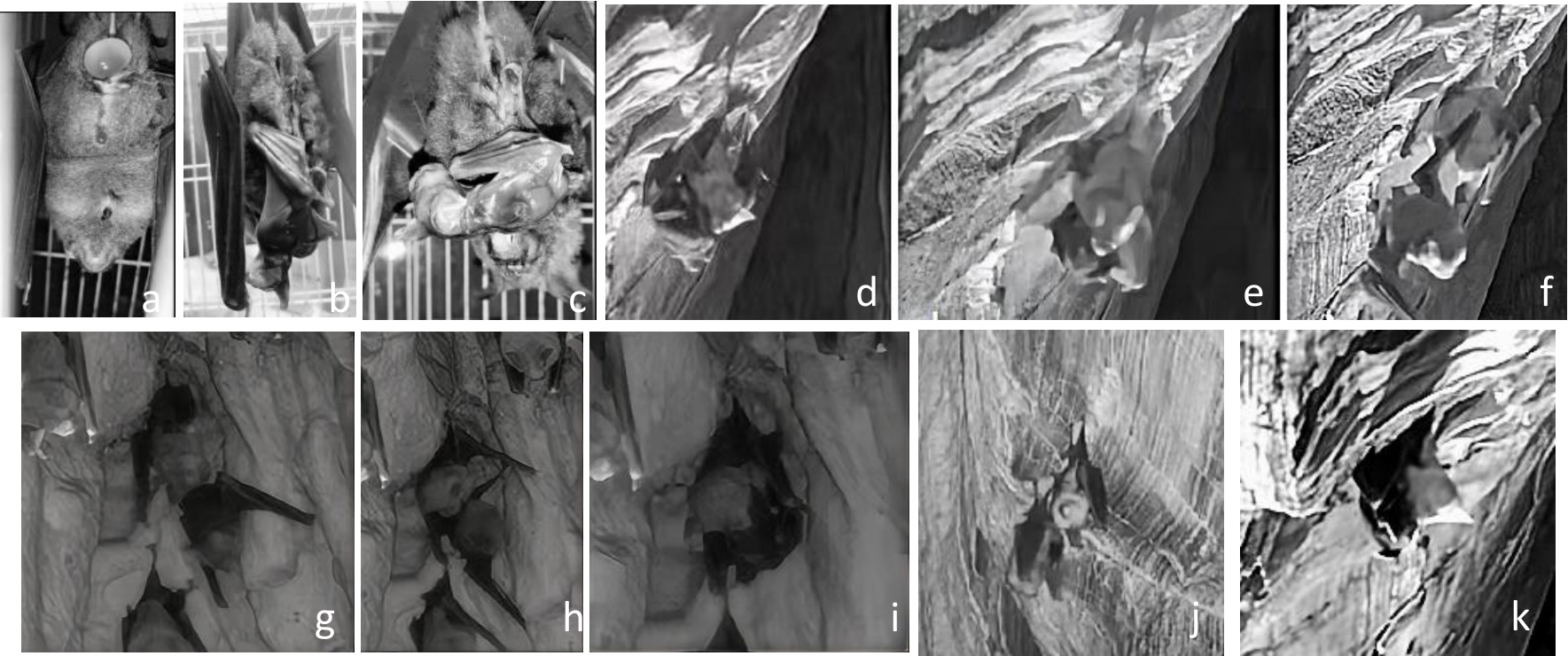
图 2 大蹄蝠5种重要而特殊的繁育行为. a ~ c:大蹄蝠室内分娩过程,a:母蝠生殖孔扩大,出现透明羊膜;b:仔蝠以头部朝下的姿态产出;c:母蝠舔舐幼仔. d ~ f: 大蹄蝠的教飞过程,d:仔蝠挂在母蝠身上,身体逐渐下沉;e:母蝠将仔蝠抖下去;f:仔蝠靠一只前臂(拇指爪)挂在母蝠身上. g ~ i:大蹄蝠仔蝠的寻母行为过程,g:仔蝠通过行走来到母蝠身边;h:仔蝠将一边翼搭在母蝠身上;i:仔蝠已经成功倒挂在母蝠身上. j:大蹄蝠的携幼行为.k:母蝠正在舔舐仔蝠的尾膜
Fig.2 Five notable breeding behaviors of Hipposideros armiger. a - c: Birthing process of Hipposideros armiger indoor,a:The female genitalpore enlarging, and transparent amniotic membrane appearing; b: The young bat given birth in a head-down posture; c: The mother licking her young bat. d - f: The flight-teaching process of Hipposideros armiger, d: The young hanging on the mother and gradually sinking; e: The mother shaking the young off; f: The young hanging from the mother by one forearm (thumb claw). g - i: Mother-seeking behavior of the young, g: The young coming to its mothers by walking; h: The young putting one of its wings on the mother; i: The young hunging successfully upside down on its mother. j: Carrying-young behavior of Hipposideros armige. k: The mother licking the tail membrane of her young
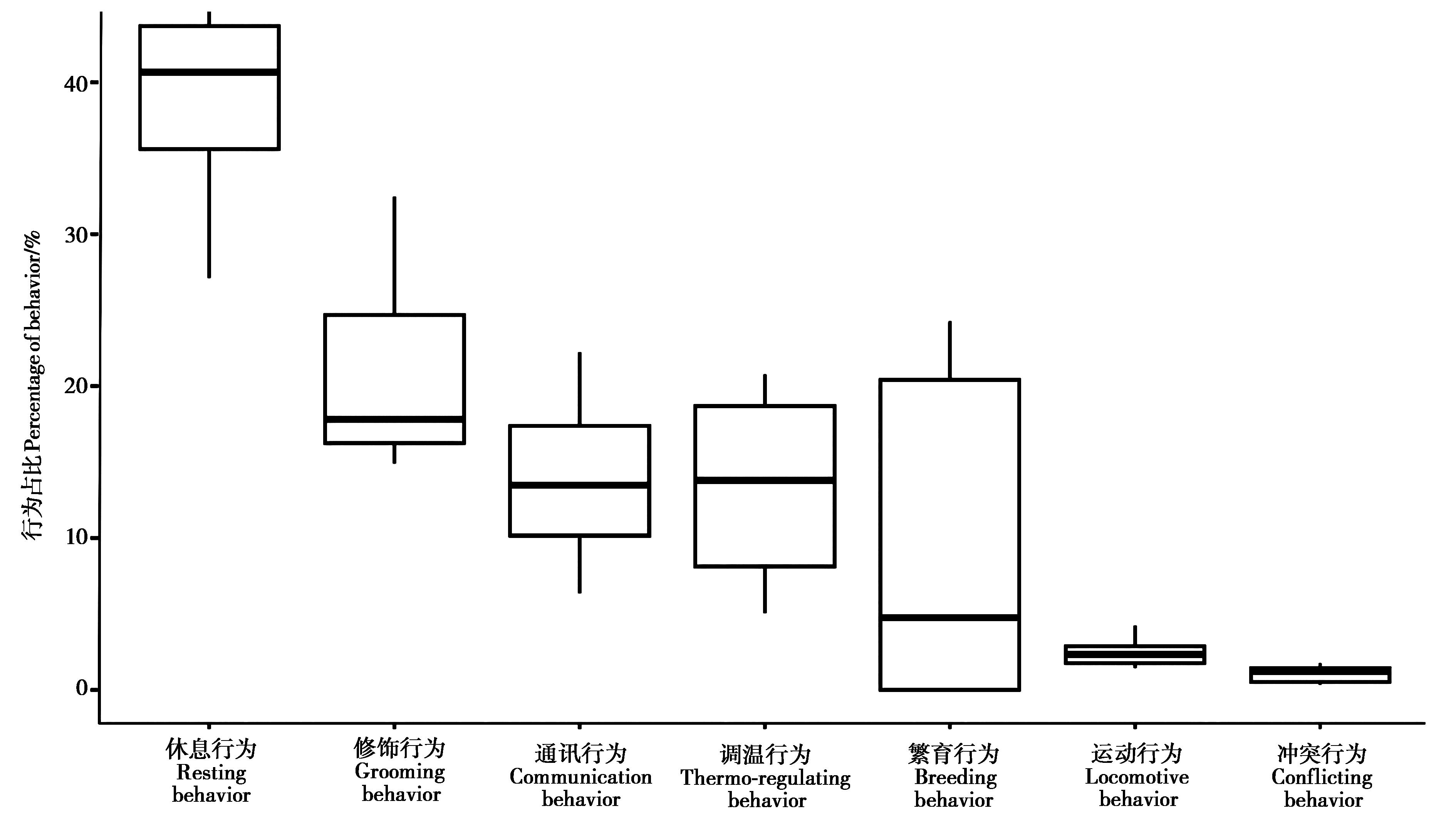
图3 大蹄蝠5—9月的总体行为时间占比
Fig. 3 Percentage of total behavioral time budget of Hipposideros armiger from May to September
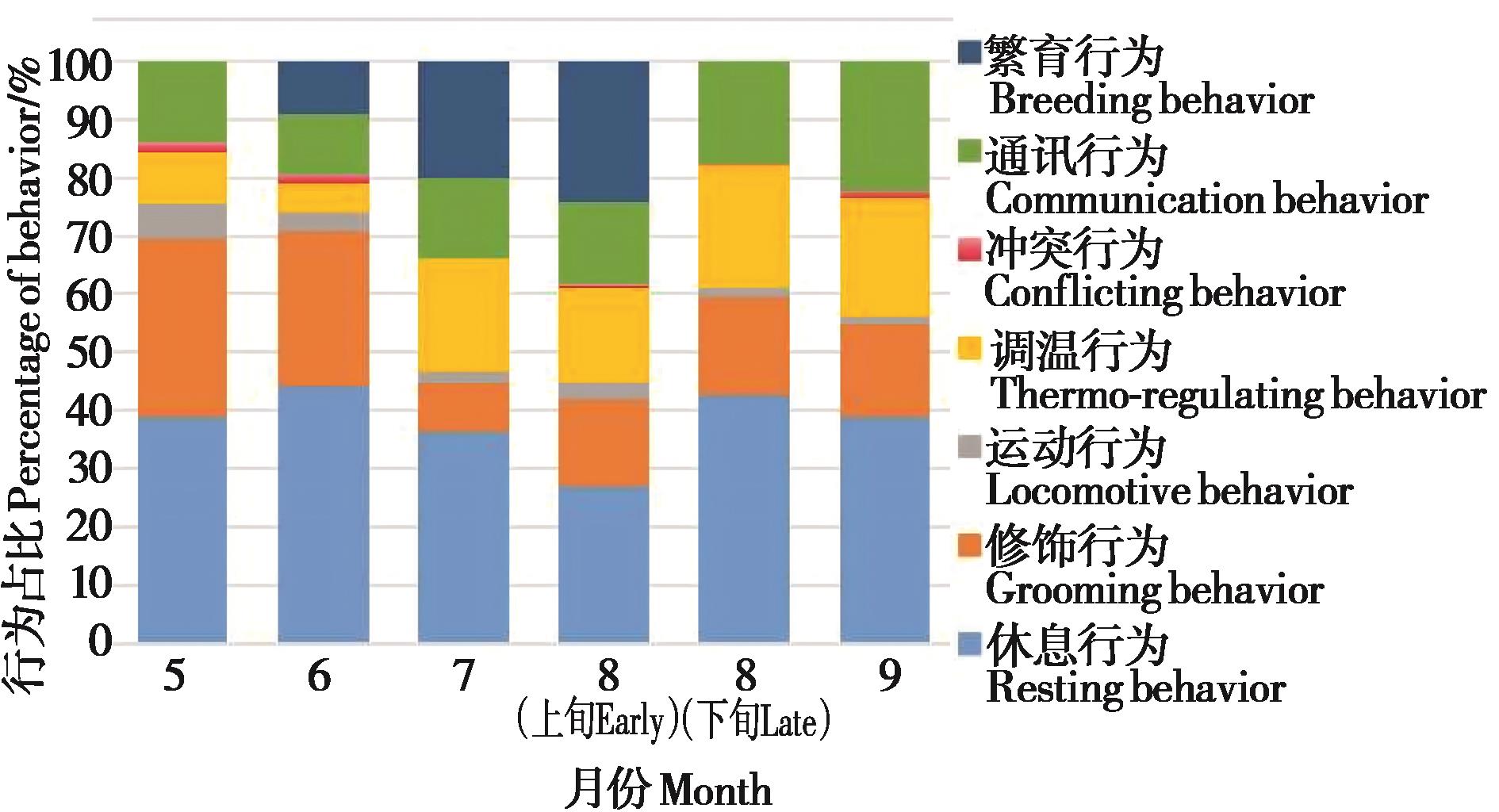
图 4 大蹄蝠七类行为逐月的时间分配
Fig. 4 Monthly time allocation for seven types of behaviors for Hipposideros armiger
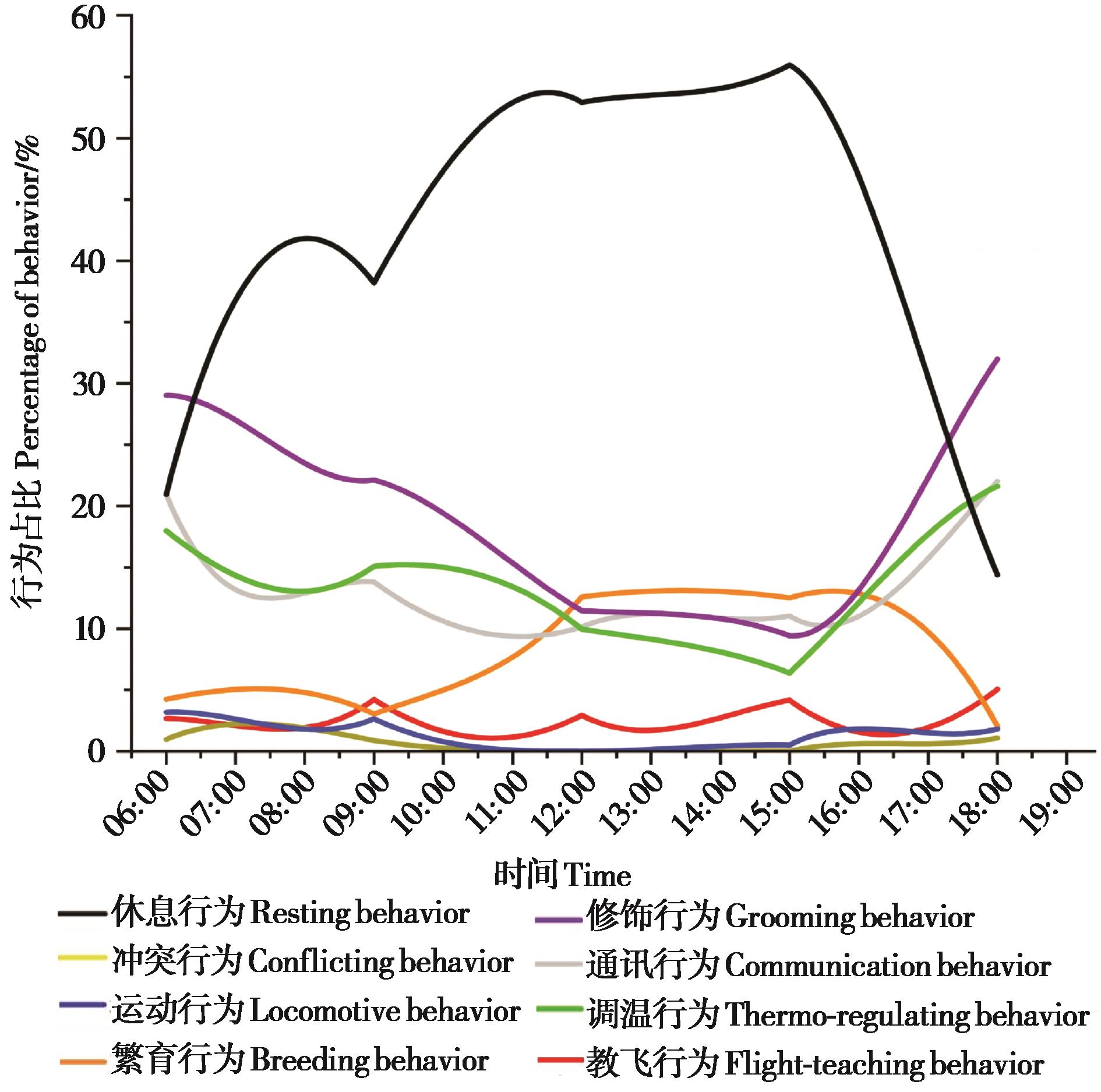
图 5 每小时各类行为所占的时间分配比率
Fig. 5 Time allocation per hour for each type of behaviors for Hipposideros armiger
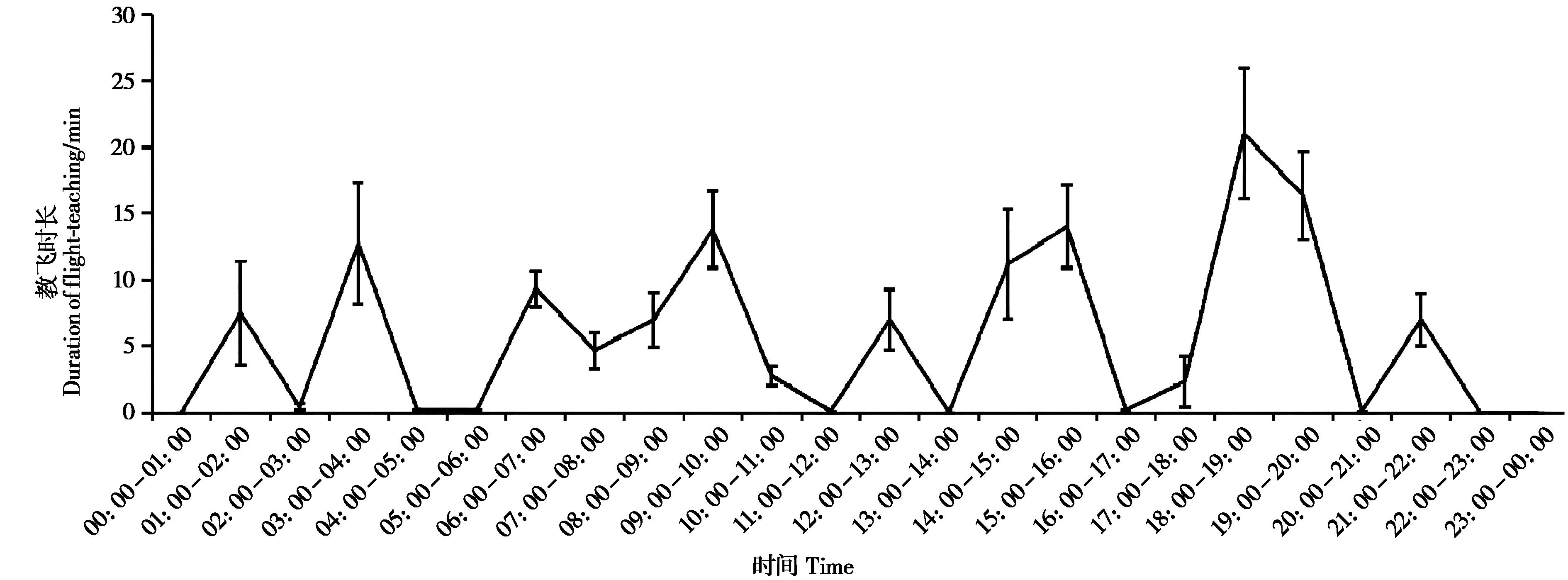
图 6 大蹄蝠繁育期间每日教飞行为的时长分布
Fig. 6 Duration distribution of daily flight-teaching behavior for Hipposideros armiger during breeding
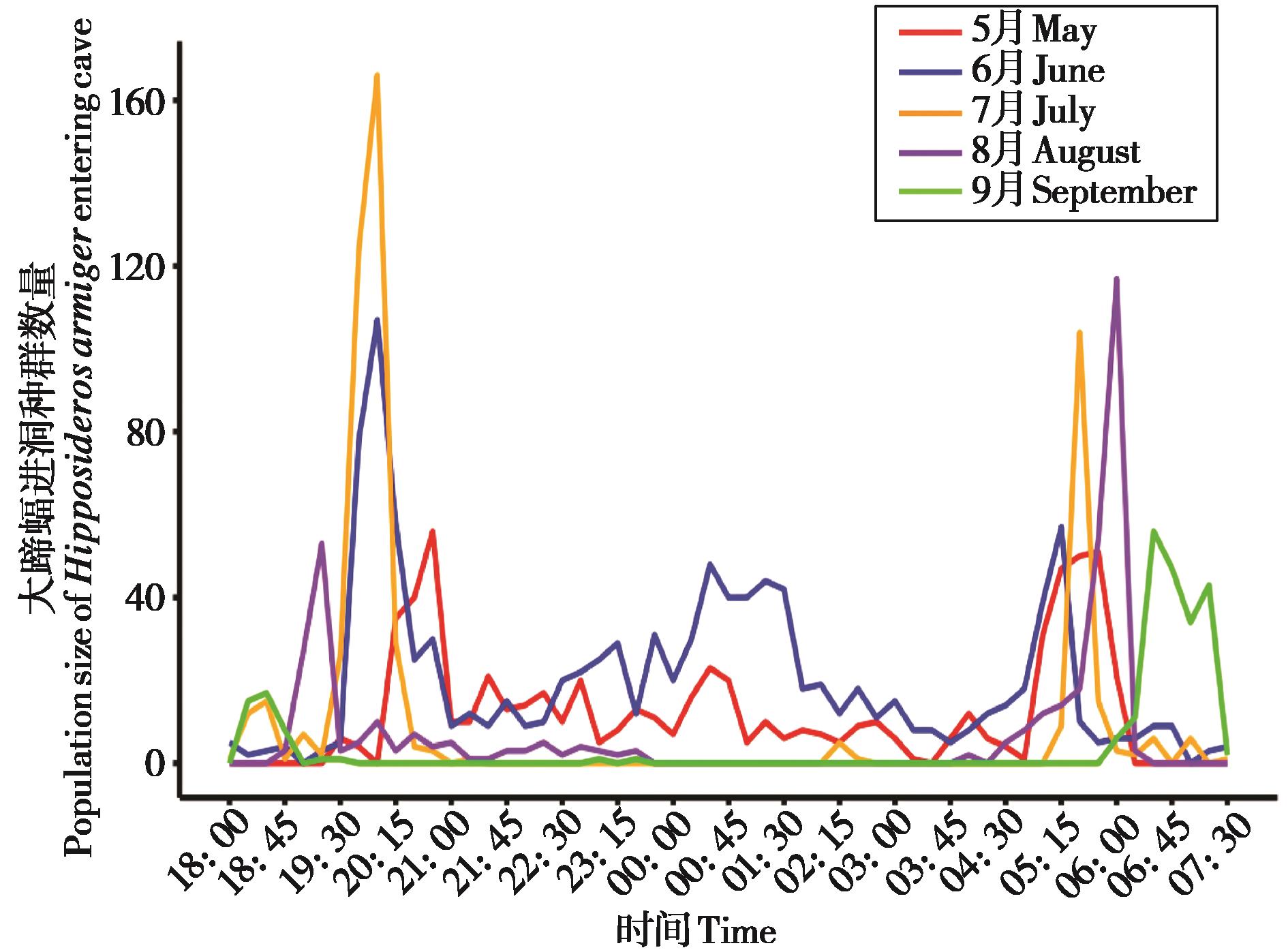
图 7 大蹄蝠在5—9月进洞的日活动节律
Fig. 7 Daily activity rhythm of the entering cave for Hipposideros armiger from May to September
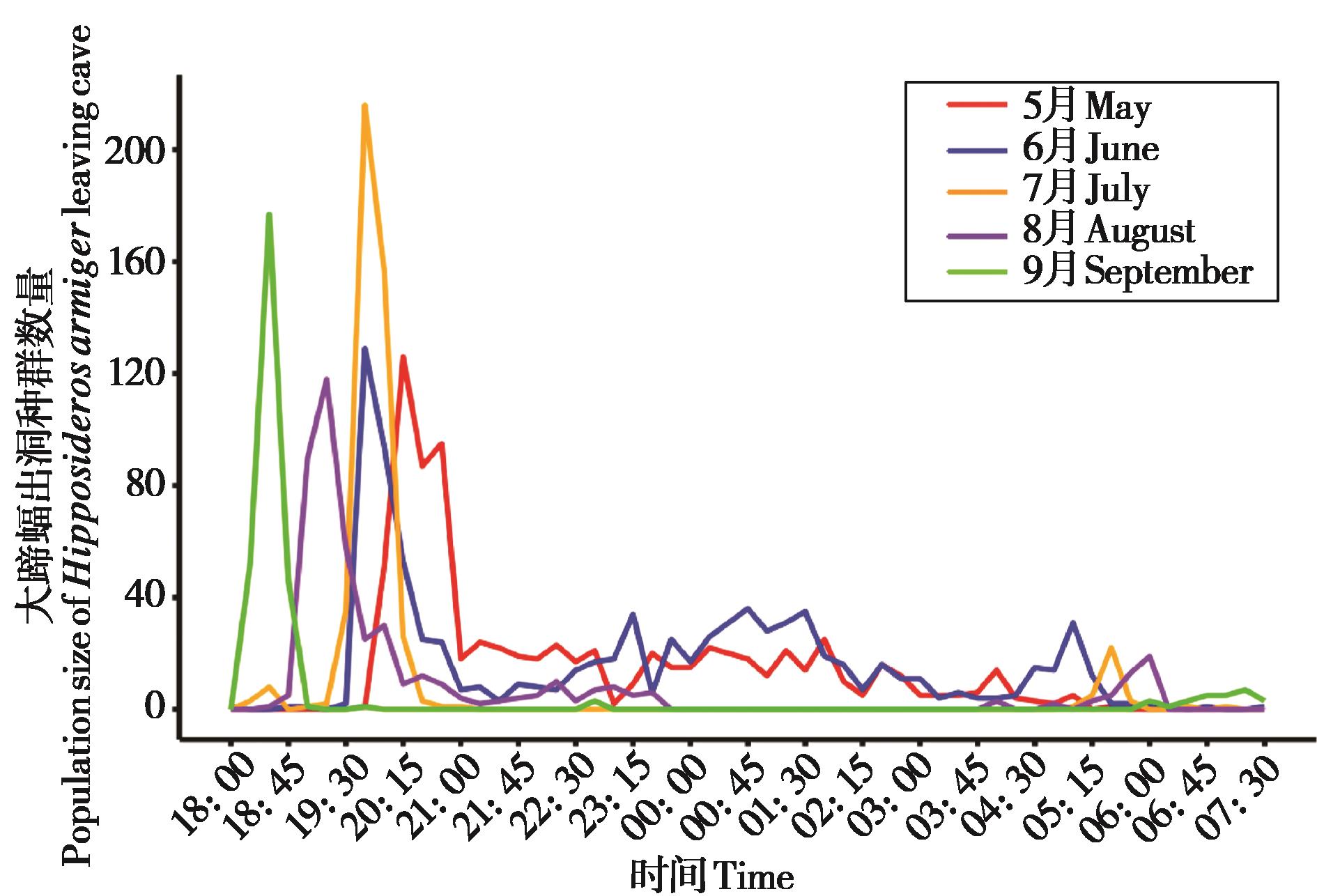
图 8 大蹄蝠在5—9月出洞的日活动节律
Fig. 8 Daily activity rhythm of the leaving cave for Hipposideros armiger from May to September
| Altringham J D,1996. Bats:biology and behaviour[M]. Oxford University Press. | |
| Bian Xinyan, Lu Yong, Wang Yan, Sun Qiang,2023. Analysis of the birthing behaviour of cynomolgus macaques[J]. Laboratory Animal and Comparative Medicine,43(4):355‑362. DOI:10.12300/j.issn.1674-5817.2023.086. (in Chinese with English abstract) | |
| Boyles J G, Cryan P M, Mccracken G F, Kunz T H,2011. Economic importance of bats in agriculture[J]. Science,332(6025):41‑42. DOI:10.1126/science.1201366 . | |
| Chen Bingyao, Meng Xiangyao, Liu Shan, Peng Tingting, Zhang Jun,2024. The behavior ethogram and PAE coding system of wild Yangtze finless porpoise in Nanjing[J]. Journal of Nanjing Normal University,47(2):63‑75. DOI:10.3969/j.issn. 1001-4616.2024.02.008. (in Chinese with English abstract) | |
| Stanton David J,2017. Emergence times and seasonality of the great leaf‑nosed bat(Hipposideros armiger,Chiroptera:Hipposideridae)in Hong Kong,China[J]. Acta Theriologica Sinica,37(3):251‑255. DOI:10.16829/j.slxb.201703005. (in Chinese with English abstract) | |
| Ding Jianan,2023. Echolocation modulation strategies of bats inrespond to acoustic interference[D]. Changchun:Northeast Normal University. DOI:10.27011/d.cnki.gdbsu.2023.001709. (in Chinese with English abstract) | |
| Divakar N, Deepak K, Ahirbudhnyan M, Gautham M, Balakrishnan P,2024. Placentophagia and birth‑associated behaviours of the fulvous fruit bat(Rousettus leschenaultii) from the Western Ghats,India[J]. Mammalia,88(3):236‑238. DOI:10.1515/mammalia-2023-0059 . | |
| Fleming T H, Nelson A A, Dalton V M,1998. Roosting behavior of the lesser long‑nosed bat,Leptonycteris curasoae [J]. Journal of MallZlllalogy,79(1):147‑155. DOI:10.2307/1382849 . | |
| Frick W F, Stepanian P M, Kelly J F, Howard K W, Kunz T H, Chilson P B,2012. Climate and weather impact timing of emergence of bats[J]. PLoS ONE,7(8):e42737. DOI: 10.1371/journal.pone.0042737 . | |
| Gao Ruiqi, Gao Haiyang, Sun Song, Wang Jingxin, Yang Jinzhen, Gu Jiayin, Hua Yan,2024. Construction of ethogram and PAE coding system of wild Chinese pangolin[J]. Chinese Journal of Wildlife,45(4):709‑716.DOI:10.12375/ysdwxb. 20240403. (in Chinese with English abstract) | |
| Guo Dongge, Xu Yanyan, Wang Fang, Wang Ying, Liu Sen,2024. Characteristics of calls of Woolly horseshoe bat Rhinolophus luctus and intermediate horseshoe bat R. affinis during parturition[J]. Chinese Journal of Zoology,59(3):358‑368. DOI:10.13859/j.cjz.2024023131. (in Chinese with English abstract) | |
| Han Xuesong, Dong Zhengyi, Zhao Ge, Zhao Xiang, Shi Xiangying, Zhi Lü, Li Hongqi,2021. Using surveillance cameras to analyze the activity pattern of the Eurasian otters(Lutra lutra) and the efficiency of camera trap monitoring[J]. Biodiversity Science,29(6):770‑779. DOI: 10.17520/biods.2020388. (in Chinese with English abstract) | |
| Hou Jin, Yan Linlu, Li Liang, Li Yujie, Liao Yushan, Zhang Jindong, 2020. Behavior coding and ethogram of the free‑ranging giant pandas(Ailuropoda melanoleuca)[J].Acta Theriologica Sinica,40(5):446‑457. DOI:10.16829/j.slxb.150392. (in Chinese with English abstract) | |
| Jiang Zhigang, Liu Shaoying, Wu Yi, Jiang Xuelong, Zhou Kaiya,2017. China’s mammal diversity(2nd edition)[J]. Biodiversity Science,25(8):886‑895. DOI: 10.17520/biods. 2017098. (in Chinese with English abstract) | |
| Jiang Zhigang,2000. Behavior coding and ethogram of the père david’s deer[J]. Acta Theriologica Sinica,20(1):1‑12. DOI:10.16829/j.slxb.2000.01.001. (in Chinese with English abstract) | |
| Kong Weiyao, Sun Quan, Liu Xinxin, Qu Li, Wang Fuyou, Yao Mingyuan, Zou Hongfei,2019. Population dynamic of far eastern leopard(Panthera pardus orientalis) in Wangqing Nature Reserve based on infrared camera monitoring[J]. Scientia Silvae Sinicae,55(5):188‑196. DOI:1011707/j.1001-7488. 20190521. (in Chinese with English abstract) | |
| Li Baoguo, Hou Rong, Zhang He, Chen Guoliang, Fang Gu,2021. Research advances and prespectives in ethology and behavioral ecology of the mammals in China[J]. Acta Theriologica Sinica,41(5):525‑536. DOI:10.16829/j.slxb.150529. (in Chinese with English abstract) | |
| Li Chengrong, Luo Bo, Wang Man, Feng Jiang,2018. Research progress on the function of acoustic signals in bats[J]. Sichuan Journal of Zoology,37(6):710‑720. DOI:10. 11984/j.issn.1000-7083. 20180151. (in Chinese with English abstract) | |
| Li Sheng, Wang Dajun, Xiao Zhishu, Li Xinhai, Wang Tianming, Feng Limin, Wang Yun,2014. Camera‑trapping in wildlife research and conservation in China:review and outlook[J]. Biodiversity Science,22(6):685‑695. DOI:10.3724/SP.J. 1003.2014.14203. (in Chinese with English abstract) | |
| Li Yong, Ren Baoping, Li Yanhong, Li Dayong, Hu Jie,2013. Behavior ethogram and PAE coding system of Rhinopithecus bieti [J].Sichuan Journal of Zoology,32(5):641‑650. DOI:10.3969/j.issn.1000-7083.2013.05.001. (in Chinese with English abstract) | |
| Liao Yang, Yan Rongling, Li Jinliang, Luo Jinqiang, Chen Jie,2014. Primary study on the evening activity rhythm of bat in the suburbs of Yongzhou[J].Sichuan Journal of Zoology,33(2):224‑228,233. DOI:10.3969/j.issn.1000-7083. 2014. 02.013. (in Chinese with English abstract) | |
| Lin C L, Hsiao C J, Hsu C H, Wang S E, Jen P H, Wu C H,2017. Hypothermic neuroprotections in the brain of an echolocation bat,Hipposideros terasensis [J].Neuroreport,28(15): 956‑962. DOI:10.1097/WNR.0000000000000856 . | |
| Liu S, Sun K, Jiang T, Ho J P, Liu B, Feng J,2012. Natural epigenetic variation in the female great roundleaf bat(Hipposideros armiger) populations[J]. Molecular Genetics and Genomics,287:643‑650. DOI:10.1007/s00438-012-0704-x . | |
| Liu Y, Feng J, Metzner W,2017. Different auditory feedback control for echolocation and communication in horseshoe bats[J]. PLoS ONE,8(4):e62710. DOI:10.1371/journal.pone. 0062710 . | |
| Lu Manman,2023. Studies on the vocal adjustment ability ofconstant frequency‑frequency modulation batsunder different acoustic environments[D]. Wuhan:Central China Normal University. DOI:10.27159/d.cnki.ghzsu.2023.000021. (in Chinese with English abstract) | |
| Qiao Zhenglei, Zhang Honghai, Ma Jianzhang, Wei Qinguo,2015. PAE coding ethogram in breeding of semi‑free‑ranging Amur tiger(Panthera tigris altaica)[J].Chinese Journal of Ecology,34(3):736‑743.DOI:10.13292/j.1000-4890. 2015.0100. (in Chinese with English abstract) | |
| Rakotoarivelo A R, Goodman S M, Schoeman M C, Willows‑Munro S,2019. Phylogeography and population genetics of the endemic Malagasy bat,Macronycteris commersoni s.s.(Chiroptera: Hipposideridae)[J]. PeerJ,7:e5866. DOI: 10.7717/peerj.5866 . | |
| Reichard J D, Gonzalez L E, Casey C M, Allen L C, Hristov N I, Kunz T H,2009. Evening emergence behavior and seasonal dynamics in large colonies of Brazilian free‑tailed bats[J]. Journal of Mammalogy,90(6):1478‑1486. DOI:10.1644/08-MAMM-A-266R1.1 . | |
| Sanderson K J,1999. Onset and completion of bat flight linked to civil twilight in Adelaide,South Australia[J]. Australian Mammalogy,21(1):147‑149. | |
| Sanderson K, Kirkley D,1998. Yearly activity patterns of bats at Belair National Park,in Adelaide,South Australia[J]. Australian Mammalogy,20(9):369‑375. DOI:10.1071/AM98369 . | |
| Schoeppler D, Schnitzler H U, Denzinger A,2018. Precise Doppler shift compensation in the hipposiderid bat,Hipposideros armiger [J]. Scientific Reports,8(1):4598. DOI:10.1038/s41598-018-22880-y . | |
| Shao Yonggang, Liu Zhixiao, Liu Qi, Chen Yi, Zhang Libiao,2024. Effect of food size on feeding behavior of fruit bats Rousettus leschenaulti and Cynopterus sphinx [J]. Acta Theriologica Sinica,34(3):232‑237.DOI:10.16829/j.slxb.2014.03.004. (in Chinese with English abstract) | |
| Shi Hongyan, Wu Yi, Hu Jinchu, Li Yanhong,2001. Study on reproductive ecology of Nyctalus velutinus [J].Acta Theriologica Sinica,21(3):210‑215.DOI:10.16829/j.slxb. 2001. 03.008. (in Chinese with English abstract) | |
| Sun Congnan,2021. Research on the resolution strategies of territorial conflict andevolutionary drivers of territorial calls of male Great Himalayanleaf‑nosed bats[D]. Changchun:Northeast Normal University.DOI:10.27011/d.cnki.gdbsu.2021. 000127. (in Chinese with English abstract) | |
| Sun C N, Zhang C M, Lucas J R, Gu H, Feng J, Jiang T L,2022. Vocal performance reflects individual quality in male Great Himalayan leaf‑nosed bats(Hipposideros armiger)[J]. Integrative Zoology,17(5):731‑740. DOI:10.1111/1749-4877. 12545 . | |
| Sun D Y, Li Y, Yin Z W, Zhang K K, Liu H, Liu Y, Jiang F,2020. Behavioural patterns and postnatal development in pups of the Asian parti‑coloured bat,Vespertilio sinensis [J]. Animals,10(8):1325. DOI:10.3390/ani10081325 . | |
| Wang Chaobin, Huang Yan, Dong Xin, Li Jianguo, Zhou Caiquan,2017. Ethogram and PAE coding system of Rostratula benghalensis in breeding period[J]. Sichuan Journal of Zoology,36(4):412‑419. DOI:10.11984/j.issn.1000-7083. 20160350. (in Chinese with English abstract) | |
| Wang Pan, Li Yujie, Zhang Jindong, Yang Jian, Zhou Caiquan,2018. Ethogram and PAE coding system of wild Pseudois nayaurin Wolong National Nature Reserve[J]. Sichuan Journal of Zoology,37(2):211‑218. DOI:10.11984/j.issn.1000-7083. 20170329. (in Chinese with English abstract) | |
| Warnecke M, Falk B, Moss C F,2018. Echolocation and flight behavior of the bat Hipposideros armiger terasensis in a structured corridor[J]. The Journal of the Acoustical Society of America,144(2):806. DOI:10.1121/1.5050525 . | |
| Wei Fuwen, Yang Qisen, Wu Yi, Jiang Xuelong, Liu Shaoying, Hu Yibo, Ge Deyan, Li Baoguo, Yang Guang, Li Ming, Zhou Jiang, Li Song, Li Sheng, Yu Wenhua, Chen Bingyao, Zhang Zejun, Zhou Caiquan, Wu Shibao, Zhang Li, Chen Zhongzheng, Chen Shunde, Deng Huaiqing, Jiang Tinglei, Zhang Libiao, Shi Hongyan, Lu Xueli, Li Quan, Liu Zhu, Cui Yaqian, Li Yuchun, He Kai,2025. Catalogue of mammals in China(2024)[J]. Acta Theriologica Sinica,45(1):1‑16. DOI:10.16829/j.slxb.151039. (in Chinese with English abstract) | |
| Wu Tong, Lian Xinming, Miao Ziyan, Li Hongqi, Chen Jiaping, Wang Dong, Zhang Tongzuo,2021. Ethogram and PAE coding system for Tibetan antelope(Pantholops hodgsonii)[J]. Chinese Journal of Ecology,40(5):1449‑1457. DOI:10.13292/j.1000-4890.202105.017. (in Chinese with English abstract) | |
| Wu Tao,2020. Preliminary research on the behavioral ecology of Hipposideros armiger based on infrared monitoring technology[D].Jishou:Jishou University. DOI:10.27750/d.cnki.gjsdx.2020.000030. (in Chinese with English abstract) | |
| Xiao Zhishu,2019. Application of camera trapping to species inventory and assessment of wild animals across China’s protected areas[J]. Biodiversity Science,27(3):235‑236. DOI: 10.17520/biods.2018329. (in Chinese with English abstract) | |
| Yao Wei,2021. Feeding ecology,and dietary flexibility of François langurin a fragmented habitat at Encheng,Guangxi,China[D].Guilin:Guangxi Normal University.DOI:10.27036/d.cnki.ggxsu.2021.000392. (in Chinese with English abstract) | |
| Zhang Chunmian,2021. Studies on the characteristics and function of multimodalcommunication signals in territory conflicts of Hipposideros armiger [D]. Changchun:Northeast Normal University. DOI:10.27011/d.cnki.gdbsu.2021.000116. (in Chinese with English abstract) | |
| Zhang Jindong, Li Yujie, Huang Jinyan, Bai Wenke, Zhou Shiqiang, Li Yinghong, Zhou Caiquan,2018. Behavior coding and ethogram of the sambar(Rusa unicolor) in field environment[J].Acta Theriologica Sinica,38(1):1‑11. DOI: 10.16829/j.slxb.150118. (in Chinese with English abstract) | |
| Zou Wenyu,2023. The influencing mechanism of artificial onthe foraging behavior of a synanthropic bat[D]. Nanchong:China West Normal University. DOI:10.27859/d.cnki.gxhsf. 2023.000151. (in Chinese with English abstract) | |
| Stanton David J,2017. Emergence times and seasonality of the great leaf‐nosed bat (Hipposideros armiger,Chiroptera:Hipposideridae)in Hong Kong,China[J].Acta Theriologica Sinica,37(3):251‑255. DOI:10.16829/j.slxb.201703005 . | |
| Smith,解焱. 2009. 中国兽类野外手册[M]. 长沙:湖南教育出版社. | |
| 丁甲南,2023. 蝙蝠应对声干扰的回声定位调节策略研究[D]. 长春:东北师范大学. DOI:10.27011/d.cnki.gdbsu. 2023.001709 . | |
| 王盼,李玉杰,张晋东,杨建,周材权,2018. 卧龙国家级自然保护区野生岩羊行为谱及PAE编码系统[J]. 四川动物,37(2):211‑218. DOI:10.11984/j.issn.1000-7083.20170329 . | |
| 王朝斌,黄燕,董鑫,李建国,周材权,2017. 彩鹬繁殖期行为谱及PAE编码系统[J]. 四川动物,36(4):412‑419. DOI: 10.11984/j.issn.1000-7083.20160350 . | |
| 卞新彦,陆勇,王燕,孙强,2023. 食蟹猴分娩行为分析[J]. 实验动物与比较医学,43(4):355‑362. DOI:10.12300/j.issn.1674-5817.2023.086 . | |
| 孔维尧,孙权,刘鑫鑫,曲丽,王福友,姚明远,邹红菲,2019. 基于红外相机监测的汪清自然保护区东北豹种群动态[J]. 林业科学,55(5):188‑196. DOI:1011707/j.1001-7488. 20190521 . | |
| 石红艳,吴毅,胡锦矗,李艳红,2001. 中华山蝠繁殖生态的研究[J]. 兽类学报,21(3):210‑215. DOI:10.16829/j.slxb.2001.03.008 . | |
| 乔征磊,张洪海,马建章,韦钦国,2015. 半散养东北虎繁殖期PAE编码行为谱的构建[J]. 生态学杂志,34(3):736‑743. DOI:10.13292/j.1000-4890.2015.0100 . | |
| 刘志霄,2021. 洞穴生物学[M]. 北京:科学出版社,119‑160. | |
| 孙淙南,2021. 大蹄蝠领域冲突解决策略及其领域叫声的进化研究[D]. 长春:东北师范大学.DOI:10.27011/d.cnki.gdbsu.2021.000127 . | |
| 李成容,罗波,王漫,冯江,2018. 蝙蝠声音信号功能研究进展[J]. 四川动物,37(6):710‑720. DOI:10.11984/j.issn.1000-7083.20180151 . | |
| 李保国,侯荣,张河,陈国梁,方谷,2021. 中国兽类行为学和行为生态学研究进展与展望[J].兽类学报,41(5):525‑536. DOI:10.16829/j.slxb.150529 . | |
| 李勇,任宝平,李艳红,黎大勇,胡杰,2013. 滇金丝猴的行为谱及PAE编码系统[J]. 四川动物,32(5):641‑650. DOI:10.3969 / j.issn.1000-7083.2013.05.001 . | |
| 李晟,王大军,肖治术,李欣海,王天明,冯利民,王云,2014. 红外相机技术在我国野生动物研究与保护中的应用与前景[J]. 生物多样性,22(6):685‑695. DOI:10.3724/SP.J.1003.2014.14203 . | |
| 肖治术,2019. 红外相机技术在我国自然保护地野生动物清查与评估中的应用[J]. 生物多样性,27(3):235‑236. DOI: 10.17520/biods.2018329 . | |
| 吴彤,连新明,苗紫燕,李宏奇,陈佳萍,王东,张同作,2021. 藏羚行为的PAE编码系统[J]. 生态学杂志,40(5):1449‑1457. DOI:10.13292/j.1000-4890.202105.017 . | |
| 吴涛,2020. 基于红外监控技术对大蹄蝠(Hipposideros armiger)行为生态学的初步研究[D]. 吉首:吉首大学. DOI:10.27750/d.cnki.gjsdx.2020.000030 . | |
| 邹文玉,2023. 灯光对东方蝙蝠觅食行为的影响机制[D]. 南充:西华师范大学. DOI:10.27859/d.cnki.gxhsf.2023.000151 . | |
| 张春棉,2021. 多模态通讯信号在大蹄蝠领域冲突中的特征和功能研究[D]. 长春:东北师范大学. DOI:10.27011/d.cnki.gdbsu.2021.000116 . | |
| 张晋东,李玉杰,黄金燕,白文科,周世强,李应洪,周材权,2018. 利用红外相机建立野生水鹿行为谱及PAE编码系统[J]. 兽类学报,38(1):1‑11. DOI:10.16829/j.slxb.150118 . | |
| 陈炳耀,孟祥垚,刘杉,彭婷婷,张俊,2024. 南京野生长江江豚行为谱及PAE编码系统[J]. 南京师大学报,47(2):63‑75. DOI:10.3969/j.issn.1001-4616.2024.02.008 . | |
| 邵永刚,刘志霄,刘奇,陈毅,张礼标,2014. 食物大小对棕果蝠和犬蝠取食行为的影响[J]. 兽类学报,34(3):232‑237. DOI:10.16829/j.slxb.2014.03.004 . | |
| 侯金,严淋露,黎亮,李玉杰,廖玉杉,张晋东,2020. 野生大熊猫行为谱及PAE编码系统[J]. 兽类学报,40(5):446‑457. DOI:10.16829/j.slxb.150392 . | |
| 姚维,2021. 广西恩城破碎化生境中黑叶猴觅食策略[D]. 桂林:广西师范大学. DOI:10.27036/d.cnki.ggxsu.2021.000392 . | |
| 高瑞麒,高海洋,孙松,王镜欣,杨锦圳,顾佳音,华彦,2024. 野生中华穿山甲行为谱及PAE编码系统的构建[J]. 野生动物学报,45(4):709‑716. DOI:10.12375/ysdwxb.20240403 . | |
| 郭东革,徐言言,王芳,王莹,刘森,2024. 大菊头蝠和中菊头蝠分娩声波的特征[J]. 动物学杂志,59(3):358‑368. DOI:10.13859/j.cjz.2024023131 . | |
| 蒋志刚,刘少英,吴毅,蒋学龙,周开亚,2017. 中国哺乳动物多样性(第2版)[J]. 生物多样性,25(8):886‑895. DOI: 10.17520/biods.2017098 . | |
| 蒋志刚,2000. 麋鹿行为谱及PAE编码系统[J]. 兽类学报,20(1):1‑12. DOI:10.16829/j.slxb.2000.01.001 . | |
| 蒋志刚,2004. 动物行为学原理与物种保护方法[M]. 北京:科学出版社,36‑37. | |
| 韩雪松,董正一,赵格,赵翔,史湘莹,吕植,李宏奇,2021. 基于视频监控系统的欧亚水獭活动节律初报及红外相机监测效果评估[J]. 生物多样性,29(6):770‑779. DOI:10.17520/biods.2020388 . | |
| 路曼曼,2023. 不同声环境下恒频-调频蝙蝠发声调节能力研究[D]. 武汉:华中师范大学.DOI:10.27159/d.cnki.ghzsu.2023.000021 . | |
| 廖阳,闫荣玲,李金亮,乔征磊,原宝东,2014. 永州城郊蝙蝠晚间活动节律初探[J]. 四川动物,33(2):224‑228,233. DOI:10.3969/j.issn.1000-7083.2014.02.013 . | |
| 魏辅文,杨奇森,吴毅,蒋学龙,刘少英,胡义波,葛德燕,李保国,杨光,李明,周江,李松,李晟,余文华,陈炳耀,张泽钧,周材权,吴诗宝,张立,陈中正,陈顺德,邓怀庆,江廷磊,张礼标,石红艳,卢学理,李权,刘铸,崔雅倩,李玉春,何锴,2025. 中国兽类名录(2024版)[J]. 兽类学报,45(1):1‑16. DOI:10.16829/j.slxb.151039 . |
| [1] | 邹明江, 钱前, 田瑶瑶, 邓春韩, 高本旺, 朱凯, 刘益平, 周友兵, 彭刚志. 湖北大老岭同域中型食肉类动物的时间生态位分化[J]. 兽类学报, 2026, 46(4): 1-. |
| [2] | 陈文琦, 陈晓冰, 张婉婷, 张雪涟, 周一凡, 李迎春, 卢宪旺, 关洪武, 赵大鹏. 天津盘山同域分布野生豹猫与貉时空活动规律研究[J]. 兽类学报, 2026, 46(4): 1-. |
| [3] | 钱宗亮, 陈星, 晋雨漪, 蒋欣芮, 蒋勇, 杨志松, 杨彪. 贡嘎山国家级自然保护区中华小熊猫的栖息地适宜性与活动节律[J]. 兽类学报, 2026, 46(4): 1-. |
| [4] | 薛熠琳, 杜海荣, 王哲禹, 杨恩泽, 常峥, 徐刚林, 张明海. 云南西双版纳半散放肇事雄性亚洲象行为特征[J]. 兽类学报, 2026, 46(3): 420-432. |
| [5] | 张健嵩, 王继山, 杨子诚, 保明伟, 王斌, 熊朝永, 苏锐, 陈飞. 卫星项圈数据揭示亚洲象的双峰活动节律[J]. 兽类学报, 2026, 46(2): 251-263. |
| [6] | 吕永磊, 王伟波, 崔雅倩, 刘郢, 周薇, 王渊, 刘锋, 王广龙, 扈晶晶, 普布顿珠, 边巴多吉, 旦增, 胡开, 王小川, 温知新, 杨奇森. 雅鲁藏布江流域亚洲黑熊适生区与活动节律[J]. 兽类学报, 2025, 45(5): 629-640. |
| [7] | 陈婷, 李斌强, 廖正杭, 李伟, 彭灿. 云南昭通亚洲黑熊适宜栖息地与日活动节律[J]. 兽类学报, 2025, 45(5): 641-654. |
| [8] | 桂俭, 曹越, 潘丹, 李佳琦, 李克源, 刘相, 李视儒, 杨梦蝶, 杨道德. 湖南都庞岭国家级自然保护区红外相机兽类和鸟类监测及日活动节律分析[J]. 兽类学报, 2025, 45(4): 513-526. |
| [9] | 李明慧, 黄莘钧, 常劲, 莫志民, 万冬梅, 蒋一婷. 辽西地区狍的相对多度、集群模式及日活动节律[J]. 兽类学报, 2025, 45(3): 356-367. |
| [10] | 马雪君, 高峰, 穆玉琴, 严晗, 王克春, 杨维康, 徐峰. 性别和季节对天山马鹿日活动节律的影响[J]. 兽类学报, 2025, 45(3): 368-377. |
| [11] | 庞大鹏, 王兰荣, 卢雨婷, 黄嘉伟, 许鹏, 江清悦, 丁仲文, 陈云峰, 丁俊, 张保卫. 安徽麝及其同域分布有蹄类动物时间生态位格局初步研究[J]. 兽类学报, 2025, 45(3): 302-311. |
| [12] | 苏浩晖, 刁海欣, 詹夏沁, 何敏怡, 黄泽锋, 吴毅, 林良恭, 陈中正, 蒋学龙, 王晓云, 余文华. 西藏采集大蹄蝠指名亚种特征描述及亚种分类的探讨[J]. 兽类学报, 2025, 45(2): 175-184. |
| [13] | 孙捷, 章蜜, 罗伟, 顾杭敏, 张微微. 庐山国家级自然保护区同域分布的鼬獾和花面狸时空分布格局[J]. 兽类学报, 2025, 45(1): 60-69. |
| [14] | 李雪阳, 何彦瑾, 陈熙尔, 依严, 黄红, 董正一, 边巴扎西, 赵翔, 史湘莹, 吕植. 西藏丁青县大型食肉动物分布现况、栖息地影响因素及时空生态位关系[J]. 兽类学报, 2024, 44(6): 681-694. |
| [15] | 李梓琛, 周雨瞳, 曹冉星, 贾康宁, 麦晓烔, 冯佳伟, 王天明. 东北虎豹国家公园虎豹及其有蹄类猎物对人类干扰的时空响应[J]. 兽类学报, 2024, 44(6): 665-680. |
| 阅读次数 | ||||||
|
全文 |
|
|||||
|
摘要 |
|
|||||
 青公网安备 63010402000199号 青ICP备05000010号-2