

中国核心期刊要目总览
中国科技核心期刊
CSCD数据库源刊
中国科技核心期刊
CSCD数据库源刊
兽类学报 ›› 2026, Vol. 46 ›› Issue (5): 688-704.DOI: 10.16829/j.slxb.2015-1207
张泽伟1,2( ), 王思雨2, 李国梁2()
收稿日期:2026-04-08
接受日期:2026-07-06
出版日期:2026-09-30
发布日期:2026-08-12
通讯作者:
李国梁
作者简介:张泽伟(1998- ),男,硕士,主要从事动物生态学研究.E‑mail: zzwei927@163.com
基金资助:
Zewei ZHANG1,2(), Siyu WANG2, Guoliang LI2()
Received:2026-04-08
Accepted:2026-07-06
Online:2026-09-30
Published:2026-08-12
Contact:
Guoliang LI
摘要:
肠道微生物在宿主生理功能及生态适应中发挥了关键作用,探究不同生境类型及季节变化对其结构的影响,对于揭示宿主‑微生物互作机制具有重要科学意义。本研究采集了夏季野外、冬季野外以及夏季室内条件下布氏田鼠(Lasiopodomys brandtii)的粪便样品,并基于16S rRNA基因的扩增子测序分析其肠道微生物的组成、共现网络、组装机制及预测代谢功能。结果表明,季节变化与生境类型均能显著塑造布氏田鼠的肠道微生物,且季节因素的影响更为显著。在生境对比方面,野外夏季个体由于高异质性的食物摄入及复杂的环境刺激,其肠道微生物的α多样性和共现网络复杂度显著高于室内夏季个体,其群落组装主要受确定性过程驱动(同质选择占比77.8%),而长期处于恒定环境下的室内个体其网络结构趋于松散,组装模式向随机性过程(占71.1%)转变。在季节对比方面,冬季野外个体的菌群多样性降至最低,且核心菌群结构发生剧烈重构:芽孢杆菌门(Bacillota)等菌群相对丰度大幅降低,而拟杆菌门(Bacteroidota,主要为鼠杆菌科Muribaculaceae)暴发式升高,导致芽孢杆菌门/拟杆菌门比值大幅下降。尽管冬季菌群网络规模收缩,但其局部聚集度(聚类系数)和关键节点的重要度显著增加,拮抗竞争加剧。此外,群落组装机制分析显示,从夏季到冬季环境定向选择压力减弱,生态漂变等随机过程的相对贡献有所增加。功能预测表明,冬季极寒和食物匮乏对菌群的基础代谢和三羧酸循环产生了广泛的抑制作用,但靶向激活了D‑阿拉伯糖和乙醇酸代谢等特殊降解通路以维持宿主能量稳态;而野外环境相比室内则诱导了菌群在细胞膜/细胞壁合成及特定氨基酸降解等细胞防御与多元营养利用上的代谢潜能。本研究系统揭示了布氏田鼠肠道微生物在极端资源及环境压力下的结构重组与功能同步谱系重塑,为深入理解野生动物的生态适应策略和宿主‑微生物互作关系提供了重要依据。
中图分类号:
张泽伟, 王思雨, 李国梁. 不同生境类型和季节变化对布氏田鼠肠道菌群组成和群落组装的影响[J]. 兽类学报, 2026, 46(5): 688-704.
Zewei ZHANG, Siyu WANG, Guoliang LI. Effects of habitat type and seasonal changes on the gut microbiota of Brandt’s voles[J]. ACTA THERIOLOGICA SINICA, 2026, 46(5): 688-704.
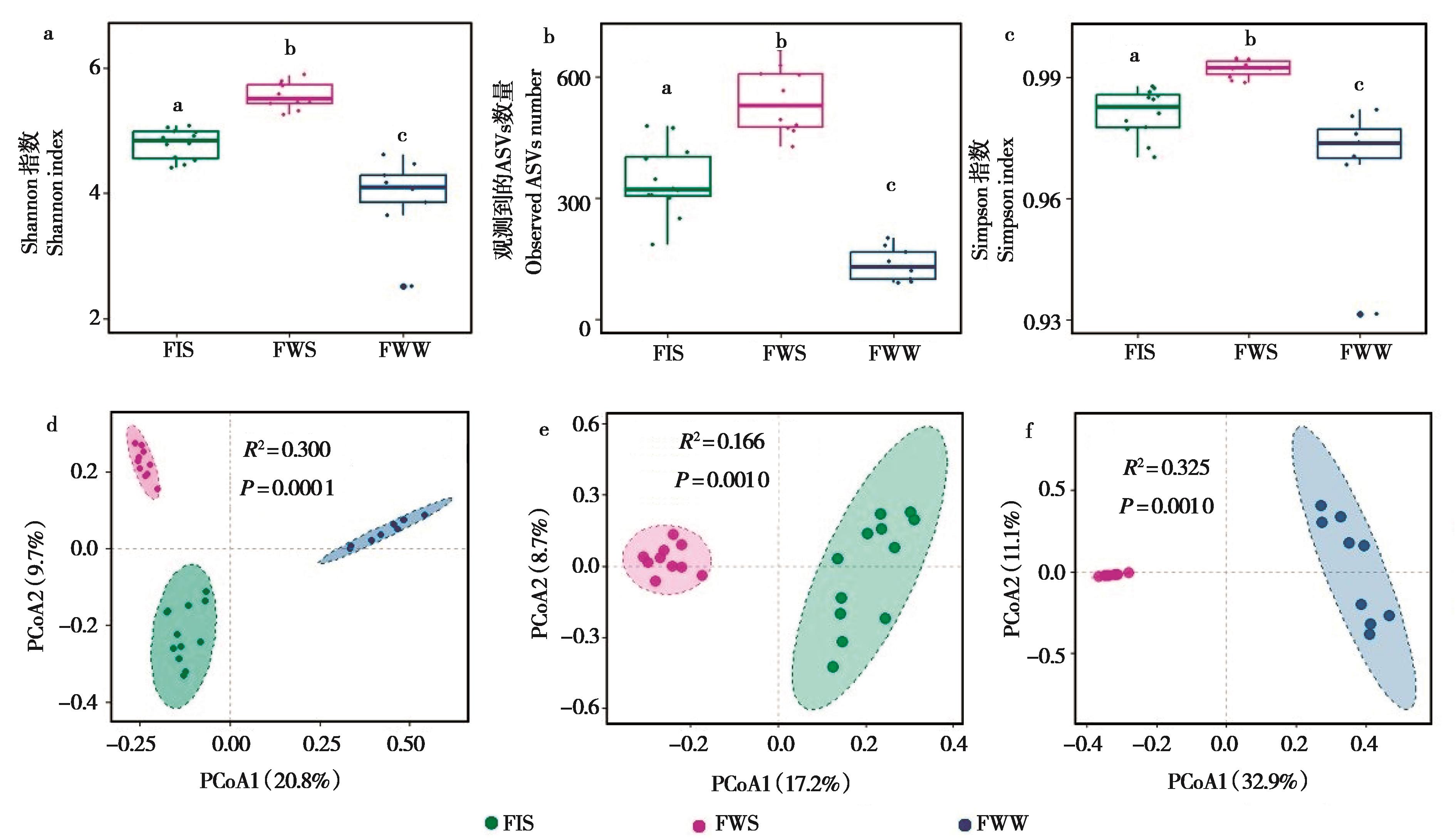
图 1 不同生境与季节下布氏田鼠肠道微生物群落Shannon指数(a),观测到的ASVs数量(b),Simpson指数(c),β多样性分析(d)及夏季室内饲养组(FIS)与夏季野外组(FWS)之间肠道微生物β多样性分析(e)和夏季野外组(FWS)与冬季野外组(FWW)之间肠道微生物β多样性分析(f). 不同字母代表统计显著性(P < 0.05)
Fig. 1 Shannon index (a), observed ASVs number (b), Simpson index (c), and β-diversity analysis (d) of Brandt’s vole gut microbiota in different habitats and seasons.β-diversity analysis of gut microbiota between summer indoor group (FIS) and summer field group (FWS) (e), and β-diversity analysis of gut microbiota between summer field group (FWS) and winter field group (FWW) (f). Different letters represent statistical significance (P < 0.05)
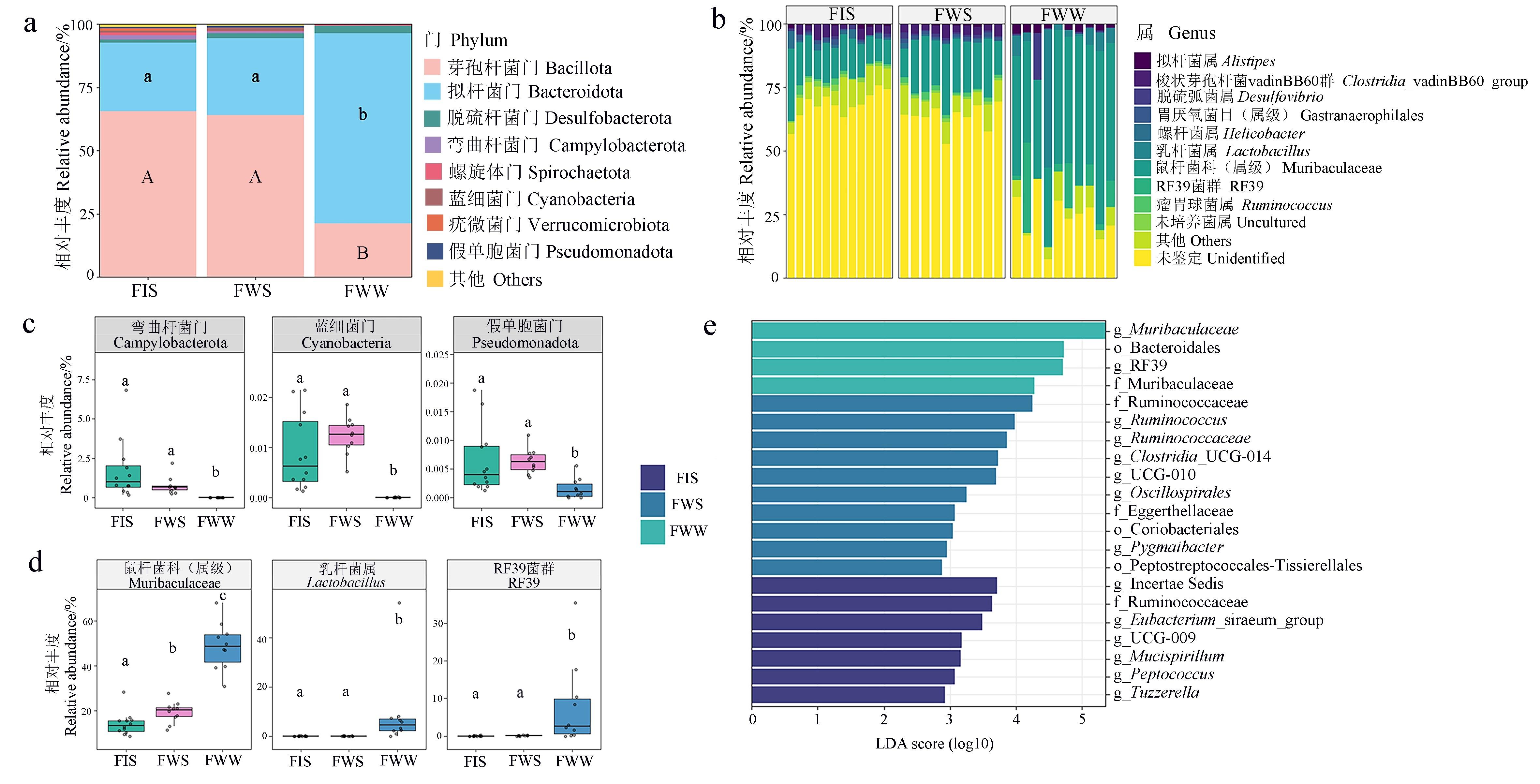
图 2 不同生境与季节下布氏田鼠肠道微生物群落结构及差异分析. a:门水平相对丰度组成;b:属水平相对丰度分布;c:低丰度微生物门的组间显著性差异分析;d:高丰度微生物属的组间显著性差异分析;e:LEfSe分析显著差异物种LDA判别图.不同小写字母代表组间具有统计学显著差异(P < 0.05)
Fig. 2 Analysis of gut microbial community structure and differences in Brandt’s vole under different habitats and seasons. a: Phylum level relative abundance composition; b: Genus level relative abundance distribution; c: Analysis of significant differences between groups of low-abundance phyla; d: Analysis of significant differences between groups of high-abundance genera; e: LEfSe analysis of LDA discriminant plot of significantly different species. Different lowercase letters represent statistically significant differences between groups (P < 0.05)

图 3 不同生境与季节下布氏田鼠肠道微生物ASV水平共现网络分析. a ~ c分别为夏季室内饲养组(FIS)、夏季野外组(FWS)、冬季野外组(FWW)的微生物共现网络. 节点大小与节点相对丰度成正比,节点颜色代表不同的细菌门
Fig. 3 Co-occurrence network analysis of gut microbiota at the ASV level in Brandt’s voles under different habitats and seasons. a ‑ c: represent the microbial co-occurrence networks of the summer indoor group (FIS), summer field group (FWS), and winter field group (FWW), respectively. Node size is proportional to the relative abundance of nodes, and node color represents different bacterial phyla
特征参数 Parameters | 组别 Group | ||
|---|---|---|---|
夏季室内 饲养组 FIS | 夏季野外组FWS | 冬季野外组 FWW | |
节点数 Nodes | 134 | 395 | 52 |
边数 Edges | 243 | 2 158 | 80 |
正相关边数 Positive edges | 129 | 1 107 | 35 |
负相关边数 Negative edges | 114 | 1 051 | 45 |
平均度 Average degree | 3.626 9 | 10.926 6 | 3.076 9 |
平均路径长度 Average path length | 3.094 8 | 2.260 9 | 2.497 0 |
网络直径 Network diameter | 6.827 3 | 4.637 7 | 5.771 0 |
网络密度 Network density | 0.027 3 | 0.027 7 | 0.060 3 |
聚类系数 Clustering coefficient | 0.301 4 | 0.379 3 | 0.597 7 |
模块化系数 Modularity | 0.666 4 | 0.609 6 | 0.750 0 |
平均接近中心性 Average closeness centrality | 0.154 7 | 0.218 0 | 0.202 3 |
平均介数中心性 Average betweenness centrality | 0.029 7 | 0.006 0 | 0.091 9 |
平均离心率 Average eccentricity | 5.319 5 | 3.732 9 | 4.715 2 |
表1 不同组别布氏田鼠肠道微生物群落共现网络拓扑特征比较
Table 1 Comparison of topological characteristics of co-occurrence networks of gut microbiota in different groups of Brandt’s voles
特征参数 Parameters | 组别 Group | ||
|---|---|---|---|
夏季室内 饲养组 FIS | 夏季野外组FWS | 冬季野外组 FWW | |
节点数 Nodes | 134 | 395 | 52 |
边数 Edges | 243 | 2 158 | 80 |
正相关边数 Positive edges | 129 | 1 107 | 35 |
负相关边数 Negative edges | 114 | 1 051 | 45 |
平均度 Average degree | 3.626 9 | 10.926 6 | 3.076 9 |
平均路径长度 Average path length | 3.094 8 | 2.260 9 | 2.497 0 |
网络直径 Network diameter | 6.827 3 | 4.637 7 | 5.771 0 |
网络密度 Network density | 0.027 3 | 0.027 7 | 0.060 3 |
聚类系数 Clustering coefficient | 0.301 4 | 0.379 3 | 0.597 7 |
模块化系数 Modularity | 0.666 4 | 0.609 6 | 0.750 0 |
平均接近中心性 Average closeness centrality | 0.154 7 | 0.218 0 | 0.202 3 |
平均介数中心性 Average betweenness centrality | 0.029 7 | 0.006 0 | 0.091 9 |
平均离心率 Average eccentricity | 5.319 5 | 3.732 9 | 4.715 2 |
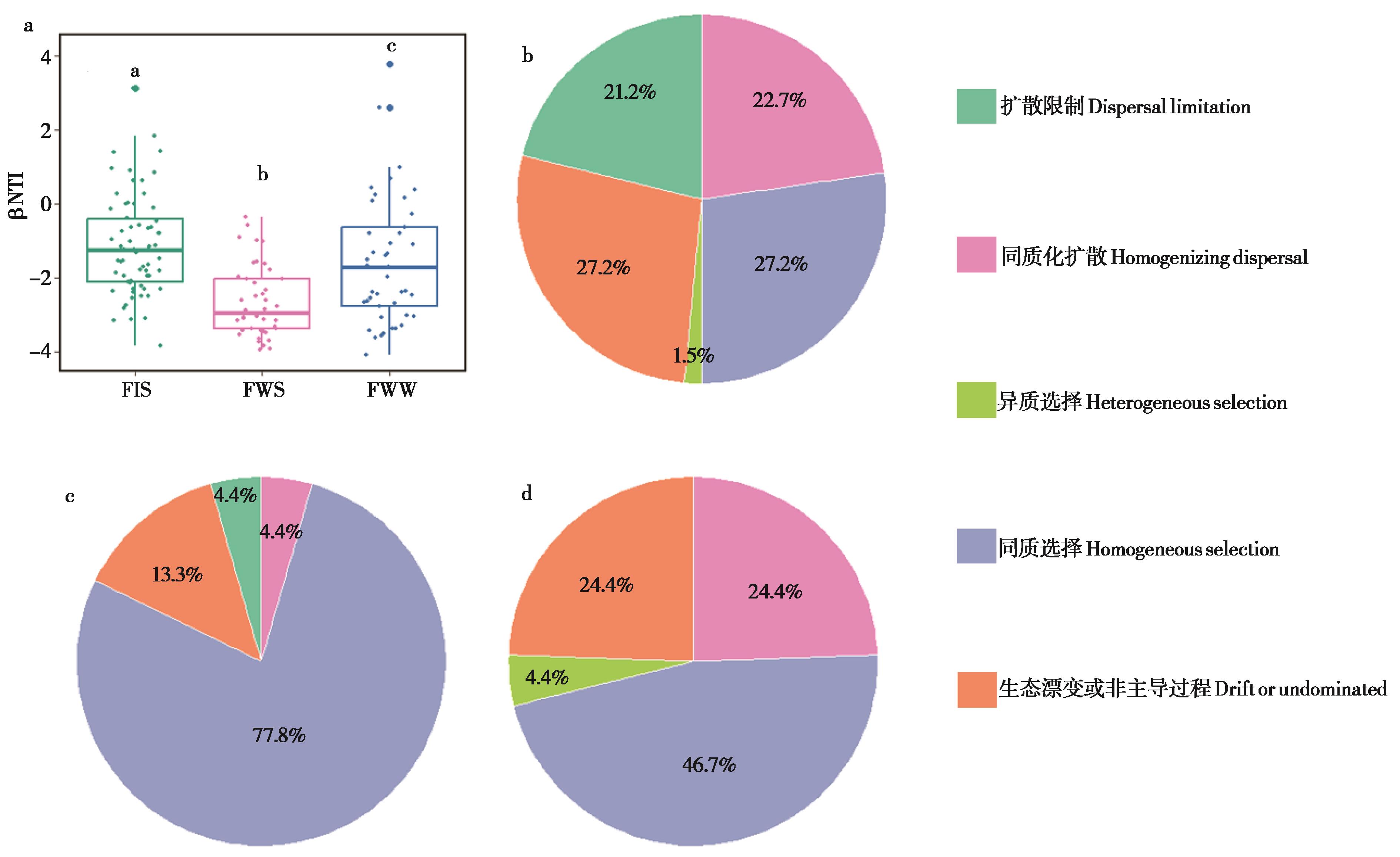
图 4 不同组别样本对βNTI值的分布情况(a)及不同生存条件下布氏田鼠粪便微生物群落的组装过程占比(b ~ d). b:夏季室内饲养组(FIS);c:夏季野外组(FWS);d:冬季野外组(FWW).不同字母代表统计显著性(P < 0.05). 图b ~ d中不同颜色代表不同的生态过程:同质选择与异质选择属于确定性过程,扩散限制、同质化扩散以及生态漂变或非主导过程属于随机性过程
Fig. 4 Distribution of βNTI values for sample pairs in different groups (a), and assembly process of Brandt’s vole fecal microbial community under different survival conditions (b - d). b: Summer indoor group (FIS); c: Summer field group (FWS); d: Winter field group (FWW). Different letters represent statistical significance (P < 0.05). Different colors in the figure b - d represent different ecological processes: homogeneous selection and heterogeneous selection are deterministic processes, while dispersal limitation, homogenizing dispersal, and drift or undominated are stochastic processes

图 5 基于PICRUSt2预测的布氏田鼠肠道微生物MetaCyc代谢通路差异分析. a:FWW组与FWS组之间MetaCyc代谢通路差异的火山图,红色点表示在FWW组中显著富集的通路(P < 0.05,log2 Fold change > 1),蓝色点表示在FWW组中显著降低的通路(P < 0.05,log2 Fold change < -1),灰色点表示差异不显著的通路. 虚线分别表示显著性阈值(P = 0.05)和倍数变化阈值(|log2 Fold change| = 1);b:差异最显著的前30条MetaCyc通路聚类热图,颜色表示经方差稳定化转换(VST)后标准化的相对丰度(Z-score),蓝色表示相对丰度较低,红色表示相对丰度较高
Fig. 5 Differential analysis of MetaCyc metabolic pathway of intestinal microbiota in Brandt’s voles based on PICRUSt2 prediction.a: Volcano plot of MetaCyc metabolic pathway differences between FWW and FWS, pathways significantly enriched in FWW on the red dot (P < 0.05, log2 Fold change > 1), blue dots indicate pathways significantly reduced in the FWW group (P < 0.05, log2 Fold change < -1), gray dots indicate pathways with insignificant differences, dashed lines indicate significance thresholds (P = 0.05) and fold change (|log2 Fold change| = 1), respectively; b: Cluster heat map of the top 30 most significantly different MetaCyc pathways, rows representing metabolic pathways, columns representing samples, colors representing normalized relative abundance (Z-score) after variance stabilization transformation (VST), blue representing lower relative abundance, and red representing higher relative abundance
| Bai D F, Wan X R, Li G L, Wan X R, Guo Y W, Shi D Z, Zhang Z B,2022. Factors influencing range contraction of a rodent herbivore in a steppe grassland over the past decades[J]. Ecology and Evolution,12(2):e8546. DOI:10.1002/ece3.8546 . | |
| Bastian M, Heymann S, Jacomy M,2009. Gephi:An open source software for exploring and manipulating networks[C]. Proceedings of the international AAAI conference on web and social media,3(1):361‑362. DOI:10.1609/icwsm.v3i1.13937 . | |
| Bauwe H, Hagemann M, Fernie A R,2010. Photorespiration: players,partners and origin[J]. Trends in Plant Science,15(6):330‑336. DOI:10.1016/j.tplants.2010.03.006 . | |
| Berry D, Widder S,2014. Deciphering microbial interactions and detecting keystone species with co‑occurrence networks[J]. Frontiers in Microbiology,5:219. DOI:10.3389/fmicb.2014.00219 | |
| Bo T B, Zhang X Y, Wen J, Deng K, Qin X W, Wang D H,2019. The microbiota‑gut‑brain interaction in regulating host metabolic adaptation to cold in male Brandt’s voles(Lasiopodomys brandtii)[J]. The ISME Journal,13(12):3037‑3053. DOI:10.1038/s41396-019-0492-y . | |
| Bolyen E, Rideout J R, Dillon M R, Bokulich N A, Abnet C C, Al‑Ghalith G A, Alexander H, Alm E J, Arumugam M, Asnicar F, Bai Y, Bisanz J E, Bittinger K, Brejnrod A, Brislawn C J, Brown C T, Callahan B J, Caraballo‑Rodríguez A M, Chase J, Cope E K, Da Silva R, Diener C, Dorrestein P C, Douglas G M, Durall D M, Duvallet C, Edwardson C F, Ernst M, Estaki M, Fouquier J, Gauglitz J M, Gibbons S M, Gibson D L, Gonzalez A, Gorlick K, Guo J, Hillmann B, Holmes S, Holste H, Huttenhower C, Huttley G A, Janssen S, Jarmusch A K, Jiang L, Kaehler B D, Kang K B, Keefe C R, Keim P, Kelley S T, Knights D, Koester I, Kosciolek T, Kreps J, Langille M G I, Lee J, Ley R, Liu Y X, Loftfield E, Lozupone C, Maher M, Marotz C, Martin B D, McDonald D, McIver L J, Melnik A V, Metcalf J L, Morgan S C, Morton J T, Naimey A T, Navas-Molina J A, Nothias L F, Orchanian S B, Pearson T, Peoples S L, Petras D, Preuss M L, Pruesse E, Rasmussen L B, Rivers A, Robeson M S, Rosenthal P, Segata N, Shaffer M, Shiffer A, Sinha R, Song S J, Spear J R, Swafford A D, Thompson L R, Torres P J, Trinh P, Tripathi A, Turnbaugh P J, Ul‑Hasan S, Van Der Hooft J J J, Vargas F, Vázquez‑Baeza Y, Vogtmann E, Von Hippel M, Walters W, Wan Y, Wang M, Warren J, Weber K C, Williamson C H D, Willis A D, Xu Z Z, Zaneveld J R, Zhang Y, Zhu Q, Knight R, Caporaso J G,2019. Reproducible,interactive,scalable and extensible microbiome data science using QIIME 2[J]. Nature Biotechnology,37(8):852‑857. DOI:10.1038/s41587-019-0209-9 . | |
| Cao K L, Tao M F, Pu X S, Hou Y, Ren Y, Liu W, Yang X G,2024. Effects of dietary nutrients of the gut microbiota in the long‑tailed dwarf hamster(Cricetulus longicaudatus)[J]. Ecology and Evolution,14(6):e11507. DOI:10.1002/ece3. 11507 . | |
| Callahan B J, McMurdie P J, Rosen M J, Han A W, Johnson A J A, Holmes S P,2016. DADA2:High‑resolution sample inference from Illumina amplicon data[J]. Nature Methods,13 (7):581‑583. DOI:10.1038/nmeth.3869 . | |
| Chen C Y, Chen P C, Weng F C H, Shaw G T W, Wang D,2017. Habitat and indigenous gut microbes contribute to the plasticity of gut microbiome in oriental river prawn during rapid environmental change[J]. PLoS ONE,12(7):e0181427. DOI:10.1371/journal.pone.0181427 . | |
| Chiang E, Deblois C L, Carey H V, Suen G,2022. Characterization of captive and wild 13‑lined ground squirrel cecal microbiotas using Illumina‑based sequencing[J]. Animal Microbiome,4(1):1. DOI:10.1186/s42523-021-00154-9 . | |
| Chidwick H S, Flack E K P, Keenan T, Walton J, Thomas G H, Fascione M A,2021. Reconstitution and optimisation of the biosynthesis of bacterial sugar pseudaminic acid(Pse5Ac7Ac) enables preparative enzymatic synthesis of CMP‑Pse5Ac7Ac[J]. Scientific Reports,11(1):4756. DOI:10.1038/s41598-021-83707-x . | |
| Culp E J, Goodman A L,2023. Cross‑feeding in the gut microbiome: ecology and mechanisms[J]. Cell Host & Microbe,31(4):485‑499. DOI:10.1016/j.chom.2023.03.016 . | |
| Dai Z L,2011. Amino acid metabolism in intestinal bacteria:links between gut ecology and host health[J]. Front Biosci,16(1):1768. DOI:10.2741/3820 . | |
| Deng Y, Jiang Y H, Yang Y F, He Z L, Luo F, Zhou J Z,2012. Molecular ecological network analyses[J]. BMC Bioinformatics,13(1):113. DOI:10.1186/1471-2105-13-113 . | |
| Douglas G M, Maffei V J, Zaneveld J R, Yurgel S N, Brown J R, Taylor C M, Huttenhower C, Langille M G I,2020. PICRUSt2 for prediction of metagenome functions[J]. Nat Biotechnol,38(6):685‑688. DOI:10.1038/s41587-020-0548-6 . | |
| Fan C, Zhang L Z, Jia S G, Tang X J, Fu H B, Li W J, Liu C F, Zhang H, Cheng Q, Zhang Y M,2022. Seasonal variations in the composition and functional profiles of gut microbiota reflect dietary changes in plateau pikas[J]. Integrative Zoology,17(3):379‑395. DOI:10.1111/1749-4877.12630 . | |
| Faust K, Raes J,2012. Microbial interactions:from networks to models[J]. Nature Reviews Microbiology,10(8):538‑550. DOI:10.1038/nrmicro2832 . | |
| Flint H J, Scott K P, Duncan S H, Louis P, Forano E,2012. Microbial degradation of complex carbohydrates in the gut[J]. Gut Microbes,3(4):289‑306. DOI:10.4161/gmic.19897 . | |
| Gromov V S,2023. Ecology and social behavior of the Brandt’s vole: a generalized review[J]. Journal of Arid Environments,214:104994. DOI:10.1016/j.jaridenv.2023.104994 . | |
| Guimerà R, Nunes Amaral L A,2005. Functional cartography of complex metabolic networks[J]. Nature,433(7028):895‑900. DOI:10.1038/nature03288 . | |
| Hanski E, Raulo A, Knowles S C L,2024. Early‑life gut microbiota assembly patterns are conserved between laboratory and wild mice[J]. Communications Biology,7(1):1456. DOI:10.1038/s42003-024-07039-y . | |
| Heiman M L, Greenway F L,2016. A healthy gastrointestinal microbiome is dependent on dietary diversity[J]. Molecular Metabolism,5(5):317‑320. DOI:10.1016/j.molmet. 2016.02.005 . | |
| Hibbing M E, Fuqua C, Parsek M R, Peterson S B,2010. Bacterial competition:surviving and thriving in the microbial jungle[J]. Nature Reviews Microbiology,8(1):15‑25. DOI:10.1038/nrmicro2259 . | |
| Hossain K S, Amarasena S, Mayengbam S,2022. B vitamins and their roles in gut health[J]. Microorganisms,10(6):1168. DOI:10.3390/microorganisms10061168 . | |
| Hou J L, Xiang J G, Li D L, Liu X H, Pan W C,2022. Gut microbial response to host metabolic phenotypes[J]. Frontiers in Nutrition,9:1019430. DOI:10.3389/fnut.2022.1019430 . | |
| Jiang Z P, Mei L, Li Y Q, Guo Y G, Yang B, Huang Z Y, Li Y Y,2024. Enzymatic regulation of the gut microbiota:mechanisms and implications for host health[J]. Biomolecules,14(12):1638. DOI:10.3390/biom14121638 . | |
| Khakisahneh S, Zhang X Y, Nouri Z, Wang D H,2020. Gut microbiota and host thermoregulation in response to ambient temperature fluctuations[J]. mSystems,5(5):e00514‑20. DOI:10.1128/mSystems.00514-20 . | |
| Kim M, Sung J, Chia N,2022. Resource‑allocation constraint governs structure and function of microbial communities in metabolic modeling[J]. Metabolic Engineering,70:12‑22. DOI:10.1016/j.ymben.2021.12.011 . | |
| Kraft N J B, Adler P B, Godoy O, James E C, Fuller S, Levine J M,2015. Community assembly,coexistence and the environmental filtering metaphor[J]. Functional Ecology,29(5):592‑599. DOI:10.1111/1365-2435.12345 . | |
| Lebrija‑Trejos E, Pérez‑García E A, Meave J A, Bongers F, Poorter L,2010. Functional traits and environmental filtering drive community assembly in a species‑rich tropical system[J]. Ecology,91(2):386‑398. DOI:10.1890/08-1449.1 . | |
| Li G L, Li J, Kohl K D, Yin B F, Wei W H, Wan X R, Zhu B L, Zhang Z B,2019. Dietary shifts influenced by livestock grazing shape the gut microbiota composition and co‐occurrence networks in a local rodent species[J]. Journal of Animal Ecology,88(2):302‑314. DOI:10.1111/1365-2656.12920 . | |
| Li G L, Shi C, Song Y R, Chu H Y, Zhang Z B,2021. The role transition of dietary species richness in modulating the gut microbial assembly and postweaning performance of a generalist herbivore[J]. mSystems,6(6):e00979‑21. DOI:10.1128/mSystems.00979-21 . | |
| Li G L, Yin B F, Wan X R, Wei W H, Wang G M, Krebs C J, Zhang Z B,2016. Successive sheep grazing reduces population density of Brandt’s voles in steppe grassland by altering food resources:a large manipulative experiment[J]. Oecologia,180(1):149‑159. DOI:10.1007/s00442-015-3455-7 . | |
| Li H, Zhou R, Zhu J X, Huang X D, Qu J P,2019. Environmental filtering increases with elevation for the assembly of gut microbiota in wild pikas[J]. Microbial Biotechnology,12(5):976‑992. DOI:10.1111/1751-7915.13450 . | |
| Lindsay E C, Metcalfe N B, Llewellyn M S,2020. The potential role of the gut microbiota in shaping host energetics and metabolic rate[J]. Journal of Animal Ecology,89(11):2415‑2426. DOI:10.1111/1365-2656.13327 . | |
| Liu J, Huang S L, Li G L, Zhao J D, Lu W, Zhang Z B,2020. High housing density increases stress hormone‑ or disease‑associated fecal microbiota in male Brandt’s voles(Lasiopodomys brandtii)[J]. Hormones and Behavior,126:104838. DOI:10.1016/j.yhbeh.2020.104838 . | |
| Liu M, Zou D S, Zhang X Y, Wang D H,2025. Huddling behavior regulate adaptive thermogenesis in Brandt’s voles(Lasiopodomys brandtii)[J]. Cell & Bioscience,15(1):51. DOI:10.1186/s13578-025-01391-0 . | |
| Magoč T, Salzberg S L,2011. FLASH:Fast length adjustment of short reads to improve genome assemblies[J]. Bioinformatics,27(21):2957‑2963. DOI:10.1093/bioinformatics/btr507 . | |
| Martínez‑Mota R, Kohl K D, Orr T J, Denise Dearing M,2020. Natural diets promote retention of the native gut microbiota in captive rodents[J]. The ISME Journal,14(1):67‑78. DOI:10.1038/s41396-019-0497-6 . | |
| Memmott J, Waser N M, Price M V,2004. Tolerance of pollination networks to species extinctions[J]. Proceedings of the Royal Society of London,Series B:Biological Sciences,271(1557):2605‑2611. DOI:10.1098/rspb.2004.2909 . | |
| Milici M, Deng Z L, Tomasch J, Decelle J, Wos‑Oxley M L, Wang H, Jáuregui R, Plumeier I, Giebel H A, Badewien T H, Wurst M, Pieper D H, Simon M, Wagner‑Döbler I,2016. Co‑occurrence analysis of microbial taxa in the atlantic ocean reveals high connectivity in the free‑living bacterioplankton[J]. Frontiers in Microbiology,7:649. DOI:10.3389/fmicb. 2016.00649 . | |
| Neha S A, Salazar‑Bravo J,2023. Fine‑scale spatial variation shape fecal microbiome diversity and composition in black‑tailed prairie dogs(Cynomys ludovicianus)[J]. BMC Microbiology,23(1):51. DOI:10.1186/s12866-023-02778-0 . | |
| Neumann‑Schaal M, Jahn D, Schmidt‑Hohagen K,2019. Metabolism the difficile way:the key to the success of the pathogen Clostridioides difficile [J]. Frontiers Microbiology,10:219. DOI:10.3389/fmicb.2019.00219 . | |
| Olesen J M, Bascompte J, Dupont Y L, Jordano P,2007. The modularity of pollination networks[J]. Proceedings of the National Academy of Sciences of the United States of America,104(50):19891‑19896. DOI:10.1073/pnas.0706375104 . | |
| Ottman N, Ruokolainen L, Suomalainen A, Sinkko H, Karisola P, Lehtimäki J, Lehto M, Hanski I, Alenius H, Fyhrquist N,2019. Soil exposure modifies the gut microbiota and supports immune tolerance in a mouse model[J]. Journal of Allergy and Clinical Immunology,143(3):1198‑1206.e12. DOI:10.1016/j.jaci.2018.06.024 . | |
| Raulo A, Bürkner P C, Finerty G E, Dale J, Hanski E, English H M, Lamberth C, Firth J A, Coulson T, Knowles S C L,2024. Social and environmental transmission spread different sets of gut microbes in wild mice[J]. Nature Ecology&Evolution,8(5):972‑985. DOI:10.1038/s41559-024-02381-0 . | |
| Rosshart S P, Vassallo B G, Angeletti D, Hutchinson D S, Morgan A P, Takeda K, Hickman H D, McCulloch J A, Badger J H, Ajami N J, Trinchieri G, Pardo‑Manuel De Villena F, Yewdell J W, Rehermann B,2017. Wild mouse gut microbiota promotes host fitness and improves disease resistance[J]. Cell,171(5):1015‑1028.e13. DOI:10.1016/j.cell.2017.09.016 . | |
| Schmidt E, Mykytczuk N, Schulte‑Hostedde A I,2019. Effects of the captive and wild environment on diversity of the gut microbiome of deer mice(Peromyscus maniculatus)[J]. The ISME Journal,13(5):1293‑1305. DOI:10.1038/s41396-019-0345-8 . | |
| Shen W J, Gao P, Zhou K Y, Li J, Bo T B, Xu D L,2024. The impact of high‑temperature stress on gut microbiota and reproduction in Siberian hamsters(Phodopus sungorus)[J]. Microorganisms,12(7):1426. DOI:10.3390/microorganisms12071426 . | |
| Stegen J C, Lin X J, Konopka A E, Fredrickson J K,2012. Stochastic and deterministic assembly processes in subsurface microbial communities[J]. The ISME Journal,6(9):1653‑1664. DOI:10.1038/ismej.2012.22 . | |
| Teng Y W, Yang X F, Li G L, Zhu Y L, Zhang Z B,2022. Habitats show more impacts than host species in shaping gut microbiota of sympatric rodent species in a fragmented forest[J]. Frontiers in Microbiology,13:811990. DOI:10.3389/fmicb. 2022.811990 . | |
| Terrapon N, Lombard V, Drula É, Lapébie P, Al‑Masaudi S, Gilbert H J, Henrissat B,2018. PULDB: the expanded database of polysaccharide utilization loci[J]. Nucleic Acids Research,46(D1):D677‑D683. DOI:10.1093/nar/gkx1022 . | |
| Tylianakis J M, Laliberté E, Nielsen A, Bascompte J,2010. Conservation of species interaction networks[J]. Biological Conservation,143(10):2270‑2279. DOI:10.1016/j.biocon. 2009.12.004 . | |
| Vellend M,2010. Conceptual synthesis in community ecology[J]. The Quarterly Review of Biology,85(2):183‑206. DOI:10.1086/652373 . | |
| Wang J J, Shen J, Wu Y C, Tu C, Soininen J, Stegen J C, He J Z, Liu X Q, Zhang L, Zhang E L,2013. Phylogenetic beta diversity in bacterial assemblages across ecosystems:deterministic versus stochastic processes[J]. The ISME Journal,7(7):1310‑1321. DOI:10.1038/ismej.2013.30 . | |
| Wefers D, Tyl C E, Bunzel M,2014. Novel arabinan and galactan oligosaccharides from dicotyledonous plants[J]. Frontiers in Chemistry,2:100. DOI:10.3389/fchem.2014.00100 . | |
| Willdigg J R, Helmann J D,2021. Mini Review:bacterial membrane composition and its modulation in response to stress[J]. Frontiers in Molecular Biosciences,8:634438. DOI:10.3389/fmolb.2021.634438 . | |
| Williams C E, Williams C L, Logan M L,2023. Climate change is not just global warming:multidimensional impacts on animal gut microbiota[J]. Microbial Biotechnology,16(9):1736‑1744. DOI:10.1111/1751-7915.14276 . | |
| Willmann M R, Endres M W, Cook R T, Gregory B D,2011. The functions of RNA‑dependent RNA polymerases in arabidopsis[J]. The Arabidopsis Book,9:e0146. DOI:10.1199/tab.0146 . | |
| Yun Y, Duan C, He X C, Tang R X, Lan Y, Lu M Y, Liu T J, Fan X, Fan Z X, Ran J H,2026. Gut microbiome plasticity explains the altitudinal distribution pattern and adaptability in a small mammal species(Apodemus draco)[J]. Microbiology Spectrum,14(1):e02388‑25. DOI:10.1128/spectrum. 02388-25 . | |
| Zeng H, Rohani R, Huang W E, Yang A,2021. Understanding and mathematical modelling of cellular resource allocation in microorganisms:a comparative synthesis[J]. BMC Bioinformatics,22(1):467. DOI:10.1186/s12859-021-04382-3 . | |
| Zhang X Y, Khakisahneh S, Liu W, Zhang X Y, Zhai W W, Cheng J L, Speakman J R, Wang D H,2023. Phylogenetic signal in gut microbial community rather than in rodent metabolic traits[J]. National Science Review,10(10):nwad209. DOI:10.1093/nsr/nwad209 . | |
| Zhang X Y, Sukhchuluun G, Bo T B, Chi Q S, Yang J J, Chen B, Zhang L, Wang D H,2018. Huddling remodels gut microbiota to reduce energy requirements in a small mammal species during cold exposure[J]. Microbiome,6(1):103. DOI:10.1186/s40168-018-0473-9 . | |
| Zhang Y M, Rock C O,2008. Membrane lipid homeostasis in bacteria[J]. Nature Reviews Microbiology,6(3):222‑233. DOI:10.1038/nrmicro1839 . | |
| Zhang Z B, Pech R, Davis S, Shi D Z, Wan X R, Zhong W Q,2003. Extrinsic and intrinsic factors determine the eruptive dynamics of Brandt’s voles Microtus brandti in Inner Mongolia,China[J]. Oikos,100(2):299‑310. DOI:10.1034/j. 1600-0706.2003.11810.x . | |
| Zhou J Z, Ning D L,2017. Stochastic community assembly: Does it matter in microbial ecology?[J]. Microbiology and Molecular Biology Reviews,81(4):e00002‑17. DOI:10.1128/MMBR. 00002-17 . | |
| 张知彬,王祖望, 1998. 农业重要害鼠的生态学及控制对策[M]. 北京:海洋出版社. |
| [1] | 周春芳, 丘宇静, 刘俸妍, 农登攀, 梁霁鹏, 黄中豪. 广西崇左黑叶猴的姿势行为[J]. 兽类学报, 2026, 46(6): 1-. |
| [2] | 高霄龙, 张万相, 翟红娟, 朱涵毅, 张知彬. 海南褐家鼠和黄胸鼠肠道菌群差异及共存机制探讨[J]. 兽类学报, 2026, 46(5): 705-719. |
| [3] | 黄鑫磊, 郎伟, 冯江, 刘博宇. 蝙蝠肠道微生物研究进展[J]. 兽类学报, 2026, 46(5): 638-649. |
| [4] | 薛淇元, 蔡赫, 张亦飞, 高艺, 郭秋颖, 张智慧, 金志民, 张隽晟, 刘铸. 同域中鼩鼱不同季节肠道菌群结构及功能研究[J]. 兽类学报, 2026, 46(5): 734-743. |
| [5] | 张天馨, 朱万龙. 食物限制下小型哺乳动物肠道微生物的跨尺度生理生态效应[J]. 兽类学报, 2026, 46(5): 650-669. |
| [6] | 袁子雨, 刘一心, 胡义波. 鼬超科动物肠道微生物组研究进展与展望[J]. 兽类学报, 2026, 46(5): 621-637. |
| [7] | 李燏湘, 田西, 刘纯兵, 于黎. 圈养对野生哺乳动物肠道微生物的影响[J]. 兽类学报, 2026, 46(1): 1-19. |
| [8] | 李强云, 吴金海, 斯日古楞, 张建平, 柳玉民, 肖治术, 苏军虎, 刘伟. 布氏田鼠警戒鸣叫的生态适应不支持声音适应假说[J]. 兽类学报, 2025, 45(6): 797-809. |
| [9] | 聂永刚, 张超, 高华窈, 刘翰卿, 谢冰. 中国大中型陆生哺乳动物保护研究进展[J]. 兽类学报, 2025, 45(5): 559-576. |
| [10] | 王霞, 陈雨, 郑海峰, 钟伟, 陈丽霞, 孙雅望. 金佛山国家级自然保护区黑叶猴种群数量分布与肠道微生物组成[J]. 兽类学报, 2025, 45(3): 324-332. |
| [11] | 周桃秀, 陈琳, 吴涌珍, 杨生妹, 魏万红, 武瑞勇. 捕食风险应激对雄性布氏田鼠及子代繁殖性能的影响[J]. 兽类学报, 2024, 44(5): 587-597. |
| [12] | 董昕, 陈慧青, 张璐, 尚国珍, 吴雁, 边疆晖. 食物中蛋氨酸含量对高原鼠兔肠道微生物群落的影响[J]. 兽类学报, 2024, 44(4): 411-426. |
| [13] | 赵星, 马锐, 吴蔚, 李明喜, 陈超, 周延山, 洪明生, 齐敦武. 不同生活环境下小熊猫皮质醇和肠道微生物的变化规律[J]. 兽类学报, 2024, 44(4): 427-435. |
| [14] | 黄小龙, 李海波, 张旭, 程绍传, 晏玉莹, 杨伟, 蒙秉顺, 王丞, 杨杰, 冉景丞. 梵净山同域分布黔金丝猴与藏酋猴的肠道微生物结构差异[J]. 兽类学报, 2024, 44(2): 183-194. |
| [15] | 李红娟, 王德华, 王振山, 张学英. 哺乳期高温经历导致布氏田鼠F1代的热中性区变窄[J]. 兽类学报, 2023, 43(4): 412-421. |
| 阅读次数 | ||||||
|
全文 |
|
|||||
|
摘要 |
|
|||||
 青公网安备 63010402000199号 青ICP备05000010号-2
